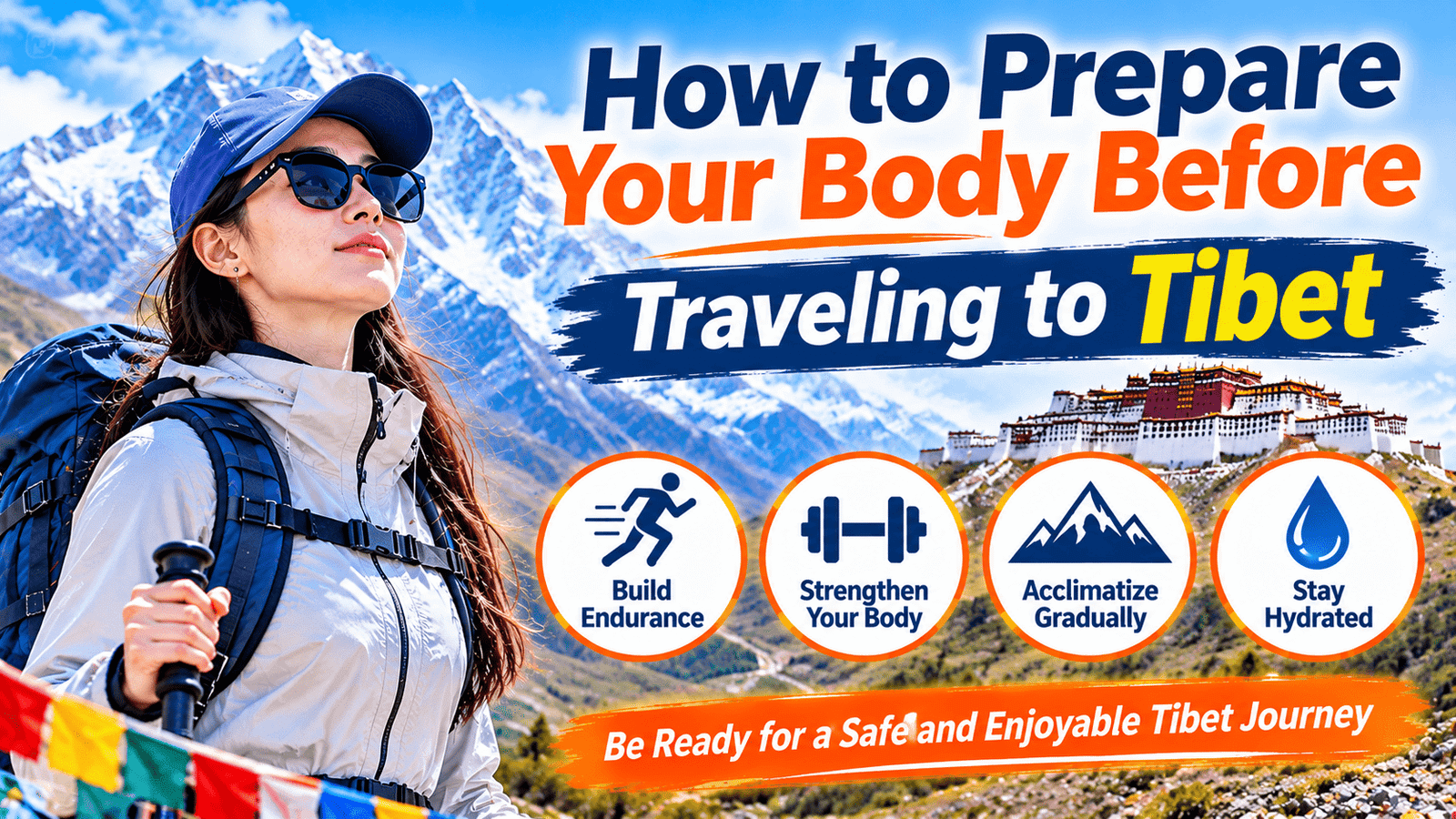
Prepare your body before departure can make the journey more comfortable. However, there is an important distinction between physical fitness and altitude acclimatization.
Traveling to Tibet can involve long road journeys, high mountain passes, steep walking routes and overnight stays above 3,500 meters. Destinations such as Lhasa, Everest Base Camp, Namtso Lake and Mount Kailash expose visitors to elevations that may be unfamiliar to people arriving from lowland cities.
Exercise can improve your endurance and prepare your legs for walking. It cannot reliably prevent altitude sickness or replace the physiological adjustments that occur when your body spends time at high altitude.
This guide explains how to prepare before traveling to Tibet, what training is useful, how pre-acclimatization works and which health precautions deserve attention.
How to Prepare Your Body Before Traveling to Tibet
1. Understand what your body will experience in Tibet
At high altitude, atmospheric pressure is lower. Although oxygen still makes up approximately 21% of the air, the reduced pressure means less oxygen is available to enter the bloodstream with each breath.
You may notice:
- Faster breathing during walking.
- A higher heart rate during physical activity.
- Reduced stamina.
- More frequent rest breaks.
- Difficulty maintaining your usual exercise pace.
- Changes in sleep during the first nights.
These responses are common during initial exposure, but serious symptoms should never be dismissed as normal adjustment.
Lhasa is approximately 3,650–3,700 meters above sea level. Everest Base Camp and Mount Kailash routes involve even higher elevations in some sections.
Your preparation should therefore address both the physical demands of the trip and the medical challenges of altitude.
Build general cardiovascular fitness
A regular exercise routine can help prepare your body for long sightseeing days and mountain travel.
Useful activities include:
- Walking at a comfortable pace.
- Brisk walking.
- Jogging, if you already run regularly.
- Cycling.
- Swimming.
- Stair climbing.
- Hiking on local trails.
Choose activities that match your current fitness level. Increase training gradually rather than suddenly starting intense workouts shortly before departure.
The goal is to improve your ability to sustain moderate activity, not to achieve a particular fitness score.
Train your legs for uphill walking
Many Tibet travel activities involve walking uphill, climbing steps or walking over uneven ground.
Preparing your legs can make these activities more manageable.
Useful exercises include:
Stair climbing
Start with a comfortable number of stairs and gradually increase the duration. Use a handrail where necessary and avoid pushing through pain or unusual breathlessness.
Uphill walking
Walking on a gentle slope helps prepare you for mountain paths and uneven terrain.
Squats and step-ups
Body weight squats and step-ups can help strengthen the muscles used during walking and climbing.
Hiking
If your itinerary includes trekking, practice walking on similar terrain before departure. Start with shorter walks and gradually increase distance.
These exercises prepare muscles and movement patterns. They do not create the same physiological response as spending several nights at high altitude.
Practice walking with a backpack
If your trip includes the Mount Kailash kora or another trekking route, carrying a backpack may be part of the experience.
Practice with the type of bag you expect to use.
Start with a light load and increase it gradually. Learn how to adjust the shoulder straps and hip belt so that the weight is distributed comfortably.
Avoid carrying unnecessary items during the actual journey. At high altitude, even a familiar backpack can feel heavier because physical performance is reduced.
For a guided Tibet tour, consider arranging for a porter or other luggage support where available rather than carrying a heavy load unnecessarily.
5. Does being fit prevent altitude sickness?
No. Good physical fitness does not reliably prevent AMS, HAPE or HACE.
Research has found that people with higher sea-level fitness may experience a lower sense of effort during trekking, but this does not mean they have a lower risk of altitude sickness.
Altitude illness is influenced by factors including:
- Sleeping altitude.
- Speed of ascent.
- Recent exposure to high altitude.
- Previous responses to similar altitude and ascent conditions.
- Individual susceptibility.
A fit traveler can still develop serious altitude illness.
Do not use your running performance, resting heart rate or ability to complete a long hike as a reason to shorten acclimatization time.
6. Can you train your lungs before traveling to Tibet?
Some travelers try breathing exercises, breath-holding exercises or resistance masks because they believe these methods can prepare their lungs for low oxygen.
However, these methods should not be confused with altitude acclimatization.
Breathing exercises
Gentle breathing exercises may help you become more aware of your breathing pattern and remain relaxed during ordinary activity.
However, there is no strong evidence that routine breathing exercises prevent AMS.
Breath-holding exercises
Breath-holding can increase tolerance to the sensation of holding your breath, but it has not been shown to provide reliable protection against altitude sickness.
Do not deliberately deprive yourself of oxygen or perform extreme breath-holding exercises as a test of readiness.
Altitude training masks
Most resistance training masks make breathing harder by adding resistance. They do not necessarily reproduce the lower atmospheric pressure or reduced oxygen availability found at high altitude.
They have not been proven to prevent AMS.
7. Can you acclimatize before arriving in Tibet?
Pre-acclimatization means spending time at high altitude before the main trip.
Previous high-altitude exposure may help prepare the body for a later ascent, but the effect depends on the altitude, duration and timing.
The CDC notes that spending at least two nights above 2,750 meters within the 14 days before a planned ascent can be useful.
This is not a guarantee against altitude sickness.
A brief visit to a mountain viewpoint is not equivalent to spending two nights at altitude. The sleeping elevation and duration of exposure matter.
If you have access to a suitable high-altitude location, plan the visit carefully and avoid rapid ascent simply to obtain altitude exposure.
8. Should you use a hypoxic tent before your trip?
Hypoxic tents and simulated-altitude systems attempt to reproduce aspects of the low-oxygen environment.
Some research has reported improvements in certain physiological measurements or symptom scores. Other studies have not found a clear reduction in AMS incidence.
The results depend on the equipment, oxygen level, exposure duration and study design.
A hypoxic tent should not be treated as a guaranteed method of acclimatization. There is no universally established number of hours that makes a traveler safe to ascend rapidly.
Do not remove acclimatization stops or change your sleeping-altitude plan because you have used simulated-altitude equipment.
9. Arrange a medical assessment before departure
Travelers with certain health conditions should speak with a healthcare professional before planning a high-altitude trip.
This is especially important if you have:
- Heart disease.
- Chronic lung disease.
- Pulmonary hypertension.
- Sleep apnea.
- A history of HAPE or HACE.
- Previous moderate or severe altitude sickness.
- Conditions that cause low blood oxygen.
- A medical condition that limits exercise or mobility.
Discuss your planned destinations, sleeping elevations, travel dates and ascent schedule.
If preventive medication may be appropriate, ask about the benefits, risks and correct use before departure. Do not start prescription altitude medication based only on advice from a travel forum or an online checklist.
10. Prepare a sensible acclimatization itinerary
Your itinerary is one of the most important parts of preparing for Tibet.
If you normally live near sea level, flying directly to Lhasa creates a rapid change in elevation.
Plan the first days carefully:
- Keep arrival-day activities light.
- Avoid strenuous walking during the first 48 hours.
- Allow time for rest.
- Do not rush to higher overnight destinations.
- Include suitable acclimatization days before longer journeys to higher elevations.
- Keep the schedule flexible in case symptoms develop.
Once above 3,000 meters, commonly recommended guidance is to limit increases in sleeping altitude to approximately 500 meters per day and include a rest day every three to four days.
These are general planning guidelines. Your itinerary may need to be more conservative depending on your health and previous altitude experience.
11. Prepare for the physical demands of different Tibet trips
Not every Tibet itinerary requires the same level of physical preparation.
Lhasa sightseeing
A typical Lhasa tour involves walking around temples, monasteries, markets and historic streets. Some attractions have stairs or uneven surfaces.
Practice comfortable walking and stair climbing before departure. You do not need to train like a marathon runner for ordinary sightseeing.
Everest Base Camp
An Everest Base Camp trip involves long road journeys, high mountain passes and overnight stays at high elevation.
Prepare for sustained walking and changes in weather. More importantly, allow adequate time for acclimatization before reaching the highest overnight stops.
Mount Kailash pilgrimage
The Mount Kailash kora is physically demanding because of its altitude, distance and terrain. The route includes a high mountain pass and can be challenging even for fit travelers.
Prepare with regular walking, uphill hiking and gradual backpack training. If you have mobility or medical concerns, discuss the route with a healthcare professional before booking.
Fitness preparation cannot remove the risks associated with the high elevation.
12. Prepare your travel health kit
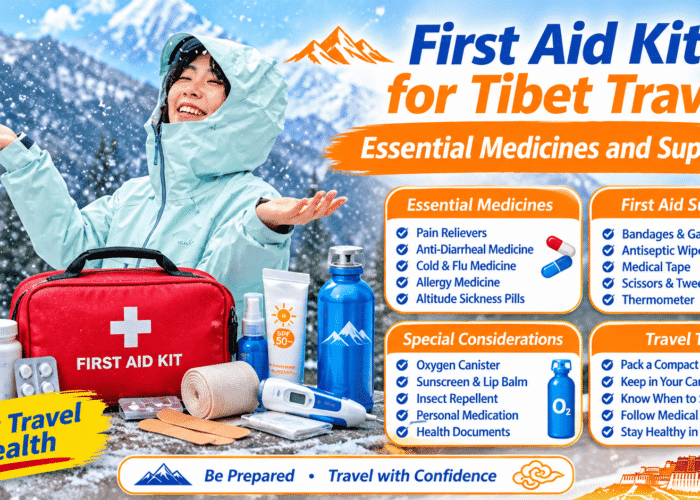
Before leaving home, organize a small health kit based on your itinerary and personal medical needs.
Consider packing:
- Your regular prescription medicines.
- A copy of your prescriptions and important medical information.
- Any medication prescribed specifically for altitude illness.
- A basic first-aid kit.
- Personal pain-relief medication that is suitable for you.
- Sunscreen and lip protection.
- Sunglasses with appropriate UV protection.
- Personal hygiene supplies.
- A thermometer.
- A pulse oximeter, if you know how to interpret its limitations.
A pulse oximeter can provide supplementary information about oxygen saturation, but it cannot diagnose or rule out altitude sickness. Do not rely on a single reading to decide whether it is safe to continue ascending.
13. Avoid common preparation mistakes
Some popular preparation ideas are not supported by reliable evidence.
| Common belief | What travelers should understand |
|---|---|
| Being very fit prevents AMS | Fitness does not reliably predict susceptibility |
| Training masks simulate real altitude | Resistance masks do not reproduce the full low-pressure environment |
| Breath-holding prevents altitude sickness | There is no reliable evidence that it prevents AMS |
| A short mountain visit guarantees acclimatization | Duration and sleeping altitude matter |
| Oxygen cans prevent altitude sickness | Small cans are not a substitute for acclimatization or emergency treatment |
| You should drink as much water as possible | Maintain normal hydration; excessive water can be harmful |
| A healthy person cannot develop HAPE or HACE | Serious altitude illness can affect otherwise healthy travelers |
The most useful preparation is a combination of sensible fitness training, medical planning and a gradual travel itinerary.
Frequently Asked Questions
How many weeks before Tibet should I start exercising?
There is no single required training period. If you are not regularly active, begin gradually as early as practical and build up comfortable walking endurance. Avoid sudden intense exercise shortly before departure.
Do I need to be very fit to visit Tibet?
Not necessarily. Many ordinary sightseeing tours require only comfortable walking. More demanding trips, such as the Mount Kailash kora, require greater physical preparation. Your health and ability to acclimatize are more important than achieving a particular fitness level.
Can running prepare me for high altitude?
Running can improve general cardiovascular fitness and endurance. It does not reproduce high-altitude acclimatization or guarantee protection against AMS.
Should I train by holding my breath?
No. Breath-holding exercises have not been established as a reliable altitude-sickness prevention method. Do not deliberately deprive yourself of oxygen.
Can I visit a high mountain before traveling to Tibet?
Recent exposure to high altitude may help, particularly when you spend multiple nights there. However, it does not guarantee protection. The CDC identifies at least two nights above 2,750 meters within 14 days before ascent as potentially useful.
What is more important: fitness or acclimatization?
Acclimatization is more important for reducing altitude-illness risk. Fitness helps you manage physical activity, but it does not replace a gradual ascent.
Final advice
Preparing for Tibet is not about becoming an elite athlete. It is about arriving in good general condition, understanding the physical demands of your itinerary and giving your body enough time to adjust to the altitude.
Walk regularly, strengthen your legs, practice with a backpack if you plan to trek and arrange medical advice when appropriate.
Most importantly, do not let good fitness create false confidence.
A sensible itinerary, gradual ascent and attention to symptoms are more important than physical strength alone.
Suggested internal links
- Altitude Sickness in Tibet: Complete Guide for Travelers
- How to Prevent Altitude Sickness: Acclimatization and Travel Planning
- Does Being Fit Prevent Altitude Sickness?
- How the Human Body Adapts to High Altitude
- Tibet Travel Checklist: Essential High-Altitude Gear and Safety Tips
- Altitude Sickness at Everest Base Camp: Risks and Safety Advice
- Altitude Sickness on the Mount Kailash Pilgrimage
- Altitude Sickness Medicines: Acetazolamide, Dexamethasone and Nifedipine
References and Further Reading
- CDC Yellow Book 2026: High-Altitude Travel and Altitude Illness.
- Wilderness Medical Society. Clinical Practice Guidelines for the Prevention, Diagnosis, and Treatment of Acute Altitude Illness: 2024 Update.
- Rossetti et al. (2017). MEDEX2015: Greater Sea-Level Fitness Is Associated with Lower Sense of Effort During Himalayan Trekking Without Worse Acute Mountain Sickness.
- A Focused Review on the Maximal Exercise Responses in Hypo- and Normobaric Hypoxia (2020).
Medical disclaimer
This article provides general travel-health information and is not a substitute for professional medical advice, diagnosis or treatment. Travelers with a history of altitude illness or underlying medical conditions should consult a qualified healthcare professional before traveling to Tibet.