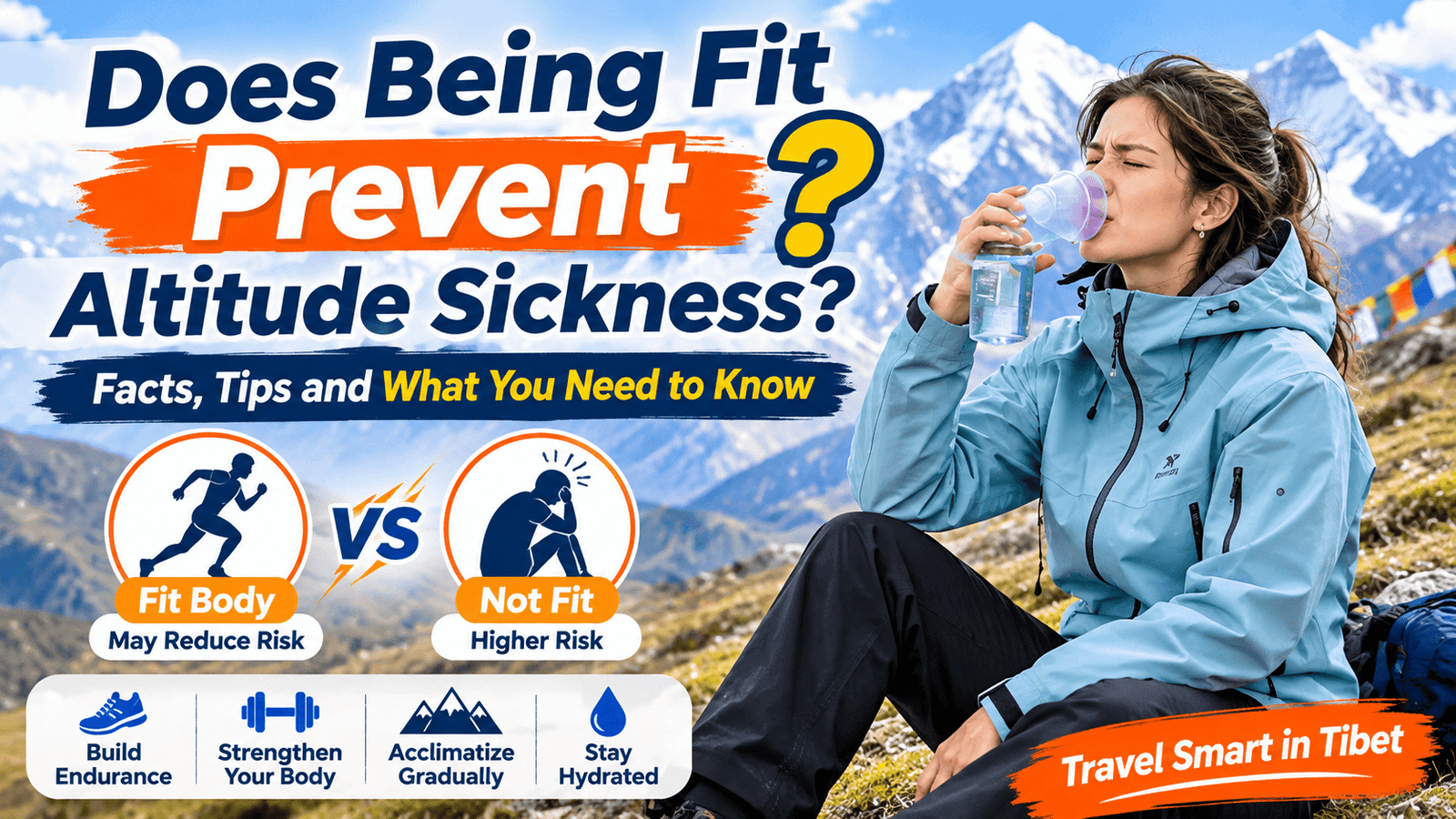
Many travelers believe that people who exercise regularly, run long distances or have strong cardiovascular fitness are less likely to develop altitude sickness. This is a common misunderstanding.
Being physically fit can make walking and trekking easier, but it does not reliably protect you from acute mountain sickness (AMS).
A fit traveler may climb faster, carry a heavier backpack and feel less tired than someone with lower fitness. However, these advantages do not mean the body can adapt to reduced oxygen availability more quickly. For people planning a trip to Tibet, Everest Base Camp or Mount Kailash, understanding the difference between fitness and acclimatization is essential.
What does physical fitness mean?
Physical fitness includes several components:
- Cardiovascular endurance.
- Muscular strength.
- Muscular endurance.
- Flexibility.
- Balance and coordination.
- General physical conditioning.
Research on fitness and altitude sickness has focused particularly on cardio-respiratory fitness, commonly measured using VO₂ max.
What is VO₂ max?
VO₂ max means maximal oxygen uptake. It measures the maximum amount of oxygen your body can take in and use during intense exercise.
A higher VO₂ max generally indicates greater aerobic capacity.
For example, a person with a higher VO₂ max may be able to run, cycle or climb stairs at a greater intensity than someone with a lower value.
However, VO₂ max is a measure of exercise performance. It is not a test of how well someone will tolerate high altitude.
Does better fitness reduce the risk of altitude sickness?
Current evidence does not show that being physically fit reliably reduces susceptibility to altitude illness.
The CDC Yellow Book 2026 explains that training and physical fitness do not determine a traveler’s risk of altitude sickness.
Important factors include:
- The elevation where you sleep.
- How quickly you ascend.
- Whether you have recently acclimatized.
- Your individual susceptibility.
- Your previous response to a similar altitude and ascent schedule.
A fit person can develop AMS, while someone with average fitness may acclimatize without significant symptoms.
What did the MEDEX2015 study find?
A study published in 2017 examined 44 trekkers who completed fitness assessments at low altitude before undertaking a three-week Himalayan trek. The route reached approximately 5,085 meters.
The researchers compared participants’ VO₂ max with their perceived effort and altitude-sickness symptoms.
They found that participants with higher VO₂ max generally:
- Reported lower perceived effort during trekking.
- Found a fixed submaximal exercise test less tiring.
- Chose a faster stepping rate at a similar perceived effort.
However, higher VO₂ max was not significantly associated with lower or higher AMS scores.
| Study measurement | Reported relationship | Interpretation |
|---|---|---|
| Perceived effort during trekking | r = -0.43 | Fitter participants generally felt less exertion |
| Effort during a fixed exercise test | r = -0.69 | The same workload felt easier |
| Self-selected stepping rate | r = +0.62 | Fitter participants could choose a faster pace |
| Proportion of days with AMS | r = +0.13, not significant | No reliable relationship was demonstrated |
| Peak Lake Louise Score | r = -0.05, not significant | VO₂ max did not predict symptom severity |
The study was relatively small, so it cannot answer every question about fitness and altitude illness. Nevertheless, it illustrates an important distinction: better fitness can improve performance without providing protection against AMS.
Why does exercise become harder at high altitude?
At high altitude, atmospheric pressure decreases. This reduces the partial pressure of oxygen available to move from the lungs into the bloodstream.
During exercise, your muscles need more oxygen to produce energy. At altitude, the body has less oxygen available to meet this increased demand.
As a result, your maximum aerobic exercise capacity decreases.
A 2020 review of studies conducted at real and simulated elevations found that maximal oxygen uptake generally declined as altitude increased. The average reductions reported in the included studies varied according to the conditions:
- Approximately 5.6% per 1,000 meters in studies conducted under real high-altitude conditions.
- Approximately 7.0% per 1,000 meters in studies using simulated, normal-pressure hypoxia.
These are study averages, not a formula for predicting an individual traveler’s performance.
Even highly trained athletes experience reduced maximum exercise capacity at high altitude.
4. Why can fit travelers make mistakes?
Good fitness can create a false sense of security.
A strong hiker may feel comfortable walking quickly during the first day in Lhasa. Someone accustomed to running or cycling may also expect to maintain their normal exercise pace.
However, the body still needs time to adapt to reduced oxygen availability.
A fit traveler who pushes too hard may experience unnecessary fatigue and make it more difficult to recognize early symptoms.
Common mistakes include:
- Walking too quickly immediately after arrival.
- Attempting long uphill walks on the first day.
- Carrying a heavy backpack without preparation.
- Continuing to ascend despite a headache or nausea.
- Assuming that good exercise performance means acclimatization is complete.
Your fitness level should determine how comfortably you can manage physical activity, not how quickly you should ascend.
5. Does being overweight increase altitude-sickness risk?
Body weight alone does not reliably predict who will develop AMS.
People with different body sizes and fitness levels can experience altitude illness.
However, body weight can affect the physical effort required for walking and climbing. Carrying additional weight may make steep terrain more demanding, particularly at high altitude.
The practical goal is to prepare for the physical requirements of your trip without assuming that a particular body weight or fitness level guarantees protection.
6. Can athletes acclimatize faster?
Not necessarily.
Athletes may have greater aerobic capacity and better muscular endurance, but these advantages do not establish that their bodies adjust to low oxygen more quickly.
Acclimatization involves physiological changes, including:
- Increased ventilation.
- Kidney compensation for respiratory alkalosis.
- Changes in blood plasma volume.
- Adjustments in circulation and oxygen transport.
- Increased red blood cell production over a longer period.
These processes require exposure to altitude and time.
A person who runs marathons at sea level still needs an appropriate acclimatization schedule when traveling to Tibet.
7. How should fit travelers prepare for Tibet?
If you exercise regularly, continue training before your trip. Focus on activities that prepare you for the actual demands of your itinerary.
Useful activities include:
- Brisk walking.
- Running at a comfortable training intensity.
- Cycling.
- Stair climbing.
- Uphill hiking.
- Walking with a light backpack.
If you are planning the Mount Kailash kora, practice longer walks and gradual uphill hiking. For Everest Base Camp road trips, comfortable walking endurance and the ability to manage uneven ground are useful.
However, do not use training performance as a reason to shorten acclimatization time.
After arriving in Tibet, keep the first 48 hours relatively light. Avoid strenuous exercise and allow your body to adjust.
8. What matters more than fitness?
For reducing altitude-illness risk, the ascent schedule is more important than your fitness score.
Follow these general principles:
- Avoid going directly from low altitude to a high sleeping elevation in one day where practical.
- Once above 3,000 meters, aim to increase sleeping altitude by no more than approximately 500 meters per day.
- Include a rest day without increasing sleeping altitude every three to four days.
- Avoid strenuous exercise during the first 48 hours after arrival.
- Never continue ascending when symptoms of altitude sickness are present.
- Descend and seek medical help if symptoms worsen or serious warning signs develop.
These are general planning recommendations, not a guarantee that altitude illness will not occur.
Frequently Asked Questions
Can a very fit person get altitude sickness?
Yes. Highly trained athletes can develop AMS, HAPE or HACE. Physical fitness does not reliably predict individual susceptibility.
Does running before traveling to Tibet help?
Running can improve cardiovascular endurance and prepare your body for walking and trekking. It does not replace acclimatization or guarantee protection against altitude sickness.
Is VO₂ max a good predictor of altitude tolerance?
No. VO₂ max measures aerobic exercise capacity. It does not reliably predict who will develop AMS.
Should fit travelers climb faster?
No. A fit traveler should follow the same gradual-ascent principles as other travelers. Good fitness is not a reason to increase sleeping altitude more quickly.
Can I exercise normally after arriving in Lhasa?
It is better to keep activity light during the first 48 hours. After that, increase activity gradually if you feel well and have no symptoms of altitude illness.
Final advice
Physical fitness is valuable for Tibet travel. It helps you walk comfortably, manage long sightseeing days and prepare for demanding routes.
But fitness and acclimatization are different things.
Train before your trip, walk at a sensible pace and give your body time to adapt. Being strong does not make you immune to altitude sickness.
Suggested internal links
- How to Prepare Your Body Before Traveling to Tibet
- How to Prevent Altitude Sickness: Acclimatization and Travel Planning
- How the Human Body Adapts to High Altitude
- Exercise at High Altitude: Walking, Trekking and Managing Physical Effort
- Altitude Sickness in Tibet: Complete Guide for Travelers
- Altitude Sickness at Everest Base Camp: Risks and Safety Advice
- Altitude Sickness on the Mount Kailash Pilgrimage
References and Further Reading
- CDC Yellow Book 2026: High-Altitude Travel and Altitude Illness.
- Rossetti et al. (2017). MEDEX2015: Greater Sea-Level Fitness Is Associated with Lower Sense of Effort During Himalayan Trekking Without Worse Acute Mountain Sickness.
- A Focused Review on the Maximal Exercise Responses in Hypo- and Normobaric Hypoxia (2020).
- Wilderness Medical Society. Clinical Practice Guidelines for the Prevention, Diagnosis, and Treatment of Acute Altitude Illness: 2024 Update.
Medical disclaimer
This article is for general education and does not replace professional medical advice, diagnosis or treatment. Travelers with previous altitude illness or underlying medical conditions should seek individualized medical advice before traveling to high altitude.