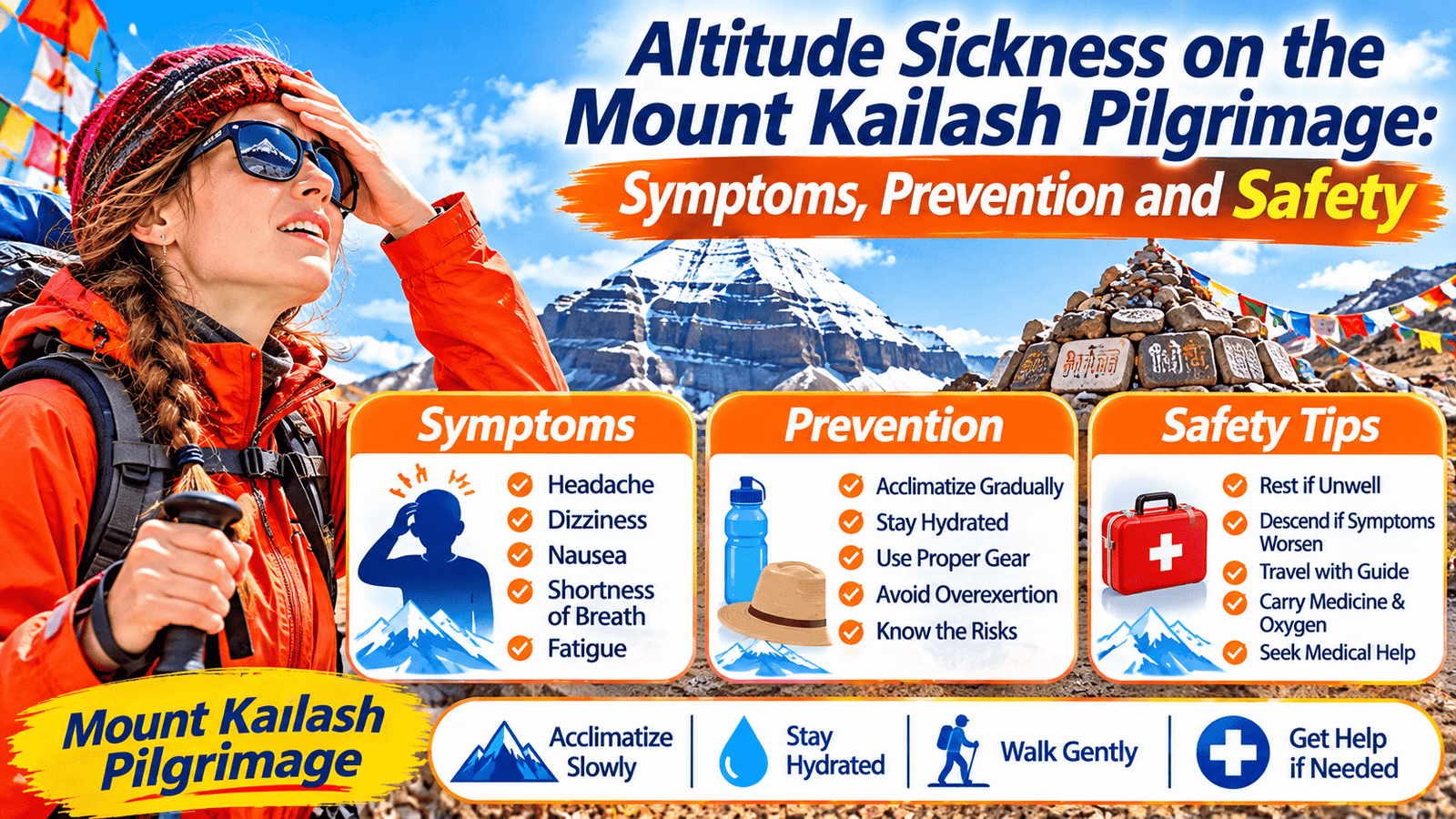
The Mount Kailash pilgrimage is one of the most significant spiritual journeys in the Himalayas. Every year, pilgrims and travelers visit this sacred mountain in western Tibet to perform the traditional circumambulation, known as the kora.
The journey is spiritually meaningful, but it is also physically demanding. The pilgrimage takes place at very high altitude, where reduced oxygen pressure, cold weather, long walking days and limited medical facilities create real health risks.
The kora begins in Darchen, at approximately 4,670 metres above sea level, and crosses Dolma La Pass at around 5,630 metres. Even travelers who have spent several days in Lhasa may find the altitude challenging.
Understanding altitude sickness before departure is essential. Proper acclimatization, a realistic itinerary and the willingness to stop or descend when necessary can make the pilgrimage safer.
How high is Mount Kailash and the kora route?
Mount Kailash is located in the Ngari region of western Tibet. The mountain itself rises to approximately 6,638 metres, but pilgrims do not climb its summit. The traditional outer kora circles the mountain along a high-altitude trail.
The most important elevations along the route are approximately:
| Location | Approximate elevation |
|---|---|
| Lhasa | 3,650–3,700 m |
| Shigatse | Around 3,850 m |
| Saga | Around 4,500 m |
| Lake Manasarovar | Around 4,590 m |
| Darchen | Around 4,670 m |
| Dirapuk area | Around 4,900–5,200 m, depending on the exact lodging or site |
| Dolma La Pass | Around 5,630 m |
| Zutulpuk area | Around 4,790–4,850 m |
These are approximate figures. Published elevations differ between maps and individual points along the trail. The actual sleeping location may also be different from the named monastery or route landmark.
The most important point is that the pilgrimage involves sleeping and walking at elevations above 4,500 metres, with a crossing above 5,600 metres.
Why is altitude sickness a concern during the Kailash pilgrimage?
At high altitude, atmospheric pressure decreases. Although the percentage of oxygen in the air remains approximately the same, each breath delivers less oxygen to the body.
At Darchen, visitors are already at an elevation where altitude sickness can occur. During the kora, the trail climbs higher, and the body must work harder during walking and climbing.
Several factors increase the challenge:
- High sleeping elevations before and during the kora
- Rapid ascent from lower-altitude regions
- Long walking distances
- Steep climbs and descents
- Cold temperatures and strong winds
- Reduced appetite and disrupted sleep
- Limited medical facilities along remote sections of the route
A person may feel comfortable during the drive to Darchen but develop symptoms after arriving or beginning the kora.
Physical fitness does not guarantee protection. Even experienced trekkers and regular athletes can develop AMS, HAPE or HACE.
Common altitude sickness symptoms during the Kailash kora
Acute Mountain Sickness (AMS)
AMS is the most common altitude illness. It usually develops after ascent to a higher elevation and may become noticeable during the first night.
Symptoms include:
- Headache
- Nausea or loss of appetite
- Dizziness
- Unusual fatigue
- Difficulty sleeping
- Reduced ability to walk or exercise
A headache accompanied by nausea, dizziness or unusual tiredness after ascent should be taken seriously.
Do not assume that these symptoms are simply caused by the long journey, poor sleep or physical exertion.
High-Altitude Pulmonary Edema (HAPE)
HAPE is a serious condition in which fluid accumulates in the lungs.
Warning signs include:
- Shortness of breath while resting
- A worsening cough
- Chest tightness or congestion
- Severe weakness
- Difficulty walking short distances
- Breathlessness that becomes progressively worse
HAPE can occur without the usual symptoms of AMS. It is a medical emergency that requires urgent descent and medical assistance.
High-Altitude Cerebral Edema (HACE)
HACE is a life-threatening condition involving swelling and dysfunction of the brain.
Warning signs include:
- Confusion
- Unusual behaviour
- Difficulty walking in a straight line
- Loss of coordination
- Severe drowsiness
- Reduced consciousness
A pilgrim with suspected HACE must not continue the kora. Arrange immediate assistance and descent.
The most challenging part: crossing Dolma La Pass
Dolma La is the highest point of the traditional outer kora, at approximately 5,630 metres.
The second day of the usual three-day pilgrimage is often the most demanding. Pilgrims leave the Dirapuk area, climb toward the pass and then descend toward Zutulpuk.
At this elevation, even a short uphill section can feel exhausting. Breathing becomes harder, walking speed decreases and frequent rest breaks are normal.
The combination of altitude, physical effort, cold and a long walking day makes this section particularly challenging.
Why should pilgrims avoid rushing?
Rushing increases physical strain and can make it harder to recognize early symptoms. It may also leave travelers exhausted before reaching the pass.
A steady pace is more appropriate than trying to keep up with faster members of the group.
Take breaks when needed, eat and drink appropriately, and follow your guide’s advice about the route and weather.
However, slowing down is not enough if you are developing altitude illness. If symptoms appear or worsen, do not try to overcome them simply by walking more slowly.
Do not force yourself across the pass
If you develop serious symptoms before reaching Dolma La, you should not continue upward.
Confusion, loss of coordination, breathlessness at rest or severe weakness require emergency action. The pilgrimage should be stopped, and medical assistance and descent should be arranged.
The religious or personal importance of completing the kora must never take priority over a medical emergency.
How to acclimatize before the Mount Kailash pilgrimage
Acclimatization should begin before reaching Darchen. It is not something that can be completed in a single afternoon.
1. Spend several nights in Lhasa
Lhasa is approximately 3,650–3,700 metres above sea level. Spending several nights there allows the body to begin adapting before continuing west.
Keep the first day relaxed and increase activity gradually. Do not begin a demanding sightseeing schedule immediately after arrival.
2. Continue gradually through the route
Many overland itineraries travel through Shigatse and Saga before reaching Lake Manasarovar and Darchen.
The route should be designed around sleeping altitude, not just driving distance. Where practical, avoid increasing sleeping altitude by more than approximately 500 metres per day once above 3,000 metres, and include additional acclimatization nights as altitude increases.
This is general guidance, not a guarantee that a particular traveler will be ready for the kora.
3. Allow time to rest before starting the kora
Arriving in Darchen does not mean you should immediately begin walking.
Give yourself time to rest, assess how you feel and prepare your equipment. If you have a headache, nausea, dizziness or unusual fatigue, do not begin the kora until the situation has been assessed and symptoms have resolved.
A short delay is preferable to beginning a demanding pilgrimage while unwell.
4. Do not treat oxygen as a replacement for acclimatization
Supplemental oxygen may help relieve hypoxia and can be important in an emergency. However, it does not make rapid ascent safe or guarantee that a person can complete the kora.
Small portable oxygen cans are not adequate treatment for serious altitude illness. Confirm the availability and suitability of medical oxygen equipment before entering remote areas.
How should older pilgrims prepare?
Mount Kailash attracts pilgrims of different ages, including older adults who have waited many years to make the journey.
Age alone does not determine whether someone can complete the pilgrimage. Overall health, mobility, medical history and the ability to tolerate high altitude are more important considerations.
Older travelers should:
- Consult a doctor familiar with high-altitude medicine before departure.
- Review heart, lung and blood-pressure conditions.
- Discuss regular medicines and possible altitude-related concerns.
- Allow a gradual itinerary with enough rest days.
- Avoid rushing to complete the kora.
- Have a clear plan for stopping or leaving the route if necessary.
People with significant heart or lung disease, pre-existing low oxygen levels or a history of severe altitude illness should receive individual medical advice before booking.
Do horses or porters make the kora safer?
Depending on local arrangements and the current route conditions, some pilgrims may use horse support for parts of the kora.
This can reduce the amount of walking, but it does not remove altitude risk. A person riding a horse is still exposed to the same thin air and high sleeping elevations.
Horses and porters cannot prevent AMS, HAPE or HACE. They also do not replace the need for an emergency plan.
Pilgrims should not assume that using support means they can safely continue if they develop symptoms.
What should you do if you develop altitude sickness during the kora?
If you develop mild symptoms, stop walking and tell your guide. Do not continue toward a higher elevation or attempt to cross Dolma La while unwell.
A healthcare professional should assess your condition where possible. Depending on the symptoms and severity, you may need to remain at the same elevation, receive treatment or descend.
If symptoms worsen despite rest, descent is necessary.
Emergency warning signs
Stop the pilgrimage and arrange urgent medical assistance and descent if someone develops:
- Breathlessness while resting
- A worsening cough with severe weakness
- Confusion or unusual behaviour
- Difficulty walking normally or loss of coordination
- Severe drowsiness or reduced consciousness
Give supplemental oxygen if available, but do not delay descent while waiting for oxygen or medication.
In remote areas, evacuation can take time. A guide and travel team should know the available vehicle access points and how to arrange assistance before the kora begins.
Inner kora and additional high-altitude challenges
The inner kora is a separate and more demanding pilgrimage route associated with the sacred landscape around Mount Kailash. Its access, route conditions and permissions may differ from the traditional outer kora.
Travelers should not assume that experience completing the outer kora makes them automatically prepared for the inner route.
The inner kora can involve more difficult terrain and additional altitude exposure. Its feasibility should be assessed separately, with current local information, appropriate permissions and medical considerations.
Anyone who has developed altitude sickness during the outer kora should not attempt a more demanding route.
Essential preparation checklist for the Mount Kailash pilgrimage
Before departure
- Arrange a gradual itinerary with several acclimatization nights.
- Consult a doctor if you have medical conditions or previous altitude illness.
- Discuss any prescribed altitude medication with a qualified clinician.
- Confirm travel insurance covers high-altitude trekking and medical evacuation.
- Ask your tour operator about emergency transport and oxygen arrangements.
- Prepare warm clothing, gloves, suitable footwear and sun protection.
During the journey
- Keep the first days in Lhasa relatively gentle.
- Avoid rapid increases in sleeping altitude.
- Rest in Darchen before beginning the kora.
- Walk slowly and take breaks.
- Eat regular meals and drink according to thirst.
- Tell your guide about headache, nausea, dizziness or unusual fatigue.
- Never continue upward while experiencing altitude sickness symptoms.
- Stop and arrange descent if serious warning signs appear.
Frequently asked questions
What is the altitude of Darchen?
Darchen is approximately 4,670 metres above sea level. The exact figure varies slightly depending on the location measured.
How high is Dolma La Pass?
Dolma La Pass is approximately 5,630 metres above sea level. It is the highest point on the traditional outer kora around Mount Kailash.
Can you get altitude sickness in Darchen?
Yes. Darchen is already at a very high elevation. Travelers may develop AMS after arriving, even before starting the kora.
How many days should I acclimatize before the Kailash kora?
There is no single number of days that guarantees safety. A gradual journey through Lhasa and the western Tibet route, with appropriate overnight stops and rest before the kora, is preferable to a rapid ascent.
Can I complete the kora if I have a headache?
A headache after ascent may be an early sign of altitude illness, especially when accompanied by nausea, dizziness or unusual fatigue. Do not begin or continue the kora without assessing the symptoms.
Does oxygen help at Mount Kailash?
Supplemental oxygen can improve oxygenation and may be important in an emergency. It does not replace acclimatization or descent when serious altitude illness develops.
Is the Mount Kailash kora suitable for older people?
Some older travelers complete the pilgrimage, but suitability depends on individual health, mobility and acclimatization. A medical assessment before departure is particularly important for people with heart or lung conditions or previous altitude illness.
Final advice
The Mount Kailash pilgrimage is a remarkable journey, but it should never be treated as an ordinary sightseeing walk. Darchen is already above 4,600 metres, and the route crosses Dolma La at approximately 5,630 metres.
Plan the journey carefully, allow time for acclimatization and avoid rushing. Most importantly, recognize when your body needs rest or descent.
A successful pilgrimage is not measured only by reaching Dolma La or completing the full kora. Protecting your health and returning safely are equally important.
Medical disclaimer: This article provides general travel-health information and is not a substitute for professional medical advice, diagnosis or treatment. Consult a healthcare professional familiar with high-altitude medicine before the pilgrimage, especially if you have a history of altitude illness or an underlying medical condition. Suspected HAPE or HACE requires urgent medical attention and descent.
Suggested internal links
- Altitude Sickness in Tibet: Complete Guide for Travelers
- How to Prevent Altitude Sickness: Acclimatization and Travel Planning
- High-Altitude Pulmonary Edema (HAPE): Symptoms and Emergency Treatment
- High-Altitude Cerebral Edema (HACE): Symptoms and Emergency Treatment
- Exercise at High Altitude: Walking, Trekking and Managing Physical Effort
- Tibet Altitude Guide: Elevations of Major Tourist Destinations
References
- CDC Yellow Book 2026, High-Altitude Travel and Altitude Illness.
- CDC Travelers’ Health, Travel to High Altitudes.
- Wilderness Medical Society, Clinical Practice Guidelines for the Prevention and Treatment of Acute Altitude Illness: 2024 Update.