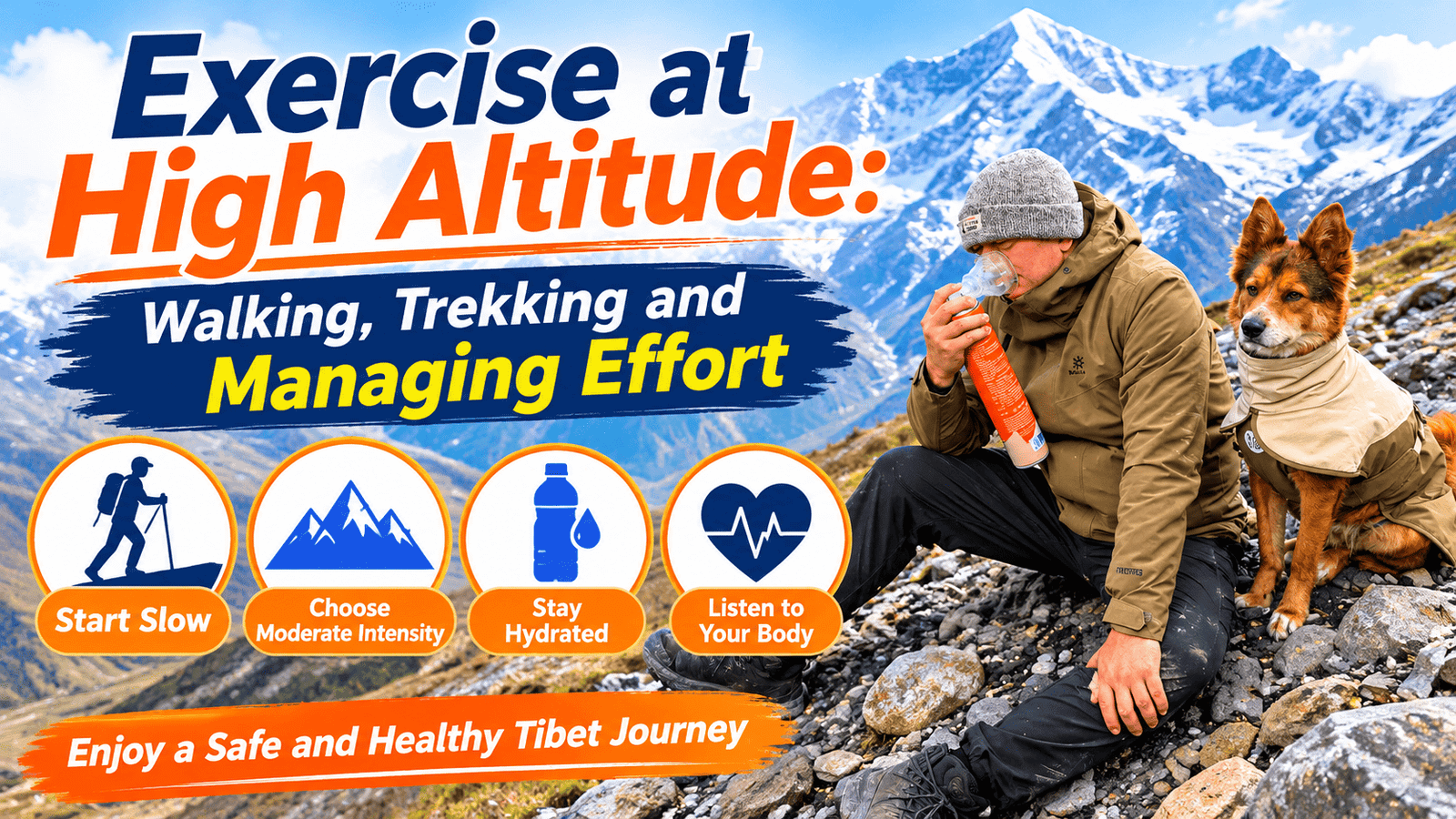
Walking and trekking are among the best ways to experience Tibet. Visitors explore historic streets in Lhasa, climb monastery steps, walk around mountain lakes and travel through high-altitude landscapes on routes toward Everest Base Camp and Mount Kailash.
However, physical activity feels different at high altitude.
The lower atmospheric pressure reduces the oxygen available to the body. During exercise, your muscles need more oxygen, while your cardiovascular and respiratory systems are already working harder to compensate for the reduced oxygen supply.
As a result, a walk that feels easy at sea level may become tiring at 3,500 or 4,500 metres.
The key to exercising safely at high altitude is to manage your effort, allow time for acclimatization and recognize when symptoms mean you should stop.
Why is exercise harder at high altitude?
Oxygen makes up approximately 21% of the atmosphere at sea level and remains close to that proportion at high altitude.
The difference is atmospheric pressure.
As elevation increases, the pressure of oxygen in the air decreases. Less oxygen is available to move from the lungs into the bloodstream.
During physical activity, the muscles require more oxygen to produce energy. The body responds by increasing breathing and heart rate.
You may notice:
- Faster breathing.
- A higher heart rate.
- Earlier fatigue.
- More frequent breaks.
- Reduced walking speed.
- Greater difficulty climbing uphill.
These effects become more noticeable as elevation increases.
Why does your exercise capacity decrease?
Maximum aerobic capacity is the highest rate at which the body can take in and use oxygen during intense exercise.
At altitude, reduced oxygen pressure limits the amount of oxygen available for aerobic energy production.
A 2020 review of research conducted at real and simulated elevations found that maximal oxygen uptake generally declined as altitude increased.
This means that even a well-trained athlete cannot maintain the same maximum exercise performance at high altitude as at sea level.
Acclimatization can improve submaximal endurance and everyday comfort, but maximum exercise performance remains reduced compared with low altitude.
3. How much should you exercise during the first 48 hours?
The CDC recommends mild exercise only during the first 48 hours after arriving at high altitude.
This is particularly important for travelers who arrive directly in Lhasa from a low-elevation city.
Suitable activities include:
- Short, gentle walks.
- Easy sightseeing near the hotel.
- Walking on relatively flat ground.
- Light daily activities.
- Resting whenever you feel tired.
Avoid:
- Long-distance trekking.
- Strenuous uphill walking.
- Heavy backpacking.
- Running or intense workouts.
- Demanding excursions to higher elevations.
You do not need to stay in bed all day if you feel well. Light activity is generally reasonable. The aim is to avoid unnecessary exertion while your body begins adjusting.
4. What does research say about exercise immediately after arrival?
Research has examined whether additional physical activity during initial high-altitude exposure affects AMS risk.
In a study by Fabries and colleagues, 32 healthy participants traveled from low altitude to approximately 3,950 metres and then either walked or traveled by vehicle to 4,300 metres.
The researchers compared the groups during the ascent and monitored them for four days at 4,300 metres.
Both groups experienced rapid ascent. However, the walking group used more energy and had lower oxygen saturation during the ascent.
The walking group also had a higher incidence of AMS on the first day, and symptoms appeared earlier. The vehicle group experienced its symptom peak on the second day.
This study suggests that additional physical exertion during rapid initial exposure may increase the early burden of altitude illness.
However, it should not be interpreted as proof that all walking is dangerous or that vehicle travel prevents AMS. The study involved a specific group and ascent profile.
Other research has produced different findings. A small simulated-altitude study involving 16 participants did not find a significant increase in AMS from moderate-intensity cycling compared with rest.
The practical conclusion is not to avoid all movement. It is to keep activity mild during the first two days and avoid using exercise as a method of acclimatization.
5. How should you walk at high altitude?
Walking is often the main physical activity during Tibet sightseeing and trekking.
A comfortable pace is more important than speed.
Start slowly
Begin with short distances and avoid trying to maintain your normal low-altitude walking speed.
Take regular breaks
Stop when you feel unusually tired or breathless. Allow your breathing and heart rate to settle before continuing.
Avoid racing uphill
Uphill walking increases physical demand. Take shorter steps and reduce your pace on steep sections.
Reduce backpack weight
A heavy backpack increases the effort required for walking. Carry only essential items, particularly on routes above 4,000 metres.
Pay attention to how you feel
If you develop a headache, nausea, dizziness or unusual fatigue after ascending, stop further ascent and assess your condition.
Do not continue simply because the group is moving forward.
6. Does walking more help you acclimatize?
No. Exercise is not a substitute for acclimatization.
The body adapts to altitude through physiological changes involving breathing, kidney function, circulation and oxygen transport.
These adjustments require time.
Walking uphill or deliberately increasing physical effort does not reliably speed up this process.
During acclimatization days, light activity is generally acceptable if you feel well. There is no need to remain completely inactive, but exhausting yourself has not been established as a prevention strategy.
7. Understand the difference between sleeping altitude and daytime exercise
A common mistake when planning a trekking itinerary is to look only at the highest elevation reached during the day.
For altitude-illness prevention, the elevation where you sleep is especially important.
The commonly recommended limit of approximately 500 metres per day above 3,000 metres refers to the increase in sleeping altitude between consecutive nights.
For example:
| Travel detail | Elevation |
|---|---|
| Previous night’s camp | 3,500 m |
| Highest daytime viewpoint | 4,700 m |
| Return to camp | 3,500 m |
| Sleeping-altitude increase | 0 m |
The sleeping-altitude increase is zero because you return to the same camp.
However, the daytime ascent still exposes your body to higher elevation and may involve substantial physical effort.
A high summit attempt can therefore be demanding even if you return to the same sleeping altitude.
When planning a day trip, consider:
- How long you will spend at the higher elevation.
- How much climbing is required.
- Whether you have acclimatized adequately.
- How difficult the return journey will be.
- Whether you can stop or descend safely.
If you already have symptoms of AMS, do not continue ascending.
8. Exercise and trekking on the Mount Kailash kora
The Mount Kailash kora is one of the most physically demanding pilgrimage routes in Tibet.
The traditional outer kora is approximately 52 kilometres long and includes the high Dolma La Pass, which is around 5,630 metres above sea level.
The challenge comes from several factors:
- High elevation.
- Long walking distances.
- Uneven and rocky terrain.
- Steep sections.
- Cold and changing weather.
- Limited access to medical facilities.
Even travelers who exercise regularly may find the route difficult.
How should you manage your pace?
Walk slowly and take breaks when needed.
Do not try to complete the route faster than other pilgrims. Your walking pace should reflect your condition and the altitude.
If you develop symptoms of altitude sickness, do not continue climbing toward the pass. Seek help from your guide and follow an appropriate medical plan.
Physical fitness can help you manage the walking demands, but it does not eliminate the risk of altitude illness.
9. Exercise during an Everest Base Camp trip
An Everest Base Camp journey often includes long road transfers, high mountain passes and walking at elevations above 5,000 metres.
Some travelers assume that the journey is easy because much of it is completed by vehicle.
However, the elevation itself can make even short walks tiring.
At high viewpoints and near the base camp area:
- Walk slowly.
- Avoid unnecessary running.
- Do not race to viewpoints.
- Take breaks during uphill sections.
- Wear suitable footwear.
- Keep warm and protect yourself from wind and cold.
- Avoid strenuous activity immediately after arriving at a higher overnight stop.
If you develop breathlessness at rest, a worsening cough, confusion or difficulty walking straight, seek urgent medical assistance.
10. Exercise and oxygen use
Some travelers consider using supplemental oxygen while walking or exercising at high altitude.
Oxygen can increase oxygen availability when used appropriately, but its effect depends on the equipment, delivery system, activity level and medical condition.
There is no universal oxygen flow rate for ordinary high-altitude exercise.
A small portable oxygen can should not be considered a reliable way to make strenuous activity safe.
If you develop unusual breathlessness or other altitude symptoms, stop exercising. Oxygen, when medically indicated and available, is not a reason to continue ascending or exerting yourself.
For suspected HAPE or HACE, urgent medical care and descent are priorities.
11. How to recognize when exercise is no longer safe
Some increase in breathing and heart rate is expected during physical activity at high altitude.
However, certain symptoms should not be dismissed as ordinary exertion.
Stop and reassess if you experience:
- A new headache after ascent.
- Nausea or vomiting.
- Dizziness.
- Unusual fatigue.
- A marked decline in walking ability.
Do not continue ascending while symptoms consistent with AMS remain.
Seek urgent medical help if you experience:
- Breathlessness at rest.
- A worsening cough.
- Chest congestion or a gurgling sensation.
- Blue or grey lips.
- Confusion or unusual behaviour.
- Loss of coordination.
- Difficulty walking in a straight line.
These can indicate serious altitude illness, including HAPE or HACE.
Stop physical activity, arrange urgent medical assistance and descend when possible.
12. A practical activity guide for Tibet travelers
| Stage of the trip | Suggested activity |
|---|---|
| Arrival day in Lhasa | Rest and short, gentle walks |
| First 48 hours | Mild activity only |
| After initial acclimatization | Gradually increase walking if symptom-free |
| Higher-altitude road journeys | Walk slowly and avoid unnecessary exertion |
| Everest Base Camp visit | Short walks at a comfortable pace |
| Mount Kailash kora | Follow a conservative pace with suitable acclimatization |
| Any symptoms of AMS | Stop ascending and seek advice |
| Suspected HAPE or HACE | Emergency response and descent |
This is general guidance. Individual health, previous altitude exposure and itinerary conditions may require a more conservative approach.
Frequently Asked Questions
Is it safe to exercise at high altitude?
Yes, light or moderate activity may be appropriate for travelers who feel well and are adequately acclimatized. Avoid strenuous exercise during the first 48 hours after arrival.
Should I walk slowly in Lhasa?
Yes. Walking at a comfortable pace helps manage physical effort while your body adjusts to the elevation. Take breaks and avoid long uphill walks during the first days.
Does exercise prevent altitude sickness?
No. Exercise can improve physical fitness, but it does not reliably prevent AMS, HAPE or HACE.
Can I go hiking on my first day in Tibet?
A short, gentle walk may be reasonable if you feel well. Avoid long hikes, steep climbs and strenuous excursions immediately after arriving.
Is walking at 5,000 metres dangerous?
Not necessarily, but physical effort becomes more demanding at this elevation, and altitude illness is a concern. Your acclimatization, symptoms, route and access to assistance all matter.
Should I stop exercising if I get a headache?
Stop strenuous activity and do not ascend further. A headache after ascent may be an early symptom of altitude illness, especially when accompanied by nausea, dizziness or fatigue.
Final advice
Exercise is part of the enjoyment of Tibet travel, but high altitude changes how your body responds to physical effort.
Walk at a comfortable pace, take breaks and avoid strenuous activity during the first two days. As acclimatization develops, increase activity gradually if you remain symptom-free.
At high altitude, the goal is not to walk the fastest. It is to travel safely, recognize your limits and give your body time to adapt.
Suggested internal links
- Altitude Sickness in Tibet: Complete Guide for Travelers
- How to Prevent Altitude Sickness: Acclimatization and Travel Planning
- Does Being Fit Prevent Altitude Sickness?
- How to Prepare Your Body Before Traveling to Tibet
- How the Human Body Adapts to High Altitude
- Altitude Sickness at Everest Base Camp: Risks and Safety Advice
- Altitude Sickness on the Mount Kailash Pilgrimage
- Tibet Travel Checklist: Essential High-Altitude Gear and Safety Tips
References and Further Reading
- CDC Yellow Book 2026: High-Altitude Travel and Altitude Illness.
- Wilderness Medical Society. Clinical Practice Guidelines for the Prevention, Diagnosis, and Treatment of Acute Altitude Illness: 2024 Update.
- Fabries et al. Research on physical activity during rapid ascent to 4,300 metres.
- Research on moderate-intensity exercise and AMS under simulated altitude.
- A Focused Review on the Maximal Exercise Responses in Hypo- and Normobaric Hypoxia (2020).
Medical disclaimer
This article is for general educational purposes and does not replace professional medical advice, diagnosis or treatment. Travelers with previous altitude illness or underlying medical conditions should seek individualized advice before undertaking strenuous activity at high altitude.