Traveling to Tibet means entering an environment where the air pressure is much lower than at sea level. Although oxygen still makes up approximately 21% of the atmosphere, the lower atmospheric pressure reduces the amount of oxygen pressure available to the body.
Your body needs time to adjust to this change. If you travel to a high elevation too quickly, you may develop acute mountain sickness (AMS), and in serious cases, high-altitude pulmonary edema (HAPE) or high-altitude cerebral edema (HACE). The most reliable way to reduce the risk of altitude sickness is gradual ascent combined with sufficient acclimatization time.
This guide explains how to plan your sleeping altitude, schedule rest days, manage physical activity and prepare for different types of Tibet travel.
Understand why gradual ascent matters
When you arrive at high altitude, your body responds by increasing breathing and heart rate. Over the following days, the kidneys, respiratory system and circulation continue adjusting to the reduced oxygen availability.
These changes do not happen immediately.
The first three to five days are particularly important for acute acclimatization. During this period, ventilation gradually increases, oxygenation improves and the body makes several adjustments to its blood chemistry and circulation.
If you continue ascending before these changes have developed, you add another low-oxygen challenge while your body is still adapting.
The 2024 Wilderness Medical Society (WMS) guidelines identify gradual ascent as the primary prevention strategy for acute altitude illness.
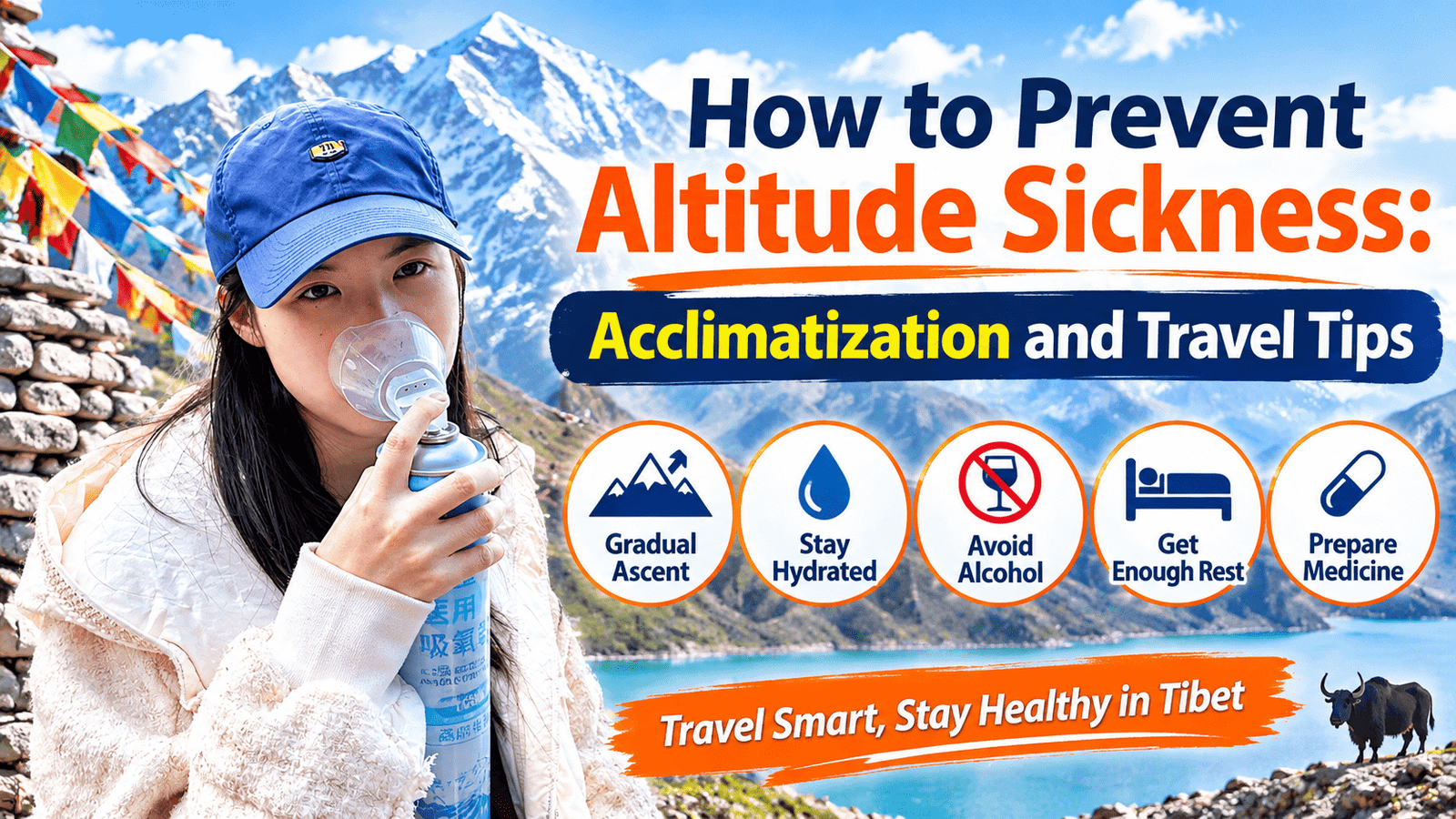
How to Prevent Altitude Sickness, Manage your sleeping altitude
Sleeping altitude is the elevation where you spend the night. It is one of the most important factors when planning a high-altitude itinerary.
The CDC recommends that travelers who start below approximately 1,200 meters avoid going directly to a sleeping altitude of 2,750 meters or higher in a single day, where practical.
Spending two to three nights around 2,450–2,750 meters before continuing higher can provide useful initial acclimatization.
This is especially relevant for travelers who normally live near sea level.
How much should you increase sleeping altitude?
Once above 3,000 meters, the commonly recommended guideline is:
- Increase sleeping altitude by no more than approximately 500 meters per day.
- Include a rest day without increasing sleeping altitude every three to four days.
- Consider an additional acclimatization night for every approximately 1,000 meters of cumulative sleeping-altitude gain.
These are planning guidelines, not guarantees. Some people need a slower ascent, particularly those with a history of significant altitude illness.
Calculate the actual sleeping-altitude increase
Use the elevation of the previous night’s accommodation and the current night’s accommodation.
For example:
| Travel detail | Elevation |
|---|---|
| Previous night’s hotel | 3,000 m |
| Highest daytime viewpoint | 3,800 m |
| Current night’s hotel | 3,400 m |
| Sleeping-altitude increase | 400 m |
The sleeping-altitude increase is 400 meters, not 800 meters.
However, the daytime high point still matters. Time spent at higher elevations, physical exertion and the route taken all contribute to the day’s overall altitude exposure.
Understand the climb-high, sleep-low principle
Climb high, sleep low means visiting a higher elevation during the day and returning to a lower elevation to sleep.
For example, you might spend part of the day at 3,800 meters but return to accommodation at 3,400 meters.
This can reduce the duration of continuous nighttime exposure to low oxygen. It does not mean that the sleeping altitude must always be lower than the previous night’s accommodation.
How to Prevent Altitude Sickness, Plan acclimatization days
An acclimatization day is a day when you do not increase your sleeping altitude.
The WMS recommends including a rest day approximately every three to four days during ascent. The CDC also advises allowing an additional acclimatization day for approximately every 1,000 meters of sleeping-altitude gain.
These days give the body more time to adjust before the next increase.
Example of a gradual ascent
The following is a simplified example for a traveler who has already spent several nights around 2,500 meters and has no altitude symptoms.
| Night | Sleeping altitude | Increase |
|---|---|---|
| 1 | 2,900 m | 400 m |
| 2 | 3,300 m | 400 m |
| 3 | 3,500 m | 200 m |
| 4 | 3,500 m | Rest day |
| 5 | 3,900 m | 400 m |
| 6 | 4,300 m | 400 m |
| 7 | 4,500 m | 200 m |
| 8 | 4,500 m | Rest day |
This illustrates how an itinerary can include regular acclimatization stops. It is not a medically validated route or a guarantee against altitude sickness.
What if the route has limited accommodation?
Some mountain roads and trekking routes have only a few practical overnight stops. It may not be possible to keep every increase below 500 meters.
In these situations, consider adding acclimatization time before and after a larger increase. The WMS also advises considering the average sleeping-altitude gain across the entire ascent.
A later rest day does not erase the risk of an earlier rapid ascent. It simply provides more time for adjustment before continuing.
4. Keep physical activity light during the first 48 hours
During the first two days after arriving at high altitude, avoid unnecessary physical exertion.
Suitable activities include:
- Short walks near your hotel.
- Gentle sightseeing on relatively flat ground.
- Normal daily activities at a comfortable pace.
- Frequent breaks when walking uphill.
Avoid long treks, strenuous climbing, heavy backpacking and demanding exercise sessions during this initial period.
This does not mean you must stay in bed all day. Light activity is generally reasonable if you feel well. The aim is to avoid adding unnecessary physical stress while your body is adjusting.
Exercise does not replace acclimatization. Increasing activity immediately after arrival has not been established as a reliable way to prevent AMS.
Plan carefully when flying directly to Tibet
Flying directly to Lhasa involves a rapid change in elevation. Lhasa is approximately 3,650–3,700 meters above sea level, which is already a substantial altitude for someone arriving from a lowland city.
The CDC classifies a first-night sleeping altitude above 3,400 meters as a high-risk characteristic for AMS in travelers starting below approximately 1,200 meters.
Where practical, staged travel through a lower intermediate elevation may help reduce the initial altitude exposure. However, a lower stop is useful only if the travel arrangements are safe and do not involve another exhausting journey.
Before departure, check:
- The elevation of your arrival airport.
- The actual elevation of your first hotel.
- Whether a lower overnight stop is practical.
- How much activity is planned on arrival day.
- Whether your itinerary can be extended if symptoms develop.
If direct arrival at Lhasa is unavoidable, discuss your individual risk and preventive options with a healthcare professional before traveling.
6. Does taking the train to Tibet provide acclimatization?
Taking the Qinghai–Tibet train can be a memorable way to enter Tibet, but a long train journey does not automatically provide sufficient acclimatization.
The train passes through high-altitude areas, and some sections involve rapid changes in elevation. Sleeping in a train carriage while traveling at high altitude is still exposure to reduced oxygen availability.
A study of passengers on the Qinghai–Tibet Railway reported an AMS incidence of 31% among a particular group of unacclimatized, low-altitude passengers. This was a specific research finding, not a prediction for every train traveler.
After arriving in Lhasa, continue to take the first days slowly. Do not assume that the train journey has removed the need for acclimatization.
7. Prepare for road travel and changing elevations
Tibet road trips often involve several mountain passes, high viewpoints and overnight stays at different elevations.
The most important planning detail is where you sleep, not simply the highest point you visit during the day.
For example, a journey that begins at 2,500 meters and finishes at a hotel at 3,300 meters has a different sleeping-altitude increase from a journey that begins at sea level and finishes at the same hotel.
Before confirming an itinerary, check the actual accommodation elevations rather than relying only on town names.
This is particularly important for journeys from Lhasa toward Shigatse, Everest Base Camp and Mount Kailash.
8. Avoid alcohol and strenuous exercise during early acclimatization
The CDC recommends avoiding alcohol during the first 48 hours at high altitude.
Alcohol can affect sleep, judgment and coordination. It can also make it harder to recognize whether symptoms are caused by altitude or another factor.
Avoid heavy exercise during this initial period as well.
If you regularly drink coffee or other caffeinated beverages, maintaining your usual moderate intake may help avoid a caffeine-withdrawal headache that could be confused with an altitude-related headache.
Do not use alcohol or sedating medicines to force yourself to sleep at altitude without appropriate medical advice.
9. Can pre-acclimatization help?
Previous exposure to high altitude may help prepare the body for a later trip.
The CDC notes that spending at least two nights above 2,750 meters within the 14 days before a planned ascent can be useful. Exposure closer to the main trip is generally more helpful.
However, pre-acclimatization does not guarantee protection. The effect depends on the altitude, duration, timing and individual response.
A brief visit to a high mountain viewpoint is not the same as spending several nights at altitude.
Record your previous exposure, including:
- The dates of your stay.
- The actual sleeping elevation.
- The number of nights spent there.
- How quickly you ascended.
- Any symptoms you experienced.
10. Do not rely on fitness or training equipment
Good physical fitness can make walking and trekking easier, but it does not reliably prevent altitude sickness.
Running, cycling, stair climbing and hiking can prepare your muscles and cardiovascular system for the physical demands of a trip. They do not reproduce the physiological adjustments that occur during sustained exposure to low oxygen.
Respiratory resistance masks and breath-holding exercises have not been established as reliable methods of preventing AMS.
Hypoxic tents and simulated-altitude equipment have produced mixed research findings. They should not be used as a reason to remove acclimatization stops from your itinerary.
How to Prevent Altitude Sickness, Know when to stop ascending
Even a carefully planned itinerary cannot guarantee that you will avoid altitude sickness.
If you develop symptoms consistent with AMS, stop ascending and do not sleep at a higher elevation while symptoms remain.
Seek medical advice if symptoms persist or worsen.
Breathlessness at rest, a worsening cough, confusion or loss of coordination may indicate HAPE or HACE. These are medical emergencies requiring urgent assessment and descent.
Do not allow the original tour schedule to take priority over your health.
Frequently Asked Questions
What is the best way to prevent altitude sickness?
Gradual ascent is the most reliable prevention strategy. Manage your sleeping altitude, include acclimatization days and avoid strenuous exercise during the first 48 hours after arriving at high altitude.
How many days should I acclimatize before going higher?
The first three to five days are particularly important for acute acclimatization. The exact time required depends on your starting elevation, ascent rate, sleeping altitude and individual response.
Is one rest day every three days enough?
A rest day every three to four days is a commonly recommended guideline once ascending above 3,000 meters. Additional acclimatization time may be necessary for some travelers.
Can I visit Everest Base Camp after two days in Lhasa?
It depends on the itinerary, your health, your recent altitude exposure and how you respond to the initial ascent. Two days in Lhasa do not guarantee that you are ready for a much higher overnight elevation. A gradual route and medical advice where appropriate are important.
Does walking slowly prevent altitude sickness?
Walking slowly reduces physical effort, which is helpful during acclimatization. However, walking slowly alone does not prevent AMS. Sleeping altitude and ascent rate remain more important factors.
Can I take medicine instead of acclimatizing?
No. Medicines such as acetazolamide can help prevent AMS in selected travelers, but they do not replace gradual ascent. Discuss medication with a qualified healthcare professional before departure.
Final advice
The safest approach to high-altitude travel is to plan the journey around your body’s ability to adapt.
For Tibet travel, this means allowing enough time in Lhasa, checking overnight elevations, avoiding unnecessary exertion during the first days and keeping the itinerary flexible.
Ascend gradually, sleep at sensible elevations and never continue climbing when altitude symptoms are present.
Suggested internal links
- Altitude Sickness in Tibet: Complete Guide for Travelers
- Acute Mountain Sickness (AMS): Symptoms, Lake Louise Score and Treatment
- How the Human Body Adapts to High Altitude
- How to Prepare Your Body Before Traveling to Tibet
- Does Being Fit Prevent Altitude Sickness?
- Sleeping at High Altitude: Oxygen Levels, Periodic Breathing and Sleep
- Altitude Sickness at Everest Base Camp: Risks and Safety Advice
- Altitude Sickness on the Mount Kailash Pilgrimage
References and Further Reading
- CDC Yellow Book 2026: High-Altitude Travel and Altitude Illness.
- Wilderness Medical Society. Clinical Practice Guidelines for the Prevention, Diagnosis, and Treatment of Acute Altitude Illness: 2024 Update.
- Beidleman BA et al. Research on intermediate-altitude exposure and subsequent acute mountain sickness.
- Research on ascent schedules and acute mountain sickness during high-altitude trekking.
Medical disclaimer
This article provides general educational information and is not a substitute for professional medical advice, diagnosis or treatment. Travelers with previous severe altitude illness or underlying medical conditions should seek individualized medical advice before traveling to high altitude.