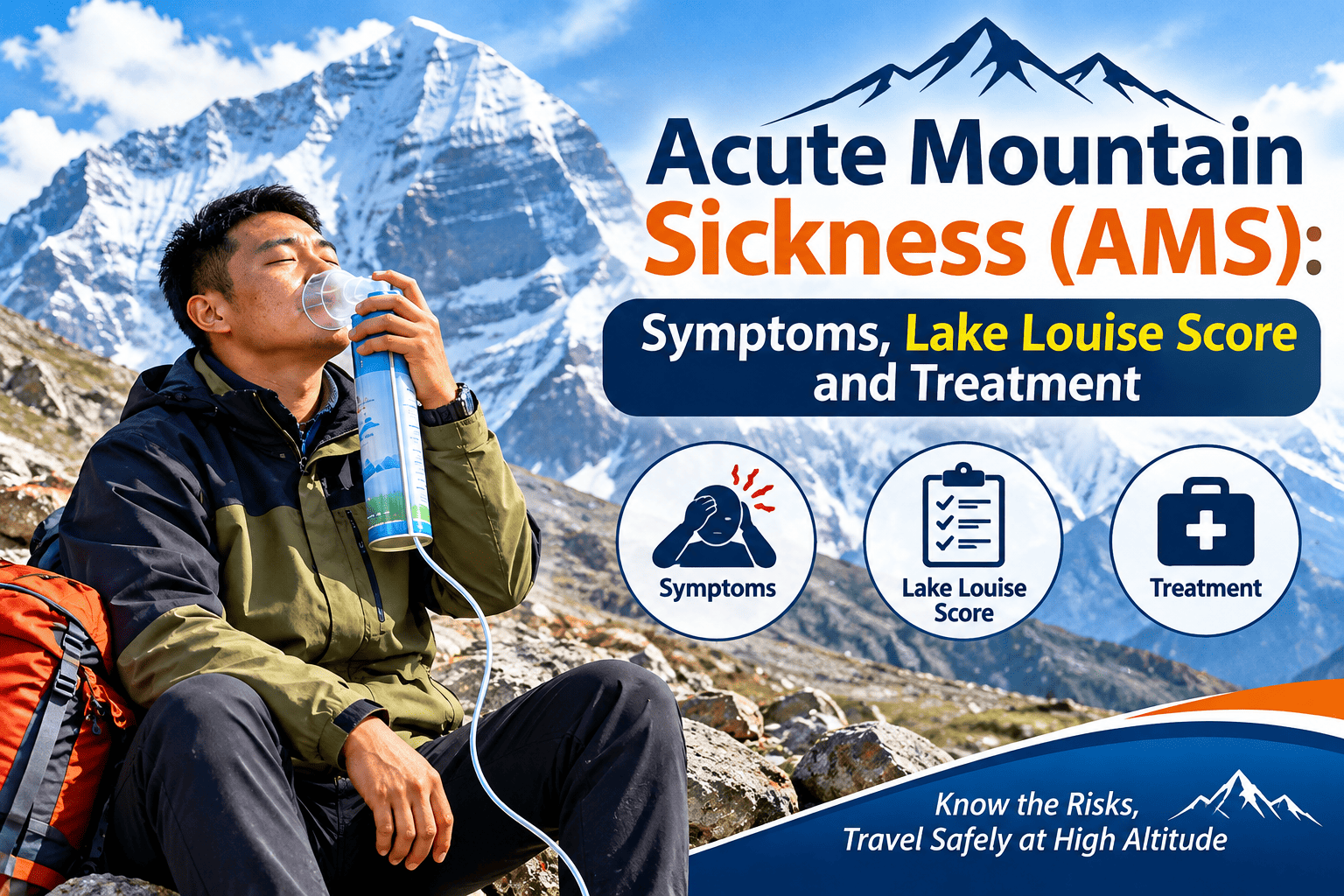
Acute mountain sickness (AMS) is the most common form of altitude illness. It can develop when someone ascends to a high elevation before the body has had enough time to adapt to the lower oxygen pressure.
For travelers visiting Tibet, AMS is an important concern because destinations such as Lhasa are already at high altitude. A visitor arriving directly from a lowland city may develop a headache, nausea, dizziness or unusual fatigue during the first hours or days of the trip.
AMS is usually less dangerous than high-altitude pulmonary edema (HAPE) or high-altitude cerebral edema (HACE), but it should not be ignored. Continuing to ascend while symptomatic can make the situation worse.
The most important rule is simple: if you develop symptoms consistent with AMS, stop ascending until they have resolved. If symptoms worsen or serious warning signs appear, arrange descent and medical assistance.
What Is Acute Mountain Sickness?
Acute mountain sickness is an illness that can occur after recent ascent to high altitude. It is associated with the body’s response to reduced oxygen availability.
As elevation increases, atmospheric pressure falls. Although the percentage of oxygen in the air remains approximately 20.9%, the lower pressure means less oxygen is available to move from the lungs into the bloodstream.
The body responds by increasing breathing and adjusting its circulation and other physiological processes. These changes take time. If a traveler ascends too quickly, symptoms of AMS may develop.
AMS commonly begins within several hours after arriving at a higher altitude or increasing sleeping elevation. Symptoms often appear during the first night or the following morning, although timing varies.
AMS is a clinical syndrome rather than a single symptom. A headache alone does not automatically mean that someone has AMS. The combination of symptoms and the recent ascent are important.
What Are the Symptoms of AMS?
The common symptoms of acute mountain sickness include:
- Headache.
- Nausea or reduced appetite.
- Dizziness or light-headedness.
- Fatigue or unusual weakness.
A headache following recent ascent is an important clue, particularly when accompanied by nausea, dizziness or fatigue.
Headache
A high-altitude headache may feel like pressure, throbbing or a persistent ache. It can become more noticeable during the first night or the following morning.
However, headache can have other causes, including dehydration, migraine, lack of sleep, infection and other medical conditions. It should be considered alongside the person’s altitude exposure and other symptoms.
Nausea and reduced appetite
Some travelers feel sick, lose interest in food or experience stomach discomfort. These symptoms may make it difficult to eat normally during the first days at altitude.
Dizziness and light-headedness
A person may feel dizzy when standing, walking or changing direction. Dizziness can also have causes unrelated to altitude, so it should not be interpreted in isolation.
Fatigue and weakness
Unusual tiredness is common during early altitude exposure. A traveler may find that ordinary activities require more effort than expected.
Fatigue becomes more concerning when it is severe, rapidly worsening or accompanied by neurological or respiratory symptoms.
How Is AMS Assessed? The 2018 Lake Louise Score
The Lake Louise Acute Mountain Sickness Score is a standardized system developed for assessing AMS symptoms in research and clinical settings.
The revised 2018 scoring system includes four symptoms:
| Symptom | Score |
|---|---|
| Headache | 0–3 |
| Gastrointestinal symptoms, such as nausea or reduced appetite | 0–3 |
| Fatigue or weakness | 0–3 |
| Dizziness or light-headedness | 0–3 |
Each symptom is rated according to its severity:
- 0: No symptoms.
- 1: Mild.
- 2: Moderate.
- 3: Severe or incapacitating.
The scores are added together, producing a possible total of 0–12.
For the research definition of AMS, the person generally needs a total score of at least 3, including a headache score of at least 1, in the context of recent altitude gain.
Why was sleep disturbance removed?
The earlier Lake Louise score included difficulty sleeping. The 2018 revision removed sleep disturbance because it did not consistently correspond with the other AMS symptoms.
Sleep can be disrupted at high altitude for several reasons, including periodic breathing and unfamiliar sleeping conditions. Poor sleep alone is therefore not sufficient to identify AMS under the revised score.
When should the score be assessed?
The revised scoring approach is intended for assessment after exposure to the new altitude, generally after at least six hours following altitude gain.
However, this timing is a research and assessment consideration—not a reason to delay action. If someone develops severe breathlessness, confusion or difficulty walking, do not wait six hours or complete a questionnaire before seeking emergency help.
Does the Lake Louise Score diagnose every case?
No. It is a standardized symptom assessment tool. It does not replace medical examination or clinical judgment.
It is also important to distinguish the research definition from practical travel decisions. A traveler with worsening symptoms should not continue ascending simply because a calculated score is below a particular threshold.
4. Mild, Moderate and Severe AMS
The Wilderness Medical Society 2024 guidance uses the Lake Louise self-assessment score to help classify AMS severity:
| Score | General classification |
|---|---|
| 0–2 | Does not meet the symptom-score threshold for AMS |
| 3–5 | Mild AMS |
| 6–12 | Moderate to severe AMS |
These categories help describe symptom severity. They do not replace assessment of the person’s overall condition.
Mild AMS
A traveler may have a headache with mild nausea, dizziness or fatigue but remain able to carry out basic activities.
The correct response is to stop ascending, rest at the same altitude and monitor symptoms.
Moderate or severe AMS
Symptoms may become more intense and interfere with normal activities. The person may struggle to eat, walk comfortably or carry out ordinary tasks.
Further ascent is not appropriate. Medical assessment and descent should be considered, especially if symptoms are worsening or not improving.
Symptoms that suggest something more serious
AMS should not be used as an explanation for every problem at altitude. Certain symptoms suggest HAPE or HACE and require emergency action.
Possible HAPE signs:
- Breathlessness that is unusual for the level of activity.
- A sudden decline in walking ability.
- Persistent or worsening cough.
- Breathlessness at rest.
Possible HACE signs:
- New difficulty walking straight.
- Loss of coordination or balance.
- Confusion or unusual behavior.
- Abnormal drowsiness or reduced consciousness.
These conditions can occur with or without typical AMS symptoms.
5. What Should You Do If You Develop AMS?
The first step is to stop ascending.
Step 1: Do not increase sleeping altitude
Do not continue to a higher hotel, camp or overnight destination while symptoms are present.
A short rest at a viewpoint does not cancel the risk of sleeping higher later that day.
Step 2: Rest and monitor symptoms
Remain at the same altitude and reduce physical activity. Avoid strenuous walking, heavy luggage and unnecessary exertion.
Monitor headache, nausea, dizziness, appetite, energy and general condition. Tell your travel companions or guide that you are unwell.
Step 3: Seek medical advice if symptoms persist or worsen
Mild AMS often improves over 12–48 hours when the person stops ascending and remains at the same altitude. This is not a guaranteed recovery period.
If symptoms worsen despite rest, arrange descent and medical assessment. Do not wait for the end of a planned acclimatization day if the person’s condition is deteriorating.
Step 4: Descend when necessary
Descending improves oxygen availability by increasing atmospheric pressure.
For AMS, a descent of approximately 300 meters or more often helps symptoms improve, particularly when the person also reduces exertion. The necessary descent varies, and a fixed distance does not guarantee recovery.
If the person has severe or worsening symptoms, descend farther as needed and seek medical assistance.
Step 5: Resume ascent only after symptoms resolve
Do not ascend again while AMS symptoms remain. Once symptoms have resolved, further travel should follow a conservative ascent plan.
6. Can Oxygen Help Treat AMS?
Supplemental oxygen can increase blood oxygen saturation and may relieve symptoms in some people with AMS.
The Wilderness Medical Society describes continuous oxygen delivered at approximately 1–2 liters per minute for at least two hours as a possible treatment approach for mild AMS. This is different from taking a few brief breaths from a small portable oxygen can.
Oxygen may improve headache relatively quickly, while nausea and fatigue can take longer to resolve.
However, oxygen is not a reason to continue ascending. Temporary symptom relief does not prove that acclimatization is complete or that the illness has resolved.
If symptoms worsen, arrange descent and medical assessment. Oxygen can support oxygenation while transport or evacuation is organized, but it must not delay appropriate care.
7. What Medicines Are Used for AMS?
Medication decisions depend on the person’s medical history, risk level, symptoms and ascent plan.
Acetazolamide
Acetazolamide is one of the best-supported medicines for preventing AMS in travelers at increased risk. It supports acclimatization by increasing ventilation through changes in the body’s acid-base balance.
It may also be used in the treatment of AMS in selected situations.
Possible side effects include tingling in the fingers or toes, increased urination and changes in the taste of carbonated drinks. People with kidney problems, a history of serious drug reactions or other relevant medical conditions should be assessed before using it.
Dexamethasone
Dexamethasone is a corticosteroid that can reduce AMS symptoms and has specific roles in preventing or treating AMS and HACE in selected circumstances.
Unlike acetazolamide, it does not promote physiological acclimatization. Symptoms may return after the medicine is stopped if the person has not adapted to the altitude.
Pain-relieving medicines
Acetaminophen (paracetamol) or ibuprofen may be used for headache relief when medically appropriate. However, reducing a headache does not prove that AMS has resolved.
Ibuprofen can affect the stomach and kidneys, particularly in people who are dehydrated or undertaking strenuous activity. Acetaminophen can cause serious liver injury if taken in excessive amounts.
Discuss medication choices with a healthcare professional before travel. This article does not provide individual dosing instructions.
8. Can a Pulse Oximeter Diagnose AMS?
No. A pulse oximeter estimates peripheral blood oxygen saturation, known as SpO₂. It does not diagnose AMS.
Oxygen saturation normally decreases as altitude increases, including in healthy people. A traveler with AMS may have a reading that appears typical for the current elevation.
Similarly, a reading above 90% does not rule out AMS, HAPE or HACE.
Use SpO₂ as supporting information alongside symptoms, recent ascent, altitude and changes over time. Do not allow a reassuring number to override serious warning signs.
9. How Can You Prevent AMS During a Tibet Tour?
The most effective prevention strategy is a carefully planned ascent.
For travel above 3,000 meters, general guidance recommends:
- Increasing sleeping altitude by no more than approximately 500 meters per night.
- Taking a rest day without an increase in sleeping altitude every three to four days.
- Allowing enough time for acclimatization.
- Keeping physical activity light during the first 48 hours after arrival.
- Avoiding alcohol during the initial acclimatization period.
- Discussing preventive medication with a healthcare professional when appropriate.
Tibet itineraries require particular attention because Lhasa is already around 3,700 meters above sea level. A traveler arriving directly from low altitude should not assume that one night in Lhasa guarantees full acclimatization.
Build flexibility into the itinerary, especially before traveling to Everest Base Camp or Mount Kailash.
Frequently Asked Questions
How soon does AMS start after arriving at high altitude?
Symptoms commonly begin within several hours after ascent. They often appear during the first night or the following morning, although timing varies.
How long does acute mountain sickness last?
Mild AMS commonly improves within 12–48 hours when a traveler stops ascending and remains at the same altitude. Worsening symptoms require medical assessment and may require descent.
Can I continue sightseeing if I have a mild headache?
A headache after ascent may be altitude-related. If it occurs with nausea, dizziness or unusual fatigue, AMS should be considered. Stop ascending, reduce exertion and monitor symptoms. Do not move to a higher sleeping altitude while symptomatic.
Can I sleep at the same altitude if I have AMS?
People with mild symptoms may remain at the same altitude under close observation, provided symptoms are not worsening and no danger signs are present. If symptoms worsen or serious warning signs appear, arrange descent and medical assistance.
Does a high SpO₂ reading mean I do not have AMS?
No. Pulse oximetry cannot diagnose or rule out AMS. Symptoms and recent altitude exposure remain essential.
Is AMS the same as HAPE or HACE?
No. AMS is usually less severe and mainly involves headache and other symptoms such as nausea, fatigue and dizziness. HAPE affects the lungs, while HACE affects brain function. Both are medical emergencies.
Can I take medicine and continue climbing?
Medication should not be used to justify an unsafe ascent. If AMS symptoms develop, stop ascending. Resume ascent only after symptoms have resolved and the itinerary has been reassessed.
Conclusion
Acute mountain sickness is a common response to rapid ascent, but it should never be treated as an ordinary travel inconvenience. Headache, nausea, dizziness and unusual fatigue after gaining altitude are reasons to stop ascending and assess the situation.
Most importantly, recognize the difference between mild AMS and the emergency warning signs of HAPE and HACE. Breathlessness at rest, loss of coordination, confusion or altered consciousness require urgent medical assistance and descent.
For travelers in Tibet, a flexible itinerary, sensible acclimatization and early communication with the guide can help prevent a manageable problem from becoming a serious emergency.
Medical Disclaimer
This article is for general educational purposes and does not replace professional medical advice, diagnosis or treatment. The Lake Louise Score is an assessment tool, not a substitute for clinical evaluation. Medication decisions should be made with a qualified healthcare professional. Suspected HAPE or HACE requires urgent medical assistance and descent or evacuation.