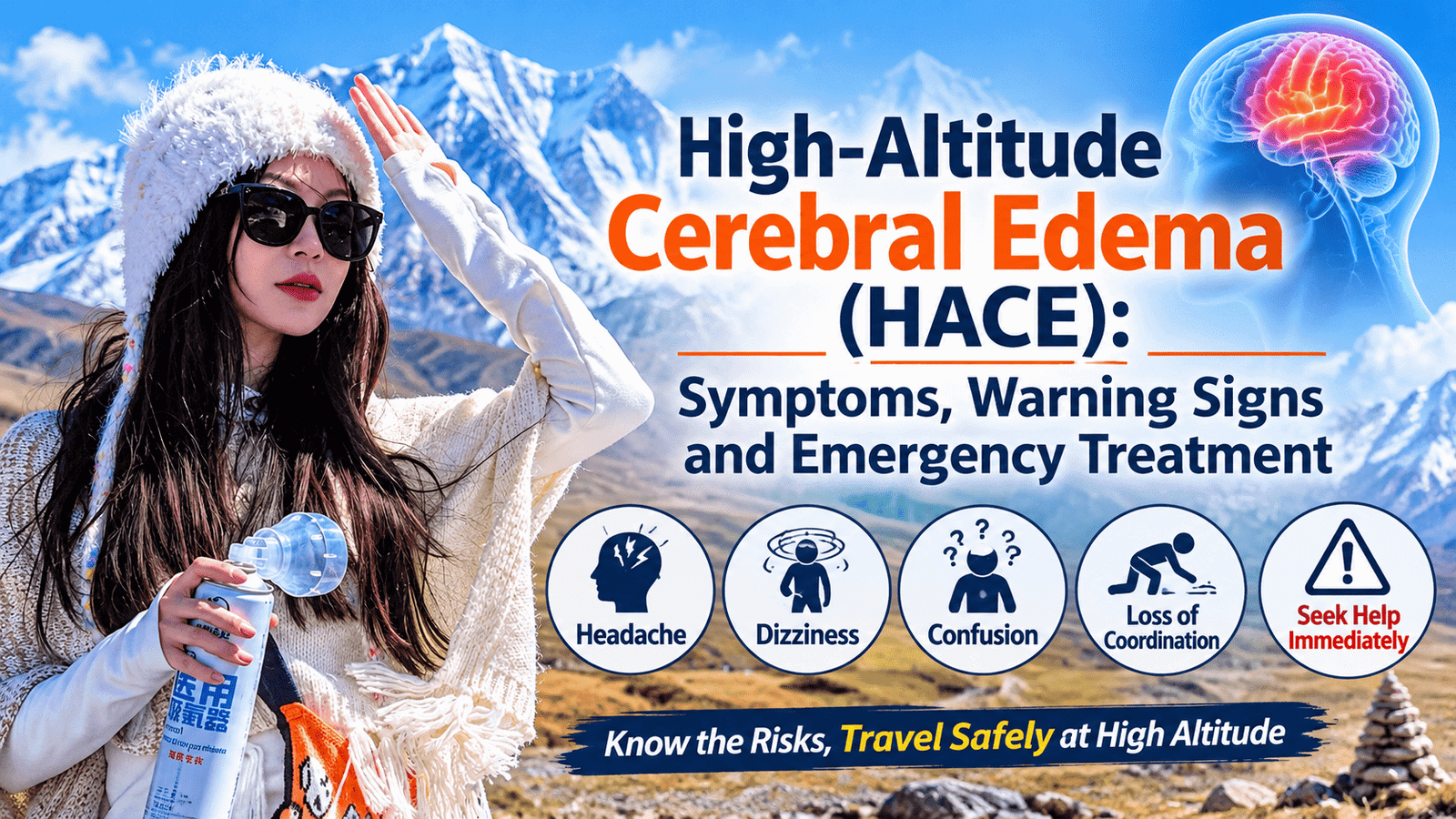
High-altitude cerebral edema (HACE) is a life-threatening form of altitude illness that affects brain function after ascent to high altitude. It can progress rapidly, causing loss of coordination, confusion, reduced consciousness and, in severe cases, coma.
The two most important warning signs are new difficulty walking or maintaining balance and changes in thinking, behavior or consciousness.
For travelers visiting Tibet, these symptoms must never be dismissed as ordinary fatigue, poor sleep or the effects of a demanding road journey. A person who becomes unusually confused or cannot walk steadily after ascending to high altitude needs urgent medical attention.
If HACE is suspected, stop ascending, activate emergency assistance, arrange immediate descent and provide supplemental oxygen if available. Do not wait for symptoms to become severe.
What Is High-Altitude Cerebral Edema?
HACE is an acute neurological emergency associated with exposure to high altitude, particularly following rapid ascent without adequate acclimatization. At high altitude, atmospheric pressure decreases, reducing the pressure of oxygen available for breathing. This condition is known as hypobaric hypoxia.
The brain responds to low oxygen through several physiological changes, including alterations in cerebral blood flow. In susceptible individuals, these changes can contribute to disruption of the blood-brain barrier, allowing fluid to accumulate in brain tissue. This swelling can interfere with normal neurological function. The exact mechanisms of HACE are complex and continue to be studied.
HACE is generally considered a severe form of acute mountain sickness (AMS), but it can sometimes occur without obvious preceding AMS symptoms. It may also occur together with high-altitude pulmonary edema (HAPE).
What Causes High-Altitude Cerebral Edema HACE?
HACE is associated with inadequate adaptation to the low oxygen pressure found at high altitude.
Several processes may contribute to the condition.
Reduced oxygen availability
As elevation increases, less oxygen is available to move from the lungs into the bloodstream. The brain is particularly sensitive to inadequate oxygen supply.
Changes in cerebral blood flow
Low oxygen changes the way blood vessels in the brain respond. Cerebral blood flow and pressure regulation may become disturbed during acute altitude exposure.
Blood-brain barrier disruption
In susceptible individuals, changes in blood flow and vascular regulation can contribute to increased permeability of the blood-brain barrier.
Fluid may then accumulate in brain tissue, causing edema and affecting neurological function.
Why rapid ascent matters
A rapid increase in sleeping altitude gives the body less time to adapt. This increases the risk of acute altitude illness, including severe conditions such as HACE.
HACE commonly develops after rapid ascent to high altitude, but there is no single elevation or exposure time that predicts every case.
The Two Most Important Warning Signs of High-Altitude Cerebral Edema (HACE)
HACE can cause several neurological symptoms. Two findings are particularly important: ataxia and altered mental status.
Loss of coordination (ataxia)
Ataxia means impaired coordination and balance. It may be one of the earliest observable signs of HACE.
Watch for:
- Staggering or unusually unsteady walking.
- Drifting to one side.
- Difficulty walking in a straight line.
- Unsteadiness when turning or standing.
- Difficulty maintaining balance.
- In severe cases, inability to stand or walk safely.
A trained responder may assess heel-to-toe walking in a safe environment. However, do not ask a suspected patient to perform walking tests if there is a risk of falling.
New, obvious coordination problems after an ascent are enough to warrant urgent action.
Changes in mental state or consciousness
Changes in mental state may be less obvious at first. Travel companions are often best placed to notice them because they know how the person normally behaves.
Watch for:
- Confusion or incorrect answers to simple questions.
- Slowed responses.
- Difficulty following instructions.
- Unusual behavior or irritability.
- Poor judgment or disorientation.
- Abnormal drowsiness.
- Difficulty completing familiar tasks, such as organizing belongings.
- Reduced consciousness.
In severe cases, HACE can progress to coma.
Do not wait for both symptoms to become severe. New ataxia or altered mental status following recent ascent should raise immediate concern.
What does the Lake Louise definition say?
Under the Lake Louise consensus definition, ataxia or altered mental status may qualify when AMS is already present. Without AMS, both neurological features are required for the formal definition.
This is a clinical and research classification distinction. It must never delay emergency action when HACE is suspected.
Can HACE Occur Without a Headache?
Yes. HACE can sometimes occur without a clearly reported headache or without obvious preceding AMS symptoms.
This is important because travel companions may assume that someone is safe if they have not complained of a headache.
New difficulty walking, confusion or abnormal behavior after an ascent should be treated seriously, even if the person says they feel fine.
HACE may also occur alongside HAPE. If a traveler develops both neurological changes and worsening breathing, both conditions need urgent assessment.
5. How Is HACE Different from Ordinary Fatigue or AMS?
High-altitude travel can cause tiredness, poor sleep and reduced concentration. These experiences do not automatically mean HACE.
However, new neurological changes are not ordinary altitude discomfort.
| Condition | Typical features | Level of concern |
|---|---|---|
| Ordinary altitude-related fatigue | Tiredness, reduced exercise capacity, disrupted sleep | Monitor and allow recovery |
| AMS | Headache, nausea, dizziness, fatigue or weakness after ascent | Stop ascending and assess |
| HACE | Ataxia, confusion, altered behavior or reduced consciousness | Medical emergency |
The most important distinction is the person’s ability to coordinate movements and think normally. A traveler who is unusually confused or unable to walk steadily should not be encouraged to rest overnight and continue the tour the next morning.
6. What Should You Do If High-Altitude Cerebral Edema (HACE) Is Suspected?
HACE requires immediate action. Do not wait for symptoms to improve on their own.
Step 1: Stop ascending and minimize exertion
Do not continue to a higher elevation.
Keep the affected person under continuous supervision. Do not ask them to carry a backpack, walk unassisted or continue the planned itinerary.
If they are confused or unsteady, protect them from falling.
Step 2: Arrange immediate descent and medical evacuation
Descent to a substantially lower altitude is a central part of HACE treatment.
Arrange rescue or assisted transport whenever possible, especially if the person is confused, unsteady or unable to walk safely.
The appropriate descent depends on the person’s condition, terrain, weather and available transport. There is no single descent distance that guarantees safety.
Do not leave the person alone or expect them to find their own way downhill.
Step 3: Provide supplemental oxygen if available
Supplemental oxygen can improve oxygenation and is an important part of emergency treatment.
Use reliable equipment according to its instructions and the guidance of trained personnel.
Oxygen should be provided alongside arrangements for descent and medical care. Do not delay evacuation while attempting to obtain a particular SpO₂ reading.
Small consumer oxygen cans are not a substitute for sustained oxygen therapy.
Step 4: Medical treatment may include dexamethasone
Dexamethasone is a corticosteroid used in the treatment of HACE. It can help improve neurological symptoms, but it does not replace descent or oxygen when indicated.
Medication choice and administration should follow an appropriate medical or expedition emergency protocol. This article does not provide self-treatment dosages.
Step 5: If descent is temporarily impossible
Weather, difficult terrain or transport problems may temporarily prevent immediate descent.
In this situation:
- Contact rescue services.
- Continue arranging evacuation.
- Provide oxygen if available.
- Keep the person warm and minimize movement.
- Follow professional medical or rescue instructions.
A portable hyperbaric chamber may be used by trained personnel in suitable circumstances. It temporarily increases pressure around the patient, simulating some of the effects of descending to a lower altitude.
It is a temporary measure, not a substitute for descent when descent becomes possible. Its use must not delay necessary evacuation.
Step 6: Monitor the person during evacuation
Continue observing and reporting:
- Alertness and ability to answer questions.
- Coordination and ability to move safely.
- Breathing and any signs of HAPE.
- Oxygen saturation, if a reliable pulse oximeter is available.
- Changes after oxygen or other treatment.
A pulse oximeter can help assess oxygenation, but no single SpO₂ reading can confirm or exclude HACE.
Neurological symptoms and their progression remain critical. Never wait until the person loses consciousness before seeking help.
Can High-Altitude Cerebral Edema (HACE) Be Treated with Oxygen Alone?
No. Oxygen is an important part of treatment, but it is not a substitute for urgent descent and medical care. Supplemental oxygen increases the oxygen concentration in the air being inhaled. This can improve blood oxygen saturation and support the brain while evacuation is organized.
However, a temporary improvement in SpO₂ or alertness does not prove that HACE has resolved. The patient still requires urgent medical assessment, appropriate emergency treatment and descent or evacuation.
8. How Can HACE Be Prevented?
Gradual ascent is a key way to reduce the risk of acute altitude illness. For itineraries above 3,000 meters, the Wilderness Medical Society recommends increasing sleeping altitude by no more than approximately 500 meters per day, with a rest day that does not increase sleeping altitude every three to four days.
These are general planning guidelines, not guarantees of safety.
Additional precautions include:
- Allow enough time for acclimatization.
- Avoid rapid increases in sleeping altitude where possible.
- Stop ascending if symptoms of altitude illness develop.
- Build flexibility into your itinerary for rest, descent and evacuation.
- If you have previously experienced HACE or other serious altitude illness, seek advice from a clinician experienced in altitude medicine before your trip.
- Plan communication, transport and emergency assistance before entering remote areas.
Good physical fitness does not eliminate the risk of HACE. Recognizing neurological warning signs and acting quickly are more important than trying to complete a planned route.
Why High-Altitude Cerebral Edema (HACE) Is Important for Tibet Travelers
Many Tibet tours involve high-altitude roads, mountain passes and remote overnight destinations. A traveler may arrive in Lhasa, spend a short time sightseeing and then continue toward higher destinations. The body may still be adapting even when the person initially feels comfortable.
HACE is uncommon compared with AMS, but its consequences can be severe. Guides, drivers and travel companions should be alert to unusual behavior, difficulty walking and changes in consciousness.
During journeys to Everest Base Camp or Mount Kailash, a traveler who develops neurological symptoms should not be encouraged to continue because the group has a fixed schedule. A responsible tour plan needs enough flexibility to arrange medical assistance and evacuation when required.
Frequently Asked Questions
How quickly can HACE develop?
HACE often develops within the first few days after rapid ascent to high altitude, although timing varies. It can progress rapidly once neurological symptoms appear.
Is HACE always preceded by AMS?
No. HACE often develops as severe altitude illness following AMS, but it can sometimes occur without obvious preceding AMS symptoms.
What is the first warning sign of HACE?
New difficulty walking or maintaining balance, known as ataxia, and changes in mental state are particularly important warning signs. Either should prompt urgent concern after recent ascent.
Can HACE cause confusion?
Yes. Confusion, unusual behavior, slowed responses, abnormal drowsiness and reduced consciousness are important symptoms.
Can HACE be treated without descending?
Descent is a central part of treatment. Oxygen, dexamethasone and a portable hyperbaric chamber may provide important support, particularly when descent is temporarily delayed, but they do not replace evacuation when it becomes possible.
Can HACE occur together with HAPE?
Yes. Both conditions can occur together. If someone has breathing difficulties as well as confusion or loss of coordination, urgent medical assessment is essential.
Can a pulse oximeter detect HACE?
No. A pulse oximeter measures estimated blood oxygen saturation, not brain function. HACE is primarily recognized through neurological symptoms and clinical assessment.
Is HACE life-threatening?
Yes. HACE can progress to coma and death if untreated. Suspected HACE requires immediate emergency assistance, oxygen when available, and urgent descent or evacuation.
Conclusion
High-altitude cerebral edema is one of the most serious medical emergencies associated with high-altitude travel. Its most important warning signs are new loss of coordination, difficulty walking, confusion and changes in consciousness.
For Tibet travelers, the safest approach is to recognize these symptoms early and act immediately. Stop ascending, arrange emergency medical assistance and descent, and provide supplemental oxygen if available.
Never wait for a person with suspected HACE to become unconscious before seeking help.
Medical Disclaimer
This article is for general educational purposes and does not replace professional medical assessment or individualized medical advice. Suspected HACE is a life-threatening emergency requiring immediate medical or rescue assistance. Oxygen and medication are supportive treatments and do not replace urgent descent or evacuation.
References
- Wilderness Medical Society Clinical Practice Guidelines for the Prevention, Diagnosis, and Treatment of Acute Altitude Illness: 2024 Update
- CDC Yellow Book 2026: High-Altitude Travel and Altitude Illness
- High-Altitude Cerebral Edema: Clinical Features, Pathophysiology and Treatment
- The 2018 Lake Louise Acute Mountain Sickness Score