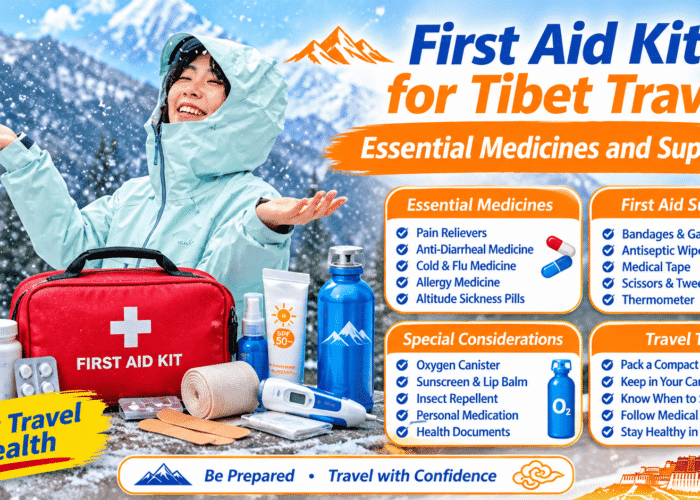

Travelers visiting Tibet may consider carrying medicines to prevent or manage altitude sickness. This can be particularly relevant when a journey includes rapid elevation changes, limited acclimatization time or remote destinations such as Everest Base Camp and Mount Kailash.
Several medicines have established roles in high-altitude medicine, but they do not all work in the same way. Some help the body acclimatize. Others reduce symptoms or address specific complications involving the brain or lungs.
The most important medicines include:
- Acetazolamide: Helps the body adapt to high altitude and is widely used to prevent acute mountain sickness (AMS).
- Dexamethasone: A corticosteroid used in selected situations to prevent or treat AMS and high-altitude cerebral edema (HACE).
- Nifedipine: A medicine used primarily for prevention or treatment of high-altitude pulmonary edema (HAPE) in specific circumstances.
- Tadalafil and sildenafil: Medicines that affect pulmonary blood vessels and may have a role in selected HAPE cases.
- Ibuprofen and acetaminophen: Pain-relieving medicines that may help with altitude-related headache, although they do not replace altitude-illness treatment.
Medication decisions should be made with a qualified healthcare professional. No medicine makes an unsafe ascent safe, and treatment should never delay emergency descent when serious altitude illness is suspected.
Why Are Medicines Used for Altitude Sickness?
At high altitude, atmospheric pressure decreases, reducing the oxygen pressure available with each breath. The body responds by increasing ventilation and making other physiological adjustments. These changes take time. When someone ascends too quickly, the body may not adapt sufficiently. This can lead to AMS, HAPE or HACE.
Medicines are used for different purposes:
| Medicine group | Main purpose |
|---|---|
| Carbonic anhydrase inhibitors | Support acclimatization and prevent AMS |
| Corticosteroids | Reduce symptoms and help prevent or treat AMS and HACE in selected circumstances |
| Pulmonary vascular medicines | Reduce pulmonary artery pressure and address HAPE risk |
| Pain relievers | Relieve headache and other pain symptoms |
Understanding these differences matters because a medicine that relieves a headache is not necessarily preventing the underlying altitude illness.
Acetazolamide: The Main Medicine for AMS Prevention
Acetazolamide is a carbonic anhydrase inhibitor. It is one of the best-studied medicines for preventing acute mountain sickness. It is commonly known by the brand name Diamox in some markets, although brand names and availability vary.
How does acetazolamide work?
At high altitude, the body responds to reduced oxygen availability by increasing breathing. Faster breathing removes more carbon dioxide from the blood, initially making the blood more alkaline. The kidneys gradually compensate by excreting bicarbonate.
Acetazolamide increases bicarbonate excretion. This produces a mild metabolic acidosis that supports increased ventilation. The result is a stronger breathing response that can help the body adapt to high altitude.
What is acetazolamide used for?
The 2024 Wilderness Medical Society (WMS) guidelines recommend considering acetazolamide for travelers at moderate or high risk of AMS. It is also included in recommendations for HACE prevention.
Its strongest evidence is for preventing AMS. It can also be considered for treatment in appropriate circumstances, although the evidence for treatment is less extensive than the prevention evidence.
What does research show?
A randomized PHAIT trial reported AMS in:
- 14 of 118 participants receiving acetazolamide, approximately 12%.
- 40 of 119 participants receiving placebo, approximately 34%.
Participants had already trekked to approximately 4,300 metres before entering the study and subsequently ascended to 4,928 metres. These results demonstrate a preventive benefit under the specific study conditions. They should not be interpreted as a guaranteed result for every traveler or itinerary.
Common side effects
Possible side effects include:
- Tingling or numbness in fingers, toes or around the mouth.
- Increased urination.
- Changes in the taste of carbonated drinks.
- Occasional gastrointestinal discomfort.
Some people have medical conditions or medication histories that require additional assessment before using acetazolamide.
Anyone with kidney disease, significant electrolyte problems or a history of serious drug reactions should discuss its suitability with a clinician.
Dexamethasone: A Corticosteroid for Selected Situations
Dexamethasone is a corticosteroid with anti-inflammatory effects. It is used in high-altitude medicine for selected cases of AMS and HACE prevention and treatment.
How does dexamethasone work?
Dexamethasone does not support acclimatization in the same way as acetazolamide. Instead, it reduces inflammatory responses and can relieve symptoms associated with altitude illness.
It can act relatively quickly, making it useful in selected situations where rapid symptom control is important.
What is it used for?
The WMS guidelines recognize dexamethasone as an alternative preventive medicine for certain adults at moderate or high risk of AMS.
It is also used to treat moderate or severe AMS and is an important part of HACE treatment.
However, it does not replace descent, and symptom improvement while taking it does not mean the body has acclimatized.
What are the limitations?
A major limitation is that symptoms may return after the medicine is discontinued if the person has not adequately acclimatized.
Further ascent should not occur while symptoms remain controlled only by dexamethasone.
Potential side effects include:
- Sleep disturbance.
- Mood changes.
- Elevated blood glucose.
- Increased susceptibility to infection.
- Other corticosteroid-related effects, particularly with prolonged use.
Dexamethasone should not be treated as an ordinary travel medicine to take casually or repeatedly without medical advice.
4. Nifedipine: A Medicine for HAPE Risk
Nifedipine is a calcium-channel blocker used in several cardiovascular conditions. In high-altitude medicine, its main role is related to high-altitude pulmonary edema.
How does nifedipine work?
At high altitude, low oxygen can cause pulmonary blood vessels to constrict. In susceptible individuals, this response may become excessive and uneven, increasing pressure in the pulmonary circulation. Nifedipine relaxes blood vessels and can reduce pulmonary artery pressure.
Who may need nifedipine?
The WMS guidelines identify nifedipine as the preferred preventive medicine for people with a known susceptibility to HAPE.
It is not a routine medicine for every traveler visiting Tibet. A history of HAPE is particularly important when assessing future high-altitude travel. Such travelers should receive specialist advice about ascent planning and preventive options.
What are the possible side effects?
Nifedipine can cause:
- Headache.
- Facial flushing.
- Dizziness.
- Swelling of the ankles or feet.
- Low blood pressure.
Low blood pressure is an important concern, especially in someone who is dehydrated or has another condition affecting circulation.
Is nifedipine used to treat HAPE?
Its role in treatment is limited. The WMS guidelines recommend nifedipine for HAPE treatment only when descent is impossible or delayed and reliable access to supplemental oxygen or portable hyperbaric treatment is unavailable. It must not replace descent and emergency medical assistance.
5. Tadalafil and Sildenafil: Other Medicines Affecting Pulmonary Blood Vessels
Tadalafil and sildenafil belong to a group called phosphodiesterase-5 (PDE-5) inhibitors.
They are commonly known for other medical uses, but they have also been studied in high-altitude medicine.
How do they work?
These medicines affect the nitric oxide signaling pathway and promote relaxation of blood vessels. In high-altitude medicine, their potential benefit is related to reducing pulmonary vascular pressure.
When might they be considered?
The WMS guidelines give tadalafil a limited role in preventing HAPE in people with known susceptibility who are not candidates for nifedipine. Evidence and recommendations for these medicines are not interchangeable with routine AMS prevention.
Important safety considerations
Possible side effects include:
- Headache.
- Facial flushing.
- Nasal congestion.
- Indigestion.
- Dizziness.
- Changes in blood pressure.
Combining PDE-5 inhibitors with nitrate medicines can cause a dangerous drop in blood pressure. They should not be taken for altitude sickness without medical assessment.
Ibuprofen: Headache Relief and AMS Research
Ibuprofen is a nonsteroidal anti-inflammatory drug (NSAID).
It is commonly used to relieve pain and inflammation, including altitude-related headache.
Some research has also examined ibuprofen for AMS prevention.
A randomized controlled trial published in 2012 involved 86 participants ascending from approximately 1,240 metres to 3,810 metres.
AMS occurred in:
- 43% of the ibuprofen group.
- 69% of the placebo group.
This study suggested a preventive effect under its particular conditions.
However, the WMS guidelines do not place ibuprofen ahead of acetazolamide for prevention. It should not be considered an equivalent substitute.
Safety considerations
Ibuprofen may cause:
- Stomach irritation.
- Gastrointestinal bleeding.
- Kidney injury.
- Fluid-retention problems in some people.
People with kidney disease, previous gastrointestinal bleeding, certain cardiovascular conditions or other relevant risk factors should seek medical advice before using it.
7. Acetaminophen (Paracetamol): Relief for Headache
Acetaminophen, also known as paracetamol, is a pain reliever commonly used for headache.
It may help reduce discomfort during a high-altitude journey, but it does not correct the underlying effects of low oxygen availability.
It has not become an established medicine for preventing AMS.
A randomized study published in 2017 compared acetaminophen with ibuprofen among 225 participants who completed the trial.
AMS occurred in:
- 25 of 113 participants in the acetaminophen group.
- 18 of 112 participants in the ibuprofen group.
Because the study did not include a concurrent placebo group, it cannot establish whether either medicine prevents AMS compared with no preventive medicine.
People with liver disease or other relevant medical conditions should seek advice before using acetaminophen. Excessive intake can cause serious liver injury.
8. Which Medicines Are Recommended for Which Conditions?
The following table summarizes the general clinical roles of commonly discussed medicines.
| Medicine | Main role in altitude medicine | Important limitation |
|---|---|---|
| Acetazolamide | AMS prevention; supports acclimatization; may be considered for AMS treatment | Does not make rapid ascent safe |
| Dexamethasone | Selected AMS prevention; treatment of AMS and HACE | Does not promote acclimatization |
| Nifedipine | HAPE prevention in susceptible individuals; selected emergency treatment circumstances | Not a routine AMS medicine |
| Tadalafil | Selected HAPE prevention in susceptible people who cannot use nifedipine | Requires specialist assessment |
| Sildenafil | Investigated for pulmonary vascular effects in HAPE | Not a general AMS prevention medicine |
| Ibuprofen | Headache relief; studied for AMS prevention | Not the preferred preventive medicine in current WMS guidance |
| Acetaminophen | Headache and pain relief | Does not prevent or treat the underlying altitude illness |
Why Medicines Cannot Replace Acclimatization
Even when a medicine reduces the risk of altitude sickness, it does not remove the physiological challenge of high altitude.
A traveler can still develop altitude illness while taking preventive medication.
Follow these basic principles:
- Ascend gradually whenever possible.
- Avoid increasing sleeping altitude too quickly.
- Include acclimatization days in the itinerary.
- Avoid strenuous activity during the initial adjustment period.
- Stop ascending if symptoms develop.
- Descend and seek emergency assistance if serious symptoms appear.
For a Tibet journey, medication planning should be considered alongside the route, sleeping elevations and time available for acclimatization.
Should You Take Altitude Medicine Before Traveling to Tibet?
Not everyone needs preventive medication.
The decision depends on factors such as:
- Your previous experience with altitude illness.
- The altitude where you will sleep on the first night.
- How quickly you will ascend.
- Whether staged acclimatization is possible.
- Your medical history.
- Other medicines you take.
- Whether you have previously experienced HAPE or HACE.
The CDC and WMS recommend considering preventive medication according to risk rather than giving every traveler the same medicine.
For example, flying directly into Lhasa from a low-altitude location creates a different risk profile from gradually traveling through lower elevations before arriving.
A clinician familiar with high-altitude travel can assess the itinerary and determine whether medication is appropriate.
Emergency Warning Signs: When Medicine Is Not Enough
Do not attempt to manage serious altitude illness with ordinary painkillers or preventive medication alone.
Seek urgent medical assistance if someone develops:
Possible HAPE:
- Breathlessness at rest.
- Worsening cough.
- Chest tightness.
- Markedly reduced exercise ability.
- Increasing difficulty breathing.
Possible HACE:
- Unsteady walking or loss of coordination.
- Confusion.
- Unusual behavior.
- Severe drowsiness.
- Altered consciousness.
Stop ascending, minimize exertion, provide oxygen if available and appropriate, and arrange urgent descent or evacuation.
Frequently Asked Questions
What is the best medicine for altitude sickness?
Acetazolamide has strong evidence for preventing AMS and is recommended for travelers at moderate or high risk. Other medicines have different roles and should not be treated as interchangeable.
Is Diamox necessary for traveling to Tibet?
Not every traveler needs acetazolamide. The decision depends on the itinerary, ascent rate, previous altitude illness and medical history.
Can dexamethasone prevent altitude sickness?
It can be used as an alternative preventive medicine for selected adults, but it does not promote acclimatization. It is also used to treat AMS and HACE.
Is nifedipine used for AMS?
No. Its main role in high-altitude medicine is related to HAPE prevention in susceptible individuals and selected treatment circumstances.
Can I take altitude medicine and continue ascending?
Preventive medication does not guarantee protection. If symptoms develop, stop ascending and follow appropriate medical advice. Serious symptoms require urgent descent or evacuation.
Can I buy altitude sickness medicine in Tibet?
Availability and prescription rules vary. It is safer to discuss medication needs with a clinician before departure rather than relying on finding the correct medicine during a remote journey.
Conclusion
Several medicines can help prevent or manage altitude-related illness, but each has a different purpose.
Acetazolamide is the best-established medicine for AMS prevention and supports acclimatization. Dexamethasone is used in selected situations for AMS and HACE. Nifedipine and certain PDE-5 inhibitors have more specialized roles in HAPE prevention or treatment.
For travelers visiting Tibet, the safest approach combines an appropriate itinerary, gradual acclimatization, medical advice and early recognition of warning signs. No medicine makes an unsafe ascent safe.
Medical Disclaimer: This article is for general educational purposes and does not provide an individual prescription or medication plan. Drug choice, dose, timing and contraindications must be assessed by a qualified healthcare professional. Do not self-treat suspected HAPE or HACE. These conditions require urgent medical assistance and descent or evacuation.
References
- Wilderness Medical Society Clinical Practice Guidelines for the Prevention, Diagnosis, and Treatment of Acute Altitude Illness: 2024 Update. Wilderness & Environmental Medicine. https://doi.org/10.1016/j.wem.2023.05.013
- CDC Yellow Book 2026: High-Altitude Travel and Altitude Illness. CDC
- Acetazolamide and acute mountain sickness prevention trials and systematic reviews. PubMed search
- Nifedipine, tadalafil and sildenafil in high-altitude pulmonary edema research. PubMed search
- Ibuprofen for acute mountain sickness prevention. PubMed search