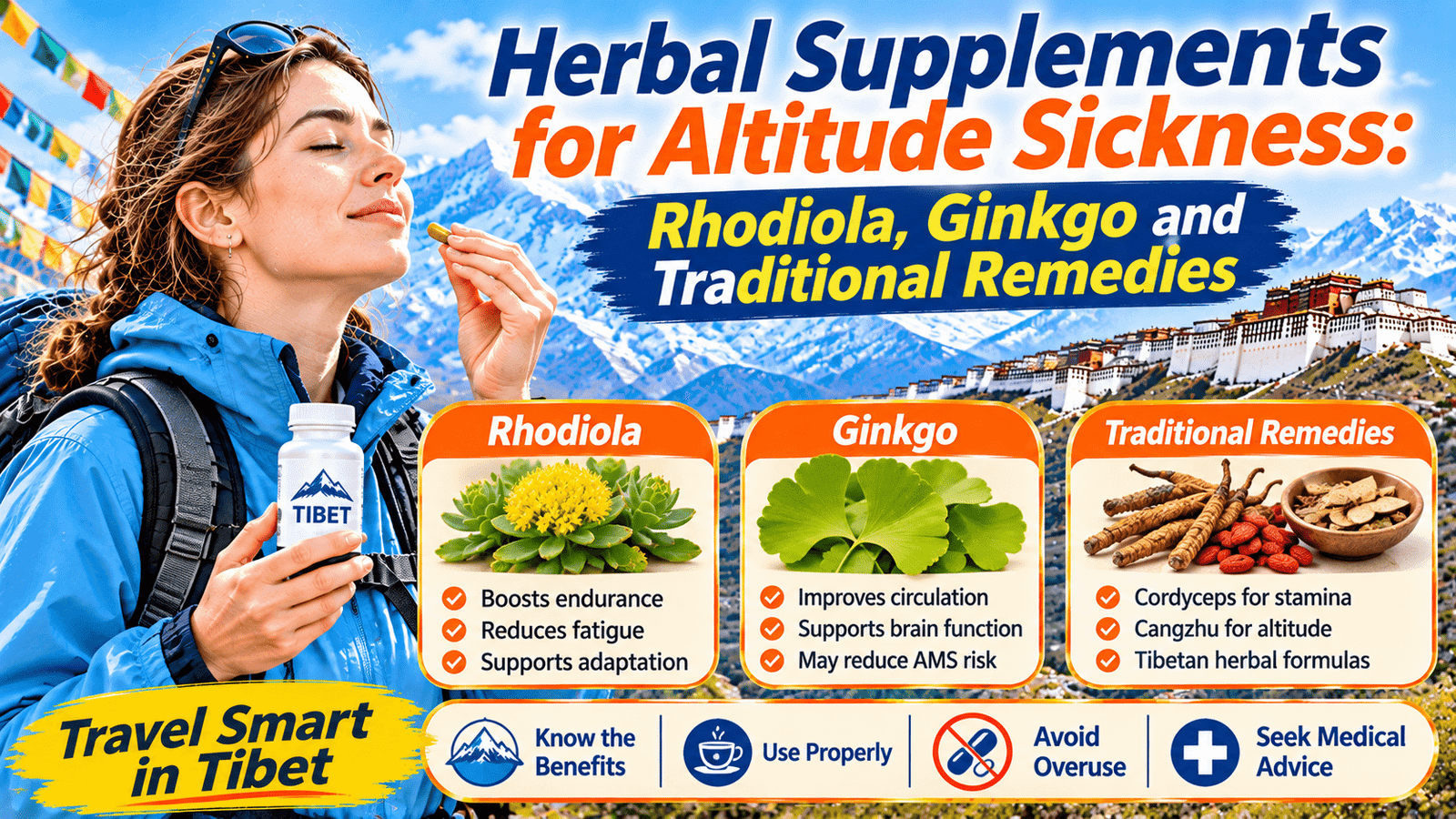
Travelers visiting Tibet may encounter many herbal products advertised for altitude adaptation, improved oxygen levels, fatigue relief and physical endurance. Some are traditional remedies used in mountain regions. Others are modern supplements developed from plants that grow in cold or high-altitude environments.
Common examples include Rhodiola, Ginkgo biloba, ginseng, Codonopsis and Danshen-based preparations. These products are popular, but popularity does not establish medical effectiveness. Some have been studied in human trials, while others are supported mainly by laboratory experiments, animal research or traditional use.
The most important point is that no herbal supplement should replace gradual acclimatization, appropriate medical treatment or emergency descent.
This article reviews the evidence and explains what travelers should know before using herbal products during a Tibet journey.
Why Are Herbal Supplements Marketed for High Altitude?
High altitude exposes the body to lower oxygen pressure.
Some plants and herbal products are marketed as ways to help the body adapt to low oxygen, improve circulation, reduce fatigue or protect cells from oxidative stress.
Proposed mechanisms include:
- Antioxidant activity.
- Effects on blood-vessel function.
- Changes in cellular energy metabolism.
- Possible effects on inflammation.
- Influence on the body’s response to low oxygen.
These mechanisms may be scientifically interesting, but they do not automatically demonstrate that a product prevents acute mountain sickness.
To establish effectiveness, researchers need reliable human studies measuring meaningful outcomes, such as AMS incidence, symptom severity or serious altitude-related complications.
2. Rhodiola: A Popular High-Altitude Supplement
Rhodiola is a group of plants that grow in cold and mountainous environments.
Different species have been used traditionally for fatigue, endurance and general well-being. Rhodiola products are also marketed in China and other high-altitude travel markets for adapting to low-oxygen conditions.
Commercial products may include:
- Standardized extract capsules.
- Tablets.
- Oral liquids.
- Herbal combinations containing Astragalus or ginseng.
Different Rhodiola species and extraction methods produce different chemical compositions. A study of one standardized extract cannot automatically be applied to every product sold under the name Rhodiola.
What does the human research show?
A randomized, double-blind, placebo-controlled crossover trial published in 2013 investigated a standardized extract of Rhodiola crenulata.
The study included 102 participants who completed both the Rhodiola and placebo conditions.
The research protocol used 800 mg per day, beginning seven days before ascent and continuing during a two-day mountaineering period. These figures describe the study protocol and are not a recommended travel dose.
AMS developed in 62 of 102 participants during both the Rhodiola and placebo conditions, equivalent to 60.8%.
The study did not find a meaningful preventive benefit for AMS. It also did not demonstrate corresponding improvements in severe AMS, headache or blood oxygen measurements.
A 2025 systematic review examined 19 Chinese randomized trials involving 1,690 patients with acute high-altitude illness. It reported improvements in some symptoms and oxygenation outcomes, but the certainty of evidence was very low.
The review mainly examined treatment-related outcomes and should not be interpreted as proof that Rhodiola prevents AMS in healthy tourists.
Is Rhodiola recommended for Tibet travel?
Current international altitude-illness guidelines do not recommend Rhodiola as a routine method of preventing AMS.
Possible side effects include:
- Dizziness.
- Headache.
- Insomnia.
- Dry mouth.
- Changes in salivation.
People taking other medicines or living with medical conditions should discuss supplement use with a healthcare professional.
Practical conclusion: Rhodiola has traditional uses and ongoing research interest, but it should not be relied upon to prevent altitude sickness.
3. Ginkgo Biloba: Does It Improve Circulation at High Altitude?
Ginkgo biloba is a tree whose leaves are processed into herbal preparations.
It has been studied for potential effects on circulation, blood vessels and oxidative stress. These proposed effects have led researchers to investigate whether Ginkgo could reduce altitude-related symptoms.
Early studies
Two randomized studies published in 2009 investigated Ginkgo leaf extract among people ascending rapidly to approximately 4,300 metres.
Both studies used 240 mg per day, but their findings differed.
In the first study:
- AMS occurred in 7 of 21 participants receiving Ginkgo.
- AMS occurred in 13 of 19 participants receiving placebo.
- The difference was statistically significant.
In the second study:
- AMS occurred in 4 of 15 participants receiving Ginkgo.
- AMS occurred in 10 of 22 participants receiving placebo.
- The difference was not statistically significant.
The studies were relatively small and used extracts from different sources.
What did the larger trial find?
The PHAIT trial provided a much larger comparison.
It enrolled 614 participants, of whom 487 completed the study. Participants trekked to approximately 4,300 metres before ascending to 4,928 metres.
AMS incidence was:
| Study group | AMS incidence |
|---|---|
| Ginkgo | 35% |
| Placebo | 34% |
| Acetazolamide | 12% |
The Ginkgo group had almost the same AMS incidence as the placebo group, while the acetazolamide group had a substantially lower incidence.
This larger study did not demonstrate a preventive benefit from Ginkgo.
Is Ginkgo recommended for altitude sickness?
The 2024 Wilderness Medical Society guidelines do not recommend Ginkgo biloba for AMS prevention.
Ginkgo products also vary in their chemical composition and standardization.
Possible safety concerns include gastrointestinal discomfort, headache and dizziness. Ginkgo may increase bleeding concerns, particularly for people taking anticoagulant or antiplatelet medicines.
Practical conclusion: Despite some positive findings in small early studies, the larger trial did not show that Ginkgo prevents AMS.
4. Danshen: Traditional Chinese Medicine Research
Danshen (Salvia miltiorrhiza) is widely used in traditional Chinese medicine. Some Danshen-based compound formulations have been studied for their potential effects on circulation and altitude-related symptoms.
However, the research involves specific products. Ordinary Danshen roots, herbal decoctions, capsules and compound preparations should not be treated as equivalent.
Compound Danshen Dripping Pills
Compound Danshen Dripping Pills contain ingredients associated with Danshen, Panax notoginseng and borneol. A placebo-controlled study published in 2020 assigned 160 volunteers to receive the formulation or placebo.
The reported AMS incidence was:
- Treatment group: 48.6%.
- Placebo group: 67.6%.
The difference was statistically significant in that study.
Researchers also reported changes in exercise duration and certain cardiovascular measurements.
However, one positive trial is not enough to establish a routine preventive treatment.
AR36/T89
AR36/T89 is another research formulation associated with Danshen, Panax notoginseng and borneol.
A randomized, double-blind Phase II trial published in 2023 assigned 132 participants to different groups. Of these, 110 ascended to approximately 3,810 metres and were included in the efficacy analysis.
The next-morning AMS incidence was:
- Placebo group: 66.7%.
- First treatment group: 61.1%.
- Second treatment group: 55.3%.
The differences were not statistically significant.
What can travelers conclude?
The findings from different Danshen studies are mixed.
The products, study populations, ascent conditions and outcome measurements were not identical. Some results are promising, but they do not establish that Danshen-based products reliably prevent altitude sickness.
These formulations are not standard preventive treatments in current international altitude-illness guidelines.
5. Kuanxiong Aerosol: Preliminary Research
Kuanxiong Aerosol is another traditional Chinese medicine compound preparation that has been investigated for possible high-altitude benefits. An exploratory randomized trial published in 2026 examined the product under simulated conditions equivalent to approximately 4,000 metres for six hours.
Among 20 participants who completed the study:
- AMS developed in 3 of 10 participants receiving the formulation.
- AMS developed in 5 of 10 participants receiving placebo.
The difference was not statistically significant, and symptom scores did not demonstrate a corresponding benefit.
An additional observation involving nine participants reported symptom improvement, but it did not include a concurrent placebo group.
The study is exploratory and too small to establish that Kuanxiong Aerosol prevents altitude sickness.
6. Ginseng: American Ginseng and Asian Ginseng
Ginseng products are widely marketed for energy, fatigue and physical endurance.
Two commonly discussed species are:
- American ginseng (Panax quinquefolius).
- Asian ginseng (Panax ginseng).
They are different plants and should not be treated as identical.
Ginseng roots contain compounds called ginsenosides, which have been investigated for several possible biological effects.
What does the research show?
Some laboratory research has examined ginsenosides in cells exposed to low-oxygen conditions.
For example, experiments involving vascular endothelial cells have investigated whether certain ginsenosides influence cellular responses to hypoxia and reoxygenation.
These findings may help researchers understand possible mechanisms.
However, laboratory experiments do not establish that taking ginseng capsules, teas or root slices prevents AMS in travelers.
There is currently insufficient reliable human evidence to recommend American or Asian ginseng as a routine method of preventing AMS, HAPE or HACE.
Safety considerations
Possible adverse effects of ginseng include:
- Insomnia.
- Digestive discomfort.
- Changes in blood glucose.
- Interactions with certain medicines.
People taking medication for diabetes or other chronic conditions should discuss ginseng use with a healthcare professional.
7. Codonopsis: Traditional Root and Compound Preparations
Codonopsis is a genus of plants whose dried roots are used in traditional Chinese medicine.
Products may be sold as:
- Dried herbal slices.
- Decoctions.
- Teas.
- Powders.
- Granules.
- Tablets.
- Compound herbal preparations.
Animal research involving Codonopsis polysaccharides has investigated cellular energy metabolism and oxidative damage under chronic hypoxic conditions.
These experiments may suggest biological mechanisms, but animal research cannot establish effectiveness in human travelers.
What about human studies?
A 2010 study of New Compound Codonopsis Tablets involved 45 male military personnel.
Participants had remained at approximately 1,400 metres for three months before ascending to 5,200 metres.
Thirty participants were assigned to the treatment group and 15 to the control group.
The published abstract reported milder symptoms and improvements in certain pulmonary-function measurements in the treatment group.
However, the study involved a small, specific military population and a particular compound formulation. The publicly available information does not provide enough detail to calculate a reliable reduction in AMS risk or attribute the reported results to Codonopsis alone.
The findings are not sufficient to establish ordinary Codonopsis products as a standard preventive treatment.
8. Other Supplements: Do They Prevent Altitude Sickness?
Many other supplements have been marketed or investigated for altitude-related benefits.
The main problem is that biological plausibility does not necessarily translate into clinical effectiveness.
Antioxidant supplements
Vitamin C, vitamin E and alpha-lipoic acid have been studied because low oxygen exposure can influence oxidative stress.
A larger clinical study did not demonstrate a clear preventive benefit from the antioxidant combination examined.
These supplements should be taken to meet ordinary nutritional needs when appropriate, not as a proven way to prevent AMS.
Magnesium
Magnesium is essential for normal muscle and nerve function. However, a 2004 altitude-illness prevention trial did not demonstrate that magnesium supplementation prevented AMS. Loose stools were more common in the oral magnesium group.
Taking additional magnesium is not an established substitute for acclimatization or medical prevention.
Beetroot and dietary nitrate
Beetroot and nitrate supplements have been investigated because nitrate can influence nitric oxide pathways and blood-vessel function.
A randomized crossover trial published in 2017 used concentrated beetroot juice for six days.
The study did not demonstrate AMS prevention or improved exercise performance. Overall headache scores were higher during the beetroot-supplement condition.
Beetroot can still be part of a normal diet, but concentrated beetroot supplements should not be considered established altitude-sickness prevention.
Ketone supplements
Ketone esters have been investigated for possible effects on energy metabolism during low-oxygen exposure.
A 2024 study involving 14 men examined 29 hours of simulated exposure equivalent to approximately 4,000–4,500 metres. Some symptom and oxygenation measurements improved.
However, a 2026 study involving 34 participants examined four days of exposure at approximately 3,375 metres and found no improvement in AMS outcomes or oxygen saturation compared with placebo.
The results are not consistent enough to recommend ketone esters for altitude-sickness prevention.
Oxygenated water
Oxygenated water is marketed as a way to increase oxygen availability in the body.
However, drinking oxygenated water is not equivalent to breathing supplemental oxygen.
A 2022 study involving 22 participants reported a smaller decrease in oxygen saturation during simulated low-oxygen walking, but walking distance did not improve significantly.
A smaller 2005 study found no improvement in oxygenation or exercise performance during low-oxygen cycling.
Oxygenated water should be regarded as a beverage rather than a treatment for altitude illness.
Local Tibetan Drinks and Traditional Practices
Travelers in Tibet may encounter several traditional drinks and foods, including butter tea, sweet tea, ginger tea and tsampa.
These foods and drinks are part of local culture and can provide energy, warmth and fluids according to their ingredients and preparation.
However, there is no reliable evidence that a particular recipe or quantity of butter tea, sweet tea or ginger tea prevents AMS.
Butter tea
Butter tea is traditionally made with tea, butter and salt. It can provide energy and warmth, especially in cold conditions. It is a traditional drink, not a clinically established altitude-sickness medicine.
Ginger tea
Ginger tea may be comforting and is commonly consumed for digestive discomfort. However, there is insufficient evidence that ginger tea prevents AMS or serious altitude-related illness.
Sweet tea and glucose drinks
Sweet tea and glucose drinks provide carbohydrates. They may be useful when someone has reduced appetite and needs an easily tolerated energy source. However, routine glucose drinks have not been established as a reliable method of preventing altitude sickness. People with diabetes should follow their individual dietary and medication plans.
Local practices: the practical distinction
It is perfectly reasonable to enjoy local Tibetan food and drinks during a trip. The important distinction is between cultural food, nutritional support and medical treatment.
A drink can provide warmth or energy without preventing altitude sickness.
Why Herbal Supplements Cannot Replace Altitude Prevention
The main preventive strategy for altitude sickness remains sensible ascent planning.
For travelers visiting Tibet:
- Allow time to acclimatize after arriving at high altitude.
- Avoid rapid increases in sleeping elevation.
- Include rest days when planning longer high-altitude journeys.
- Avoid strenuous activity during early acclimatization.
- Do not continue ascending when AMS symptoms develop.
- Seek urgent medical help for breathlessness at rest, unsteady walking or confusion.
For people at moderate or high risk, a clinician may recommend an established preventive medicine such as acetazolamide.
Herbal products should not replace these measures.
11. Safety: What to Check Before Taking Supplements
Herbal supplements are not automatically safe because they are natural.
Before using one, consider:
- Product identity: Confirm the plant species, ingredients and formulation. Products with similar names may contain different ingredients.
- Standardization: Extracts can vary in their active compounds and concentration.
- Drug interactions: Herbal ingredients may interact with prescription medicines, particularly medicines affecting blood pressure, blood glucose or blood clotting.
- Existing medical conditions: Kidney, liver, heart and other medical conditions may affect supplement safety.
- Product quality: Contamination, inaccurate labeling and inconsistent manufacturing are possible concerns.
- Pregnancy and breastfeeding: Safety information for many herbal products is limited.
Do not begin several supplements at once before a high-altitude trip. If an adverse reaction develops, it may be difficult to identify the cause.
Frequently Asked Questions
Does Rhodiola prevent altitude sickness?
A randomized trial of a standardized Rhodiola crenulata extract did not show a reduction in AMS compared with placebo. It is not recommended as a routine preventive treatment.
Is Ginkgo biloba effective for altitude sickness?
Some small studies reported positive results, but a much larger trial found nearly identical AMS incidence in the Ginkgo and placebo groups. Current WMS guidance does not recommend it for AMS prevention.
Does Danshen help with altitude sickness?
Specific Danshen-based formulations have been studied in human trials, but the findings are mixed. They are not established as standard preventive treatments.
Can ginseng help the body adapt to high altitude?
Laboratory research has investigated possible effects of ginseng compounds under low-oxygen conditions. However, there is insufficient reliable human evidence to recommend ginseng for preventing AMS.
Does butter tea prevent altitude sickness?
No reliable clinical evidence establishes butter tea as an AMS preventive treatment. It can be enjoyed as part of the local diet, but it does not replace acclimatization or medical care.
Are herbal supplements safer than altitude medicines?
Not necessarily. Herbal products can have side effects, interact with medicines and vary in quality. Their safety and effectiveness should be assessed individually.
What should I take to prevent altitude sickness in Tibet?
The most important preparation is a sensible ascent plan. A clinician can assess whether established preventive medication, such as acetazolamide, is appropriate for your itinerary and medical history.
Conclusion
Many herbal supplements are marketed for high-altitude travel, but the evidence varies widely.
Rhodiola and Ginkgo have been studied in human trials, yet important research has not established reliable AMS prevention benefits. Danshen-based preparations have produced mixed results. Ginseng and Codonopsis have interesting traditional and laboratory research backgrounds, but the evidence is insufficient to recommend them as routine preventive medicines.
Butter tea, ginger tea and other local drinks can be enjoyed as part of the Tibet travel experience, but they should not be confused with medical treatment.
For a safer journey to Lhasa, Everest Base Camp or Mount Kailash, prioritize gradual acclimatization, appropriate medical advice and a clear emergency plan.
Medical Disclaimer: This article provides general educational information and does not replace professional medical advice. Herbal supplements may interact with prescription medicines and may not be suitable for people with certain health conditions. Do not use herbal products to delay treatment or descent when altitude illness is suspected.
References
- Wilderness Medical Society Clinical Practice Guidelines for the Prevention, Diagnosis, and Treatment of Acute Altitude Illness: 2024 Update. Wilderness & Environmental Medicine. https://doi.org/10.1016/j.wem.2023.05.013
- CDC Yellow Book 2026: High-Altitude Travel and Altitude Illness. CDC
- Rhodiola crenulata and acute mountain sickness prevention research. PubMed search
- Ginkgo biloba and acute mountain sickness prevention research, including the PHAIT trial. PubMed search
- Danshen-based formulations and acute mountain sickness research. PubMed search
- US National Center for Complementary and Integrative Health (NCCIH): Rhodiola, Asian Ginseng and related herbal product information.
- European Medicines Agency: Ginkgo biloba herbal medicinal product information.
Suggested Internal Links
- Altitude Sickness in Tibet: Complete Guide for Travelers
- Altitude Sickness Medicines: Acetazolamide, Dexamethasone and Nifedipine
- How to Prevent Altitude Sickness
- Nutrition at High Altitude: What to Eat in Tibet
- How the Human Body Adapts to High Altitude
- Blood Oxygen Levels at High Altitude
- Tibet Travel Checklist: Essential High-Altitude Gear