
Nagarjuna is one of the most influential philosophers in the history of Mahayana Buddhism and one of the most important Indian Buddhist masters associated with the development of Madhyamaka, or the Middle Way.
Revered in Tibetan Buddhism as a great scholar and spiritual master, Nagarjuna is traditionally counted among the Six Ornaments and Two Supreme Ones of Buddhist India. His teachings on emptiness, wisdom, compassion, and the Middle Way profoundly influenced the development of Buddhist philosophy in Tibet.
His life is surrounded by rich traditional stories, including accounts of his studies at Nalanda, his journey to the realm of the Nagas, his extraordinary longevity, and his extensive work to preserve and spread Buddhist teachings.
For travelers interested in Tibetan Buddhism, ancient Indian Buddhist philosophy, monasteries, and pilgrimage, learning about Nagarjuna provides valuable background to the religious traditions encountered across Tibet.
Who Was Nagarjuna?
Nagarjuna was an influential Indian Buddhist philosopher traditionally believed to have lived several centuries after the Buddha Shakyamuni.
He is particularly famous as a major exponent and systematizer of Madhyamaka, the philosophical tradition known as the Middle Way. His writings examine concepts such as emptiness, dependent origination, wisdom, and the nature of reality.
Traditional Tibetan Buddhist sources place Nagarjuna among India’s greatest Buddhist scholars, alongside masters such as Aryadeva, Asanga, Vasubandhu, Dignaga, Dharmakirti, Gunaprabha, and Shakyaprabha.
Nagarjuna’s Early Life
Traditional biographies state that Nagarjuna was born in the southern Indian region of Vaidarbha, into a wealthy Brahmin family.
According to these accounts, astrologers predicted that he would have an unusually short life. His family sought ways to extend his lifespan, eventually leading him toward Buddhist teachings and spiritual practice.
He eventually traveled to Nalanda, one of the most important centers of Buddhist learning in ancient India. There he studied under renowned teachers and received extensive instruction in Buddhist philosophy, monastic discipline, and Vajrayana traditions.
Nagarjuna and Nalanda
Nalanda was one of the great intellectual centers of ancient Buddhist India, attracting scholars and students from across Asia.
According to the traditional account, Nagarjuna received a long-life empowerment from the master Saraha and later completed his monastic ordination under the monastery’s abbot. He then continued studying a vast range of Buddhist teachings belonging to both the sutra and tantra traditions.
His association with Nalanda is particularly important when understanding the historical connections between Indian Buddhism and the later development of Tibetan Buddhist scholarship.
Nagarjuna and the Middle Way
Nagarjuna’s greatest philosophical legacy is Madhyamaka, or the Middle Way. His teachings challenged extreme views about existence and non-existence and emphasized the Buddhist principle of emptiness (shunyata).
Rather than understanding emptiness as simple nothingness, Madhyamaka examines how phenomena arise through causes, conditions, and relationships rather than possessing an independent, permanent existence.
This philosophical approach became one of the most influential systems of Mahayana Buddhist thought. Nagarjuna’s works were later studied extensively in Tibet and became fundamental to Tibetan Buddhist philosophical education.
Nagarjuna and the Realm of the Nagas
One of the best-known stories in Nagarjuna’s traditional biography concerns his journey to the realm of the Nagas. According to the account, two extraordinary children came to listen to his teachings. They later revealed that they were connected with the Naga King Shesha and invited Nagarjuna to the Naga realm.
Nagarjuna is said to have accepted the invitation because he hoped to benefit the Nagas and recover an extensive Prajnaparamita scripture believed to be unavailable in the human world.
The Nagas subsequently presented him with sacred materials, scriptures, and dharanis, which he brought back to the human world. This traditional story is also connected with the explanation of Nagarjuna’s name and his distinctive artistic representation with seven serpent hoods above his head.
Nagarjuna’s Work for Buddhism
Traditional accounts describe Nagarjuna as a prolific teacher who worked extensively to preserve and spread Buddhist teachings. He is said to have built temples and stupas and supported Buddhist communities in different parts of India. His activities also included protecting important sacred Buddhist sites.
Later in life, Nagarjuna is traditionally associated with Shriparvata in southern India, where he continued teaching both sutra and tantra. His principal philosophical contribution was the development and explanation of the Madhyamaka view, which became central to Mahayana Buddhist philosophy.
Nagarjuna’s Major Buddhist Texts
Nagarjuna is traditionally credited with numerous important Buddhist works.
Among the best known are:
- Mulamadhyamakakarika — Fundamental Verses on the Middle Way
- Ratnavali — Precious Garland
- Suhrllekha — Letter to a Friend
- The Six Collections of Reasoning
- Works concerning Buddhist practice and philosophy
His writings examine profound questions concerning emptiness, dependent origination, ethics, wisdom, and the path to enlightenment.
Through these works, Nagarjuna became one of the foundational figures of Madhyamaka philosophy.
Nagarjuna and Aryadeva
Among Nagarjuna’s most important disciples was Aryadeva, known in Tibetan as Pakpa Lha. Traditional Buddhist sources describe Nagarjuna and Aryadeva as the “Father and Son” of the Madhyamaka tradition.
Other masters associated with Nagarjuna’s lineage include Shakyamitra, Nagabodhi, Matriceta, Buddhapalita, and Bhavaviveka.
Their writings and interpretations helped establish Madhyamaka as one of the major philosophical traditions of Mahayana Buddhism.
Nagarjuna in Tibetan Buddhism
Nagarjuna’s influence became particularly important in Tibetan Buddhism. His philosophical teachings on emptiness and the Middle Way became part of the curriculum of Tibetan Buddhist monasteries and were studied by generations of Tibetan scholars.
The Madhyamaka tradition also became an important subject in the philosophical education of major Tibetan Buddhist schools.
For travelers visiting Tibet, this history can be seen through the monasteries, temples, debate courtyards, scriptures, and religious institutions where Buddhist philosophy continues to be studied.
Nagarjuna in Tibetan Buddhist Art
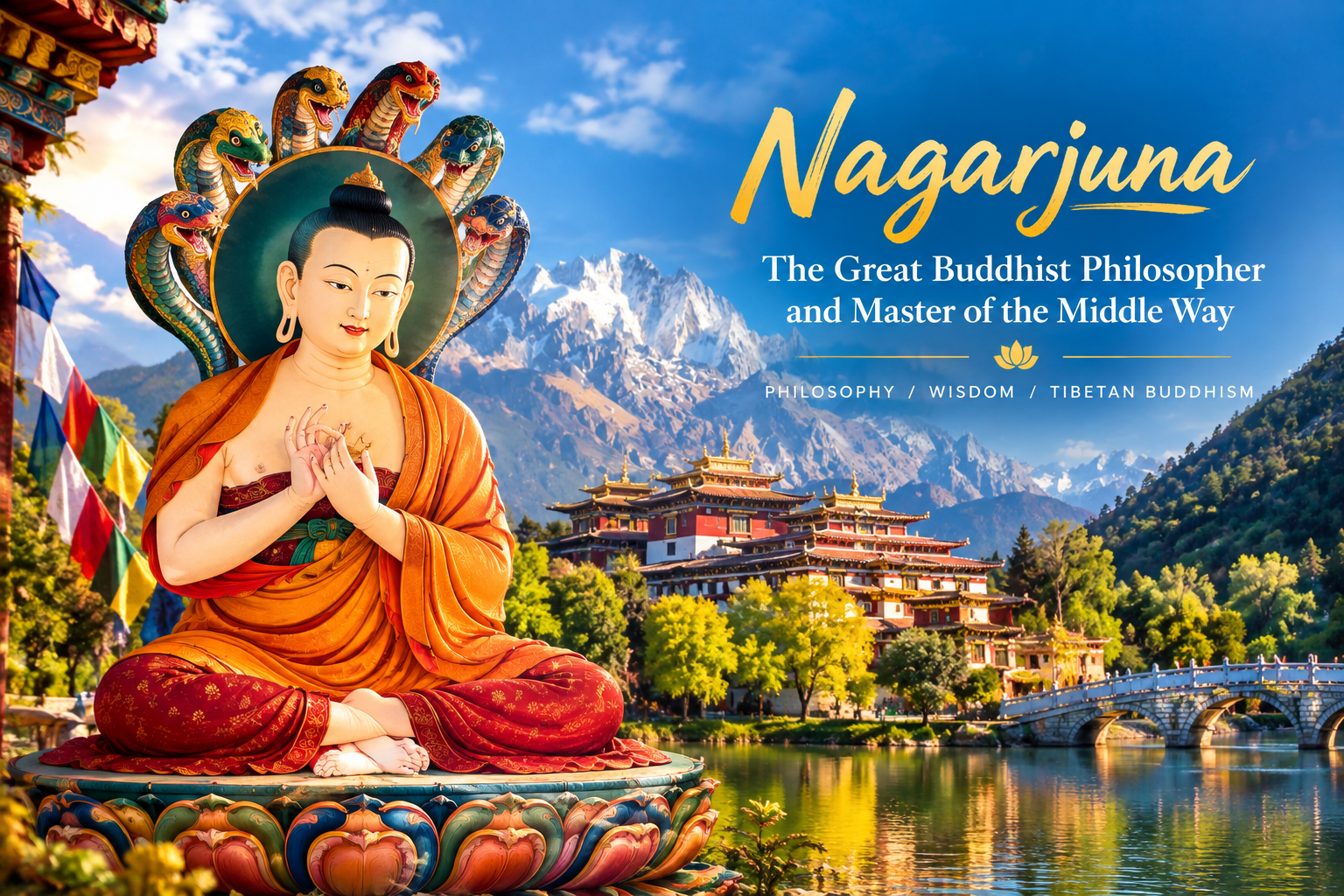
Nagarjuna has a distinctive representation in Buddhist art. Traditional Tibetan images commonly portray him seated in a teaching posture, with seven serpent hoods above his head. The serpents represent the Nagas associated with his traditional biography.
His hands are often shown forming the Dharma Wheel mudra, symbolizing the teaching of the Buddha’s Dharma. This distinctive imagery makes Nagarjuna recognizable in Tibetan Buddhist paintings, sculptures, and monastery artwork.
Why Nagarjuna Matters When Traveling in Tibet
Understanding Nagarjuna can add another dimension to a journey through Tibet. Tibet is not only known for its dramatic Himalayan scenery, sacred lakes, and high-altitude pilgrimage routes. It is also home to a sophisticated intellectual and philosophical tradition that developed through centuries of exchange with India and other Buddhist regions of Asia.
Travelers visiting Tibetan monasteries may encounter:
- Buddhist philosophical texts
- Monastic debate
- Madhyamaka teachings
- Images of Nagarjuna and Aryadeva
- Sanskrit and Tibetan Buddhist scriptures
- Meditation and prayer practices
- Traditional Buddhist artwork
For travelers interested in Buddhist culture, these experiences provide an opportunity to understand the ideas behind Tibet’s religious heritage rather than simply viewing monasteries as historic attractions.
Explore Tibet’s Buddhist Heritage With Tibet Yak Travel
A journey through Tibet can combine cultural exploration, Buddhist heritage, monasteries, pilgrimage sites, and Himalayan landscapes. A cultural itinerary may include Lhasa, Shigatse, Gyantse, Nyethang, Yerpa, and other important religious sites, while longer journeys can connect Central Tibet with the ancient Buddhist heritage of western Tibet.
At Tibet Yak Travel, we help travelers arrange private and small-group Tibet tours, including cultural journeys, monastery visits, Buddhist pilgrimage routes, and longer trips to destinations such as Mount Kailash and Ngari.
Travel requirements, permits, and access to specific sites can vary according to the itinerary and current regulations, so advance planning is important.
Nagarjuna’s Lasting Legacy
Nagarjuna’s influence extends far beyond ancient India. His exploration of emptiness and the Middle Way became one of the central philosophical foundations of Mahayana Buddhism and profoundly influenced Tibetan Buddhist thought.
His traditional biography also reflects the extraordinary world of Buddhist history, where scholars traveled across India, studied at great monasteries, exchanged teachings, and preserved scriptures across generations.
For anyone exploring Tibet’s Buddhist heritage, Nagarjuna is an essential figure to know. His teachings help explain the philosophical foundations behind many of the traditions that travelers encounter in Tibetan monasteries today.
Key Facts About Nagarjuna
| Detail | Information |
|---|---|
| Name | Nagarjuna |
| Tradition | Mahayana Buddhism |
| Main Philosophy | Madhyamaka / Middle Way |
| Major Center | Nalanda |
| Principal Disciple | Aryadeva |
| Major Teaching | Emptiness and the Middle Way |
| Famous Works | Mulamadhyamakakarika, Precious Garland, Letter to a Friend |
| Traditional Residence | Shriparvata |
| Tibetan Buddhist Importance | Foundational Madhyamaka master |
Frequently Asked Questions
Who was Nagarjuna?
Nagarjuna was a great Indian Buddhist philosopher and master traditionally regarded as one of the principal founders and systematizers of the Madhyamaka tradition.
What is Nagarjuna famous for?
Nagarjuna is best known for his teachings on emptiness (shunyata) and the Middle Way (Madhyamaka), which became foundational to Mahayana Buddhist philosophy.
Where did Nagarjuna study?
Traditional accounts associate Nagarjuna with Nalanda, one of ancient India’s most important Buddhist centers of learning.
Who was Aryadeva?
Aryadeva was one of Nagarjuna’s principal disciples and an important Madhyamaka philosopher. Together, Nagarjuna and Aryadeva are traditionally known as the Father and Son of Madhyamaka.
What is Nagarjuna’s connection with Tibetan Buddhism?
Nagarjuna’s Madhyamaka philosophy became a major part of Tibetan Buddhist philosophical study and influenced generations of Tibetan scholars and monasteries.
Why is Nagarjuna important for understanding Tibetan Buddhism?
His teachings on emptiness, wisdom, and the Middle Way provide an important philosophical foundation for understanding many traditions of Tibetan Buddhism.
Can travelers learn about Nagarjuna in Tibet?
Yes. Visitors interested in Buddhist philosophy can explore Tibetan monasteries, temples, Buddhist art, scriptures, and monastic debate traditions that reflect the influence of Indian masters such as Nagarjuna.