

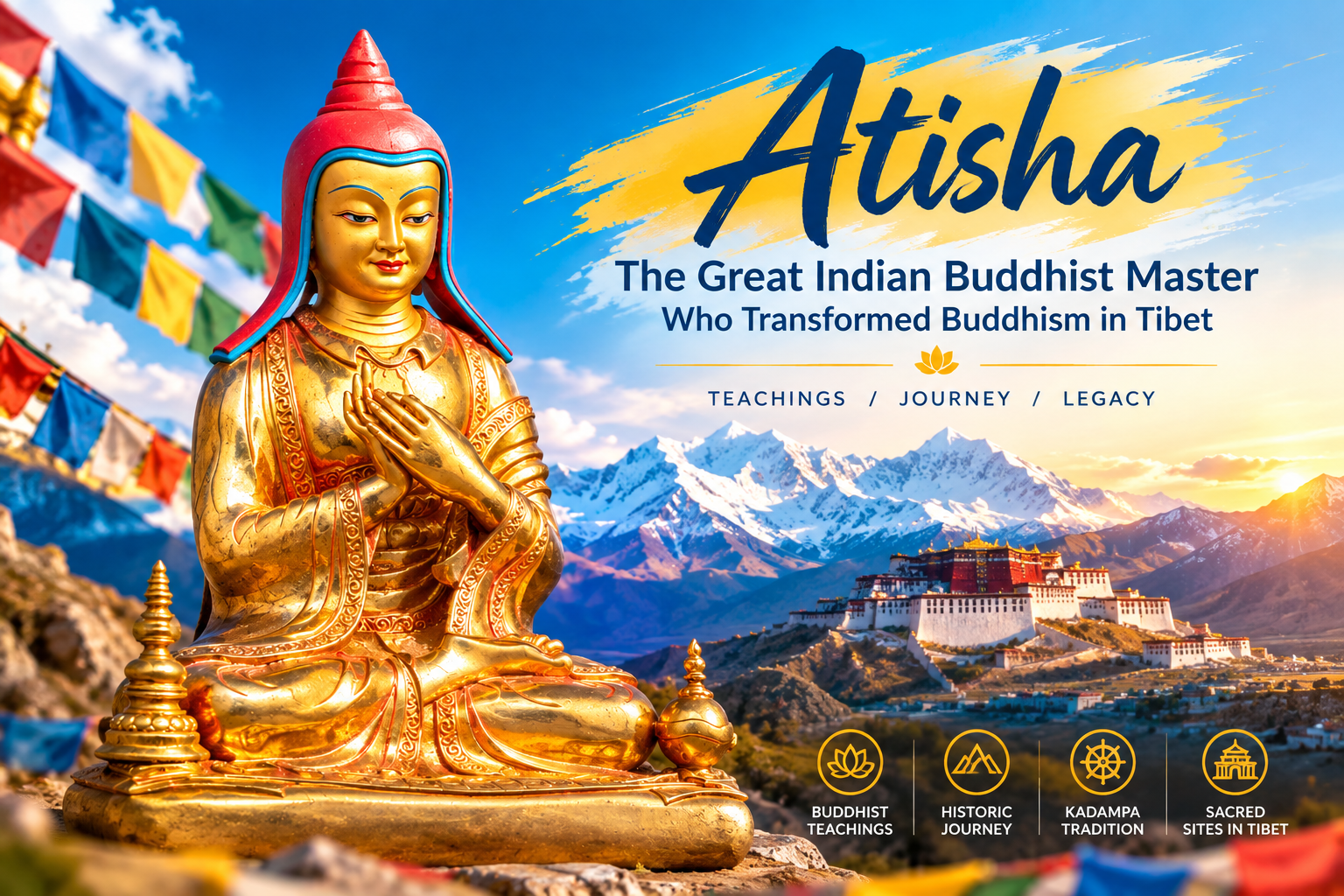
Atisha, also known as Jowo Je Palden Atisha and Dipamkara Shri Jnana, was one of the most influential Indian Buddhist scholars to travel to Tibet. His teachings played a major role in the revival of Buddhism in Tibet during the 11th century and became the foundation of the Kadampa tradition.
Born in India in 982 CE, Atisha spent much of his life studying Buddhist philosophy, meditation, monastic discipline, and other fields of knowledge under renowned teachers. His journey to Tibet connected the great Buddhist centers of India with the Tibetan plateau and left a lasting influence on Tibetan Buddhism.
For travelers exploring Tibet, Atisha’s story offers an important window into the religious history behind many of the monasteries, pilgrimage sites, and cultural landscapes found across Ngari and Central Tibet.
Who Was Atisha?
Atisha was an Indian Buddhist master, scholar, and teacher who lived from 982 to 1054 CE. His Sanskrit name was Dipamkara Shri Jnana, while Tibetan traditions commonly refer to him as Jowo Je Palden Atisha.
He was born into a royal family in the region traditionally identified as Zahor in eastern India. From an early age, Atisha showed an exceptional interest in learning and spiritual practice.
Atisha eventually renounced his royal life and became a Buddhist monk. Over the following decades, he studied under numerous teachers and became highly respected as a pandita, a title traditionally associated with a learned Buddhist scholar.
His importance to Tibet was not simply that he was a famous Indian teacher. Atisha helped organize Buddhist teachings into a clear and systematic path of practice, emphasizing ethical discipline, compassion, meditation, and wisdom.
Atisha’s Early Life and Buddhist Education
Atisha received an extensive education in Buddhist and classical Indian learning.
Traditional accounts describe his studies as covering subjects such as:
- Buddhist philosophy
- Logic and debate
- Meditation
- Sanskrit literature
- Monastic discipline
- Mahayana Buddhism
- Vajrayana Buddhism
- Ethics and spiritual practice
- Other classical fields of Indian scholarship
After renouncing his royal position, Atisha received monastic ordination and adopted the name Dipamkara Shri Jnana. He continued traveling throughout India in search of qualified teachers. His education included both scholarly study and intensive spiritual practice.
Among the teachers traditionally associated with his training was Dharmakirti of Suvarnadvipa, from whom Atisha received important teachings concerning bodhicitta, the compassionate intention to attain enlightenment for the benefit of all beings.
This emphasis on compassion became an important feature of Atisha’s later teachings in Tibet.
Atisha’s Journey to Sumatra
At around age 31, Atisha undertook a difficult journey to Sumatra, traditionally identified with Suvarnadvipa, to study under the renowned Buddhist master Serlingpa (Dharmakirti of Suvarnadvipa).
He is traditionally said to have spent 12 years studying bodhicitta, compassion, and Buddhist practice under Serlingpa. Before Atisha left, Serlingpa (Dharmakīrtiśrī) encouraged him to travel north to the “Land of Snows,” referring to Tibet.
This journey became a crucial stage in Atisha’s spiritual development before his later mission to Tibet.
Why Did Atisha Come to Tibet?
By the 11th century, Tibetan Buddhist communities were seeking to strengthen Buddhist scholarship, translation, and monastic discipline. Tibetan rulers and religious figures looked toward India, then one of the world’s most important centers of Buddhist learning, for highly accomplished teachers and texts.
One of the figures associated with inviting Atisha to Tibet was Yeshe Ö, the ruler of the western Tibetan kingdom of Guge. His efforts to strengthen Buddhism in western Tibet eventually contributed to Atisha’s journey to the Tibetan plateau. Atisha’s arrival was therefore part of a much larger period of intellectual and religious exchange between India and Tibet.
Atisha’s Journey to Ngari
Atisha eventually traveled to Ngari in western Tibet, arriving around 1042 CE according to widely used Tibetan historical accounts. The journey was significant because Ngari was an important center of Buddhist activity and was closely connected with the western Tibetan kingdom of Guge.
During his time in western Tibet, Atisha taught Buddhist philosophy and practice and worked with Tibetan scholars and translators. One of his most important contributions from this period was the composition of the Bodhipathapradipa, usually translated as Lamp for the Path to Enlightenment.
The Lamp for the Path to Enlightenment
The Lamp for the Path to Enlightenment is one of Atisha’s most influential works.
Rather than presenting Buddhist teachings as a collection of unrelated practices, the text explains a gradual path toward enlightenment. This approach became extremely influential in Tibetan Buddhism.
Atisha’s presentation emphasized different levels of spiritual motivation and practice, bringing together important elements such as:
- Ethical conduct
- Compassion
- Bodhicitta
- Meditation
- Wisdom
- The gradual development of the path toward enlightenment
The work later became an important foundation for the Tibetan Lamrim, or “Stages of the Path,” tradition.
For visitors interested in Tibetan Buddhism, understanding Atisha’s Lamp for the Path helps explain why the concept of a structured spiritual path is so important in Tibetan Buddhist teachings.
Atisha and Dromtönpa
One of the most important figures in Atisha’s life in Tibet was Dromtönpa. Dromtönpa became Atisha’s principal Tibetan disciple and played a central role in preserving and transmitting his teachings.
After Atisha traveled from western Tibet toward Central Tibet, Dromtönpa accompanied and supported his work. Atisha taught at several important religious centers, including Yerpa and Nyethang, and attracted students who helped spread his teachings throughout Tibet.
Among the Tibetan scholars associated with Atisha’s teaching lineage were Dromtönpa, Khutön, Ngok Lekpai Sherab, and Gotsang Lotsawa.
Through these teachers and their successors, Atisha’s approach to Buddhist practice became deeply established in Tibet.
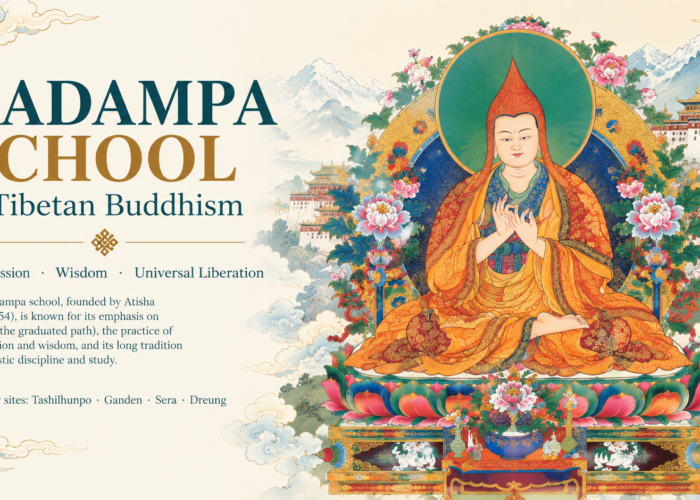
Atisha and the Kadampa Tradition
Atisha’s teachings became the foundation of what later developed into the Kadampa tradition. The Kadampa approach placed particular emphasis on integrating Buddhist teachings into everyday spiritual practice.
Important themes included:
- Compassion toward other beings
- Bodhicitta
- Ethical discipline
- Meditation
- Wisdom
- Respect for Buddhist teachings
- A gradual and systematic path to enlightenment
The tradition established by Atisha and his disciples later influenced the development of other major Tibetan Buddhist traditions.
Centuries later, the great Tibetan scholar Tsongkhapa drew extensively on the Lamrim tradition. His teachings helped establish the intellectual and spiritual foundations of the Gelug tradition. Atisha’s influence therefore extends far beyond the 11th century.
Atisha’s Final Years in Central Tibet
After spending years teaching in Tibet, Atisha continued his religious work in Central Tibet. He eventually settled at Nyethang, southwest of present-day Lhasa.
Nyethang became closely associated with Atisha and his legacy. He continued teaching his disciples there until his death in 1054 CE. Atisha was approximately 72 years old when he passed away.
Following his death, Dromtönpa and other disciples continued transmitting his teachings. The religious institutions and teaching lineages associated with Atisha subsequently became an important part of Tibet’s Buddhist heritage.
Where Did Atisha Die?
Atisha died in 1054 CE at Nyethang, in the region around present-day Lhasa. Today, Nyethang remains an important historical location for people interested in the history of Tibetan Buddhism.
A visit to the area can be combined with other cultural and religious attractions around Lhasa, making it particularly relevant for travelers interested in monasteries, Buddhist philosophy, Tibetan history, and pilgrimage.
Atisha’s Connection With Ngari and Guge
Atisha’s story is especially important for travelers visiting Ngari. Western Tibet was one of the most important areas in the transmission of Indian Buddhist knowledge into Tibet during this period.
The Guge Kingdom, centered in western Tibet, played a major role in the revival of Buddhism and maintained strong religious and cultural connections with the Buddhist centers of India. This history is one reason why western Tibet is so important for travelers interested in Buddhist heritage.
The wider Ngari region is also home to some of Tibet’s most remarkable destinations, including Mount Kailash, Lake Manasarovar, Tholing Monastery, Tsaparang, and the ancient Guge ruins.
Traveling through this landscape provides an opportunity to see the geographical setting in which Buddhist ideas, scholars, translators, and pilgrims moved between India and Tibet.
Atisha and the Guge Kingdom
The story of Atisha is closely connected with the Buddhist revival associated with the Guge Kingdom. Western Tibetan rulers supported the translation of Buddhist scriptures and invited Indian scholars to Tibet.
This period helped establish new intellectual and religious connections between Tibetan and Indian Buddhist communities. For modern travelers, the remains of the Guge Kingdom provide a remarkable way to explore this history.
The ruins of Tsaparang and Tholing Monastery are among the most important historical sites in western Tibet and can be included in longer Ngari and Mount Kailash travel itineraries, subject to current travel regulations and permits.
Why Atisha Matters to Travelers Visiting Tibet
Atisha’s story is more than an account of an ancient Buddhist scholar. It helps explain the cultural landscape that travelers encounter across Tibet.
When visiting monasteries, temples, pilgrimage routes, and historic Buddhist sites, travelers are often seeing the result of centuries of interaction between Indian Buddhism and Tibetan culture. Atisha represents one of the most important chapters in that exchange.
His journey also demonstrates how Tibet historically connected with wider Asian Buddhist networks through:
- Religious teachers
- Tibetan translators
- Pilgrims
- Monastic communities
- Buddhist scriptures
- Philosophical traditions
- Trade and cultural routes
For travelers interested in Tibetan Buddhism, visiting historical sites connected with this period can make a Tibet journey much more meaningful.
Places Associated With Atisha That Travelers Can Explore
Several places are particularly relevant to Atisha’s history.
Ngari
Ngari in western Tibet was where Atisha began his major period of teaching in Tibet. The region is now famous for its extraordinary landscapes and pilgrimage destinations, including Mount Kailash and Lake Manasarovar.
Tholing Monastery
Tholing Monastery in western Tibet was one of the most important Buddhist centers associated with the Guge period. Its history reflects the close religious connections between western Tibet and India.
Guge Kingdom and Tsaparang
The ruins of Tsaparang preserve the remains of the ancient Guge Kingdom. The site offers travelers a rare opportunity to explore the historical landscape of western Tibet and understand the cultural environment in which Buddhist revival movements developed.
Nyethang
Nyethang near Lhasa is closely associated with Atisha’s final years and death. It is particularly significant for travelers interested in the history of the Kadampa tradition and the development of Tibetan Buddhism.
Yerpa
Yerpa, northeast of Lhasa, is another important religious site associated with Atisha’s teaching activities. Its caves, temples, and mountain setting make it a meaningful destination for travelers exploring the spiritual heritage of Central Tibet.
Traveling to Atisha’s Historic Sites With Tibet Yak Travel
Atisha’s story can be incorporated into a wider Tibet cultural and Buddhist pilgrimage journey. For example, travelers interested in his legacy can combine Lhasa, Central Tibet, and Ngari with destinations connected to the development of Tibetan Buddhism.
A longer western Tibet journey can include:
Lhasa → Shigatse → Saga → Mount Kailash → Lake Manasarovar → Tholing → Guge Kingdom
Depending on the itinerary, travelers can also explore monasteries, ancient ruins, high-altitude lakes, Himalayan landscapes, and traditional Tibetan communities along the way.
Because western Tibet involves high altitudes, long driving distances, and additional travel permissions, itinerary planning should be done carefully. Tibet Travel Permits and other required permissions depend on nationality, route, and destination and should be checked before departure.
At Tibet Yak Travel, local Tibetan travel specialists can help travelers plan private and small-group journeys focused on Tibetan Buddhist culture, historic monasteries, Mount Kailash pilgrimage, and the ancient heritage of western Tibet.
Atisha’s Legacy
More than nine centuries after his death, Atisha remains one of the most important figures in Tibetan Buddhist history. His influence can be seen through the Kadampa tradition, Lamrim teachings, Buddhist scholarship, and the continuing connections between Indian and Tibetan Buddhist traditions.
His Lamp for the Path to Enlightenment provided a concise framework for understanding the Buddhist path, while his teachings through Dromtönpa helped establish a lasting lineage in Tibet. For modern travelers, Atisha’s legacy provides another way to understand Tibet—not simply as a destination of spectacular mountains and monasteries, but as a place shaped by centuries of religious learning, cultural exchange, pilgrimage, translation, and spiritual practice.
Exploring places associated with Atisha in Ngari, Guge, Nyethang, and Central Tibet can therefore turn a sightseeing trip into a deeper journey through Tibetan Buddhist history.
Key Facts About Atisha
| Detail | Information |
|---|---|
| Name | Atisha |
| Sanskrit Name | Dipamkara Shri Jnana |
| Tibetan Name | Jowo Je Palden Atisha |
| Born | 982 CE |
| Birth Region | Zahor, India |
| Arrived in Tibet | Around 1042 CE |
| Major Tibetan Region | Ngari and Central Tibet |
| Major Work | Lamp for the Path to Enlightenment |
| Principal Tibetan Disciple | Dromtönpa |
| Tradition | Kadampa |
| Died | 1054 CE |
| Place of Death | Nethang, Central Tibet |
Frequently Asked Questions About Atisha
Who was Atisha?
Atisha was an influential Indian Buddhist master and scholar who traveled to Tibet in the 11th century. His teachings played an important role in the revival and development of Buddhism in Tibet.
When did Atisha come to Tibet?
Atisha arrived in western Tibet around 1042 CE, according to widely used Tibetan historical accounts. He later traveled to Central Tibet, where he continued teaching.
Why did Atisha come to Tibet?
Atisha was invited to Tibet during a period of Buddhist revival. Tibetan religious leaders and rulers sought Indian Buddhist scholars who could help strengthen Buddhist teachings, scholarship, translation, and monastic discipline.
What is Atisha’s most famous book?
Atisha is best known for the Bodhipathapradipa, commonly translated as Lamp for the Path to Enlightenment. The text became an important foundation for later Lamrim teachings.
Who was Dromtönpa?
Dromtönpa was Atisha’s principal Tibetan disciple. He helped preserve and transmit Atisha’s teachings after Atisha’s death and became a central figure in the development of the Kadampa tradition.
What is Atisha’s connection with the Kadampa tradition?
Atisha’s teachings formed the foundation of the Kadampa tradition in Tibet. Dromtönpa and his successors continued this lineage and helped spread its teachings throughout Tibet.
Where did Atisha die?
Atisha died at Nyethang in Central Tibet in 1054 CE. Nyethang remains an important historical location associated with his life and teachings.
Can travelers visit places associated with Atisha?
Yes. Travelers interested in Atisha and Tibetan Buddhist history can explore places associated with his life and legacy, including Ngari, Nyethang, Yerpa, and historic Buddhist sites connected with the Guge Kingdom. Access and itinerary requirements depend on current travel regulations.
Why is Atisha important to Tibetan Buddhism?
Atisha helped strengthen Buddhist scholarship, ethical discipline, meditation, compassion, and systematic spiritual practice in Tibet. His teachings influenced the Kadampa tradition and later Lamrim traditions that remain important in Tibetan Buddhism today.
Plan a Buddhist and Cultural Journey Through Tibet
Atisha’s journey from India to Tibet was part of a much larger history of cultural and religious exchange across the Himalayas. Today, travelers can follow part of this historical story through Lhasa, Nyethang, Yerpa, Shigatse, Ngari, Mount Kailash, Lake Manasarovar, Tholing, and the ancient Guge Kingdom.
Whether your interest is Tibetan Buddhism, ancient history, pilgrimage, monasteries, or the landscapes of western Tibet, a carefully planned journey can bring these historical connections to life. Explore Tibet with Tibet Yak Travel and discover the Buddhist heritage behind the landscapes.

[…] Atisha and the Kailash Region […]
[…] Atisha: The Indian Master Who Revitalized Tibetan Buddhism […]