
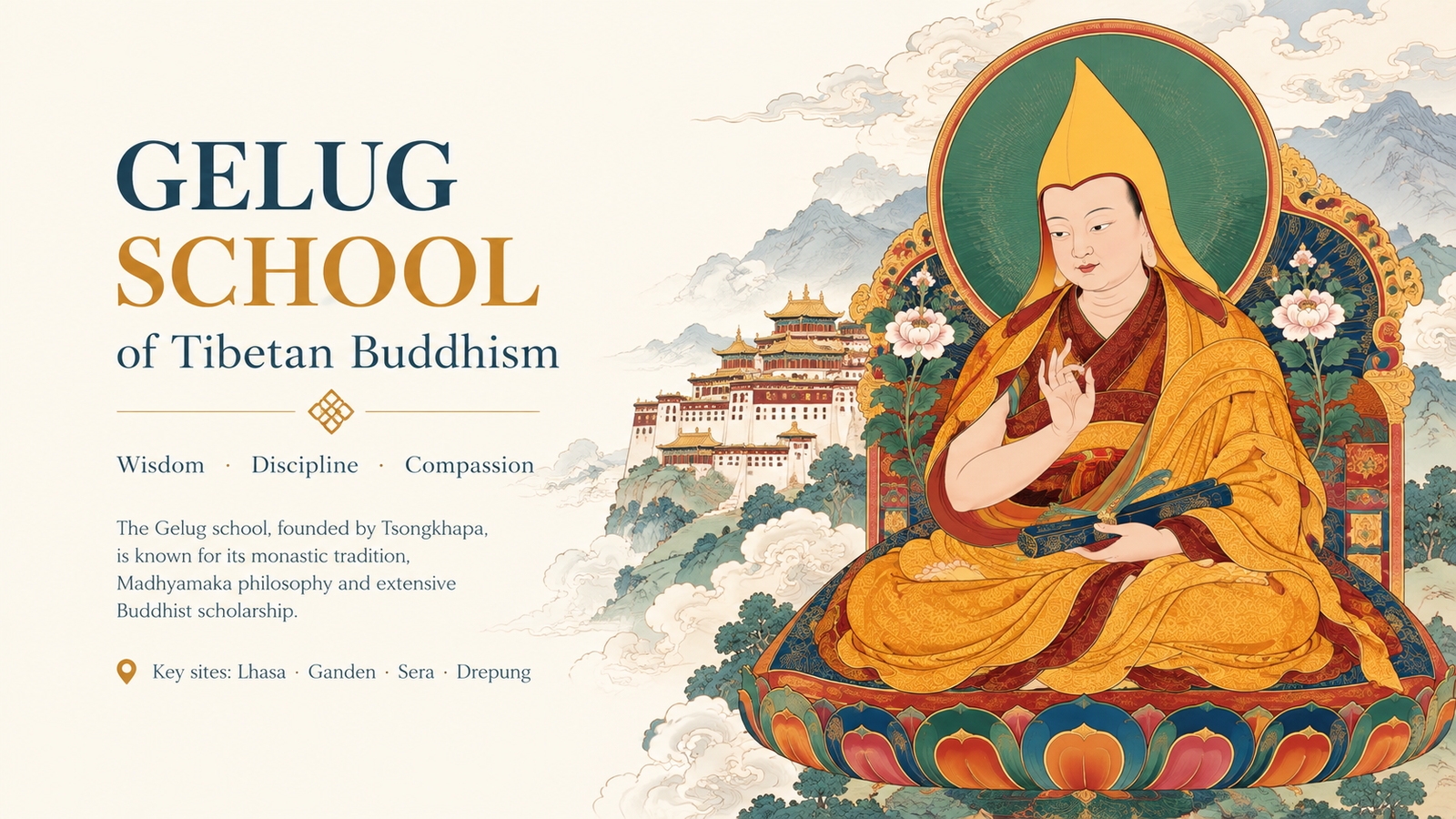
The Gelug School of Tibetan Buddhism, also known as the Yellow Hat School, is one of the major traditions of Tibetan Buddhism. The Tibetan word “Gelug” (དགེ་ལུགས་) means a tradition of “virtuous practice” reflecting the school’s strong emphasis on monastic discipline, systematic Buddhist education, philosophical debate, and a structured path from sutra to tantra.
Founded in the early 15th century by Je Tsongkhapa (1357–1419), the Gelug tradition became one of the most influential schools of Tibetan Buddhism. Its monasteries, including Ganden, Drepung, Sera, and Tashilhunpo, are among the most important religious and cultural attractions in Tibet.
The Founder of the Gelug School: Tsongkhapa
The central figure in the formation of the Gelug tradition was Je Tsongkhapa Lobsang Drakpa, who was born in the Tsongkha region of Amdo in northeastern Tibet in 1357. From an early age, Tsongkhapa received Buddhist teachings and monastic vows. As he grew older, he traveled extensively throughout Tibet and studied under numerous masters representing different Tibetan Buddhist traditions.
Rather than limiting his education to a single lineage, Tsongkhapa carefully studied Sutra, Tantra, Buddhist philosophy, logic, meditation, and monastic discipline. His teachers came from several established Tibetan traditions, while the Kadampa teachings had a particularly strong influence on his approach.
Tsongkhapa became one of Tibet’s most influential Buddhist scholars. His writings and teachings emphasized the importance of combining deep philosophical understanding with ethical discipline, meditation, compassion, and direct realization. Among his many disciples were several outstanding scholars and teachers who continued his teachings and helped establish the Gelug tradition throughout Tibet.
His two most important works are the Great Treatise on the Stages of the Path (Lamrim Chenmo) and the Great Treatise on the Stages of the Tantric Path. These works became important foundations of Gelug philosophy and education. In 1409, Tsongkhapa organized the famous Great Prayer Festival (Monlam Chenmo) in Lhasa.
Origins of the Gelug school of Tibetan Buddhism
The roots of the Gelug School can be traced to the teachings of Atisha, an eminent Indian Buddhist scholar associated with the great monasteries of Nalanda and Vikramashila. Atisha traveled to Tibet in the 11th century and became an important figure in the revival and organization of Buddhist teachings in Tibet.
His teachings emphasized the systematic development of the Buddhist path, bringing together ethics, meditation, wisdom, compassion, and tantric practice. This tradition was transmitted through Tibetan masters including Dromtönpa Gyalwé Jungné (1005–1064) and other Kadampa teachers.
The Kadampa tradition became particularly influential for its systematic presentation of the Buddhist path. Centuries later, Tsongkhapa studied these teachings and incorporated many of their principles into his own understanding of Buddhist philosophy and practice.
History and Development of the Gelug Tradition
Foundation in the 15th Century
A major milestone came in 1409, when Tsongkhapa founded Ganden Monastery near Lhasa. The monastery became the principal seat of his teachings and an important center of Gelug scholarship. The tradition was initially known as Gandenpa, after Ganden Monastery. Over time, it became widely known as the Gelug tradition. His leading disciples later established other major monasteries, particularly Drepung Monastery and Sera Monastery near Lhasa. Together, Ganden, Drepung, and Sera became known as the Three Great Monasteries of Lhasa. The Gelug tradition inherited important philosophical and disciplinary teachings from the earlier Kadampa tradition, and it was sometimes described historically as the New Kadampa tradition.
Expansion and Institutional Development
The Gelug school expanded rapidly through its monastery-based education system. Additionally, monasteries developed structured programs of Buddhist philosophy, logic, debate, meditation, and monastic discipline. The tradition also became associated with several important reincarnation lineages. Among the most prominent are the Dalai Lama and Panchen Lama traditions. Over time, the Gelug school became an important religious and political force in Tibet, particularly from the 17th century onward.
Important Gelug Masters
Several important teachers and religious figures shaped the development of the Gelug tradition.
- Tsongkhapa is regarded as the founder and principal spiritual master of the school.
- Gyaltsab Je was one of Tsongkhapa’s most important disciples and became the first Ganden Tripa, or throne holder of Ganden Monastery, the traditional head of the Gelug school.
- Khedrub Je was another major disciple of Tsongkhapa and an influential scholar in the development of Gelug philosophical thought. He was later traditionally associated with the Panchen Lama lineage.
- Gendün Drup, a disciple of Tsongkhapa and founder of Tashilhunpo Monastery, was later recognized as the First Dalai Lama.
Other influential Gelug figures include Shakya Yeshe, who traveled to the Ming imperial court and helped promote connections between the Gelug tradition and the Chinese mainland.
The Six Major Gelug Monasteries
For travelers interested in Tibetan Buddhism, Tibetan culture, monasteries, and religious history, several Gelug monasteries are especially important.
Ganden Monastery
Ganden Monastery is regarded as the traditional birthplace and principal monastery of the Gelug school. Tsongkhapa founded the monastery himself, and his traditional reliquary remains one of its most important religious sites. Ganden is also famous for its dramatic mountain setting and panoramic views of the surrounding valleys. Ganden later developed two major monastic colleges, Jangtse and Shartse, which became important centers of Gelug education.
Drepung Monastery
Drepung Monastery was historically one of the largest monasteries in Tibet. It became an important center of Gelug scholarship and was closely connected with the Dalai Lama institution. In 1416, Jamyang Chöjé Tashi Palden (1379–1449), one of Tsongkhapa’s principal disciples, founded Drepung Monastery near Lhasa. Drepung eventually became one of the largest monasteries in Tibet and developed several colleges, including Loseling and Gomang. It became an important center for Buddhist philosophy, monastic education, and debate. Today, Drepung is particularly famous for the annual Shoton Festival, during which a huge Buddhist thangka is traditionally displayed on the hillside.
Sera Monastery
Sera Monastery is one of the most popular cultural attractions in Lhasa. In 1419, another important disciple of Tsongkhapa, Jamchen Chöjé Shakya Yeshe (1354–1435), founded Sera Monastery near Lhasa. Sera developed into one of the most important institutions for Gelug Buddhist scholarship. Its principal colleges included Sera Jé and Sera Mé.
The monastery became particularly famous for its tradition of monastic debate, in which monks discuss Buddhist philosophy and test their understanding through formal questions and logical reasoning. For visitors, the afternoon debate sessions offer one of the most accessible ways to experience the intellectual tradition of Tibetan Buddhist monasteries.
Tashilhunpo Monastery
In 1447, Gyalwa Gendün Drup (1391–1474), later recognized as the First Dalai Lama, founded Tashilhunpo Monastery in Shigatse. The monastery became one of the most important Gelug institutions in Tibet and later served as the traditional seat of the Panchen Lamas. Today, Tashilhunpo is one of the most significant Buddhist monasteries for travelers visiting the Shigatse region. It is one of the most important monasteries in western Tibet and an essential stop on many Lhasa–Shigatse–Everest Base Camp tours. The monastery is renowned for its enormous Buddhist statues, richly decorated chapels, murals, religious sculptures, and historical importance.
Kumbum Jampa Ling Monastery, commonly known as Ta’er Monastery, is located near Xining in Qinghai and is closely associated with Tsongkhapa’s birthplace. It is particularly famous for its traditional Tibetan Buddhist artistic heritage, including butter sculpture, murals, and appliqué embroidery, often described as the monastery’s three artistic treasures.
Labrang Monastery, located in Xiahe, Gansu, is one of the most important Gelug institutions in the Amdo Tibetan region. Historically, it developed into a major center of Buddhist philosophy and monastic education. Its long pilgrimage circuit and extensive monastery complex make it an important destination for travelers exploring Tibetan culture beyond the Tibet Autonomous Region.
The Gelug Tantric Colleges
Although Gelug monasteries are famous for philosophical study and monastic debate, Tantra is also an essential part of the Gelug tradition. Specialized tantric institutions were established to preserve and transmit advanced tantric teachings and practices.
- Gyumé Monastery, also known as Lower Tantric College, was founded in 1440 by Je Sherab Senge. It became an important center for Gelug tantric education and ritual practice.
- Gyutö Monastery, known as Upper Tantric College, was established in 1474 by Gyuchen Kunga Dhondup. Together, Gyumé and Gyutö have played an important role in preserving the tantric traditions of the Gelug school.
Main Teachings of the Gelug School
The philosophy and practice of the Gelug tradition are based on a systematic understanding of the Buddhist path. Among its most important teachings is Lamrim, or the Stages of the Path to Enlightenment. The Gelug presentation of Lamrim draws heavily on Atisha’s earlier teachings and was developed extensively by Tsongkhapa. Lamrim organizes Buddhist practice into a gradual path, covering subjects such as:
- Renunciation
- Compassion and Bodhicitta
- Karma and ethical conduct
- Meditation
- Wisdom
- Emptiness
- The development of the mind toward enlightenment
This structured approach is one of the defining characteristics of Gelug Buddhist philosophy.
The Five Major Textual Subjects
Traditional Gelug monastic education places strong emphasis on the study of major Indian Buddhist philosophical works. The curriculum is commonly organized around five major textual subjects:
- Prajnaparamita – teachings on the perfection of wisdom
- Madhyamaka – the Middle Way philosophy and the understanding of emptiness
- Pramana – Buddhist logic and epistemology
- Abhidharma – analysis of mind, phenomena, and Buddhist psychology
- Vinaya – monastic discipline and ethical conduct
Important works studied within this curriculum include texts such as Abhisamayalamkara, Madhyamakavatara, Pramanavarttika, Abhidharmakosha, and major Vinaya texts.
Students traditionally spend many years studying these subjects through scriptural study, memorization, philosophical debate, and commentary.
Philosophy, Debate and Meditation
One of the most recognizable features of the Gelug School of Tibetan Buddhism is its strong emphasis on philosophical study. Monks at major Gelug monasteries traditionally engage in formal debates covering subjects such as logic, consciousness, Buddhist philosophy, and the nature of reality. Debate is not simply an intellectual exercise; it is regarded as a method for developing clear reasoning and strengthening one’s understanding of Buddhist teachings.
Study is combined with meditation and ethical training. The ultimate purpose is not merely to accumulate intellectual knowledge but to transform one’s understanding into direct spiritual realization.
Emptiness and Compassion
Two central themes in Gelug Buddhist practice are wisdom and compassion.The realization of emptiness (shunyata) is regarded as essential for overcoming ignorance and attaining liberation. At the same time, practitioners cultivate Bodhicitta, the altruistic intention to attain enlightenment for the benefit of all sentient beings. The Gelug path therefore brings together philosophical investigation, meditation, compassion, and ethical conduct.
Sutra and Tantra in Gelug Buddhism
Gelug Buddhism incorporates both Sutra and Tantra as complementary aspects of the Buddhist path. Sutra teachings provide the foundation through ethical discipline, compassion, wisdom, and the gradual development of the mind. Tantric practices provide advanced methods for transforming body, speech, and mind on the path toward enlightenment. The Gelug tradition therefore does not treat philosophical study and tantric practice as separate religious systems. Instead, they are understood as different levels of a comprehensive Buddhist path.
Gelug School and the Dalai Lama Tradition
The Gelug tradition has also played a major role in the history of Tibet through its connection with the Dalai Lama institution. The recognition of Gyalwa Gendün Drup as the First Dalai Lama came after his lifetime. The Dalai Lama lineage subsequently became closely associated with the Gelug tradition and played an important role in Tibet’s religious and political history. The Panchen Lama lineage, meanwhile, has been closely associated with Tashilhunpo Monastery and the Gelug tradition.
Main Characteristics of the Gelug School
Strong Monastic Discipline
The Gelug tradition places particular importance on Vinaya, the Buddhist monastic code. Traditionally, fully ordained monks are expected to maintain celibacy and follow strict monastic regulations. This strong emphasis on discipline is one reason the school became popularly known as the Yellow Hat School.
Study Before Tantric Practice
A defining feature of Gelug education is its systematic progression from sutra studies to tantric practice. Students traditionally study Buddhist philosophy, logic, epistemology, Madhyamaka philosophy, Prajnaparamita, monastic discipline, and Abhidharma before progressing to advanced tantric teachings. This educational structure is designed to establish a strong philosophical foundation rather than treating tantric practice as an isolated or shortcut path.
Monastic Debate and Buddhist Education
Monastic debate is one of the most recognizable features of Gelug culture. Students use formal debate to test their understanding of Buddhist philosophy and logic. This educational tradition helped transform major Gelug monasteries into centers of advanced Buddhist scholarship. The Geshe degree became one of the most important academic achievements within the Gelug educational system, traditionally requiring many years of study and debate.
Reincarnation Lineages
The Gelug tradition became associated with major reincarnate-lama lineages, especially the Dalai Lama and Panchen Lama traditions. The recognition of reincarnate lamas developed into an important institution within Tibetan Buddhist society and became intertwined with the wider political history of Tibet.
The Yellow Hat
The yellow or saffron-colored ceremonial hat became a distinctive visual symbol of the Gelug tradition. Because of this, the school became widely known in English as the Yellow Hat School.
Gelug school of Buddhism and Tibet Travel
For travelers interested in Tibet travel, Tibetan Buddhism, monasteries, Buddhist culture, and Tibetan history, visiting Gelug monasteries provides an excellent introduction to the religious traditions that have shaped the Tibetan plateau.
Experience Monastic Debate at Sera Monastery
The afternoon debate at Sera Monastery is one of the most popular cultural experiences in Lhasa. Visitors can observe monks practicing Buddhist logic and philosophical argument in a lively traditional setting.
Visit Drepung During the Shoton Festival
Drepung Monastery is one of the key locations associated with the Shoton Festival, particularly the spectacular thangka display that traditionally opens the festival.
Explore Ganden Monastery
Ganden offers a combination of religious history, mountain scenery, pilgrimage routes, and connections to Tsongkhapa. It is particularly worthwhile for travelers interested in the origins of the Gelug school.
Visit Tashilhunpo Monastery in Shigatse
Tashilhunpo is one of the most important stops for travelers heading from Lhasa to Shigatse and Everest Base Camp. Its connection with the Panchen Lama lineage makes it especially significant in Tibetan Buddhist history.
Explore Tibetan Buddhist Art
Gelug monasteries preserve extensive collections of murals, thangka paintings, Buddhist sculptures, butter sculptures, scriptures, reliquaries, and traditional architectural details. These artistic traditions provide another way to understand the religious history of Tibet.
Best Gelug Monasteries to Visit in Tibet
For a first-time Tibet trip, the following route provides a strong introduction to Gelug Buddhist heritage:
- Lhasa: Drepung Monastery, Sera Monastery, and Ganden Monastery
- Shigatse: Tashilhunpo Monastery
- Kumbum Monastery in Qinghai and
- Labrang Monastery in Gansu
- Although the Potala Palace is not itself a Gelug monastery
A typical Lhasa monastery day can include Drepung and Sera, while Ganden is better treated as a separate excursion because of its location outside central Lhasa. Tashilhunpo can be combined naturally with a Shigatse or Everest Base Camp journey.
Gelug Buddhism Today
The Gelug tradition continues to be practiced in Tibet, across the Himalayan region, and in Buddhist communities around the world. Its monasteries and educational institutions preserve centuries of Buddhist scholarship, ritual traditions, philosophical study, and meditation practices.
For visitors to Tibet, the historic Gelug monasteries around Lhasa and Shigatse offer an opportunity to learn about Tibetan Buddhist philosophy and experience living monastic traditions.
Conclusion
The Gelug School of Tibetan Buddhism emerged from the intellectual and spiritual heritage of the Kadampa tradition and was formally established through the work of Je Tsongkhapa in the early 15th century.
Its distinctive approach combines Lamrim, Buddhist philosophy, monastic discipline, logical debate, meditation, compassion, and Tantra. The great monasteries of Ganden, Drepung, Sera, Tashilhunpo, Gyumé, and Gyutö became important centers for preserving and transmitting these teachings.
Today, Gelug Buddhism remains one of the most influential Tibetan Buddhist traditions, with a rich intellectual heritage and a living tradition of study, meditation, and spiritual practice.



[…] Lamrim tradition. His teachings helped establish the intellectual and spiritual foundations of the Gelug tradition. Atisha’s influence therefore extends far beyond the 11th […]