Discover Tibet’s Sacred Chimphu Meditation Caves
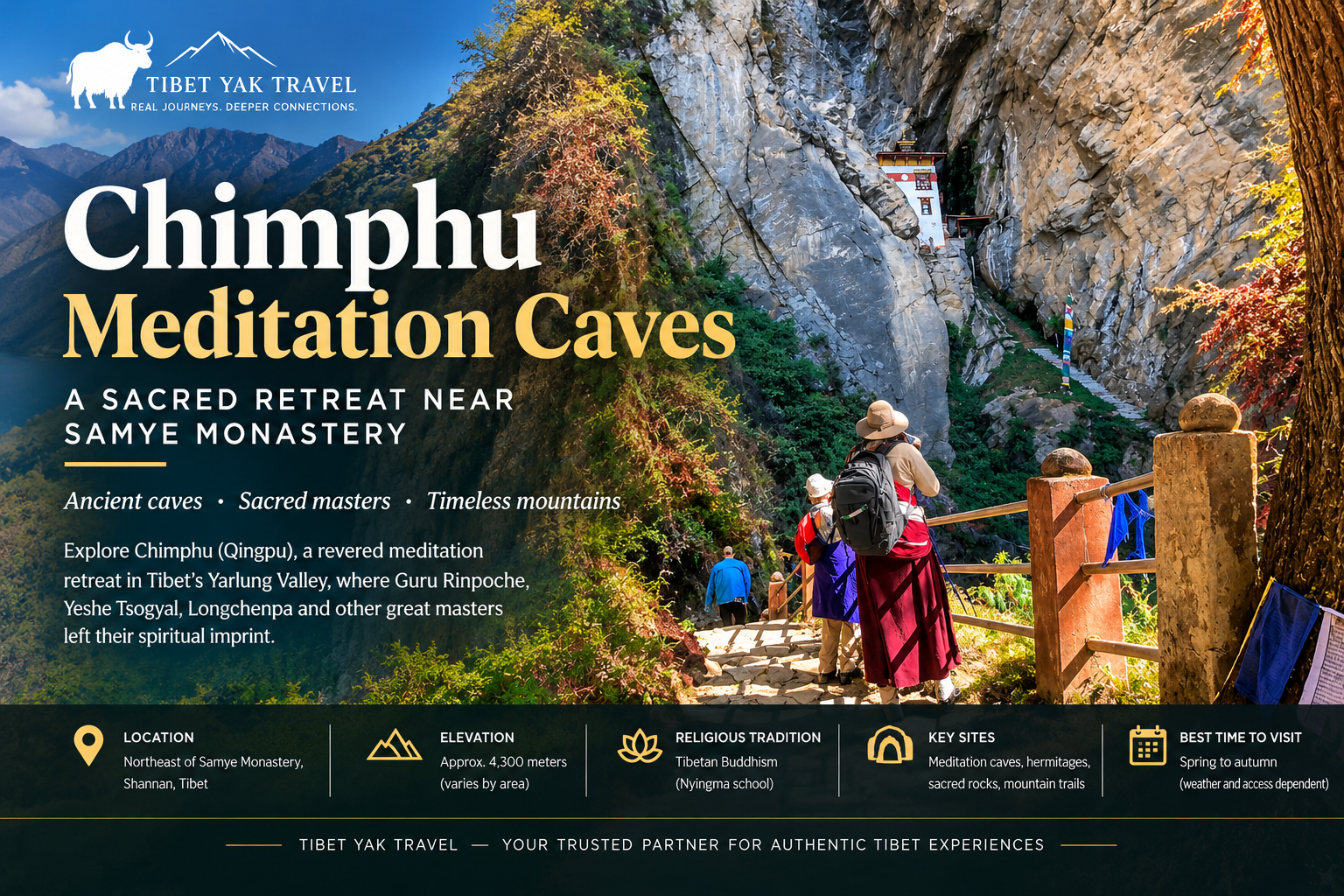
Hidden among the mountains northeast of Samye Monastery in southern Tibet, the Chimphu Meditation Caves are among the region’s most significant traditional Buddhist retreat sites. Also known as Qingpu, Chimpu, or Samye Chimphu, this secluded landscape is renowned for its meditation caves, small hermitages, sacred rock formations, and associations with generations of Tibetan Buddhist masters.
According to Tibetan Buddhist tradition, Guru Rinpoche (Padmasambhava), Yeshe Tsogyal, Vairotsana, Künkhyen Longchen Rabjam (Longchenpa), Jigme Lingpa, and other influential practitioners are connected with the wider Chimphu retreat landscape. Their stories have made the valley an important destination for pilgrims and students of Tibetan Buddhism, particularly those interested in the Nyingma school and the Dzogchen tradition.
Unlike the monumental architecture of Tibet’s major monasteries, Chimphu reveals another side of Tibetan Buddhist culture: the secluded caves and mountain retreats where practitioners withdrew from ordinary life to meditate, study, and transmit spiritual teachings.
For travelers exploring Tibet’s religious heritage, visiting Chimphu alongside Samye Monastery offers a deeper understanding of the relationship between Buddhist institutions, contemplative practice, and sacred geography.
Where Are the Chimphu Meditation Caves?
Chimphu lies in a mountain valley northeast of Samye Monastery in Shannan, southern Tibet. The retreat area forms part of the wider Yarlung region, a landscape closely associated with Tibetan history and the early development of Buddhism on the Tibetan Plateau. The surrounding terrain consists of rocky slopes, mountain paths, secluded caves, and small retreat structures. Some religious sites lie relatively low on the mountainside, while others require a longer uphill walk.
Chimphu is best understood as a dispersed retreat landscape rather than a single monastery or tourist attraction. Its sacred sites are spread across the mountains, and their significance often depends on the religious histories associated with individual caves and rock formations.
Many visitors combine Chimphu with a visit to Samye Monastery. The two destinations complement one another: Samye represents the institutional and architectural development of early Tibetan Buddhism, while Chimphu highlights the tradition of solitary meditation and spiritual retreat.
Why Is Chimphu Sacred in Tibetan Buddhism?
Chimphu holds a special place in Tibetan Buddhist religious history because of its association with meditation, tantric practice, and the transmission of Buddhist teachings. Traditional accounts connect the retreat with Guru Rinpoche and his disciples during the period when Buddhism was becoming established in Tibet. Later generations of practitioners also used the surrounding caves and hermitages for extended meditation.
The area is particularly important to the Nyingma school, one of the major traditions of Tibetan Buddhism. Nyingma teachings place special emphasis on Padmasambhava, early tantric transmissions, revealed spiritual treasures known as terma, and contemplative practices associated with Dzogchen, or the Great Perfection. Chimphu’s importance therefore extends beyond the age of its individual structures. Its caves represent a continuing religious ideal: seeking a quiet, secluded environment in which to develop concentration, deepen understanding, and pursue spiritual realization.
For pilgrims, the valley is a place associated with the blessings and activities of revered masters. For culturally curious visitors, it provides an opportunity to learn how religious traditions shape the meaning of a landscape.
Guru Rinpoche and the Spiritual Legacy of Chimphu Meditation Caves
Guru Rinpoche, also known as Padmasambhava, is one of the most influential figures in Tibetan Buddhism. Tibetan Buddhist traditions remember him as a great tantric master who played a central role in the establishment and transmission of Buddhism in Tibet during the eighth century. Chimphu is traditionally associated with his meditation activities and spiritual teachings. Religious narratives describe Padmasambhava practicing in secluded locations around the Samye valley and transmitting teachings to disciples who helped establish Buddhism in Tibet.
One cave commonly associated with the Padmasambhava tradition is known in some accounts as Zhamag Khar, although transliterations and the identification of particular caves can vary between sources. Other caves in the wider retreat area are linked with his disciples and later Buddhist masters. Chimphu is also connected with the Nyingma tradition of terma. According to this tradition, certain teachings and sacred objects were concealed by enlightened masters to be discovered by qualified treasure revealers, or tertöns, when the appropriate time arrived.
These accounts are part of Tibetan Buddhism’s religious heritage and should be understood within that tradition. They explain why the caves are revered as more than historical locations: they are places where devotees remember the transmission and preservation of Buddhist teachings.
Why Are Chimphu Meditation Caves Important?
Meditation caves occupy an important place in Tibetan Buddhist culture. Their isolation offers a practical environment for retreat, while their association with accomplished masters gives them additional religious meaning. A cave does not need elaborate architecture to become an important pilgrimage site. A small opening in the rock may be revered because a teacher meditated there, a teaching was transmitted there, or a religious biography connects it with a particular spiritual accomplishment.
At Chimphu, this relationship between landscape and religious memory is central to the visitor experience.
Künkhyen Longchen Rabjam: The Great Dzogchen Master of Chimphu
One of the most important figures associated with Chimphu is Künkhyen Longchen Rabjam, widely known as Longchenpa (1308–1364). He was a major scholar, contemplative master, and author in the Nyingma school of Tibetan Buddhism. His writings remain foundational to the study of Dzogchen, the Great Perfection.
Longchenpa is especially remembered for bringing together profound philosophical analysis and practical contemplative instruction. His works explore the nature of awareness, the relationship between ordinary experience and awakened wisdom, and the view and practice of Dzogchen.
Chimphu occupies an important place in traditional accounts of his spiritual life. After receiving teachings from his teacher Rigdzin Kumaradza, Longchenpa spent extended periods in secluded retreat. Religious biographies and lineage accounts associate him with years of meditation in the Chimphu area and other remote locations. These retreats were not simply periods of isolation. They formed part of a broader process of receiving teachings, practicing meditation, contemplating their meaning, and transmitting them to qualified students.
Longchenpa and the Khandro Nyingthig Teachings
Longchenpa is closely connected with the Khandro Nyingthig, an important cycle of teachings within the Nyingma tradition. Traditional accounts associate Chimphu with Longchenpa’s transmission of these teachings to a small group of disciples. This connection strengthens the retreat’s importance in the history of the Nyingma lineage and the development of Dzogchen practice.
The Khandro Nyingthig belongs to the broader Nyingthig tradition, which emphasizes essential instructions and contemplative practices associated with Dzogchen. Longchenpa’s writings helped clarify and systematize many aspects of this tradition, making his legacy influential among later Tibetan Buddhist teachers. Visitors interested in the history of Tibetan Buddhism can therefore approach Chimphu not only as a place connected with Padmasambhava, but also as a landscape associated with the later development and transmission of profound contemplative teachings.
Bairo Phuk: A Cave Associated with Vairotsana and Longchenpa
Bairo Phuk is identified in some published accounts as a meditation cave associated with both Vairotsana and Longchenpa. Vairotsana was one of the celebrated translators connected with the early transmission of Buddhist teachings into Tibetan. The association of these two masters illustrates the continuity between early translation activity and later contemplative traditions. Vairotsana represents the formative period of translating and transmitting Buddhist teachings, while Longchenpa became one of the great interpreters and systematizers of the Nyingma and Dzogchen traditions.
Because several caves in Chimphu are linked with different masters, visitors should avoid assuming that every cave is Longchenpa’s personal retreat. Exact identifications and local names should be confirmed with knowledgeable guides or reliable lineage sources.
Longchen Dungbum: The Reliquary Stupa
The wider Chimphu landscape also includes Longchen Dungbum, a reliquary site associated with Longchenpa. A reliquary stupa commemorates a revered Buddhist teacher and may preserve relics or other objects connected with the teacher’s religious legacy. Such monuments are important in Tibetan Buddhist pilgrimage because they provide a physical focus for remembrance, devotion, and the transmission of lineage traditions.
Longchenpa’s association with Chimphu gives the area particular significance for practitioners interested in Dzogchen. His writings, including works commonly known as the Seven Treasuries, continue to influence Tibetan Buddhist scholarship and meditation practice.
For visitors, the sites associated with Longchenpa offer a connection with a major figure whose intellectual and contemplative legacy extends far beyond the Samye valley.
Yeshe Tsogyal: A Revered Female Practitioner
Yeshe Tsogyal is one of the most revered female figures in Tibetan Buddhism, especially within the Nyingma tradition. Traditional biographies portray her as an accomplished practitioner, a principal disciple of Padmasambhava, and an important figure in preserving and transmitting Buddhist teachings. Chimphu’s sacred landscape includes sites associated with her meditation activities. A cave traditionally connected with Yeshe Tsogyal is among the places that reflect her enduring importance in Tibetan religious memory.
According to traditional accounts, Yeshe Tsogyal received tantric teachings, engaged in sustained meditation, and helped preserve teachings for future generations. Her association with terma traditions is particularly important: these narratives describe teachings concealed for later discovery by qualified practitioners. Her story also highlights the contributions of women to Tibetan Buddhist history. Although many historical records focus on male monastic scholars and institutional leaders, Yeshe Tsogyal’s religious legacy has made her an enduring model of devotion, perseverance, and spiritual accomplishment.
For pilgrims, visiting a cave associated with Yeshe Tsogyal can be an opportunity to reflect on the role of female practitioners in the development and preservation of Tibetan Buddhist traditions.
Vairotsana and the Early Translation of Buddhist Teachings
Vairotsana is remembered as one of the great Tibetan translators associated with the early spread of Buddhism in Tibet. Traditional accounts place him among the important figures who helped translate Indian Buddhist teachings into Tibetan and establish the foundations for later Tibetan Buddhist scholarship. Chimphu’s association with Vairotsana connects the retreat with the wider history of Buddhist translation, transmission, and meditation.
Translation was central to the development of Tibetan Buddhism. Indian Buddhist scriptures and tantric instructions had to be translated, interpreted, and transmitted through teachers and students before they could become established in Tibetan religious life.
Vairotsana’s traditional connection with Chimphu also illustrates how the same sacred landscape can preserve memories of different periods. The valley is associated not only with the early masters of Tibetan Buddhism but also with later scholars and contemplative teachers who developed and transmitted their teachings.
Jigme Lingpa and the Longchen Nyingthig Tradition
Jigme Lingpa (1730–1798) was an influential Nyingma master, scholar, and tertön, or revealer of spiritual treasures. He is particularly known for revealing the Longchen Nyingthig, one of the most important cycles of teachings in the Nyingma tradition.
Chimphu is associated with Jigme Lingpa’s meditation history. Traditional biographies describe his retreat experiences and spiritual visions as important elements in the development of his religious activity.
The Longchen Nyingthig draws on the contemplative legacy of Longchenpa and is especially important to the transmission of Dzogchen teachings. Its influence has extended through numerous Tibetan Buddhist lineages and continues among practitioners today.
Jigme Lingpa’s connection with Chimphu demonstrates that the retreat remained important long after the early establishment of Buddhism in Tibet. It continued to attract practitioners who sought solitude for meditation, study, and spiritual development.
For visitors interested in Tibetan Buddhist philosophy, the association between Chimphu, Longchenpa, and Jigme Lingpa reveals how sacred places can connect multiple generations of teachers through a shared contemplative tradition.
Wenza Nunnery and the Living Retreat Landscape
The lower religious sites of the Chimphu area include a monastery or nunnery referred to in some accounts as Wenza. Spellings and descriptions of individual institutions can vary, so visitors should confirm the current name and access arrangements locally.
Religious buildings in and around Chimphu provide an introduction to the valley’s living spiritual traditions before visitors continue toward higher meditation caves.
Unlike major monasteries designed around large courtyards and elaborate halls, retreat communities may consist of small temples, simple residences, and meditation spaces. Their modest appearance reflects the practical requirements of religious life in a secluded mountain environment.
The presence of monastic and retreat communities also means Chimphu is not simply an archaeological site. Some locations may be actively used for prayer, meditation, and religious study.
Visitors should respect residents’ privacy, ask before entering religious buildings, and follow local instructions concerning photography and access.
Sacred Footprints, Rock Images, and the Copper-Colored Mountain
The mountains around Chimphu contain natural rock formations and sacred sites connected with Tibetan Buddhist religious narratives. Some locations are traditionally associated with footprints, handprints, or other marks attributed to Padmasambhava and other revered masters. Devotees may regard these features as signs of spiritual blessing or as physical reminders of a teacher’s presence.
The wider sacred landscape also includes associations with Zangdok Palri, often translated as the Copper-Colored Mountain, the pure realm of Guru Rinpoche in Tibetan Buddhist tradition.
These associations should be understood within their religious context. Their significance does not depend on whether a rock formation can be independently verified as a historical footprint. Rather, they express the way Tibetan Buddhist communities connect spiritual teachings with mountains, caves, and natural features.
The Six-Syllable Mantra of Compassion
Visitors may also encounter Mani stones and religious inscriptions connected with Avalokiteshvara, the bodhisattva of compassion. The best-known six-syllable mantra associated with Avalokiteshvara is:
Om Mani Padme Hum
The mantra is widely recited in Tibetan Buddhist practice and appears on prayer objects, stones, and pilgrimage routes throughout Tibet and the Himalayan region. Its presence in the broader religious landscape connects Chimphu with a living tradition of prayer, compassion, and devotional practice. When visiting sacred rocks or inscriptions, avoid touching fragile surfaces, adding marks, or moving religious objects.
The Traditional 108 Sacred Sites of Chimphu
Some local and religious accounts describe Chimphu as a landscape containing 108 meditation caves, along with other sacred places such as springs and traditional sky-burial sites. The number 108 carries symbolic importance in Buddhist traditions. It appears in prayer beads, ritual practices, and religious lists, although the significance can vary by context.
The traditional description of 108 caves emphasizes the scale of Chimphu’s sacred geography. Rather than a single sanctuary, the area is understood as a network of retreat locations associated with different teachers and practices. The precise number, location, and accessibility of individual caves should not be assumed without reliable local documentation. Some sites may be difficult to identify, inaccessible, or inappropriate for casual visits.
For travelers, the most rewarding approach is to explore accessible locations with a knowledgeable local guide rather than attempting to locate every cave independently.
Natural Scenery and Wildlife Around Chimphu Meditation Caves
The Chimphu valley combines rugged mountain scenery with pockets of vegetation and secluded religious settlements. Rocky slopes, narrow paths, seasonal plants, and changing light give the landscape a distinctive character. Depending on the season and conditions, visitors may see mountain birds, including high-altitude species such as the Tibetan snowcock, as well as domestic animals around inhabited areas.
The relative quiet of the retreat distinguishes it from busier sightseeing destinations. The natural environment is also closely connected with the religious meaning of the valley: isolation, silence, and distance from ordinary settlement have made such landscapes attractive for meditation over many generations. Spring and summer can bring greener vegetation to some parts of the valley, while autumn often offers crisp air and clear mountain views. Weather can change quickly, and shaded paths may remain cold even when the lower valley is warm. Please do not feed wildlife, disturb animals, leave rubbish, or enter areas used for religious retreat without permission.
Chimphu and Samye Monastery: Two Essential Sites in Tibetan Buddhist History
Chimphu and Samye Monastery are closely connected, but each offers a different perspective on the history of Buddhism in Tibet. Samye Monastery is traditionally regarded as Tibet’s first Buddhist monastery. Established under the patronage of King Trisong Detsen during the eighth century, it became a major center for the institutional establishment of Buddhism and the development of Tibetan monastic life.
Chimphu represents another aspect of the same religious landscape: the tradition of retreat, meditation, and contemplative transmission.
| Samye Monastery | Chimphu Meditation Caves |
|---|---|
| Renowned for its historic monastery complex | Renowned for mountain caves and hermitages |
| Associated with the institutional establishment of Buddhism in Tibet | Associated with meditation and spiritual retreat |
| Features religious buildings, courtyards, and Buddhist art | Features secluded paths, rock formations, and retreat sites |
| Offers insight into early Tibetan Buddhist institutions | Offers insight into contemplative and lineage traditions |
Visiting both sites helps explain why Tibetan Buddhist history cannot be understood through monasteries alone. Secluded retreat locations were also essential to the development, preservation, and transmission of teachings. For travelers with an interest in the Nyingma tradition or Dzogchen, Chimphu adds valuable context to a visit to Samye.
How to Visit Chimphu Meditation Caves
Chimphu is commonly visited as part of a journey to Samye Monastery and the surrounding Shannan region. The visit generally involves reaching the Samye area and continuing toward the retreat landscape. Depending on the sites selected, the route may include walking uphill on rocky or uneven mountain paths. Because the caves and hermitages are distributed across the mountainside, the time required depends on your walking pace, physical condition, local access, and interest in particular religious sites.
How Much Time Should You Allow?
A short visit can focus on accessible lower sites and nearby religious landmarks. Exploring higher caves and more distant retreat locations may require several additional hours and greater physical effort. Avoid planning an ambitious route without confirming the distance, elevation gain, and current access conditions with a local guide.
Practical Travel Tips
- Acclimatize first. Spend adequate time adjusting to Tibet’s altitude before undertaking strenuous uphill walking. High altitude can cause illness even in otherwise healthy travelers.
- Wear suitable footwear. Trails may be rocky, uneven, dusty, or slippery after rain.
- Bring water and snacks. Do not assume that shops or refreshments will be available along the mountain paths.
- Use sun protection. High-altitude sunlight can be intense, even on cool days.
- Dress in layers. Weather and temperatures can change significantly throughout the day.
- Respect active retreat sites. Keep noise low and do not enter occupied caves or private religious buildings without permission.
- Ask before photographing. Photography may be restricted inside temples, caves, or places used for religious practice.
- Follow local guidance. Some locations may be closed or difficult to reach because of weather, maintenance, or religious activities.
Do International Visitors Need a Tibet Travel Permit?
Foreign travelers generally need to arrange the applicable Tibet travel authorization and an organized travel itinerary through an authorized Tibet travel agency. Requirements depend on nationality, route, travel documents, and current regulations. Before traveling to Samye and Chimphu, confirm the current permit requirements and local access arrangements with your Tibet travel operator. Do not assume that an ordinary Chinese visa or visa-free entry arrangement automatically grants permission to travel throughout Tibet.
Best Time to Visit Chimphu Meditation Caves
Spring through autumn is generally the most practical period for exploring the Chimphu retreat area, although actual conditions depend on weather and local access.
- Spring: The landscape begins to warm, and some areas develop fresh vegetation. Mornings and evenings can remain cold.
- Summer: The valley may appear greener, but rain can make trails slippery. Check the weather before setting out.
- Autumn: Clear skies and cooler temperatures can provide favorable conditions for walking and enjoying the mountain scenery.
- Winter: Cold temperatures, snow, and ice may make some routes difficult or unsafe. Confirm access before planning a visit.
There is no single best month for everyone. The right time depends on your itinerary, walking ability, weather conditions, and the religious sites you hope to visit.
Is Chimphu Worth Visiting?
Chimphu is especially rewarding for travelers who want to understand Tibet beyond its best-known monasteries and landmarks.
Its principal attractions include:
- Tibetan Buddhist history: Explore the traditions associated with Guru Rinpoche, Yeshe Tsogyal, Vairotsana, Longchenpa, and Jigme Lingpa.
- Meditation caves: Learn about the long-standing tradition of solitary retreat in Tibetan Buddhism.
- Dzogchen heritage: Discover the retreat landscape associated with major Nyingma teachers and contemplative lineages.
- Sacred geography: See how caves, rocks, mountains, and natural features acquire religious meaning.
- Mountain scenery: Experience the quieter landscape around Samye and the Yarlung Valley.
- Living religious practice: Observe, where permitted, how retreat traditions continue to shape the area.
Chimphu may be less suitable for travelers who want only a brief, easy sightseeing stop. Some locations involve uphill walking, and access to particular caves may be restricted. Its greatest value lies in taking time to appreciate the religious history and landscape.
Frequently Asked Questions About Chimphu Meditation Caves
Where are the Chimphu Meditation Caves?
Chimphu, also written as Qingpu or Chimpu, is a mountain retreat area northeast of Samye Monastery in Shannan, southern Tibet. It is known for its meditation caves, hermitages, and sacred sites.
Why is Chimphu important in Tibetan Buddhism?
Chimphu is traditionally associated with Guru Rinpoche, Yeshe Tsogyal, Vairotsana, Longchenpa, Jigme Lingpa, and other Buddhist practitioners. It is particularly significant in the history of the Nyingma school and its contemplative traditions.
Is Chimphu the same as Qingpu?
Yes. Chimphu, Chimpu, and Qingpu are alternative English transliterations used for the same general retreat area. Samye Chimphu is another common name.
Who was Longchenpa?
Künkhyen Longchen Rabjam (1308–1364), known as Longchenpa, was a major Nyingma scholar and meditation master. His writings, including the Seven Treasuries, are influential works in the study of Dzogchen.
Did Longchenpa meditate at Chimphu?
Traditional biographies and lineage accounts associate Longchenpa with extended meditation retreats in the Chimphu area and other secluded locations. The retreat is also connected with the transmission of Khandro Nyingthig teachings. Exact cave identifications should be confirmed through reliable lineage sources or knowledgeable local guides.
Which cave is associated with both Vairotsana and Longchenpa?
Bairo Phuk is identified in some published accounts as a cave associated with both masters. Because names and local identifications can vary, confirm the location before planning a visit.
How many caves are at Chimphu Meditation Caves?
Chimphu is traditionally associated with 108 meditation caves. This number belongs to local and religious accounts; the precise number and location of individual caves should not be assumed to be independently verified.
Can I visit Chimphu and Samye Monastery in one day?
It may be possible, depending on your starting point, travel arrangements, walking pace, and the caves you want to explore. A visit to higher retreat sites requires more time than a brief stop at the lower area.
Can non-Buddhists visit Chimphu Meditation Caves?
Travelers who are not Buddhist can visit accessible areas where permitted and learn about the history, culture, and scenery. All visitors should respect religious customs and avoid disturbing people engaged in meditation or prayer.
Is Chimphu suitable for older travelers?
Suitability depends on health, acclimatization, walking ability, and the route chosen. Some lower sites may be more manageable than the higher caves. Travelers should discuss their needs with a local guide and avoid strenuous walking if they experience altitude-related symptoms.
What should I bring to Chimphu?
Bring sturdy walking shoes, water, sun protection, warm layers, and any personal medication you normally need. A camera may be useful outdoors, but always check photography rules at religious sites.
Plan Your Samye and Chimphu Visit with Tibet Yak Travel
Discover the religious heritage of the Yarlung Valley with a visit to Samye Monastery and the Chimphu Meditation Caves.
Tibet Yak Travel can help you plan a Tibet itinerary that combines historic monasteries, sacred mountain landscapes, and local cultural experiences. A knowledgeable local guide can explain the traditions associated with Guru Rinpoche, Longchenpa, Yeshe Tsogyal, and the Nyingma school while helping you navigate the route and respect active religious sites.
Interested in visiting Chimphu and Samye? Contact Tibet Yak Travel to discuss your itinerary, travel permits, transportation, and local guiding arrangements.
Explore more with Tibet Yak Travel:
- Tibet Travel Permit Guide
- Samye Monastery and the Yarlung Valley
- Tibet Cultural Tours
- Tibet Travel Guide
Editorial note: Confirm that the suggested internal-link URLs match published pages on your website before adding them.