
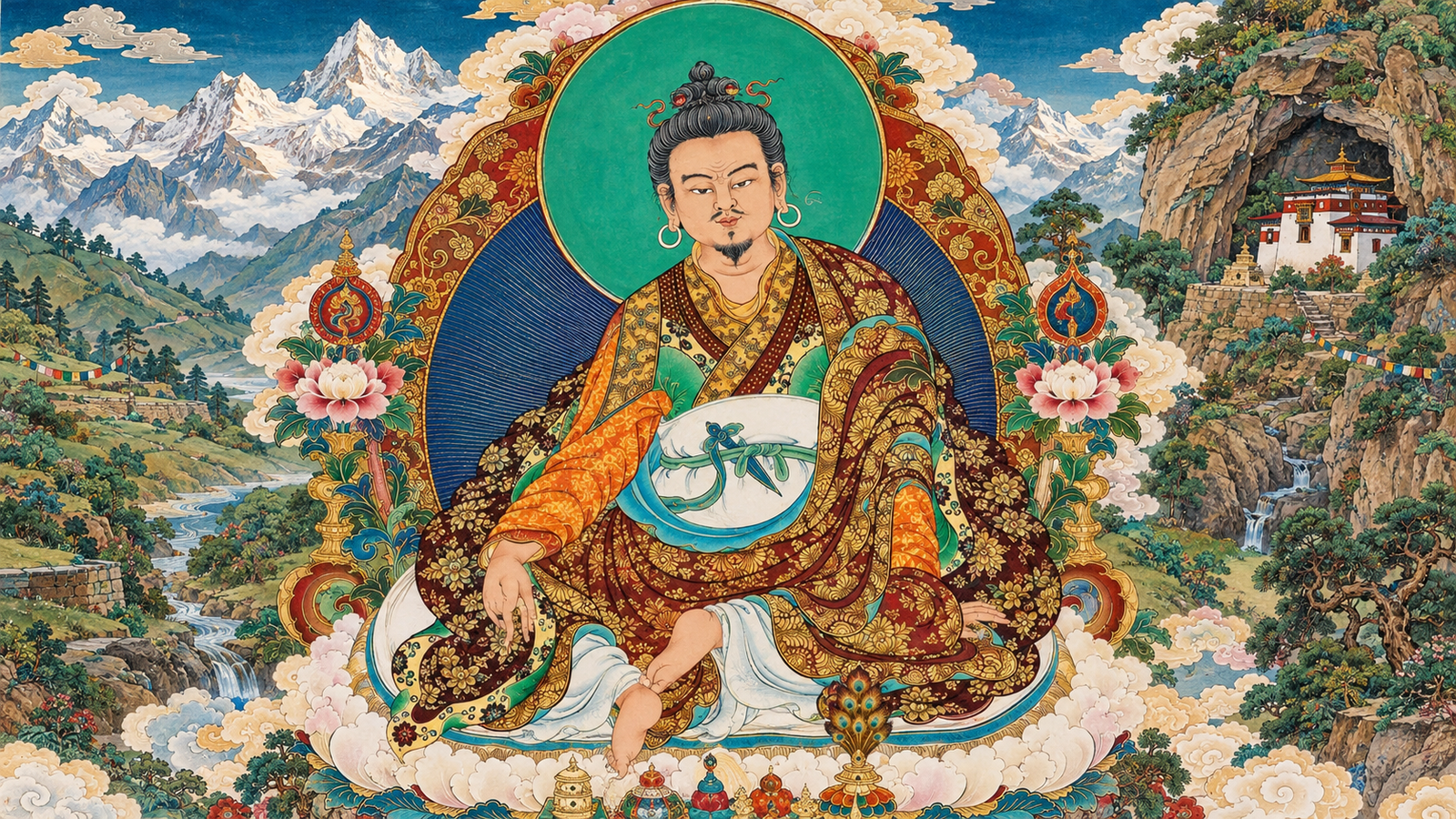
Who Was Jigme Lingpa?
Jigme Lingpa (1729–1798) was a renowned Tibetan Buddhist master, scholar, Yogi, and treasure revealer of the Nyingma school. He is especially celebrated for revealing the Longchen Nyingthig, or Heart Essence of the Vast Expanse, one of the most influential cycles of Dzogchen teachings in Tibetan Buddhism.
Jigme Lingpa devoted much of his life to intensive meditation, the study and transmission of Buddhist teachings, and the preservation of the Nyingma tradition. His influence extended beyond his own religious lineage through his disciples, literary works, the establishment and restoration of religious institutions, and his contributions to Buddhist ritual and scholarship.
Traditional Tibetan biographies describe him as a master who combined extensive learning with profound contemplative experience. His life remains an important subject for understanding the development of the Nyingma school and the transmission of Dzogchen teachings in eighteenth-century Tibet.
Birth and Early Life in Southern Tibet
Jigme Lingpa was born in 1729 in the Yarlung region of Lhoka, in southern Tibet. According to his traditional biography, his father was Chöje Monlam Zangpo, described as belonging to the same ancestral lineage as the great Nyingma master Longchen Rabjam (1308–1364). His mother, Metö Yanjam, came from the Medog Srib Teng household.
His birthplace connected him with a region of considerable historical and religious importance. The Yarlung Valley is closely associated with the early history of Tibet and contains important sites connected with the development of Tibetan Buddhist culture.
From an early age, Jigme Lingpa showed a strong inclination toward religious study and spiritual practice. When he was six years old, he entered monastic life at Palyul Ösel Thegchen Ling, according to the biography. He was ordained by the tulku Ngawang Lozang Pema and received the religious name Pema Khyentse Özer.
This early ordination marked the beginning of a life devoted to Buddhist education, meditation, and the preservation of religious teachings.
Buddhist Education and Intellectual Training
Jigme Lingpa received instruction from several teachers and studied a broad range of Buddhist and traditional disciplines.
Learning language, mathematics, and medicine
At approximately ten years of age, he studied language, mathematics, and medicine under the teacher Lobön Böntsen. His biography describes him as acquiring these subjects with remarkable ease. He also studied classical literary composition under Drung Damchö Losel Wangpo, receiving instruction in the Mirror of Poetry, a celebrated work on Sanskrit poetics and literary aesthetics.
Jigme Lingpa’s literary abilities developed alongside his religious education. His later writings demonstrate a command of philosophical exposition, devotional expression, poetry, and the interpretation of Buddhist teachings.
Receiving Buddhist transmissions
Jigme Lingpa also received important empowerments and instructions from accomplished masters. From the elder Kusum Özer, he received transmissions associated with the Dzogchen teachings known as Nyingtik and the Lama Gongdü cycle.
At the age of thirteen, he met the Eighth Karmapa, Mikyö Dorje’s later lineage successor, Karma Thekchok Dorje, as identified in the traditional account. He received teachings associated with Mahamudra, including the Wisdom That Liberates Through Seeing, as well as empowerments connected with Samten Lhundrub. At fifteen, he received novice monastic vows from Ngawang Kunga Lekjung.
These formative years established the foundations of his later work as a scholar and meditation master. His education included not only Nyingma teachings but also transmissions from other Tibetan Buddhist traditions.
A Wide Range of Teachers and Buddhist Lineages
Jigme Lingpa studied with numerous masters from different branches of Tibetan Buddhism. His traditional biography names several teachers from whom he received teachings belonging to both the older Nyingma tradition and the newer Tibetan Buddhist schools.
Among those mentioned are:
- Drime Lingpa, a prominent treasure revealer.
- Dharma Kirti of Zhangtod, a Buddhist teacher.
- Shinatha, associated with the Mindrolling tradition.
- Tenzin Yeshe Lhundrub, a religious master.
- Dröktang Ön Pema Chokdrub, another teacher in his network of transmissions.
- Mon Zhakara Lama Dargye, from whom he received further instructions.
Through these teachers, Jigme Lingpa received both Kama and Terma teachings.
In the Nyingma school, Kama refers broadly to the transmitted teachings passed down through established teacher-to-disciple lineages. Terma refers to teachings and sacred objects understood within the tradition to have been concealed for later discovery by treasure revealers, or tertöns.
He also received teachings associated with the New Translation schools, commonly known as the Sarma traditions. This broad education gave Jigme Lingpa access to a wide range of Buddhist philosophical, ritual, and contemplative traditions.
Years of Intensive Meditation Retreat
Despite his extensive education, Jigme Lingpa’s biography emphasizes that he did not limit himself to intellectual study. He devoted long periods to secluded meditation and spiritual practice. Motivated by renunciation and a strong desire for liberation, he undertook retreats at several sacred locations, including Shiwa Tsal and meditation caves in the Chimphu area near Samye Monastery.
Chimphu has long been regarded as an important retreat landscape in Tibetan Buddhism. Its caves and secluded valleys are associated with generations of meditators, including practitioners of the Nyingma tradition. Jigme Lingpa’s biography describes him as spending successive years engaged in intensive contemplative practice.
Three years of retreat at Palyul Pema Ö Ling
At his home monastery, Palyul Pema Ö Ling, Jigme Lingpa undertook a three-year retreat in which he remained in strict seclusion. During this period, he practiced the generation and completion stages associated with the profound treasure teachings of the great tertön Sherab Özer, particularly the cycle known as Droltik Gongpa Rangdrol. The biography describes him as attaining significant signs of meditative realization through this practice.
Three years at Chimphu
Another particularly important retreat took place at Sangchen Metok Phuk, a meditation cave in the Chimphu region near Samye. According to the traditional account, Jigme Lingpa spent three years there devoted to profound contemplative practice. During this retreat, he experienced numerous extraordinary meditative insights and pure visions.
The biography places particular emphasis on his visions of Longchen Rabjam, the great fourteenth-century Nyingma master whose writings became central to the intellectual and contemplative heritage of the school. Jigme Lingpa is said to have encountered Longchenpa’s wisdom form on three occasions. These encounters were understood within the tradition as a transmission of spiritual blessing and authorization.
Such visionary encounters are important features of Tibetan Buddhist hagiography, particularly in accounts of treasure revealers. They express the perceived continuity of spiritual realization across generations of masters.
The Revelation of the Longchen Nyingthig
Jigme Lingpa’s enduring reputation rests largely on his role as a revealer of profound Buddhist treasures. The Nyingma tradition understands certain teachings as mind treasures, or Gongter, which are discovered through contemplative realization rather than through the physical recovery of concealed manuscripts alone.
According to Jigme Lingpa’s traditional biography, his intensive practice and visionary experiences enabled him to reveal profound teachings associated with Longchenpa’s wisdom tradition. His best-known revelation became the Longchen Nyingthig, translated as the Heart Essence of the Vast Expanse.
The Longchen Nyingthig is one of the most influential Dzogchen cycles in the Nyingma school. It includes preliminary practices, meditation instructions, and teachings concerning the nature of mind and the path to awakening. Its importance lies in the way it connects the contemplative teachings associated with Longchenpa with a practical cycle of instructions transmitted through Jigme Lingpa and his successors.
The tradition continues to be practiced by Nyingma teachers and students around the world.
What makes Jigme Lingpa important in Dzogchen?
Dzogchen, or the Great Perfection, is a major contemplative tradition within the Nyingma school. It emphasizes recognizing the nature of awareness through specific instructions transmitted by qualified teachers. Jigme Lingpa’s contribution was not simply to preserve older teachings. Through the Longchen Nyingthig, he established a particularly influential cycle of practice that became central to subsequent Nyingma lineages.
His work illustrates how Tibetan Buddhist traditions maintain continuity while also developing through the spiritual experiences, interpretations, and literary contributions of later masters.
Establishing Retreat Centers and Supporting Monastic Institutions
Jigme Lingpa’s activities extended beyond meditation and the transmission of teachings. His biography describes substantial efforts to establish religious institutions, commission sacred images, sponsor Buddhist literature, and restore ritual practices.
Pema Ösel Thegchok Ling at Tsering Jong
Near the royal burial complex of Songtsen Gampo at Chonggyé, Jigme Lingpa established a retreat center associated with Tsering Jong Pema Ösel Thegchok Ling. The site became an important center for religious practice and the transmission of the Nyingma teachings.
According to the account accompanying his biography, the institution was severely damaged during the Cultural Revolution and subsequently rebuilt. The restored center is described as housing approximately fifty nuns and maintaining its own liturgical and contemplative practices associated with the Nyingthig tradition.
This history reflects the broader experience of many Tibetan Buddhist institutions, which have faced periods of destruction and later reconstruction.
Patronage of sacred monuments and images
Jigme Lingpa also sponsored important religious works at Samye and other sacred locations.
His biography attributes several significant commissions to him, including:
- A richly decorated bodhi stupa constructed using a substantial quantity of silver.
- A golden Dharma wheel offered to the great assembly of Samye.
- A large silver image of Maitreya Buddha.
- Numerous statues of Padmasambhava and Indian Buddhist masters and translators.
- Approximately sixty painted religious works depicting important Buddhist figures and traditional biographies.
The biography also records his support for the production of complete collections of Nyingma tantric literature. These activities demonstrate the importance he placed on preserving not only meditation instructions but also the material and institutional foundations of Buddhist practice.
7. Preserving the Nyingma Kama and Terma Traditions
One of Jigme Lingpa’s major contributions was his effort to protect and renew the older Buddhist traditions associated with the Nyingma school. His biography describes concerns that important teachings and ritual traditions were at risk of disappearing or being transmitted inaccurately.
In response, he supported the continuation of ritual and meditation practices at sacred sites, including Shiwa Parvata. He also promoted the preservation of key Nyingma teachings associated with the three foundational categories often called the Three Inner Tantras: Mahayoga, Anuyoga, and Atiyoga.
Atiyoga is closely associated with Dzogchen, while Mahayoga and Anuyoga represent other important systems of practice within the Nyingma tradition. His efforts to preserve these teachings helped maintain the continuity of religious study, ritual performance, and contemplative practice.
This institutional work complemented his role as a treasure revealer and author. Together, these activities strengthened the transmission of the Nyingma tradition into later generations.
Jigme Lingpa’s Disciples and Spiritual Lineage
Jigme Lingpa attracted numerous disciples, including important meditation masters, reincarnate lamas, religious scholars, and members of Tibetan ruling families. His traditional biography names several prominent students.
Among them were the four masters known collectively as the Four Jigmes:
- Jigme Trinley Özer, a renowned accomplished master.
- Jigme Gyalwai Nyugu, an important transmitter of Jigme Lingpa’s teachings.
- Jigme Künzang Drolwe Gyalpo, associated with the Mon region.
- Jigme Ngotsar, a lama connected with Gertse.
Other disciples named in the account include Drigung Rinpoche Nyinje Özer, Sakya throne holder Ngawang Palden Chökyong and his relatives, two masters associated with Ganden Jang, the Palyul incarnation associated with Chonggyé, the Lhatsam incarnation, and the Kongpo Götsang incarnation Jigme Tenpai Gyaltsen.
The biography also mentions religious figures from Lhodrak, as well as the king of Derge and his queen, Nangtsulma. This broad network of disciples illustrates Jigme Lingpa’s influence across regional and sectarian boundaries. His teachings reached practitioners associated with different Tibetan Buddhist institutions and helped establish lineages that continued long after his death.
Major Literary Works of Jigme Lingpa
Jigme Lingpa was a prolific author whose writings addressed Buddhist philosophy, meditation, tantric ritual, history, literature, and moral instruction. His collected works are traditionally preserved in nine volumes, with the woodblocks for the collection housed at the Derge Printing House, according to the biography.
Some of his best-known works include the following.
Treasury of Precious Qualities
The Treasury of Precious Qualities, commonly known by its Tibetan title Yönten Dzö, is an important work associated with the Nyingma tradition. Jigme Lingpa’s commentary and related explanations help clarify the structure and meaning of the Buddhist path. The work discusses the qualities of the Buddhist teachings and the stages of spiritual development, presenting a systematic account of the path to awakening.
Yeshe Lama
Yeshe Lama, or Lama of Wisdom, is a major set of instructions associated with the practice of Dzogchen and the Longchen Nyingthig tradition. It presents guidance on contemplative practice and is especially important for understanding how the Longchen Nyingthig teachings are explained and transmitted.
The Nyingma Gyübum and related works
Jigme Lingpa contributed to the preservation and interpretation of the Nyingma Gyübum, the collection of Nyingma tantric scriptures. His writings also include works related to the Lama Gongdü ritual tradition, explanations of tantric practices, and texts concerning the Longchen Nyingthig.
These writings supported the continued study and practice of Nyingma teachings.
Historical, literary, and ethical writings
Jigme Lingpa’s literary interests extended beyond explicitly religious treatises. His collected works include writings on historical monuments, religious inventories, animals, birds, forests, and moral instruction.
Titles recorded in the traditional biography include works that can be rendered approximately as:
- The Treasury of the History of the Tashi Songtsen Royal Tomb
- An Inventory of the Tashi Songtsen Royal Tomb
- The Messenger of Renunciation: A Discourse on Wild Animals
- Spontaneous Wisdom: A Discourse on Birds
- The Garland of Udumbara Blossoms: A Discourse on Forests
- Rely on Meaning, Not Merely on Words: A Discourse for the Wise
- The Ornament of the Rocky Mountain Ridge: A Discourse on the Steadfast Rabbit
- Medicine for Sustaining the World: Advice to Kings and Common People
These English titles are explanatory translations rather than verified standardized English publication titles.
The range of subjects demonstrates that Jigme Lingpa’s literary activity encompassed religious scholarship, ethical reflection, historical documentation, and the use of natural imagery to communicate philosophical ideas.
Jigme Lingpa’s Death in 1798
Jigme Lingpa passed away in 1798 at the age of seventy, according to traditional Tibetan biographies. His death marked the end of a life devoted to scholarship, meditation, religious patronage, and the transmission of profound Buddhist teachings.
However, his spiritual influence continued through his disciples, his writings, the Longchen Nyingthig lineage, and the institutions associated with his activities. His biography is preserved through multiple traditional accounts, including his own autobiographical writings and later works by Tibetan Buddhist authors.
For a deeper historical study, readers can consult the traditional biographies named in Tibetan sources, including Jigme Lingpa’s own Concise Account of the Births and Liberation of the Vidyadhara Jigme Lingpa, together with biographical works attributed to Dzogchenpa Rangjung Dorje and Pema Wangchen Roltsel.
These sources provide a foundation for studying his life within its religious and historical context.
Frequently Asked Questions
Who was Jigme Lingpa?
Jigme Lingpa (1729–1798) was an influential Tibetan Buddhist master of the Nyingma school, known for his Dzogchen teachings, treasure revelations, literary works, and efforts to preserve the Nyingma tradition.
What is Jigme Lingpa famous for?
He is best known for revealing the Longchen Nyingthig, a major cycle of Dzogchen teachings that remains widely practiced within the Nyingma school.
Who was Longchenpa, and what was his connection with Jigme Lingpa?
Longchenpa, or Longchen Rabjam (1308–1364), was one of the most important scholars and meditation masters in the Nyingma tradition. Jigme Lingpa regarded Longchenpa as a central spiritual inspiration. According to traditional accounts, he experienced visionary encounters with Longchenpa during meditation retreats.
Where did Jigme Lingpa meditate?
His traditional biography describes extended retreats at Shiwa Tsal, Chimphu near Samye, Sangchen Metok Phuk, and Palyul Pema Ö Ling, among other secluded locations.
What are Jigme Lingpa’s most important writings?
His best-known works include the Treasury of Precious Qualities and Yeshe Lama, alongside writings associated with the Longchen Nyingthig, the Nyingma Gyübum, tantric ritual, history, and ethical instruction.
How did Jigme Lingpa contribute to the preservation of Tibetan Buddhism?
He helped preserve and transmit Nyingma teachings, established and supported religious institutions, sponsored sacred images and literary works, and trained disciples who continued his teachings.
When did Jigme Lingpa die?
He died in 1798 at the age of seventy, according to traditional Tibetan biographical accounts.
Conclusion: The Enduring Legacy of Jigme Lingpa
Jigme Lingpa remains one of the most influential figures in the history of the Nyingma school of Tibetan Buddhism. His contributions combined intensive meditation, the revelation and transmission of Dzogchen teachings, extensive literary work, religious patronage, and the training of future generations of Buddhist masters. Through the Longchen Nyingthig and his other writings, Jigme Lingpa helped shape the continuing development of Tibetan Buddhist contemplative practice. His legacy also survives in the institutions, sacred sites, and lineages associated with his activities.
More than two centuries after his death, his life offers a valuable window into the relationship between scholarship, meditation, religious institutions, and the preservation of Tibetan Buddhist heritage.



[…] Jigme Lingpa and the Longchen Nyingthig Tradition […]