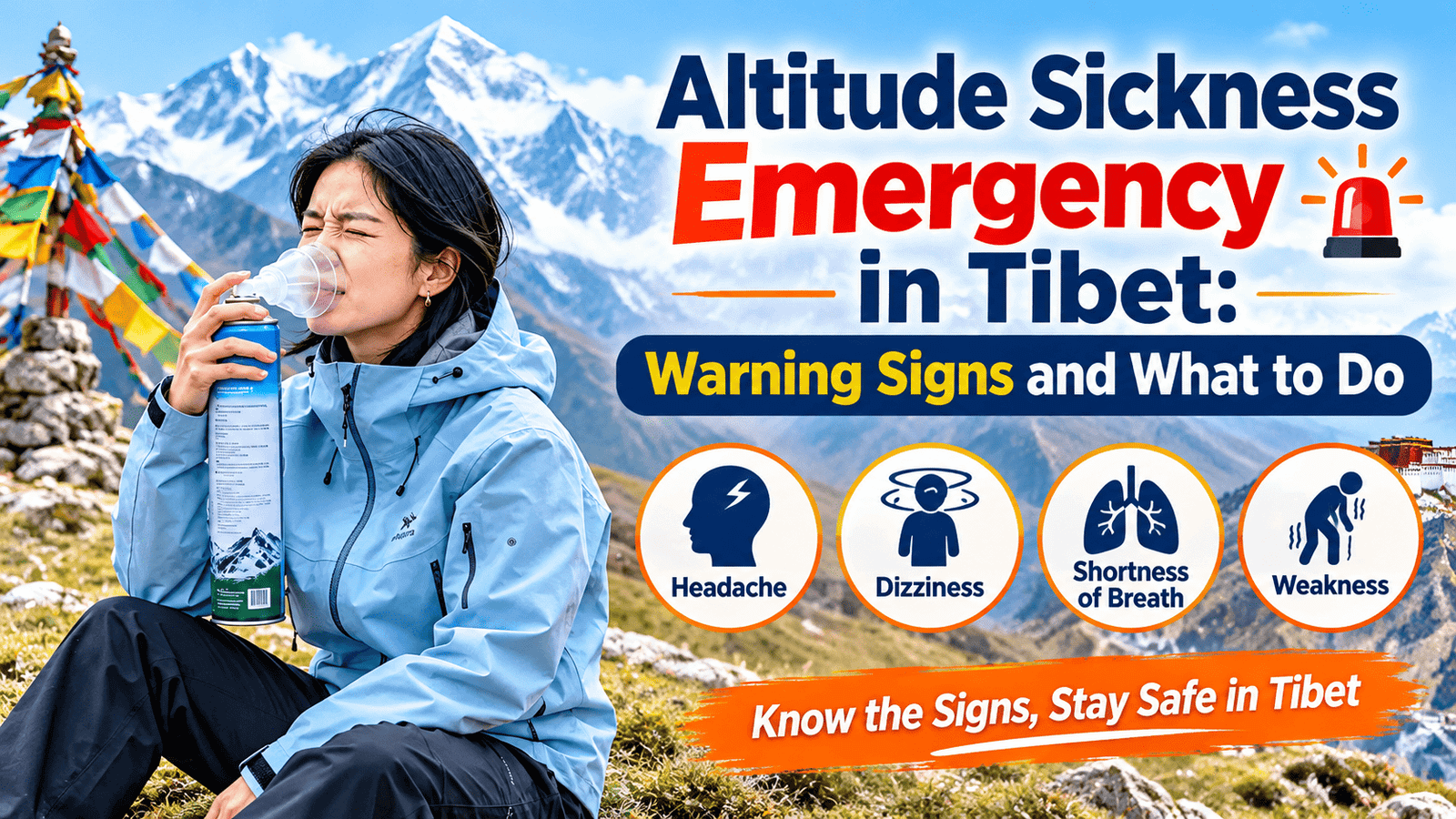
Traveling in Tibet means spending time at elevations where the body receives less oxygen than it does at sea level. Many visitors experience mild symptoms while adjusting to the altitude, particularly during the first few days in Lhasa or after traveling to higher destinations.
However, altitude sickness can sometimes become a medical emergency. The most serious conditions are high-altitude pulmonary edema (HAPE), which affects the lungs, and high-altitude cerebral edema (HACE), which affects the brain. Both can become life-threatening without prompt treatment.
Recognizing the warning signs early is especially important on remote routes to Everest Base Camp, Mount Kailash, Namtso Lake and other high-altitude destinations, where medical facilities may be far away.
This guide explains how to distinguish ordinary altitude symptoms from dangerous warning signs and what travelers, guides and tour companions should do.
Understand the three main types of altitude illness
Altitude illness is not one single condition. Its symptoms range from mild discomfort to severe medical emergencies.
Acute Mountain Sickness (AMS)
AMS is the most common form of altitude illness. It usually develops within several hours after arriving at a higher elevation or sleeping higher than the previous night.
Typical symptoms include:
- Headache
- Nausea or reduced appetite
- Dizziness
- Unusual tiredness or weakness
- General discomfort
A person with mild AMS may still be able to walk, talk and take care of themselves. However, they should not continue ascending while symptoms remain.
High-Altitude Pulmonary Edema (HAPE)
HAPE occurs when fluid accumulates in the lungs, making it difficult for the body to absorb oxygen.
Early warning signs include:
- Breathlessness that is greater than expected during ordinary activity
- A noticeable drop in walking or climbing ability
- Persistent cough
- Chest congestion or tightness
- Unusual fatigue
As the condition worsens, a person may become breathless even while resting. They may develop a wet cough, produce pink or blood-tinged sputum, or show blue or grey lips and fingertips.
HAPE can occur with or without the usual symptoms of AMS. Do not assume someone is safe simply because they do not have a headache.
High-Altitude Cerebral Edema (HACE)
HACE is a severe altitude-related condition involving swelling and dysfunction of the brain.
Important warning signs include:
- Confusion or unusual behavior
- Difficulty walking in a straight line
- Loss of balance or coordination
- Severe drowsiness
- Difficulty speaking clearly
- Reduced awareness of surroundings
- Unusual difficulty looking after oneself
A person with HACE may appear intoxicated, even though they have not consumed alcohol. New confusion or poor coordination at altitude must be treated as an emergency.
Emergency warning signs: when to act immediately
The following symptoms should never be dismissed as ordinary tiredness or a normal part of acclimatization.
Emergency signs involving breathing
- Shortness of breath while resting
- Rapid or difficult breathing
- A worsening cough accompanied by breathlessness
- Chest congestion with a sudden decline in physical ability
- Pink, frothy or blood-stained sputum
- Blue or grey lips or fingertips
These signs may indicate HAPE or another serious respiratory or cardiovascular problem.
Emergency signs involving the brain
- Confusion or disorientation
- Staggering or inability to walk steadily
- Loss of coordination
- Unusual behavior or personality changes
- Severe drowsiness or difficulty waking
- Seizures or loss of consciousness
These signs may indicate HACE or another serious neurological condition.
Other serious warning signs
Repeated vomiting, severe weakness, collapse or rapidly worsening symptoms also require urgent medical assessment. Do not try to diagnose the exact condition yourself.
Important: A person does not need to show every symptom. One major warning sign, particularly breathlessness at rest, confusion or loss of coordination, is enough to justify emergency action.
A practical decision guide for Tibet travelers
Use this guide to decide how urgently to respond. It is not a substitute for medical diagnosis.
| What you notice | Possible concern | What to do |
|---|---|---|
| Mild headache, dizziness or nausea; person remains alert and walks normally | Possible mild AMS | Stop ascent, rest and monitor closely |
| Symptoms are moderate, persistent or getting worse | Worsening AMS or another illness | Do not ascend; seek medical advice and consider descent |
| Breathlessness at rest, worsening cough or chest congestion | Possible HAPE | Arrange urgent descent and medical assistance |
| Confusion, staggering or inability to walk steadily | Possible HACE | Emergency descent and urgent medical treatment |
| Collapse, severe breathing difficulty or unconsciousness | Life-threatening emergency | Activate emergency help immediately |
If you are unsure whether symptoms are serious, choose the safer option: stop the ascent and arrange medical assessment.
What to do if someone develops severe altitude sickness
When a traveler shows signs of HAPE or HACE, time matters. Do not wait until the next morning to see whether the person improves.
Step 1: Stop all ascent
Do not continue driving to a higher overnight destination or ask the affected person to keep walking uphill.
A traveler with altitude-related symptoms should not sleep at a higher elevation. If the condition is severe or worsening, descent is required.
Step 2: Arrange immediate medical help
Contact local medical services, the tour operator and the guide. Explain the person’s symptoms, current location, approximate altitude and how quickly the condition has developed.
On remote Tibet routes, the guide and driver may need to coordinate transport to a lower elevation and the nearest appropriate medical facility.
Do not leave a seriously ill person alone.
Step 3: Descend to a lower altitude
Descent is the most important treatment for severe altitude illness.
For serious AMS or suspected HACE, descend until symptoms improve, if it is safe to do so. A decrease of approximately 300–1,000 meters can improve AMS symptoms, although the required descent varies.
For suspected HAPE, urgent descent is generally recommended, often aiming for at least 1,000 meters or until the person’s condition improves.
Use a vehicle or other transport where possible. A person with HAPE should avoid unnecessary physical effort, and someone with HACE should not be expected to walk unaided.
Never delay an urgently needed descent merely to complete sightseeing or reach a planned hotel.
Step 4: Give oxygen if available
Supplemental oxygen can help improve oxygen levels and relieve symptoms while medical assistance and descent are being arranged.
For severe altitude illness, oxygen should be administered by someone who understands the equipment and can monitor the patient. It is not a replacement for descent when descent is needed.
Small consumer oxygen cans are not adequate treatment for serious HAPE or HACE.
Step 5: Keep the person warm and reduce exertion
Protect the patient from cold, wind and unnecessary movement. Keep them in a comfortable position that makes breathing easier.
Do not force them to walk, carry luggage or continue trekking. If they are confused or drowsy, monitor their breathing and level of consciousness while arranging urgent care.
Step 6: Seek hospital assessment
Even if the person improves after oxygen or descent, they may still need medical evaluation.
A clinician can assess oxygenation, breathing, neurological function and other possible causes of the symptoms. Conditions such as pneumonia, heart problems, stroke, low blood sugar and carbon monoxide exposure can sometimes resemble altitude illness.
Why a pulse oximeter cannot rule out an emergency
A pulse oximeter measures peripheral blood oxygen saturation (SpO₂). It can help monitor a traveler’s condition, but it cannot diagnose altitude sickness on its own.
At high altitude, healthy people normally have lower oxygen saturation than at sea level. Readings also vary with elevation, temperature, circulation, movement and device quality.
Pay attention to the person’s symptoms and changes over time.
For example:
- A traveler with confusion or poor coordination needs urgent assessment even if the displayed SpO₂ seems acceptable.
- A traveler with severe breathlessness needs medical help even if a single reading appears reassuring.
- A falling reading combined with worsening cough or breathing difficulty is particularly concerning.
Do not delay descent or medical assistance while repeatedly checking the pulse oximeter.
Special precautions on remote Tibet routes
Some Tibet destinations involve long driving distances, high mountain passes and limited medical facilities.
Everest Base Camp
The road to Everest Base Camp crosses high-altitude areas, including the region around Gyawu La Pass. Travelers may experience headache, nausea, fatigue or reduced exercise tolerance.
A new cough, unusual breathlessness or a major decline in walking ability should not be dismissed as normal acclimatization.
Mount Kailash
The Mount Kailash pilgrimage involves long periods at high altitude, remote accommodation and physically demanding walking during the kora.
Confusion, loss of balance, breathlessness at rest or a worsening cough requires immediate attention. Do not encourage someone with these symptoms to continue the pilgrimage.
Namtso Lake and northern Tibet
Namtso and the surrounding highland routes are exposed to cold, wind and high elevation. Weather can complicate transport and evacuation.
A tour plan should include enough flexibility to stop, rest or descend if a traveler becomes unwell.
How tour guides and companions can help prevent emergencies
A guide or travel companion may be the first person to notice that someone is becoming seriously ill.
Useful precautions include:
- Ask travelers how they feel each day, especially after a significant increase in sleeping altitude.
- Watch for unusual fatigue, reduced walking ability, persistent cough or changes in behavior.
- Do not pressure travelers to keep up with the group.
- Never encourage further ascent when altitude symptoms are still present.
- Know the route to the nearest lower settlement and medical facility.
- Keep communication available where possible.
- Make sure the group knows how to request help.
A traveler who is confused may not recognize their own condition. Companions should take new changes in behavior seriously.
Can altitude sickness be prevented?
There is no way to guarantee that a traveler will avoid altitude illness, but sensible planning reduces risk.
Before traveling to Tibet:
- Plan a gradual ascent and allow time to acclimatize.
- Avoid strenuous activity during the first days at high altitude.
- Do not increase sleeping altitude while experiencing altitude symptoms.
- Discuss preventive medication with a qualified healthcare professional before departure.
- Avoid alcohol during the initial acclimatization period.
- Keep the itinerary flexible enough to allow rest or descent.
A well-planned itinerary is particularly important for travelers going from Lhasa to Everest Base Camp or Mount Kailash.
Frequently Asked Questions
What is the first sign of a serious altitude sickness emergency?
There is no single first sign for everyone. Breathlessness that is unusual for the level of activity, a worsening cough, confusion and loss of coordination are important warning signs. Breathlessness at rest or new neurological problems require urgent action.
Can altitude sickness become dangerous overnight?
Yes. HAPE and HACE can progress over hours. A person who develops a worsening cough, breathing difficulty, confusion or poor coordination should not be left to sleep without assessment.
Should I descend if I only have a headache?
A headache alone does not necessarily mean severe altitude sickness. However, if it occurs after ascent and is accompanied by nausea, dizziness or unusual fatigue, AMS is possible. Stop ascending and monitor symptoms. Descend and seek medical advice if symptoms become severe or worsen.
Does oxygen cure severe altitude sickness?
Oxygen can improve oxygenation and help stabilize a patient, but it does not always solve the underlying problem. Descent and medical assessment remain essential in suspected HAPE or HACE.
Can a person with altitude sickness continue traveling by car?
It depends on the severity and the medical assessment. A person with mild symptoms may be able to continue at the same or a lower altitude after appropriate assessment. Someone with suspected HAPE or HACE needs urgent medical care and descent, not ordinary sightseeing travel.
What should a Tibet tour guide do if a guest becomes confused?
Treat new confusion at altitude as a medical emergency. Stop the ascent, arrange urgent medical assistance and descent, provide oxygen if available and appropriate, and do not leave the person alone.
Final advice
Altitude sickness is often manageable when recognized early, but HAPE and HACE can become life-threatening. On a Tibet trip, never ignore breathlessness at rest, a worsening cough, confusion or loss of coordination.
Stop ascending, arrange medical help and descend when serious altitude illness is suspected. A flexible itinerary and a prompt decision to change plans are far more important than completing every sightseeing stop.
Suggested internal links
- Altitude Sickness in Tibet: Complete Guide for Travelers
- Acute Mountain Sickness (AMS): Symptoms, Lake Louise Score and Treatment
- High-Altitude Pulmonary Edema (HAPE): Symptoms, Causes and Emergency Treatment
- High-Altitude Cerebral Edema (HACE): Symptoms, Warning Signs and Emergency Treatment
- How to Prevent Altitude Sickness: Acclimatization and Travel Planning
- Tibet Travel Checklist: Essential High-Altitude Gear and Safety Tips
- Oxygen at High Altitude: Benefits, Flow Rates, Duration and Safety
Medical disclaimer
This article provides general travel-health information and is not a substitute for professional medical advice, diagnosis or treatment. Suspected HAPE, HACE or another serious medical emergency requires urgent medical assessment. Medication and oxygen treatment should be guided by qualified healthcare professionals.