

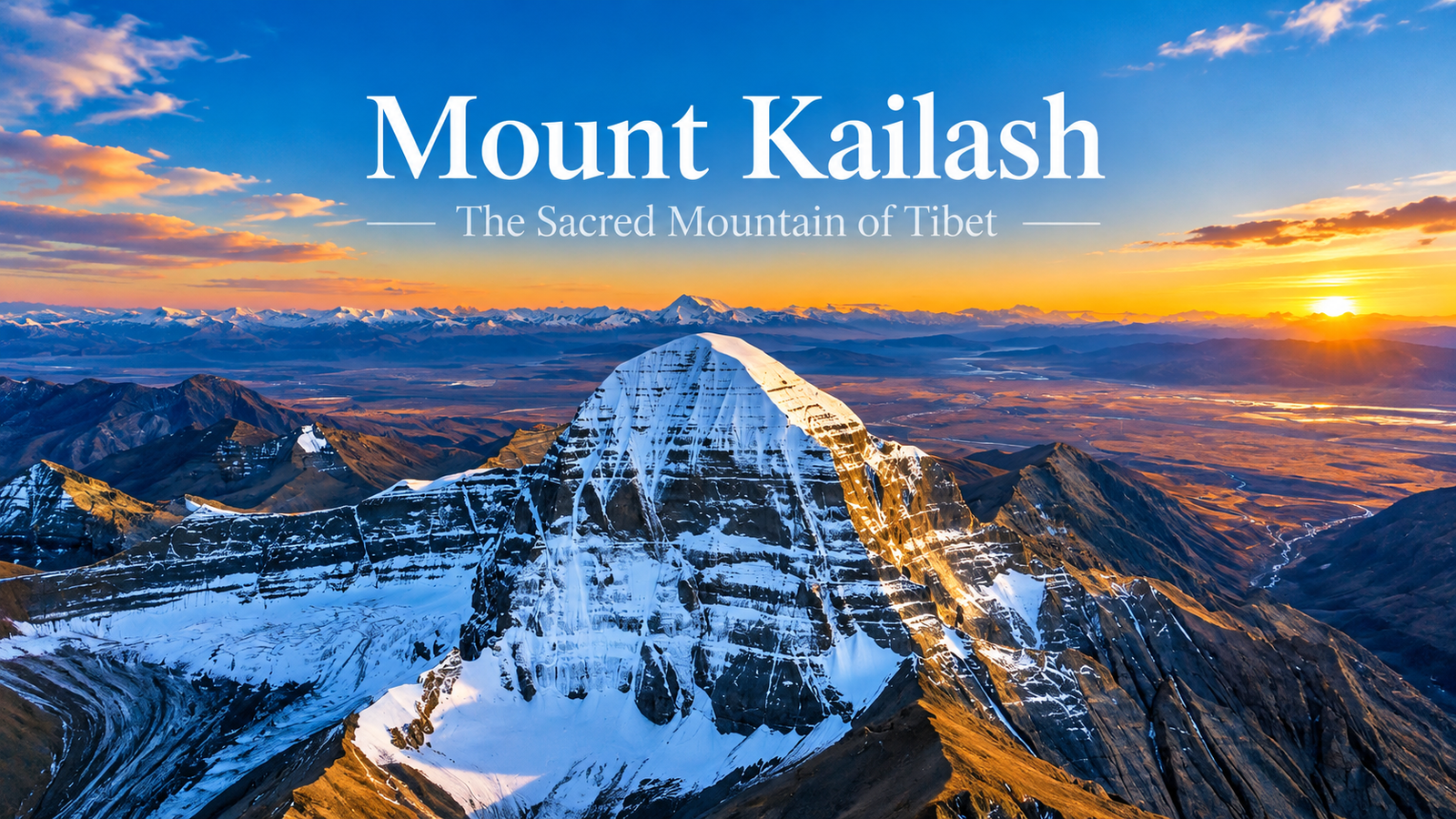
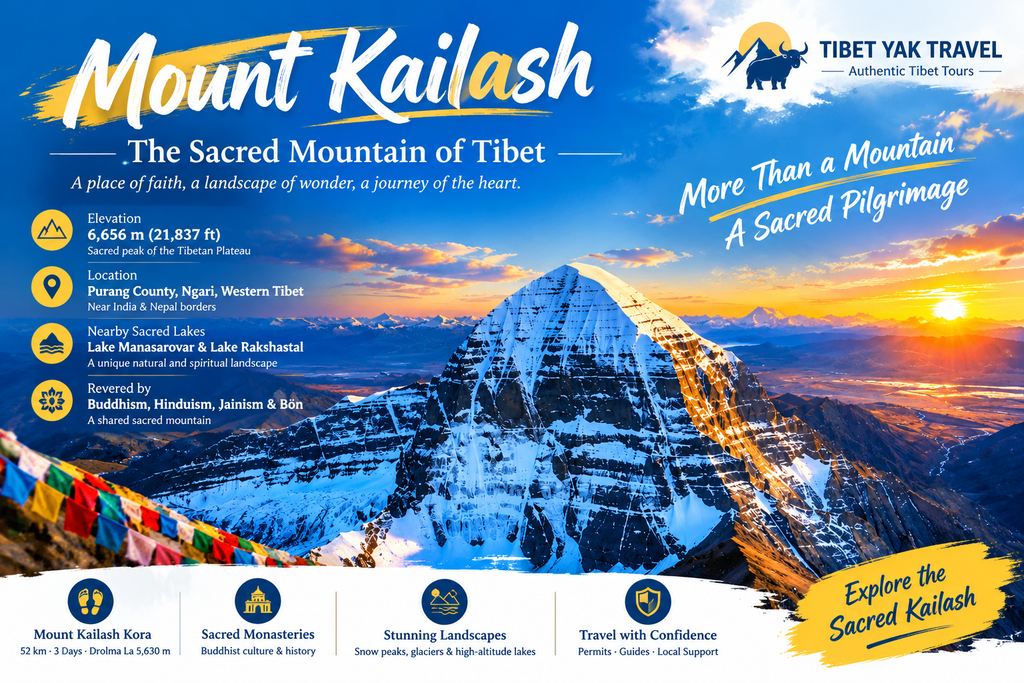
Mount Kailash, known in Tibetan as Gang Rinpoche, is one of the most revered sacred mountains in Asia. Rising to approximately 6,656 meters (21,837 feet) above sea level, it stands in Purang County in western Tibet.
For centuries, Mount Kailash has been an important pilgrimage destination for Tibetan Buddhists, Hindus, Jains, and followers of the Bön tradition. Each tradition has its own religious interpretation of the mountain, but all regard it as a place of exceptional spiritual importance. Unlike many of the world’s famous high mountains, Mount Kailash is not primarily known as a climbing destination. Its greatest significance comes from pilgrimage, sacred geography, meditation, and religious tradition.
Today, travelers who visit the region often combine the Mount Kailash kora with visits to Lake Manasarovar, Lake Rakshastal, monasteries, and other sacred sites across western Tibet.
Where Is Mount Kailash?
Mount Kailash is located in Purang County, Ngari Prefecture, western Tibet, close to the borders of India and Nepal.
The mountain rises from one of the most remote areas of the Tibetan Plateau. The surrounding landscape includes high-altitude valleys, snow-covered mountains, glaciers, broad plains, and some of Tibet’s most famous sacred lakes.
Two lakes are particularly important:
- Lake Manasarovar, south of Mount Kailash
- Lake Rakshastal, west of Lake Manasarovar
Together with Mount Kailash, these lakes form one of the most important pilgrimage landscapes in western Tibet. For international travelers, journeys to Mount Kailash commonly begin in Lhasa and continue westward through destinations such as Shigatse and Saga before reaching the Kailash-Manasarovar region. Because of the region’s remote location and high altitude, visiting Mount Kailash requires careful planning, appropriate permits, transportation arrangements, and sufficient time for acclimatization.
Why Is Mount Kailash Sacred?
Mount Kailash is sacred because four major religious traditions—Tibetan Buddhism, Hinduism, Jainism, and Bön—regard the mountain as a place of exceptional spiritual importance. Each tradition tells different stories about Kailash, but together they have made it one of Asia’s most important pilgrimage landscapes.
Located in Purang County, Ngari, western Tibet, Mount Kailash rises to 6,656 meters (21,837 feet). Its distinctive pyramid-like summit and surrounding glaciers have helped make it an enduring symbol of sacred geography.
Tibetan Buddhism: The Precious Snow Mountain
Tibetan Buddhists call Mount Kailash Kang Rinpoche, meaning “Precious Snow Mountain.” They regard it as a sacred center of pilgrimage, meditation, and Buddhist practice. Pilgrims travel to Kailash to perform the kora, the traditional circumambulation of the mountain. Buddhist traditions connect the region with renowned meditation masters, including Milarepa, and with the wider sacred geography of western Tibet.
The mountain’s importance comes not from its height alone but from the religious traditions, pilgrimage routes, monasteries, and meditation sites that surround it.
Hinduism: The Abode of Shiva
For Hindus, Mount Kailash holds a different but equally profound meaning. Hindu tradition regards the mountain as the abode of Lord Shiva, one of the principal deities of Hinduism.
The nearby Lake Manasarovar also forms an important part of the Hindu pilgrimage landscape. Pilgrims traditionally travel to the Kailash-Manasarovar region as an act of devotion and spiritual purification.
Jainism: A Sacred Place of Liberation
Jain tradition connects the Kailash region with Rishabhanatha (Adinatha), the first Tirthankara.
For Jain pilgrims, the wider Himalayan landscape represents an important sacred geography associated with spiritual liberation and the history of Jainism.
Bön: An Ancient Sacred Landscape
The Bön tradition also regards Mount Kailash as one of its most sacred places. Bön developed its own religious traditions, cosmology, rituals, and pilgrimage practices in Tibet.
Bön practitioners traditionally call the mountain Tise and follow their own form of circumambulation. Their traditions give Kailash a religious significance that does not depend on Buddhist interpretations.
Mount Kailash and Tibetan Sacred Geography
Mount Kailash occupies a central position in traditional Tibetan sacred geography. Ancient Buddhist literature contains descriptions of sacred mountains, lakes, continents, and cosmic landscapes. Tibetan Buddhist traditions later connected some of these descriptions with the physical geography of the Kailash region.
The mountain has traditionally been identified with Ti-se, a sacred mountain described in Tibetan religious literature. Traditional descriptions sometimes use symbolic dimensions and cosmological imagery, including references to the mountain’s shape and its relationship with surrounding landscapes.
These descriptions belong to religious cosmology and sacred geography and should not be confused with modern geological measurements or scientific descriptions of Mount Kailash.
Mount Kailash and the Four Great Rivers
The wider Kailash-Manasarovar region is associated with the headwaters of several major Asian river systems.
The region is traditionally connected with four great rivers:
- Indus River
- Sutlej River
- Brahmaputra River
- Karnali River, one of the major tributaries of the Ganges
This remarkable geographical setting has contributed to the importance of Mount Kailash throughout history. From the high Tibetan Plateau, these river systems eventually flow toward different parts of Asia, linking the remote Himalayan region with major landscapes of South and Central Asia.
The connection between sacred mountain, lakes, and great rivers is one reason the Kailash-Manasarovar area has such a powerful place in Asian religious imagination.
Mount Kailash in Tibetan Buddhist Tradition
Mount Kailash has been an important destination for Tibetan Buddhist pilgrims, practitioners, and religious masters for centuries. Traditional Tibetan Buddhist literature connects the mountain with sacred geography and with numerous meditation masters who traveled through the region.
For Buddhist practitioners, Kailash is not simply a spectacular mountain. It is a place associated with:
- Pilgrimage
- Meditation
- Religious devotion
- Sacred geography
- Buddhist teachings
- Spiritual practice
The mountain’s importance is therefore closely connected with the wider religious landscape of western Tibet.
Atisha and the Kailash Region
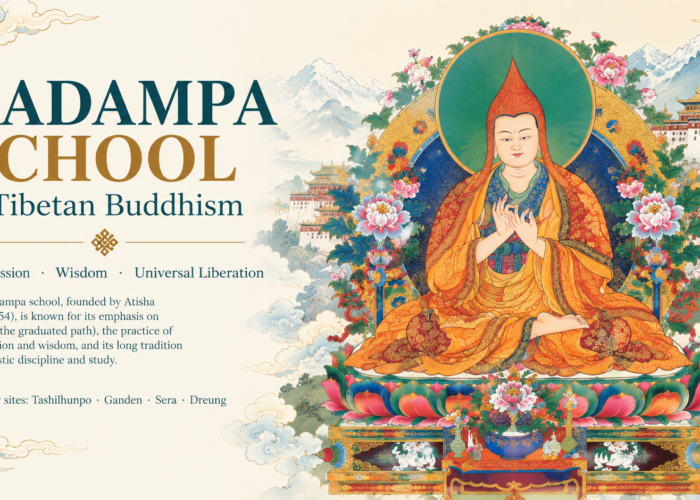
The great Indian Buddhist scholar and teacher Atisha (982–1054) is strongly associated with the development of Buddhism in western Tibet. Atisha traveled to the kingdom of Guge in western Tibet, where he played an important role in the later transmission and revival of Buddhist teachings.
Traditional Tibetan accounts also connect Atisha with the wider sacred landscape of Ngari and Mount Kailash. Stories concerning Atisha’s journey to western Tibet have become part of the region’s religious history and demonstrate the importance of Ngari as a major center of Buddhist learning during the later dissemination of Buddhism in Tibet.
Mount Kailash and the Drikung Kagyu Tradition
Mount Kailash has a particularly strong connection with the Drikung Kagyu tradition of Tibetan Buddhism. Over the centuries, Buddhist practitioners traveled to the Kailash region for meditation, retreat, pilgrimage, and spiritual practice.
Among the best-known Tibetan Buddhist figures associated with Kailash is Milarepa, the celebrated Tibetan yogi, poet, and meditation master.
Other practitioners traditionally associated with the Kailash region include:
- Drikung Kyobpa Jigten Sumgön
- Drikung Chenga Sherab Jungne
- Sengge Yeshe
- Götsangpa
- Panchen Lobsang Chögyen
- Shabkar Tsokdruk Rangdrol
Their biographies and religious traditions helped establish Kailash as one of Tibet’s great centers of pilgrimage and meditation.
Milarepa and Mount Kailash
Milarepa (c. 1040–1123) was one of Tibet’s most influential Buddhist yogis and poets and became a major figure in the Kagyu tradition. Traditional Tibetan biographies connect him with remote retreat sites around Mount Kailash and Lake Manasarovar, where he practiced meditation and lived as a wandering yogi. These traditions helped establish Kailash as an important landscape for Buddhist retreat and spiritual practice.
Tibetan tradition also associates Milarepa with several meditation caves in the wider Kailash region, including Tise Dzütrül Phuk, known as Miracle Cave. His disciple Rechungpa also practiced in the region. These sites illustrate how Buddhist practitioners historically used the remote valleys, cliffs, and caves around Kailash for solitary meditation, retreat, and religious practice, rather than simply visiting the mountain as a scenic destination.
A famous Tibetan Buddhist story describes a spiritual contest between Milarepa and Naro Bonchung, a Bön practitioner, over Mount Kailash. Traditional accounts portray the two masters displaying miraculous powers, with Milarepa ultimately establishing his spiritual connection with the mountain. Scholars generally treat this episode as part of Tibetan religious tradition and sacred literature, rather than as a historically verified event.
Milarepa’s legacy continues to shape the spiritual identity of Mount Kailash. His association with the mountain, its caves, and the surrounding pilgrimage landscape influenced later generations of Tibetan Buddhist practitioners, particularly within the Kagyu traditions. For pilgrims today, Kailash remains more than a spectacular mountain: it represents a landscape of meditation, devotion, pilgrimage, and spiritual transformation.
The Sacred Footprints of Mount Kailash
Tibetan Buddhist traditions include stories about sacred footprints associated with Mount Kailash. One traditional legend describes Mahakala attempting to move Mount Kailash to the realm of the Nāgas. According to the story, sacred footprints were placed around the mountain, preventing it from being moved.
These became known as sacred “anchors” of Mount Kailash. This story is part of the religious mythology surrounding the mountain rather than a geological explanation. Like many Kailash legends, it illustrates how Buddhist traditions use the physical landscape to express religious ideas about sacred power, protection, and immovability.
Sacred Caves and Meditation Sites Around Mount Kailash
The valleys and slopes surrounding Mount Kailash contain numerous caves, monasteries, retreat sites, and other locations associated with Tibetan Buddhist practitioners. Some are traditionally connected with famous masters, including Milarepa and other meditation practitioners.
These sites form an important part of the broader pilgrimage landscape. Visitors should remember that many caves and retreat locations are considered religious sites rather than ordinary tourist attractions. Respecting monks, pilgrims, meditation practices, and local customs is essential when visiting them.
Lake Manasarovar and Mount Kailash
Lake Manasarovar is one of the most important sacred lakes in Asia and is located south of Mount Kailash. The lake has profound religious significance in Tibetan Buddhism, Hinduism, Jainism, and Bön traditions, although each tradition understands its sacred importance differently.
The combination of the snow-covered Mount Kailash and the deep blue waters of Lake Manasarovar creates one of the most spectacular landscapes on the Tibetan Plateau.
For travelers, the Kailash-Manasarovar journey can combine:
- Sacred mountain landscapes
- High-altitude lakes
- Tibetan monasteries
- Buddhist pilgrimage traditions
- Remote Himalayan scenery
- Cultural experiences
The region is particularly meaningful for travelers interested in Tibetan religion, Himalayan culture, nature, and pilgrimage.
Mount Kailash Kora: The Sacred Circumambulation
The most important pilgrimage practice at Mount Kailash is the kora, or circumambulation of the mountain. Pilgrims walk around Mount Kailash as an act of religious devotion, prayer, and spiritual practice.
The traditional kora route is approximately 52 kilometers (32 miles), although the exact distance can vary depending on how the route is measured. The highest point is Drolma La Pass, which reaches approximately 5,630 meters (18,471 feet) above sea level.
For many travelers, the kora takes around three days, but the duration depends on physical condition, altitude, weather, pace, and individual religious practice. Some pilgrims complete the entire route through repeated full-body prostrations. This form of pilgrimage can take considerably longer and requires extraordinary physical endurance.
What Is the Drolma La Pass?
Drolma La Pass is the highest point of the Mount Kailash kora. At approximately 5,630 meters, the pass is one of the most physically demanding sections of the pilgrimage.
The name Drolma is associated with Tara, an important figure in Tibetan Buddhism. Pilgrims traditionally regard this section of the route as spiritually significant. The crossing is also physically challenging because of the extreme elevation and rapidly changing mountain weather. For visitors completing the kora, proper acclimatization is particularly important before reaching Drolma La.
Why Is the Kailash Kora Important?
The Mount Kailash kora is much more than a conventional mountain trek. For pilgrims, circumambulation the mountain represents religious devotion, purification, prayer, merit, and spiritual aspiration. Different traditions and religious communities have developed their own interpretations of pilgrimage around Kailash. In Tibetan Buddhist practice, the kora is commonly associated with the accumulation of merit and purification of negative karma.
For this reason, visitors should approach the route with respect. A pilgrimage should not be treated simply as a high-altitude hiking challenge.
Can anybody Climb Mount Kailash?
Mount Kailash is not climbed as an ordinary mountaineering objective. Its religious importance means that the traditional journey involves circumambulation the mountain rather than attempting to reach its summit.
Visitors should never attempt to climb Mount Kailash or leave established routes in pursuit of a summit experience. This is one of the defining characteristics of Kailash: its importance lies not in conquering the mountain, but in respecting and circumambulation it.
Mount Kailash as a Living Sacred Landscape
Mount Kailash should be understood as a living sacred landscape, not simply a tourist attraction.
Pilgrims continue to visit the mountain to:
- Pray
- Meditate
- Make religious offerings
- Perform the kora
- Visit monasteries
- Practice traditional rituals
- Seek spiritual merit
Travelers should therefore follow local regulations and respect religious practices throughout the journey.
Responsible Travel Around Mount Kailash
When visiting the Kailash region:
- Do not attempt to climb Mount Kailash.
- Stay on established pilgrimage routes.
- Respect pilgrims and religious ceremonies.
- Do not disturb meditation or retreat sites.
- Do not remove stones, soil, or religious objects.
- Avoid littering and protect the fragile high-altitude environment.
- Follow local instructions and environmental regulations.
- Prepare carefully for extreme altitude and changing weather.
Responsible travel helps protect both the natural environment and religious character of the region.
Mount Kailash in Tibetan Culture
The importance of Mount Kailash extends far beyond formal religious texts. The mountain appears throughout Tibetan religious literature, biographies, pilgrimage accounts, oral traditions, songs, paintings, and sacred geographical descriptions.
It is associated with ideas such as:
- Sacred geography
- Meditation
- Spiritual purification
- Religious devotion
- Buddhist wisdom
- Pilgrimage
- Enlightenment
For Tibetan communities and other Himalayan religious traditions, Kailash represents a sacred landscape whose importance predates modern tourism by many centuries.
Visiting Mount Kailash Today
Modern Mount Kailash journeys combine ancient pilgrimage traditions with long-distance travel across the Tibetan Plateau.
A typical journey may include:
- Arrival in Lhasa
- Acclimatization and sightseeing
- Travel through Shigatse and western Tibet
- Crossing the high plateau toward Ngari
- Visiting Saga and the Kailash-Manasarovar region
- Visiting Lake Manasarovar and Lake Rakshastal
- Reaching the Mount Kailash area
- Completing the kora
- Returning through western Tibet
Exact routes and travel requirements can change according to local regulations, road conditions, seasonal access, and permit requirements. Because Mount Kailash lies in a remote and extremely high-altitude region, travelers should arrange the necessary permits, transportation, accommodation, and guide services before departure.
Best Time to Visit Mount Kailash
The main travel season for Mount Kailash is generally from spring through autumn, when road access and weather conditions are more suitable.
May to June
May and June generally offer relatively favorable conditions, with increasing temperatures and good opportunities for mountain views.
July to August
Summer brings warmer temperatures but can also bring periods of rain and changing road conditions, particularly during the Tibetan Plateau monsoon season.
September to October
September and October often provide clear skies and excellent mountain visibility. Temperatures, however, can become significantly colder, especially at night.
Weather in the Kailash region can change rapidly at any time of year. Travelers should check current local conditions before departure.
Mount Kailash Travel and Altitude
Altitude is one of the most important considerations for a Mount Kailash journey. The region is located at extreme elevation, and the kora reaches more than 5,600 meters at Drolma La Pass.
Travelers should allow adequate time for acclimatization before beginning the pilgrimage. A responsible itinerary should avoid rushing from low altitude directly into the kora. Physical preparation, hydration, appropriate clothing, a suitable pace, and awareness of altitude-related symptoms are all important.
Travelers should seek professional medical advice before a high-altitude journey if they have concerns about their ability to safely participate.
Frequently Asked Questions About Mount Kailash
Where is Mount Kailash?
Mount Kailash is located in Purang County, Ngari Prefecture, western Tibet, on the Tibetan Plateau near the borders of India and Nepal.
How high is Mount Kailash?
Mount Kailash is approximately 6,656 meters (21,837 feet) above sea level.
Why is Mount Kailash sacred?
Mount Kailash is revered by Tibetan Buddhists, Hindus, Jains, and followers of Bön. Each tradition has its own religious understanding of the mountain.
Can tourists climb Mount Kailash?
No. Mount Kailash is regarded as a sacred mountain, and the traditional pilgrimage involves circumambulation it rather than climbing the summit.
How long is the Mount Kailash kora?
The traditional kora is approximately 52 kilometers (32 miles) and commonly takes around three days, although the duration varies between individuals.
What is the highest point of the Kailash kora?
The highest point is Drolma La Pass, at approximately 5,630 meters (18,471 feet).
What lakes are near Mount Kailash?
The two most famous nearby lakes are Lake Manasarovar and Lake Rakshastal.
Is Mount Kailash connected with Milarepa?
Yes. Tibetan Buddhist traditions strongly associate Milarepa with the Kailash region and its meditation caves and sacred landscape.
What religions consider Mount Kailash sacred?
Mount Kailash is particularly important in Tibetan Buddhism, Hinduism, Jainism, and Bön.
When is the best time to visit Mount Kailash?
The main travel season is generally May through October, with May–June and September–October often offering favorable conditions. Weather and access can vary each year.
Mount Kailash: Key Facts
| Feature | Information |
|---|---|
| Tibetan name | Kang Rinpoche / Gang Rinpoche |
| Traditional name | Ti-se |
| Location | Purang County, Ngari, western Tibet |
| Elevation | Approximately 6,656 m |
| Nearby sacred lake | Lake Manasarovar |
| Other nearby lake | Lake Rakshastal |
| Main pilgrimage | Mount Kailash kora |
| Kora distance | Approximately 52 km |
| Highest point of kora | Drolma La Pass |
| Drolma La elevation | Approximately 5,630 m |
| Major traditions | Tibetan Buddhism, Hinduism, Jainism, Bön |
| Famous Buddhist master | Milarepa |
| Main travel season | Generally May–October |
Plan a Mount Kailash Pilgrimage with Tibet Yak Travel
A journey to Mount Kailash requires more than simply reaching a mountain. The remote location, extreme altitude, religious significance, permits, transportation, and changing local travel conditions all need to be considered. Tibet Yak Travel helps travelers plan journeys to Mount Kailash and western Tibet, including arrangements for transportation, accommodation, permits, guides, and the traditional Kailash kora.
Whether your goal is a Mount Kailash pilgrimage, Kailash-Manasarovar journey, Tibetan cultural experience, or private western Tibet adventure, careful preparation can make the journey safer, smoother, and more meaningful. Explore our Mount Kailash travel guide and related Tibet travel resources before planning your journey.
Conclusion
Mount Kailash is one of the world’s most important sacred mountains. Its significance comes from much more than its dramatic Himalayan appearance. For centuries, the mountain has been a center of pilgrimage, meditation, religious storytelling, sacred geography, and spiritual practice.
For Tibetan Buddhists, Kailash is deeply connected with sacred traditions and masters such as Milarepa, while Hindu, Jain, and Bön traditions give the mountain their own profound religious meanings.
Today, pilgrims and travelers continue to cross the Tibetan Plateau to experience the Mount Kailash kora, Lake Manasarovar, Lake Rakshastal, monasteries, and the extraordinary landscapes of Ngari.
The journey is physically demanding and logistically complex, but for many pilgrims it represents something far greater than a trip to a remote mountain: it is a journey through one of Asia’s most enduring living sacred landscapes.

[…] restrictions are particularly important for travelers visiting Saga, Mount Kailash, Lake Manasarovar, western Tibet and the Nepal–Tibet border […]