
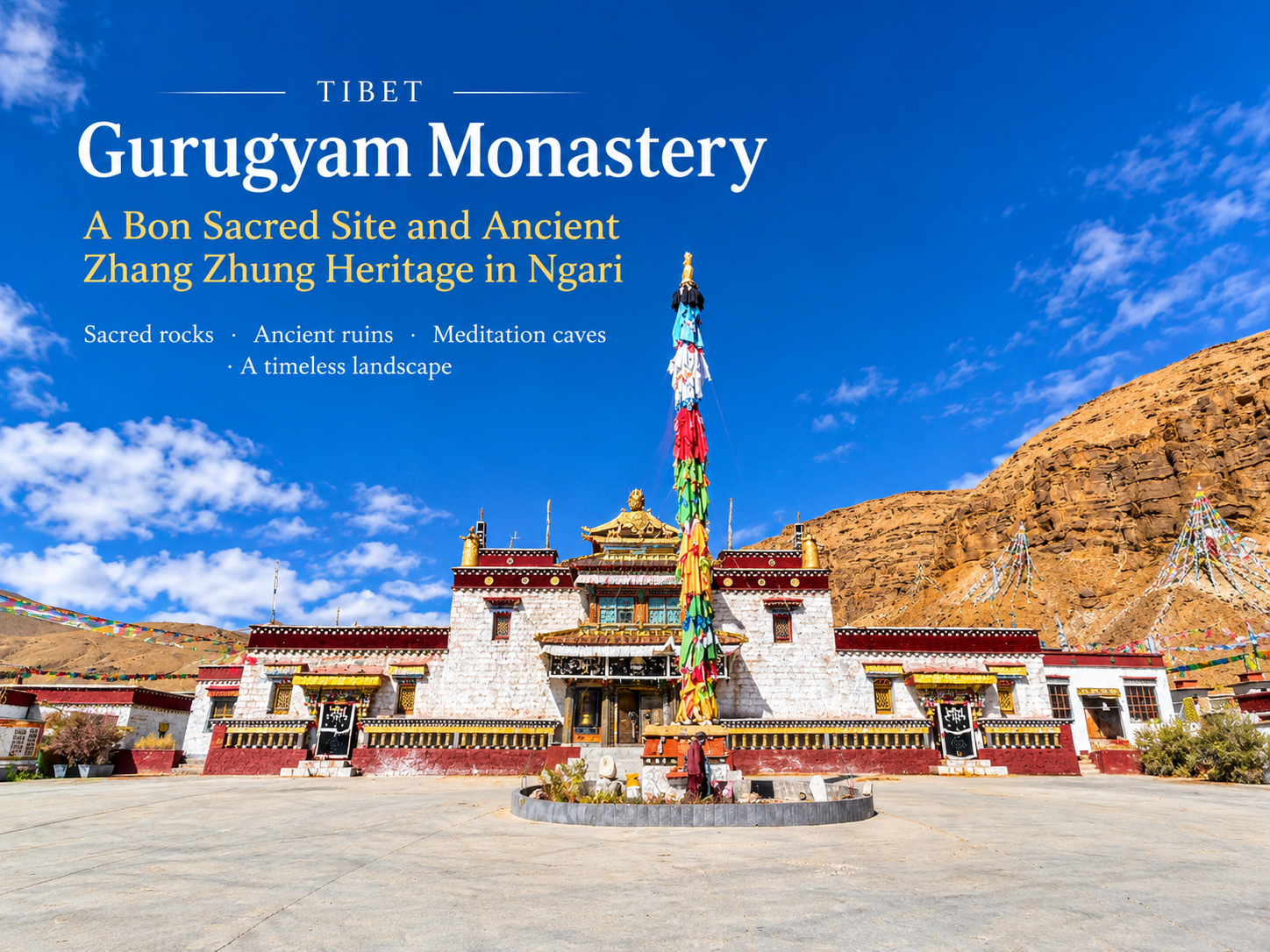
Gurugyam Monastery, also spelled Guru Gyam Monastery is one of the most important surviving Bon monasteries in Ngari, western Tibet. Located in Men’shi Township of Gar County, the monastery stands in a dramatic valley associated with the ancient Zhang Zhung kingdom, surrounded by colorful earthen formations, caves, ancient ruins, and sacred landscapes. Gurugyam is particularly important because it connects several layers of Tibetan history and culture: the indigenous Bon tradition, the ancient Zhang Zhung civilization, twentieth-century Bon revival, Tibetan medicine, religious printing, and archaeological discoveries.
The monastery lies close to the traditionally identified site of Khyunglung Ngül Khar, or the “Silver Garuda Fortress,” traditionally regarded as the capital of Zhang Zhung. A large ancient citadel known as Khardong (Mkhar-gdong) is also located nearby. The wider area is therefore one of the most intriguing cultural landscapes in western Tibet.
Where Is Gurugyam Monastery?
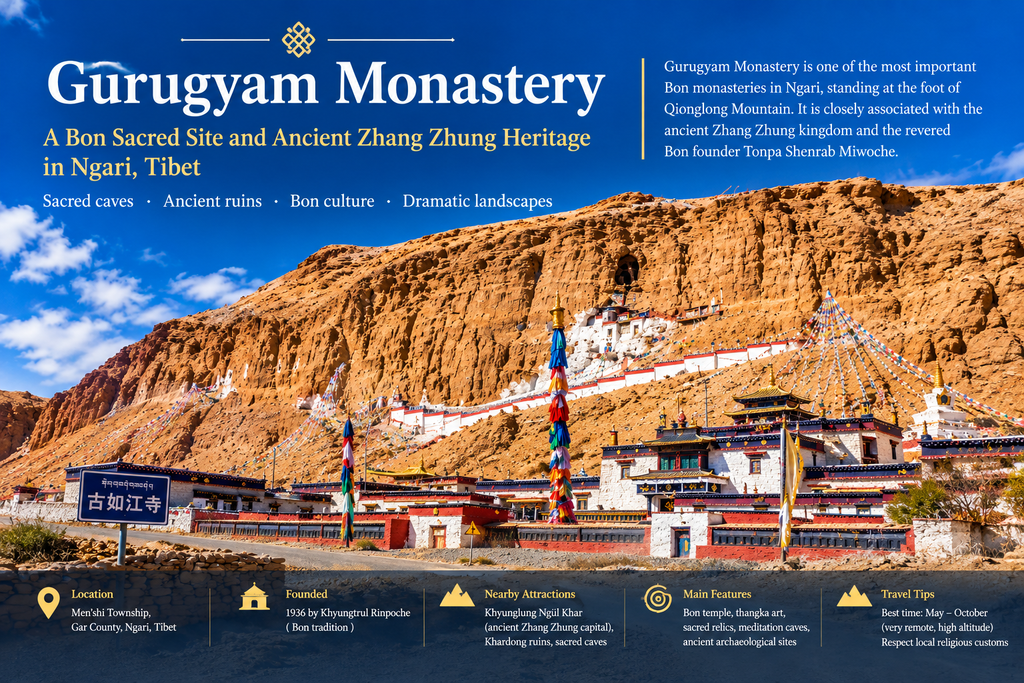
Gurugyam Monastery is located in Men’shi Township, Gar County, Ngari Prefecture, Tibet. The monastery sits in the upper reaches of the Sutlej River valley, in a remote landscape characterized by high mountains, colorful earth formations, cliffs, caves, and dry river valleys.
Traditional descriptions place the monastery in the area of Khyunglung Ngül Khar, one of the oldest Bon religious landscapes associated with Zhang Zhung. A survey of Bon monasteries places Gurugyam in Men’shi Township and describes the surrounding area as one of the oldest Bonpo religious sites. For travelers exploring western Tibet, Gurugyam can be combined with other important sites in the Gar and Zhang Zhung region, particularly for those interested in ancient Tibetan civilization rather than only the better-known pilgrimage destinations.
Gurugyam Monastery and Ancient Zhang Zhung
The history of Gurugyam cannot be separated from the story of Zhang Zhung, the ancient civilization traditionally associated with western Tibet. Bon historical traditions identify this region as an important center of Zhang Zhung and as a homeland of the early Bon tradition. Nearby Khyunglung Ngül Khar, traditionally translated as the Silver Garuda Fortress, is often identified in historical and religious literature with the capital of Zhang Zhung.
The exact identification and chronology of Zhang Zhung sites remain subjects of historical and archaeological study, so traditional accounts of the ancient kingdom should be distinguished from conclusions based on archaeological evidence. Nevertheless, the concentration of ruins, caves, tombs, and religious sites makes the Gurugyam valley one of the most important archaeological and cultural landscapes in western Tibet.
Khardong: The Ancient Citadel Near Gurugyam Monastery
One of the most striking archaeological features near Gurugyam is Khardong (Mkhar-gdong). The ruins are located on a raised mesa approximately one kilometer from the monastery, according to the travel account published by Peregrine Treks. The elevated citadel overlooks the surrounding valley and provides a dramatic reminder of the area’s ancient settlement history. The combination of the monastery and the nearby fortress is especially significant for travelers.
Within a short distance, visitors can encounter:
- A living Bon monastery
- Ancient fortress ruins
- Caves and meditation sites
- Colorful geological formations
- Archaeological remains
- A landscape traditionally connected with Zhang Zhung
This makes Gurugyam more than a monastery visit; it is an entry point into the wider ancient cultural landscape of Ngari.
Foundation of Gurugyam Monastery
Gurugyam Monastery was founded in 1936 by the great Bon master Khyungtrul Jigme Namkha Dorje (Khyungtrul Rinpoche). The University of Virginia’s survey of Bon monasteries records that Khyungtrul founded the monastery in 1936 and gives its monastic name as mDo sngags grags rgyas gling.
Khyungtrul came from the Hor region of eastern Tibet, but his major religious work was carried out in the Gurugyam valley of western Tibet. According to Bon historical traditions, he came to the region with the goal of strengthening and reviving the Bon tradition in an area regarded as one of its ancient homelands. He established the monastery close to the traditional location of Khyunglung Ngül Khar and beside a cave associated with the revered Bon master Drenpa Namkha.
Khyungtrul Rinpoche: Founder, Scholar and Physician
Khyungtrul Rinpoche was much more than a monastery founder. He was an influential Bon scholar, religious teacher, physician, writer, artist, poet, and composer.
According to the account of Gurugyam published by Peregrine Treks, Khyungtrul studied and wrote about subjects including:
- Tibetan medicine
- Astrology
- Tibetan grammar
- Bon philosophy
- Religious practice
He also had a reputation as a painter and composer of religious songs. His travels extended beyond Tibet. He visited India, Nepal, and Bhutan, where he explored important religious sites and developed connections with practitioners. His interest in knowledge and publishing would later have an important influence on Gurugyam.
Gurugyam Monastery as a Center of Bon Printing and Scholarship
One of the lesser-known aspects of Gurugyam Monastery is its role in the preservation and printing of Bon religious literature. Khyungtrul encountered modern printing technology while traveling in Delhi. After returning to Gurugyam, he devoted considerable effort to producing printed editions of important Bon and Buddhist texts. Among the works associated with his publishing activities were the collected writings of the influential Bon master Shardza Tashi Gyaltsen (1859–1935).
A copy of these collected works was reportedly preserved at Gurugyam. This makes the monastery important not only as a place of worship but also as a center for the preservation and transmission of Tibetan religious literature.
Thirteen Years to Build the Monastery
The construction of Gurugyam was a major undertaking. According to the Peregrine Treks account, Khyungtrul spent much of his time at Gurugyam overseeing the construction of the monastery and working on religious publications. After approximately 13 years, the monastery was completed in 1948.
Even while managing the construction project, Khyungtrul continued teaching, writing, and practicing Tibetan medicine. In 1949, he completed a substantial four-volume medical commentary known as Khyungtrul Menpe, reflecting his reputation as an important Tibetan medical scholar.
Gurugyam Monastery and Tibetan Medicine
Tibetan medicine is an important part of Gurugyam’s twentieth-century history. Khyungtrul was reportedly trained by several Tibetan physicians and became well known for his medical knowledge. People traveled to Gurugyam seeking his advice and treatment.
This connection between Bon religion and Tibetan medicine is significant because traditional Tibetan medical knowledge developed within a wider intellectual world that included religious practice, astrology, pharmacology, ritual, and natural observation. Gurugyam therefore represents more than a religious institution. Its history also reflects the preservation of traditional Tibetan knowledge.
The Architecture of Gurugyam Monastery
The monastery contains several religious halls and buildings associated with Bon practice.
Important structures include:
- Kadong Lhakhang
- Tsula Lhakhang, supported by 24 pillars
- Tsangkhang, with five pillars
- Gaden Gyula Lhakhang, with six pillars
The complex contains sacred images, ritual implements, scriptures, stupas, and other religious objects.
Gurugyam also has visual features associated with Yungdrung Bon, including the use of white in the architecture and decorative Garuda motifs. Another important distinction is the direction of ritual circumambulation.
Visitors familiar with Tibetan Buddhist monasteries should note that Bon pilgrimage traditionally follows a counterclockwise direction, unlike the clockwise circumambulation commonly practiced at Buddhist sites. Visitors should follow the local signs and the guidance of monks when performing circumambulation.
Bon Religious Art and Sacred Collections
Gurugyam preserves important examples of Bon religious art. Among its reported treasures are 12 thangka paintings depicting the virtuous deeds of Shenrab Miwoche, the principal founder figure of Yungdrung Bon.
The monastery also preserves:
- Bon scriptures
- Stupas
- Ritual implements
- Religious paintings
- Sacred images
- Manuscripts and printed texts
These collections help demonstrate the depth of Bon’s religious and artistic traditions. The monastery is particularly valuable for travelers who want to see Bon religious culture in its own institutional setting, rather than learning about Bon only through general accounts of Tibetan Buddhism.
Gurugyam Monastery and the Revival of Bon
The establishment of Gurugyam in the twentieth century formed part of a broader revival of Bon scholarship and monastic activity. Khyungtrul was a contemporary of the renowned Bon master Shardza Tashi Gyaltsen, who lived from 1859 to 1935.
Both figures played important roles in strengthening Bon intellectual and religious traditions during the late nineteenth and early twentieth centuries. While Shardza became particularly famous for his extensive writings, Khyungtrul was influential through his combination of religious teaching, scholarship, medicine, artistic work, travel, and publishing. Their legacy remains important within Bon communities today.
Gurugyam Monastery Archaeological Museum
One of the most fascinating aspects of Gurugyam is its connection with archaeological discoveries. In 2006, monks living near the monastery discovered an ancient burial site.
According to the Peregrine Treks account, excavation recovered part of a femur that was dated to approximately 220–350 CE. Other objects found in the burial were believed to belong broadly to the same period, although some may have been older. The discovery included a remarkable collection of burial objects.
Reported finds include:
- Silk
- Thick-walled vessels
- Turned wooden objects
- A bronze cup
- Silver objects
- A copper bellows tube
- A fragment of human skull
The collection is particularly interesting because it provides material evidence for the complexity of ancient societies in western Tibet.
What the Gurugyam Archaeological Finds Tell Us
The objects discovered near Gurugyam indicate that people living in this region possessed sophisticated manufacturing and material traditions. The quality and variety of the burial objects suggest that the individual buried there held a relatively high social position.
The objects also point toward technological skills and possible long-distance exchange networks. Importantly, the archaeological material should be treated separately from traditional accounts identifying Gurugyam with the capital of Zhang Zhung.
The archaeological discoveries provide physical evidence of ancient occupation and material culture, while the identification of specific ancient kingdoms or historical figures involves additional interpretation. For visitors, however, the combination of archaeological evidence and living religious tradition makes Gurugyam exceptionally interesting.
Yungdrung Bon: The Indigenous Religious Tradition of Tibet
Bon, particularly Yungdrung Bon, is an indigenous Tibetan religious tradition with its own scriptures, philosophy, rituals, monasteries, and lineages. Traditional Bon histories trace the origins of the tradition to Tonpa Shenrab Miwoche, who is believed by Bon followers to have lived in the ancient Zhang Zhung world.
Bon traditions describe Shenrab as a great teacher who organized and transformed earlier religious practices into Yungdrung Bon.
Bon religious culture includes teachings and practices concerning:
- Meditation
- Ethics
- Healing
- Ritual
- Longevity
- Cosmology
- Divination
- Spiritual liberation
Buddhism and Bon have also interacted for centuries, resulting in a complex religious history in Tibet. Today, Bon remains a living religious tradition with monasteries, monks, scholars, practitioners, and communities in Tibet and across the wider Himalayan region.
Shenrab Miwoche and Zhang Zhung
For Bon followers, Shenrab Miwoche is the central founding figure of their tradition. Bon religious texts describe him as an ancient teacher associated with Zhang Zhung.
Traditional accounts credit him with teaching numerous religious disciplines and transmitting knowledge concerning medicine, ritual, astrology, craftsmanship, and spiritual practice. Some Bon traditions describe him as having reformed earlier practices, including rejecting harmful forms of animal sacrifice.
These accounts are central to Bon religious identity. At the same time, the chronology and historical details of Shenrab Miwoche belong primarily to Bon textual and religious traditions and should not be presented as independently established historical facts.
The Sacred Caves Around Gurugyam Monastery
The Gurugyam valley is famous for its caves as well as its monastery and archaeological remains. One particularly important cave is traditionally associated with Drenpa Namkha, an important Bon master generally placed in the eighth century in Bon tradition.
The monastery was deliberately established near this sacred landscape, reinforcing the connection between ancient meditation traditions and the twentieth-century revival of Bon at Gurugyam. The caves, cliffs, and unusual geological formations give the valley a distinctive atmosphere and help explain why the area became a focus of religious practice.
The Gurugyam Valley Landscape
The landscape around Gurugyam is one of the most visually distinctive parts of the journey.
The upper Sutlej valley contains:
- Brightly colored earth formations
- High cliffs
- Natural caves
- Dry mountain valleys
- Ancient ruins
- Archaeological sites
- Monastic buildings
The contrast between the colorful sedimentary formations and the stark high-altitude environment creates a landscape unlike the greener valleys of southeastern Tibet. For photographers and travelers interested in geology, archaeology, and Tibetan culture, the journey itself can be as rewarding as the monastery.
Why Visit Gurugyam Monastery?
Gurugyam offers several experiences in one destination.
1. Explore a Living Bon Monastery
Gurugyam remains an active religious institution and provides an opportunity to learn about Yungdrung Bon directly within a Bon monastic setting.
2. Discover Ancient Zhang Zhung Heritage
The monastery stands in a landscape traditionally associated with Khyunglung Ngül Khar and ancient Zhang Zhung.
3. See Bon Religious Art
The monastery’s thangkas, sacred images, scriptures, and ritual objects offer insight into Bon artistic traditions.
4. Learn About Khyungtrul Rinpoche
The monastery preserves the legacy of a remarkable twentieth-century Bon master who combined religion, scholarship, medicine, art, and publishing.
5. Visit an Archaeological Landscape
Nearby ruins and ancient burial discoveries add an archaeological dimension to the journey.
6. Experience Remote Ngari
Gurugyam is far removed from Tibet’s busiest tourist destinations, making it particularly suitable for travelers seeking the lesser-known cultural heritage of western Tibet.
Historical sources give somewhat different travel distances and present-day access descriptions, so travelers should confirm the current route locally before departure. An academic survey describes the road approach through Men’shi Township and notes the monastery’s remote setting.
How to Visit Gurugyam Monastery Respectfully
Gurugyam is an active religious site, not simply an archaeological attraction.
Visitors should:
- Dress modestly.
- Speak quietly inside religious buildings.
- Ask before photographing monks or ceremonies.
- Avoid touching statues, scriptures, or ritual objects.
- Follow the monastery’s instructions regarding circumambulation.
- Do not remove stones or archaeological objects.
- Avoid entering restricted areas or caves without permission.
- Make offerings only if they wish; offerings should never be treated as compulsory.
Because Bon circumambulation traditionally follows a counterclockwise direction, visitors should pay attention to local practice rather than automatically following the clockwise direction familiar from Buddhist monasteries.
Best Time to Visit Gurugyam
The most practical period for exploring remote Ngari is generally during the warmer travel season, when road conditions are more manageable. May to October is traditionally the more active pilgrimage and travel period cited for Gurugyam, although actual conditions can vary each year.
Western Tibet remains a high-altitude environment, so even during summer travelers should prepare for:
- Cold nights
- Strong sunlight
- High UV exposure
- Wind
- Rapid weather changes
- Long driving distances
Before visiting, check current road conditions, local access arrangements, weather, and applicable Tibet travel permits.
Gurugyam Monastery and the Wider Ngari Journey
Gurugyam is particularly worthwhile when incorporated into a broader Ngari cultural journey. A route through this part of western Tibet can combine religious and archaeological landscapes, including the heritage associated with ancient Zhang Zhung, the wider Khyunglung region, and the pilgrimage landscapes surrounding Mount Kailash and Lake Manasarovar.
For travelers whose main interest is Tibetan religion, Gurugyam offers something different from the major Gelug, Kagyu, Sakya, and Nyingma monasteries commonly featured on standard Tibet itineraries. It provides a direct introduction to Bon religious history and its continuing presence in western Tibet.
Gurugyam Monastery: Where Bon, Zhang Zhung and Archaeology Meet
Gurugyam Monastery is one of the most fascinating cultural sites in western Tibet because several different histories converge here. The monastery represents the living tradition of Yungdrung Bon.
The surrounding landscape preserves traditions associated with ancient Zhang Zhung. Nearby caves preserve memories of Bon masters and meditation practices. The work of Khyungtrul Rinpoche connects the site with twentieth-century Bon revival, Tibetan medicine, scholarship, art, and religious printing.
And the archaeological discoveries near the monastery provide tangible evidence of ancient communities that lived in this remote part of the Tibetan Plateau. Together, these elements make Gurugyam much more than an isolated monastery. It is a place where religion, archaeology, ancient civilization, medicine, literature, art, and the dramatic landscape of Ngari come together.
For travelers looking beyond the standard Tibet itinerary, Gurugyam Monastery offers one of the clearest opportunities to explore the living heritage of Bon and the ancient cultural landscape of western Tibet.