
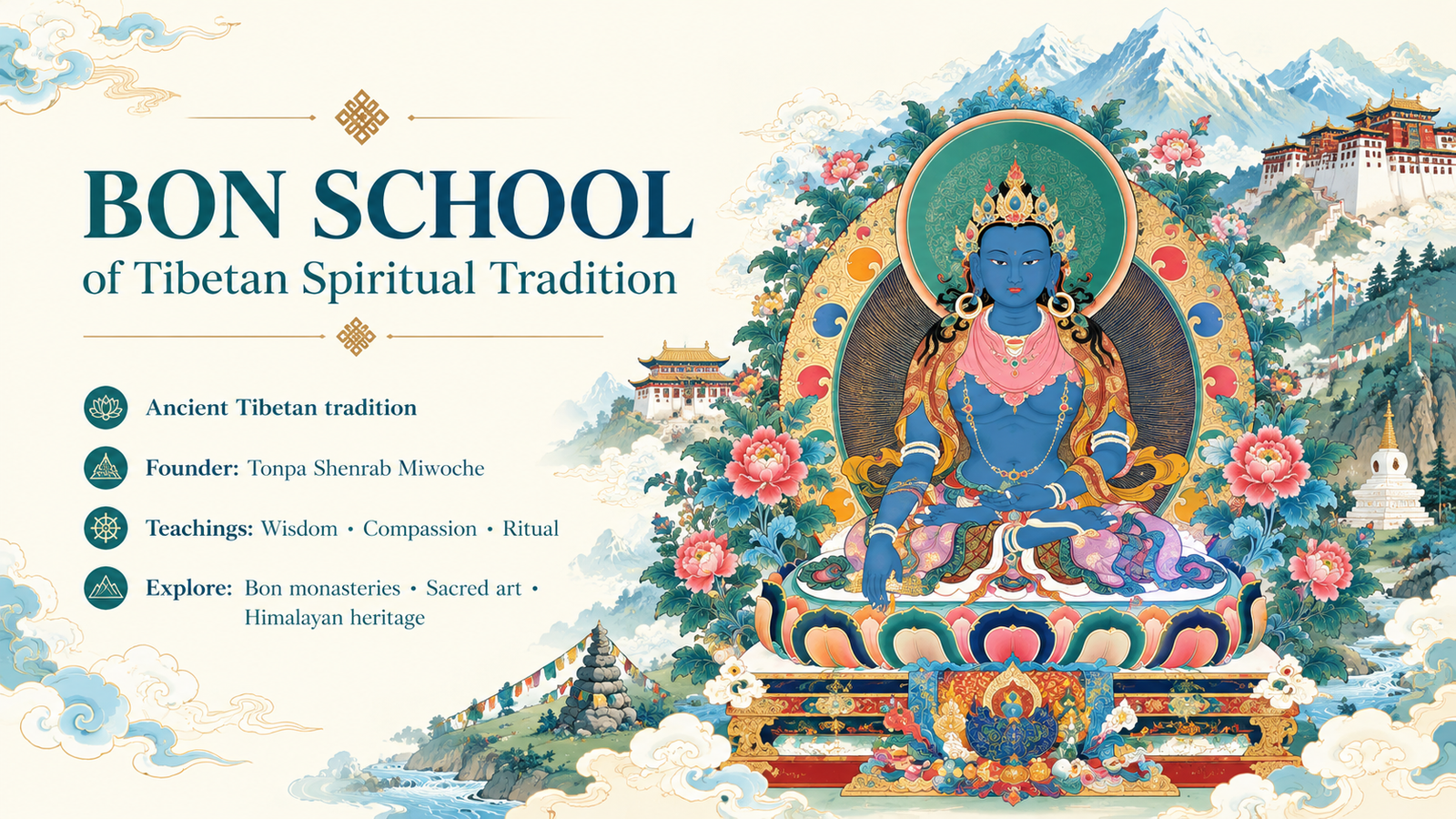
Bon (བོན་), particularly Yungdrung Bon, is one of the most distinctive religious traditions of the Tibetan Plateau. Often described as Tibet’s indigenous religious tradition, Bon developed in the cultural world of ancient Zhang Zhung and preserves a rich heritage of rituals, mythology, meditation, sacred mountains and lakes, oral teachings, and revealed texts. Bon is a complex religious tradition rather than simply a counterpart to Tibetan Buddhism.
One of its most recognizable symbols is the counterclockwise swastika, known in Tibetan as the Yungdrung. In traditional Bon pilgrimage practice, sacred sites such as mountains and lakes are generally circumambulated counterclockwise, while Buddhist pilgrimage is generally performed clockwise. Today, Bon monasteries and sacred sites can be found across Tibetan cultural area and the Himalayan region, with particularly important centers in western Tibet, Nagqu, and eastern Tibet.
Who Founded Bon?
The traditional founder of Yungdrung Bon is Tönpa Shenrab Miwoche, regarded by Bon followers as the Buddha and principal teacher of the Bon tradition. According to Bon tradition, Shenrab Miwoche came from the ancient western Tibetan cultural world and transmitted teachings covering ethics, rituals, cosmology, meditation, medicine, astrology, and spiritual practice. However, it is important to distinguish between early Tibetan indigenous religious practices and the later organized Yungdrung Bon tradition.
Early Indigenous Bon Practices
Before the development of an organized religious system, communities across the Tibetan Plateau practiced diverse forms of indigenous religion.
These included:
- Mountain and lake worship
- Reverence for local deities and spirits
- Ritual specialists and divination
- Offerings and protective rituals
- Funeral and purification ceremonies
- Ritual traditions connected with kingship and agriculture
These practices are sometimes collectively described as pre-Buddhist Bon, although historians generally caution against treating all early Tibetan religious practices as one unified religion.
The Development of Yungdrung Bon
Yungdrung Bon developed into a more systematic religious tradition with its own scriptures, cosmology, ethical teachings, meditation systems, rituals, and monastic institutions. Bon tradition attributes this transformation to Shenrab Miwoche. Over time, Bon developed its own sophisticated system of teachings, including a Nine Ways or Nine Vehicles framework and its own traditions of Dzogchen, ritual practice, meditation, and sacred literature.
History of Bon in Tibet
Bon and Ancient Zhang Zhung
Western Tibet and the region traditionally associated with Zhang Zhung occupy an important place in Bon historical memory. The Ngari region, including areas around Mount Kailash and Lake Manasarovar, remains especially important to Bon pilgrims. According to Bon tradition, the sacred geography of western Tibet contains many sites connected with ancient Bon masters, deities, and spiritual events. For modern travelers, this makes western Tibet particularly important for understanding the relationship between Bon, Zhang Zhung, and the sacred landscape of the Tibetan Plateau.
Bon During the Tibetan Empire
During the Tibetan Empire of the 7th–9th centuries, Buddhism gradually became increasingly influential among the Tibetan elite. Buddhist and indigenous religious traditions interacted, competed, and influenced one another. The reign of King Trisong Detsen is traditionally associated with the establishment of Buddhism as a major religious force in Tibet and the construction of Samye Monastery. Later political and religious changes affected both Buddhist and indigenous traditions.
The Later Development of Bon
During the later spread of Buddhism in Tibet, Bon developed its own institutional and textual traditions.
Bon practitioners preserved teachings through:
- Oral transmission
- Revealed treasure texts
- Monastic education
- Meditation lineages
- Ritual traditions
Monasteries from Bon eventually developed across central and eastern Tibet, while important Bon communities survived in remote areas. Bon did not establish a centralized political government comparable to the Sakya or later Gelug political systems.
Tonpa Shenrab Miwoche
For Bon followers, Tonpa Shenrab Miwoche is the central religious teacher. Traditional Bon biographies describe him as a great spiritual master who taught a comprehensive path encompassing both worldly and spiritual knowledge.
His teachings are traditionally associated with:
- Ethics and moral conduct
- Ritual purification
- Protection practices
- Meditation
- Cosmology
- Medicine
- Astrology
- Funeral rituals
- Tantric practices
- Dzogchen
His importance to Bon is comparable, within the Bon tradition, to the central role that Shakyamuni Buddha plays in Buddhist traditions.
Important Bon Masters
- Tonpa Shenrab Miwoche: The principal Buddha and founder of Yungdrung Bon according to Bon tradition.
- Zhang Zhung Nyen Gyud Masters: Oral Transmission of Zhang Zhung, is one of the most important Bon meditation traditions and is especially associated with the preservation of ancient Bon contemplative teachings.
- Treasure Revealers: Like some Tibetan Buddhist traditions, Bon developed its own tradition of terma, or revealed treasure teachings.
Treasure revealers discovered teachings believed to have been concealed in sacred landscapes or transmitted through visionary experiences. These revelations became an important mechanism for preserving and renewing Bon teachings.
Bon Monasteries and Sacred Places
Zizhu Monastery
Zizhu Monastery (孜珠寺) in Dingqing County, Chamdo, is one of the most spectacular Bon monasteries in eastern Tibet. Built among dramatic mountain peaks, the monastery appears to cling to the cliffs above the surrounding landscape.
It is famous for:
- Bon religious traditions
- Dramatic mountain architecture
- Meditation caves
- Ritual ceremonies
- Bon sacred dance
- Traditional religious festivals
For travelers exploring northern Sichuan–Tibet or eastern Tibet, Zizhu Monastery is one of the most visually impressive Bon destinations.
Gurugyang Monastery
Gurugyang Monastery in Ngari is associated with the Bon tradition and is particularly interesting because of its proximity to the archaeological and cultural landscape traditionally associated with ancient Zhang Zhung. It can be incorporated into a longer Ngari or Northern Route Tibet itinerary.
Yungdrung Bon Sites Around Dangra Yumtso
Dangra Yumtso (Lake Dangra) is one of the most sacred lakes in Bon tradition. Located in northern Tibet, the lake is surrounded by mountains, caves, monasteries, and sacred landscapes associated with Bon religious history. For Bon pilgrims, Dangra Yumtso is an especially important sacred site. The remote location also means that visiting the region requires careful planning, appropriate permits, transportation, and preparation for high-altitude conditions.
Serzhig Monastery
Serzhig Monastery in Shigatse is another important Bon institution in Tibet and represents the continued presence of Bon in western and central Tibetan regions.
The Yungdrung Symbol
One of the easiest ways to recognize Bon religious culture is the Yungdrung symbol. The Yungdrung is traditionally represented as a counterclockwise swastika and has deep symbolic meaning within Bon. The symbol should not be confused with the modern political appropriation of the swastika in Europe. The swastika is an ancient religious symbol found across Asia and has been used for thousands of years in different cultural and religious contexts.
In Bon culture, the Yungdrung represents concepts including:
- Permanence
- Spiritual stability
- The eternal nature of the teachings
- Auspiciousness
Clockwise and Counterclockwise Pilgrimage
One of the most interesting differences between Bon and Tibetan Buddhist pilgrimage traditions is the traditional direction of circumambulation.
- Bon pilgrimage: Counterclockwise
- Tibetan Buddhist pilgrimage: Clockwise
This difference can be particularly noticeable when visiting sacred mountains, lakes, monasteries, and pilgrimage routes shared by different religious traditions.
However, travelers should always follow the specific instructions of the local monastery or pilgrimage site, because practices can vary depending on the location.
Core Teachings of Yungdrung Bon
The Nine Ways
Bon has its own sophisticated system known as the Nine Ways or Nine Vehicles. The system organizes different levels of religious practice, ranging from ritual and ethical teachings to advanced meditation. At its highest level is Dzogchen, or the Great Perfection.
Bon Dzogchen
Tibetan Bon religion has its own Dzogchen tradition, which is independent in lineage from Buddhist Dzogchen traditions while sharing important terminology and philosophical themes. Bon Dzogchen emphasizes direct recognition of the nature of mind and the primordial purity and spontaneous presence of awareness. This makes Bon Dzogchen an important subject for anyone studying the broader history of Tibetan contemplative traditions.
Oral Transmission
Bon teachings have traditionally been transmitted through teacher-to-student oral lineages. Oral transmission remains important for advanced meditation and tantric teachings.
Treasure Tradition
Another distinctive feature is the tradition of revealed treasures. Bon practitioners believe that important teachings were concealed and later revealed by spiritually accomplished masters. These teachings helped preserve Bon identity through periods when its institutions were under pressure.
Bon and Nature Worship
Bon is closely associated with the sacred geography of the Tibetan Plateau. Mountains, lakes, caves, rivers, and unusual rock formations can have profound religious significance. Many sacred mountains and lakes in Tibet are associated with indigenous religious traditions that predate or developed alongside Buddhism. Later Tibetan Buddhist traditions also incorporated many local deities and sacred places into their own religious systems.
Therefore, Tibet’s sacred landscape cannot always be divided neatly into “Bon” and “Buddhist” categories. Centuries of interaction created a complex religious environment.
Bon Monks and Lay Practitioners
Bon communities include both monastic practitioners and lay religious specialists. Historically, some Bon ritual specialists lived outside monasteries and performed ceremonies for local communities.
These traditions could include:
- Ritual protection
- Divination
- Healing ceremonies
- Funeral rituals
- Blessings
- Exorcism and purification ceremonies
This combination of monastic and lay traditions helped Bon remain connected to Tibetan village life.
Bon and Tibetan Buddhism: Similarities and Differences
Bon and Tibetan Buddhism have influenced one another for centuries.
Modern Yungdrung Bon has sophisticated systems of:
- Monastic education
- Scriptures
- Tantra
- Meditation
- Dzogchen
- Ritual
- Philosophy
- Sacred geography
- Reincarnation and religious lineages
At the same time, Bon maintains its own scriptural canon, mythology, cosmology, ritual traditions, historical narratives, and lineage systems. Therefore, describing Bon simply as “Tibetan Buddhism” is inaccurate. It is better understood as a distinct Tibetan religious tradition that has interacted deeply with Buddhism throughout Tibetan history.
Best Bon Destinations for Tibet Travelers
Zizhu Monastery
Best for travelers interested in: Bon architecture + mountain scenery + religious festivals + traditional rituals. Its spectacular cliffside setting makes it one of the most memorable Bon monasteries in Tibet.
Dangra Yumtso
Best for: Bon pilgrimage + sacred lake + ancient Tibetan landscape. The remote environment provides a powerful introduction to Bon’s connection with sacred geography.
Ngari and Ancient Zhang Zhung
The Ngari region is ideal for travelers interested in the relationship between Bon traditions and ancient Zhang Zhung. A longer western Tibet itinerary can combine Bon sites with Mount Kailash, Lake Manasarovar, the ruins associated with Zhang Zhung, and other sacred landscapes.
Northern Tibet
Northern Tibet offers some of the least-visited landscapes associated with Bon culture. Because many locations are extremely remote, these journeys require experienced local planning and appropriate travel permits.
Bon Travel Etiquette
- Follow the correct direction: At Bon pilgrimage sites, circumambulation is traditionally counterclockwise. When unsure, ask a local guide or monastery staff.
- Respect religious ceremonies: Treat Bon dances, chanting, rituals, offerings, and ceremonies as religious practices, not tourist performances. Remain quiet and respectful.
- Follow photography rules: Photography restrictions vary by monastery. Always ask permission and follow signs or instructions, especially around statues, scriptures, murals, and ritual objects.
- Prepare for high altitude: Many Bon sites are remote and located at high elevations. Allow time to acclimatize and prepare for cold weather, long journeys, limited facilities, and changing road conditions.
Why Visit Bon Sites in Tibet?
For travelers interested in Tibetan culture, ancient Zhang Zhung, Tibetan religion, sacred mountains, and off-the-beaten-path Tibet, Bon sites offer a different perspective from the famous Buddhist monasteries of Lhasa. A visit to Zizhu Monastery, Dangra Yumtso, or Bon sites in Ngari can reveal another layer of Tibetan history—one connected with ancient indigenous traditions, sacred landscapes, oral teachings, meditation, and the cultural memory of Zhang Zhung.
Rather than viewing Bon simply as a “religion before Buddhism,” it is more accurate to understand Yungdrung Bon as a living Tibetan religious tradition with its own institutions, scriptures, philosophy, rituals, and practitioners.
Frequently Asked Questions About Bon
Is Bon the original religion of Tibet?
Bon represents important indigenous religious traditions of the Tibetan Plateau, but the historical development of Bon was complex. Modern Yungdrung Bon developed into a structured religious tradition over many centuries.
Who is the founder of Bon?
Tonpa Shenrab Miwoche is regarded by Yungdrung Bon followers as its principal Buddha and founder.
What is the difference between Bon and Tibetan Buddhism?
Bon is a distinct Tibetan religious tradition with its own scriptures, cosmology, rituals, and lineages. It developed alongside and interacted extensively with Tibetan Buddhism.
Why do Bon pilgrims walk counterclockwise?
Traditional Bon circumambulation is generally performed counterclockwise, reflecting Bon religious customs and the symbolism of the Yungdrung.
What is Yungdrung Bon?
Yungdrung Bon is the organized and developed form of Bon that exists today, with its own monastic institutions, scriptures, meditation systems, rituals, and philosophical traditions.
Where can I see Bon monasteries in Tibet?
Important destinations include Zizhu Monastery in Chamdo, Bon sites around Dangra Yumtso in northern Tibet, Bon monasteries in Ngari, and Serzhig Monastery in Shigatse.
Is Bon still practiced today?
Yes. Bon remains a living religious tradition, with monasteries, monks, teachers, practitioners, rituals, pilgrimage sites, and communities across the Tibetan cultural region.
Conclusion
Yungdrung Bon is one of the most fascinating and least understood religious traditions of Tibet. Its history is connected with ancient Tibetan culture, Zhang Zhung, sacred mountains and lakes, Tonpa Shenrab Miwoche, revealed treasures, Dzogchen, and distinctive pilgrimage traditions.
For visitors, Bon offers an opportunity to see Tibet beyond the best-known Buddhist landmarks. From the dramatic cliffs of Zizhu Monastery to the remote sacred waters of Dangra Yumtso and the ancient landscapes of Ngari, Bon heritage provides a deeper understanding of the cultural and religious diversity of the Tibetan Plateau.



[…] important because it connects several layers of Tibetan history and culture: the indigenous Bon tradition, the ancient Zhang Zhung civilization, twentieth-century Bon revival, Tibetan medicine, religious […]