
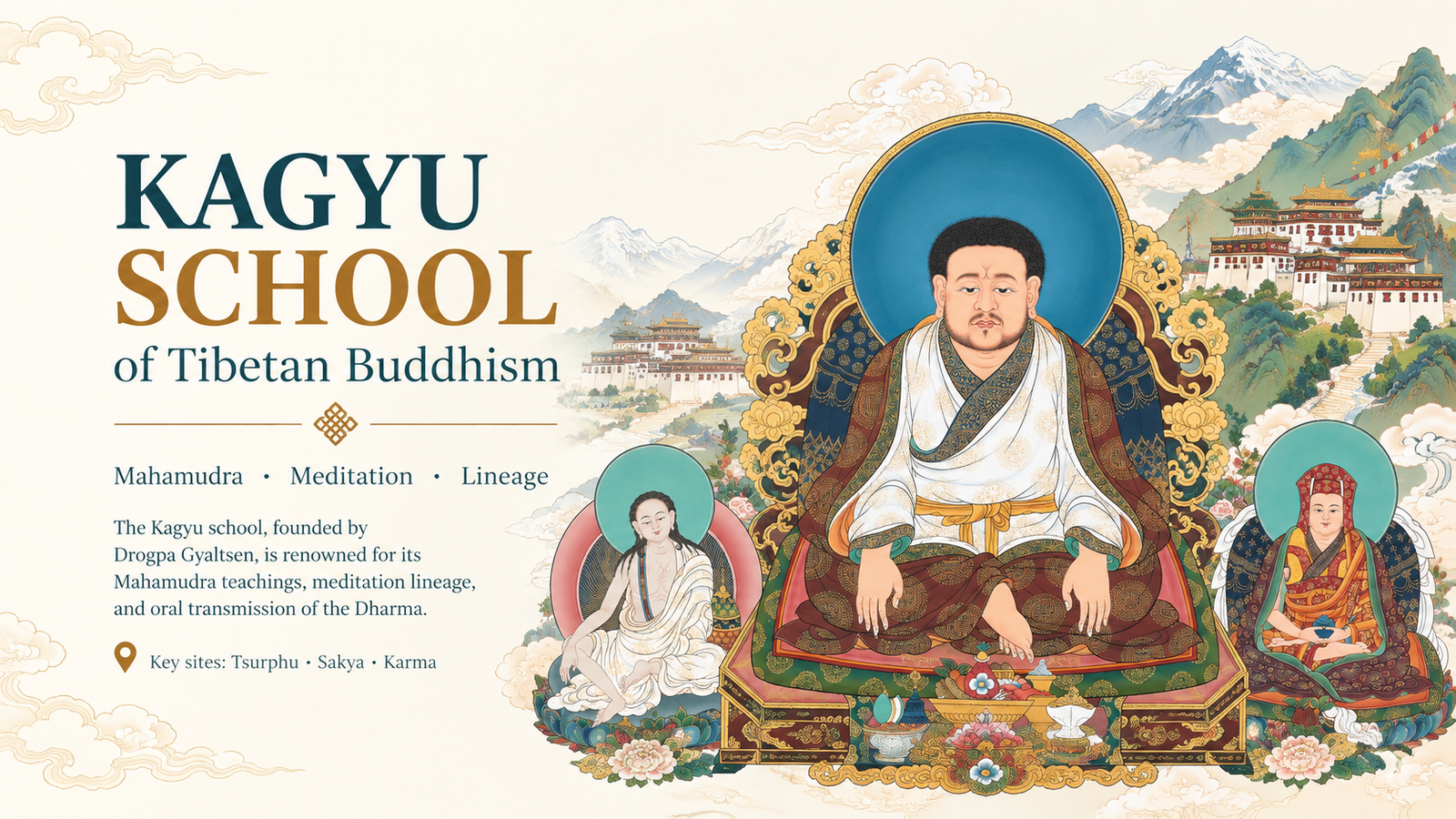
The Kagyu School of Tibetan Buddhism is one of the four major traditions of Tibetan Buddhism. The Tibetan word “Kagyu” (བཀའ་བརྒྱུད་) means oral transmission. Kagyu school is particularly famous for Mahamudra meditation and the Six Yogas of Naropa. It also played a major role in the development of the tulku, or reincarnate lama, with the Karma Kagyu tradition traditionally regarded as the first Tibetan Buddhist lineage to establish a formal reincarnation lineage.
The Kagyu tradition traces much of its Indian lineage to great Buddhist masters such as Tilopa, Naropa, Maitripa, and Niguma. Their teachings were brought to Tibet by accomplished translators and yogis, particularly Marpa Lotsawa, and were later transmitted through masters such as Milarepa and Gampopa. The word Kagyu is generally understood as referring to an oral transmission lineage, reflecting the tradition’s strong emphasis on direct teacher-to-student transmission of Buddhist teachings and meditation instructions.
Unlike the highly centralized monastic universities associated with the Gelug tradition, many Kagyu lineages historically placed greater emphasis on meditation, retreat, experiential realization, and direct teacher-student transmission. Today, major Kagyu traditions remain active across Tibet, China, Bhutan, Nepal, India, and Tibetan Buddhist communities around the world.
Indian Origins of the Kagyu School
The roots of the Kagyu lineage extend back to the great Indian Mahasiddhas. Among the most important figures were Tilopa, Naropa, Maitripa, Niguma, and other tantric masters. Traditional Kagyu accounts trace the tantric lineage back to Vajradhara, the primordial Buddha associated with the transmission of Vajrayana teachings. These teachings were passed through successive Indian masters before reaching Tibet.
Two major early Tibetan transmission streams became particularly important in the development of Kagyu Buddhism:
- Marpa Lotsawa, who established the lineage that eventually gave rise to the Dakpo Kagyu traditions.
- Khyungpo Naljor, who founded the Shangpa Kagyu tradition.
These two transmission systems developed independently but shared important Indian Buddhist tantric sources.
Marpa Lotsawa: Bringing Indian Teachings to Tibet
Marpa Lotsawa Chokyi Lodro (c. 1012–1097) was one of the most important figures in the early history of the Kagyu school. A gifted Tibetan translator, Marpa traveled repeatedly to India and Nepal in search of Buddhist teachings. During his journeys, he studied with numerous Indian masters and received important teachings on Buddhist philosophy, Tantra, and meditation.
Among his principal teachers was Naropa, one of the great Mahasiddhas of India. From Naropa, Marpa received teachings associated with the Six Yogas of Naropa, including practices concerning inner heat, illusory body, dream yoga, clear light, consciousness transference, and the intermediate state. Marpa returned to Tibet and transmitted these teachings to his disciples. His most famous student was the great Tibetan yogi Milarepa.
Milarepa and the Meditation Tradition
Milarepa (c. 1040–1123) is one of the most celebrated meditation masters in Tibetan Buddhist history. After receiving teachings from Marpa, Milarepa devoted himself to intensive meditation and retreat. Tibetan Buddhist tradition regards him as a great realized yogi who attained profound spiritual realization within his lifetime.
His life became a model of renunciation, perseverance, meditation, and spiritual transformation. Milarepa became especially famous for his songs of realization, which express Buddhist teachings through poetry and direct personal experience. His poetry remains one of the most beloved forms of Tibetan Buddhist literature. His meditation lineage was continued by several disciples, including Gampopa and Rechungpa, while other students helped transmit different aspects of Marpa’s teachings.
Gampopa and the Development of Dakpo Kagyu
Gampopa (1079–1153) was one of the most influential disciples in the development of the Kagyu tradition. He received meditation instructions from Milarepa and combined the Kagyu tantric meditation practices with the teachings of the Kadampa tradition that he had previously studied.
He brought together the practices of Mahamudra and the Six Yogas of Naropa into a systematic path of Buddhist practice. This lineage became known as Dakpo Kagyu, which later developed into several major Kagyu schools.
Because of its influence on many later Kagyu traditions, Dakpo Kagyu is often regarded as the principal mother lineage of the modern Kagyu schools. From the Dagpo Kagyu lineage developed numerous important Kagyu branches, traditionally described as the Four Great and Eight Lesser Kagyu Schools.
The Four Major Kagyu School
The Dakpo Kagyu tradition eventually developed into several major branches. Four became particularly influential:
Karma Kagyu
Karma Kagyu, also known as the Karmapa lineage, was founded by Düsum Khyenpa (1110–1193), who became the first Karmapa. The Karma Kagyu tradition became one of the most internationally recognized Kagyu lineages. It places strong emphasis on Mahamudra meditation, tantric practice, and the lineage of the Karmapas.
Barom Kagyu
Barom Kagyu was established by Barom Darma Wangchuk, a disciple in the Dakpo Kagyu tradition. Although smaller than some other Kagyu schools, the Barom lineage contributed to the preservation and transmission of Kagyu meditation teachings.
Tsalpa Kagyu
Tsalpa Kagyu was founded by Zhang Tsalpa Tsondru Drakpa. It became another important branch of the Dakpo Kagyu tradition and contributed to the development of later Kagyu lineages.
Phagdru Kagyu
Phagdru Kagyu was established by Phagmo Drupa Dorje Gyalpo, one of Gampopa’s major disciples. It became particularly influential because several later Kagyu sub-schools developed from this lineage.
The Eight Major Kagyu Sub-Schools
The Phagdru Kagyu tradition eventually gave rise to a number of important branches, traditionally described as the Eight Minor Kagyu Schools.
These include:
- Drikung Kagyu – founded by Jigten Sumgön, an important disciple of Phagmo Drupa.
- Taklung Kagyu – established by Taklung Thangpa Tashi Pal.
- Trophu Kagyu – associated with Gyal Tsha and Kunden Repa.
- Drukpa Kagyu – developed through Lingre Pema Dorje and Tsangpa Gyare Yeshe Dorje.
- Martsang Kagyu – founded by Marpa Drubthob Sherab Senge.
- Yelpa Kagyu – established by Drubthob Yeshe Tsegpa.
- Yazang Kagyu – associated with Sharawa Kalden Yeshe Senge.
- Shugseb Kagyu – founded by Gyergom Chenpo.
These branches developed different approaches to transmitting and practicing the core Kagyu teachings while maintaining connections to the wider Dakpo Kagyu heritage.
Shangpa Kagyu Tradition
The Shangpa Kagyu tradition developed through Khyungpo Naljor (978–1079), a Tibetan master and translator. Khyungpo Naljor traveled to Nepal and India, where he studied with numerous Buddhist teachers and received extensive teachings on both Sutra and Tantra.
Among his most important teachers were Niguma, Sukhasiddhi, and Rahulagupta. Niguma, in particular, is one of the most important figures in the Shangpa tradition and is associated with a distinctive transmission of advanced tantric meditation practices. After returning to Tibet, Khyungpo Naljor established his own lineage. This became known as Shangpa Kagyu, one of the two major early Kagyu transmission traditions.
Unlike the Dakpo Kagyu lineage, the Shangpa tradition developed through its own distinctive meditation and tantric transmissions. Although historically influential, the Shangpa Kagyu became less institutionally widespread than some of the Dagpo Kagyu branches. Its teachings nevertheless remain part of the wider heritage of Tibetan Buddhist tantric practice.
The Development of the Kagyu school
The 11th and 12th Centuries
The foundations of Kagyu Buddhism were established through the transmission of Indian tantric teachings by Marpa, Milarepa, Gampopa, and their successors.
The tradition developed through a combination of: Tantric teachings + meditation retreat + Mahamudra + oral transmission
Rather than creating a single centralized institution, Kagyu teachings spread through multiple masters and independent monasteries.
The Rise of the Karma Kagyu Lineage
One of the most influential Kagyu branches became the Karma Kagyu, founded by Düsum Khyenpa (1110–1193), traditionally recognized as the First Karmapa. Düsum Khyenpa established important monasteries, including Tsurphu Monastery, which later became the principal seat of the Karmapas in central Tibet. The Karma Kagyu lineage became especially important because of its system of recognizing successive Karmapas.
The Reincarnate Lama Tradition
The Karma Kagyu tradition is traditionally credited with establishing the first formal reincarnation lineage of Tibetan Buddhist masters. The Second Karmapa, Karma Pakshi (1204–1283), was recognized as the reincarnation of Düsum Khyenpa, creating a model that later became highly influential throughout Tibetan Buddhism.
Over subsequent centuries, reincarnation lineages became important within many Tibetan Buddhist traditions. The Karmapa lineage is also associated with the title Gyalwa Karmapa, while its historical leaders have received important titles and recognition from successive Tibetan and Chinese political authorities.
The Phagmodrupa Period
The Phagdru Kagyu tradition became a major political force in Tibet. Its founder, Phagmodrupa Dorje Gyalpo, established a powerful political institution that eventually replaced Sakya political dominance in central Tibet. The Phagmodrupa regime governed large parts of central Tibet for roughly two centuries before being replaced by other political powers.
This demonstrates that Kagyu history was not limited to meditation and monastic practice; some Kagyu lineages also played important roles in the political history of Tibet.
Major Kagyu Masters
- Marpa Chökyi Lodrö: Marpa was the great translator who transmitted Indian tantric teachings to Tibet.
- Milarepa: He is the best-known Kagyu yogi and one of the most famous spiritual figures in Tibetan history.
- Gampopa: Gampopa integrated Kadam-style with Mahamudra and tantric traditions inherited from Milarepa.
- Düsum Khyenpa: He established the Karma Kagyu tradition and is traditionally recognized as the First Karmapa.
- Karma Pakshi: He is traditionally regarded as the first recognized reincarnate lama in the Karmapa lineage.
- Phagmodrupa: Phagdru Kagyu tradition and established the political institution that later became the Phagmodrupa regime.
- Jigten Sumgön: the founder of the Drikung Kagyu tradition, established Drigung Til Monastery.
The Main Kagyu Teachings
The two practices most strongly associated with the Kagyu tradition are:
- Mahamudra
- The Six Yogas of Naropa
Together, these teachings provide methods for understanding the nature of mind and transforming one’s experience through meditation.
Mahamudra
Mahamudra, meaning Great Seal, is one of the defining teachings of Kagyu Buddhism. At its heart, Mahamudra is concerned with directly recognizing the nature of mind. Rather than treating enlightenment as something completely separate from ordinary experience, the practice guides the meditator toward recognizing the mind’s fundamental nature.
Mahamudra can be explained and practiced through both Sutra and Tantra approaches, depending on the particular Kagyu lineage and instruction. Advanced practice focuses on recognizing the mind’s clear-light nature, allowing wisdom and awareness to become directly experienced rather than remaining merely philosophical concepts.
The Six Yogas of Naropa
The Six Yogas of Naropa are a collection of advanced tantric meditation practices traditionally associated with the Indian master Naropa.
They are commonly described as:
- Inner Heat (Tummo)
- Illusory Body
- Dream Yoga
- Clear Light
- Consciousness Transference (Phowa)
- Bardo – intermediate-state practice
These practices are traditionally taught within a structured relationship between teacher and student and are generally considered advanced Vajrayana methods.
Oral Transmission
The meaning of Kagyu, “oral lineage,” emphasizes the importance of direct teacher-to-student transmission. A Kagyu teaching is traditionally not understood simply as information contained in a book. Its transmission may involve empowerment, oral instruction, meditation guidance, and a long-term relationship between teacher and student.
Mountain Retreat and Meditation
Kagyu Buddhism is strongly associated with mountain retreats and solitary meditation. The life of Milarepa became an enduring model for practitioners who sought spiritual realization through extended retreat. Caves, mountains, hermitages, and retreat centers therefore occupy an important place in Kagyu sacred geography.
Major Kagyu Monasteries and Travel Destinations
Tsurphu Monastery
Tsurphu Monastery, located in Tölung Dechen District northwest of Lhasa, is traditionally regarded as the principal monastery of the Karma Kagyu lineage. It is closely associated with the Karmapa lineage and is one of the most important Kagyu pilgrimage sites near Lhasa. For travelers interested in Karmapa history and Kagyu Buddhism, Tsurphu is an excellent day-trip destination from Lhasa.
Drigung Til Monastery
Drigung Til Monastery, located in Maizhokunggar County northeast of Lhasa, is the principal monastery of the Drikung Kagyu tradition. The monastery is particularly famous for its dramatic mountain setting and its historical association with the Drigung Kagyu lineage.
Nearby is the famous Drigung Til Sky Burial Site, one of the best-known sky burial sites in Tibet. Visitors should approach the site with great respect. Sky burial is a sacred Tibetan funerary practice, and photography is generally inappropriate and may be prohibited.
Taklung Monastery
Taklung Monastery in Lhünzhub County is an important center of the Taklung Kagyu tradition. Its historical significance makes it a valuable destination for travelers exploring the lesser-known Kagyu heritage around Lhasa.
Riwoche Monastery
Riwoche Monastery in Chamdo is an important Kagyu institution in eastern Tibet and is associated with the Taklung Kagyu tradition. Its large monastery complex and distinctive regional architecture reflect the religious diversity of eastern Tibet.
Daglha Gampo Monastery
Daglha Gampo Monastery, associated with Gampopa, is regarded as the principal historical seat of the Dagpo Kagyu tradition. It is located in a relatively remote region, making it more suitable for travelers undertaking specialized Tibetan Buddhist or cultural journeys.
Samding Monastery
Samding Monastery, near Yamdrok Lake in Nagarzê County, is associated historically with the Shangpa Kagyu tradition. It is particularly famous for its connection with the Samding Dorje Phagmo lineage, a prominent female reincarnate-lama tradition. Its location near Yamdrok Lake also makes it an interesting addition to a southern Tibet itinerary.
What Makes Kagyu Buddhism Different?
The Kagyu School of Tibetan Buddhism is particularly known for its strong focus on meditation, spiritual practice, direct experience, and teacher-to-student transmission.
A simple way to understand the traditional Kagyu approach is: Receive teachings → learn from a qualified teacher → practice meditation → undertake retreat → develop direct realization.
This does not mean that Kagyu Buddhism places less importance on Buddhist philosophy or scholarship. Kagyu monasteries have preserved extensive collections of Buddhist texts and developed sophisticated traditions of philosophical study. However, meditation and practical experience have traditionally held a particularly important place in Kagyu spiritual life.
The combination of Mahamudra meditation, Vajrayana practices, retreat traditions, oral transmission, and the guidance of experienced teachers gives Kagyu Buddhism its distinctive character among the major schools of Tibetan Buddhism.
Kagyu Buddhism and Tibet Travel
For travelers interested in Tibetan Buddhism, Buddhist monasteries, meditation, Himalayan culture, and religious history, visiting Kagyu sites can provide a different perspective from the major Gelug institutions around Lhasa. Kagyu monasteries are often located in dramatic mountain landscapes and remain important centers of Buddhist practice and pilgrimage.
Tsurphu Monastery
Tsurphu Monastery is one of the most important historical centers of the Karma Kagyu tradition and is closely associated with the Karmapa lineage. Located in a mountain valley west of Lhasa, Tsurphu offers visitors an opportunity to learn about the history of the Karmapas while experiencing a quieter Himalayan environment away from the busy center of Lhasa. The monastery can be included in a wider Lhasa and Central Tibet cultural itinerary, subject to current travel and access requirements.
Drigung Til Monastery
Drigung Til Monastery is an important center of the Drikung Kagyu lineage. Its spectacular mountain setting and long religious history make it an interesting destination for travelers looking beyond the most famous monasteries of Lhasa. The area is particularly associated with meditation retreats, pilgrimage, and Tibetan Buddhist funerary traditions. Visitors should remember that sacred sites connected with sky burial are religious spaces, not tourist attractions. Photography and access may be restricted, and local customs should always be respected.
Samding Monastery and Yamdrok Lake
Samding Monastery can be combined with a visit to the spectacular Yamdrok Lake region. The monastery is historically connected with the Samding Dorje Phagmo lineage, an important female spiritual lineage in Tibetan Buddhism. Its history provides an opportunity to learn about the role of female religious leaders and practitioners within Tibetan Buddhist traditions. For travelers, Samding can be incorporated into a broader Yamdrok Lake and southern Tibet itinerary, depending on local travel regulations and accessibility.
Kagyu Buddhism, Poetry and Tibetan Literature
The Kagyu tradition has made important contributions to Tibetan Buddhist literature, religious biographies, meditation manuals, songs, and poetry. Perhaps the most famous literary figure associated with Kagyu Buddhism is Milarepa, one of Tibet’s most celebrated yogis.
Milarepa’s songs of realization express Buddhist teachings through simple but powerful poetry. His verses often describe meditation, solitude in the mountains, perseverance, suffering, spiritual transformation, and awakening. His connection with the Himalayan landscape is particularly striking. Mountains and remote caves are not simply backgrounds in his poetry; they represent the environment in which he practiced and pursued spiritual realization.
For travelers interested in Tibetan culture, Buddhist philosophy, Himalayan landscapes, and Tibetan poetry, the story of Milarepa provides a valuable way to understand the experiential character of Kagyu Buddhism.
Travel Tips for Visiting Kagyu Monasteries
Plan enough time
Tsurphu Monastery and Drigung Til Monastery can potentially be incorporated into excursions from Lhasa, although travel times, road conditions, permits, and local access rules should be checked before planning the journey. Samding Monastery can be combined with a Yamdrok Lake tour or a wider southern Tibet itinerary. The historic Kagyu monasteries of Kham and eastern Tibet are generally more remote and are better suited to longer cultural and pilgrimage journeys.
Understand the difference between visiting and receiving teachings
Travelers may visit Kagyu monasteries and learn about their history and culture, but this does not mean that visitors automatically receive advanced Buddhist teachings. Practices such as Mahamudra and the Six Yogas of Naropa are traditionally considered advanced teachings. Their practice generally requires instruction, preparation, lineage transmission, and guidance from a qualified teacher.
Kagyu Buddhism Today
The Kagyu School of Tibetan Buddhism remains an important living tradition in Tibet, the Himalayan region, and Buddhist communities around the world. Major Kagyu institutions continue to preserve the teachings of Mahamudra, the Six Yogas of Naropa, Vajrayana meditation, Buddhist philosophy, and monastic practice.
The tradition is also particularly visible through the activities of the Karmapa lineage and other Kagyu communities outside Tibet. For travelers interested in Tibetan Buddhism, Kagyu monasteries and retreat centers provide opportunities to learn about the tradition’s distinctive approach to meditation, Buddhist philosophy, and spiritual practice.
Conclusion
The Kagyu School of Tibetan Buddhism grew from the teachings of Indian Mahasiddhas and was established in Tibet through the efforts of masters such as Marpa Lotsawa and Khyungpo Naljor. Through Milarepa and Gampopa, Marpa’s transmission developed into the influential Dakpo Kagyu tradition. It later produced major schools such as Karma Kagyu, Drukpa Kagyu, Drikung Kagyu, Taklung Kagyu, and other lineages.
The heart of Kagyu practice is the direct realization of the nature of mind. Mahamudra and the Six Yogas of Naropa remain its best-known teachings, combining meditation, tantric practice, and profound methods for recognizing the mind’s clear-light nature. Today, Kagyu Buddhism continues to be one of the major traditions of Tibetan Buddhism, preserving a living lineage of meditation, philosophy, Tantra, and teacher-to-student transmission.



[…] Gampo Monastery is one of the important historic monasteries of the Kagyu school of Tibetan Buddhism. Founded in 1121 by Gampopa (1079–1153), a renowned disciple of Jetsun Milarepa, the monastery […]
[…] Monastery and the Kagyu School of Tibetan […]