

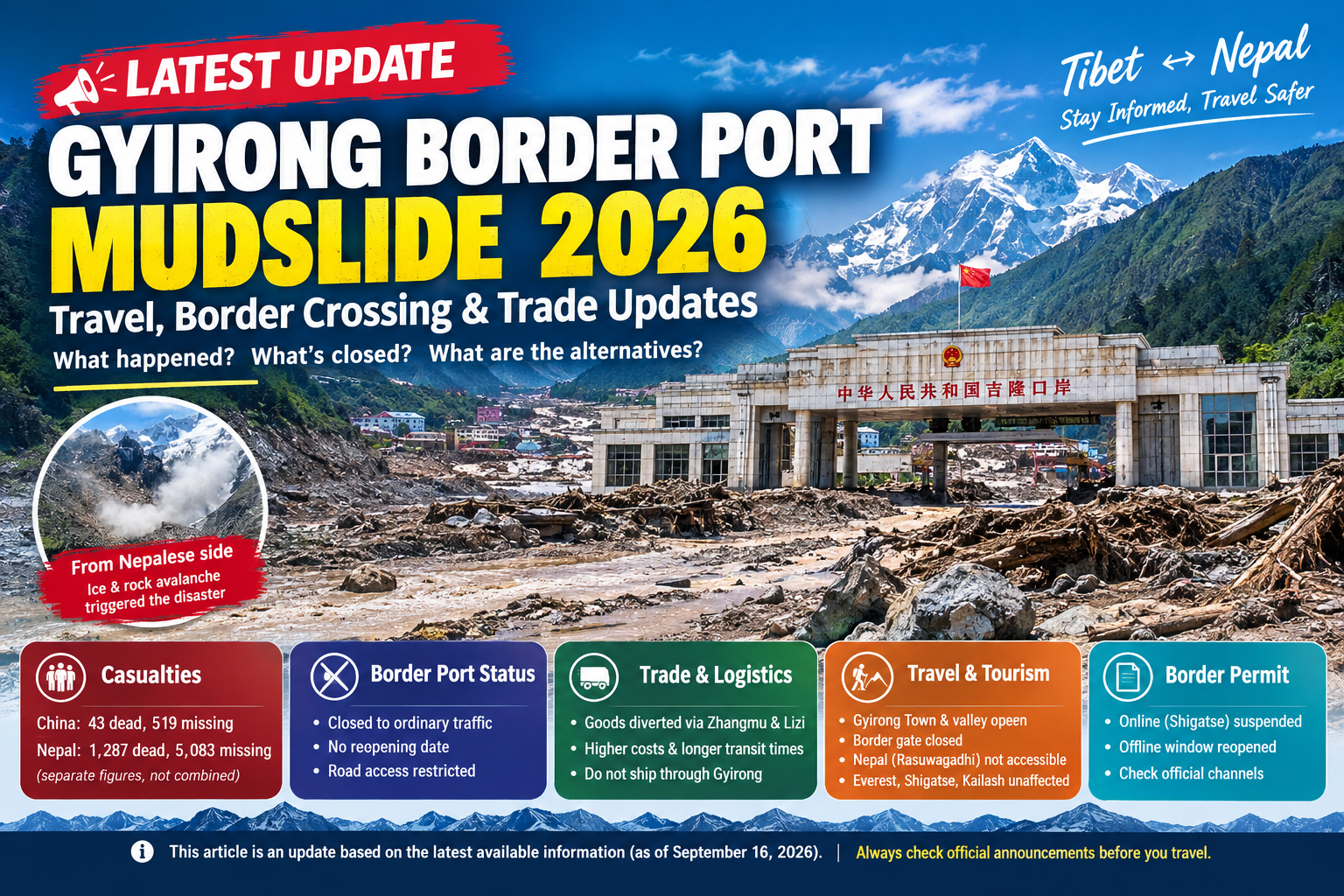
On August 26, 2026, a catastrophic debris flow struck the Gyirong border port area in southern Tibet after an ice-and-rock avalanche on the Nepalese side of the Himalayas. The disaster severely damaged border facilities, roads, bridges, and nearby infrastructure, disrupting cross-border travel and trade between China and Nepal.
The disaster affected the Resuo (Rasuwagadhi) border area on the Nepalese side and the Gyirong (Gyirong) border port in Tibet. Rescue operations, debris clearance, road repairs, and emergency transportation arrangements followed.
As of September 16, 2026, Gyirong border port remains closed to ordinary passenger and freight traffic, with no official reopening date announced in the information available for this update. Travelers should distinguish between visiting Gyirong County and reaching the restricted border port.
What Happened at Gyirong Border Port on August 26, 2026?
The disaster reportedly began with a major ice-and-rock avalanche on the northern slope of Langtang Lirung in Nepal. The collapse generated a fast-moving debris flow that traveled through a mountain valley toward the China–Nepal border.
According to the supplied reports, the flow traveled approximately 22 kilometers and reached the Gyirong border port area within minutes. The disaster struck the Chinese border inspection facilities, parking areas, and associated buildings. Extensive deposits of mud, rocks, and debris covered the affected area, with reported accumulation depths reaching approximately 16 meters in some locations and averaging around 4 meters.
The Nepalese side of the border also suffered extensive damage, particularly around Rasuwagadhi and the Trishuli River valley. The event disrupted transportation, border operations, and local communities on both sides of the Himalayas.
Casualties and Missing Persons
The disaster caused major loss of life and triggered a large-scale search-and-rescue operation.
The figures in the supplied reports include:
| Area | Reported figures |
|---|---|
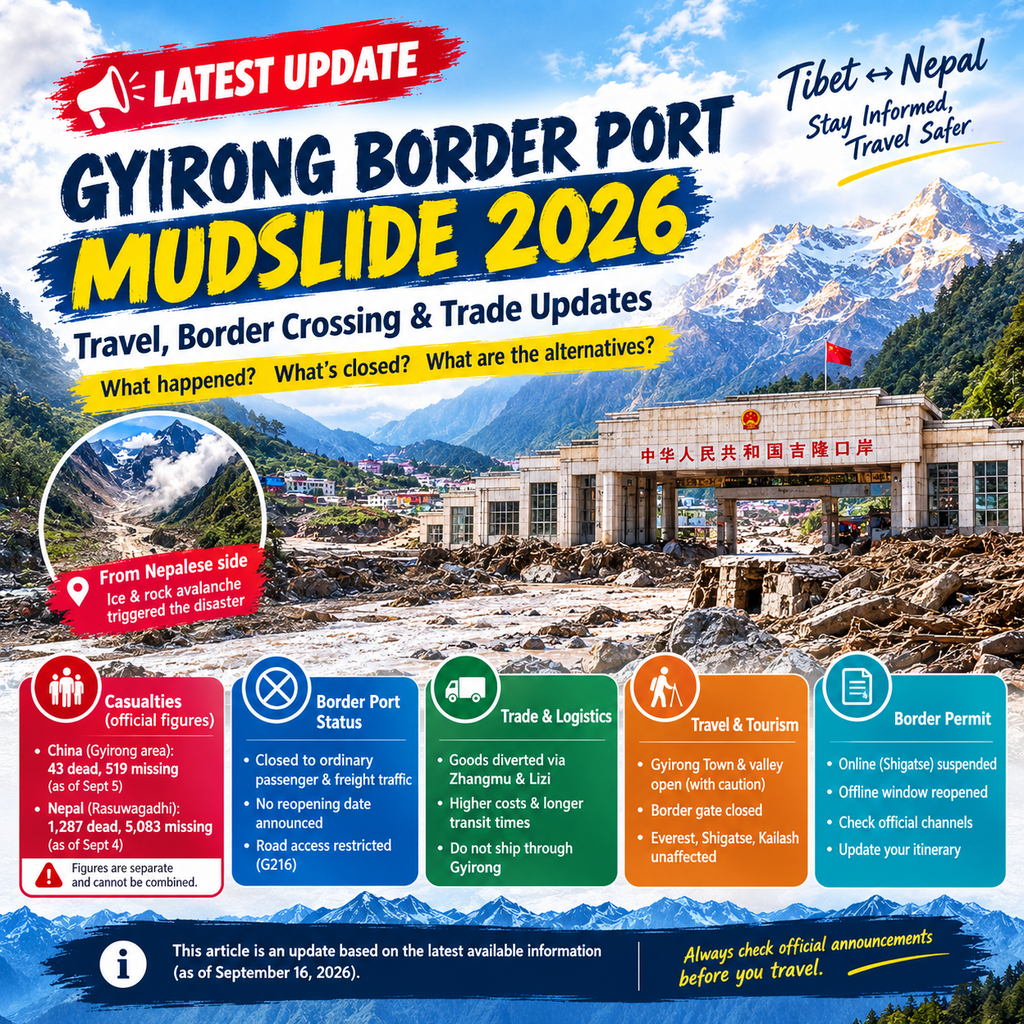
| Chinese side, Gyirong border area | 43 deaths and 519 people missing as of September 5 |
| Nepalese side, Rasuwa region | 1,287 deaths and 5,083 people missing, according to a September 4 figure in the supplied material |
Important: These figures are separate reporting totals for different affected areas and must not be combined into a single casualty count. The unusually high Nepalese figures should be checked against the original Nepalese government announcement before publication. Casualty and missing-person figures can change as rescue operations continue.
The supplied reports also describe the evacuation of 555 domestic tourists and 499 residents from Gyirong Town and Sale Township, alongside arrangements to accommodate approximately 1,720 Nepalese residents.
Search operations have faced difficult conditions because of deep mud, large rocks, damaged roads, and unstable terrain.
Gyirong Border Port Status: Is It Open?
No. According to the supplied updates, Gyirong border port remains closed to ordinary passenger and freight traffic as of September 16, 2026.
The disaster damaged the border crossing infrastructure and access routes on both sides of the international boundary.
The closure affects:
- Ordinary passenger entry and exit between Tibet and Nepal through Gyirong.
- Commercial freight transportation through the port.
- Access by ordinary vehicles to the restricted border port area.
- Travelers who planned to use Gyirong as a land crossing between China and Nepal.
The G216 road section connecting Gyirong Town with the border port has been subject to traffic restrictions. According to the supplied notices, ordinary vehicles are prohibited from proceeding to the border port, with access reserved for authorized emergency and rescue operations.
Has Gyirong Border Port Announced a Reopening Date?
No official reopening date is provided in the supplied information.
Restoring operations requires more than clearing the Chinese-side border facilities. Authorities must also address damaged roads, bridges, transportation infrastructure, and safety conditions on the Nepalese side.
Claims circulating online that the port will reopen in a particular month should not be treated as confirmed unless supported by an official announcement.
Latest Rescue and Reconstruction Progress
Rescue operations and emergency recovery work have continued following the disaster.
According to the supplied updates, the major barrier-lake emergency had been resolved by early September, and the river had resumed flowing through the affected area.
On September 2, a land access route reportedly reached the central port area, allowing heavy machinery to enter and support rescue and debris-clearance operations.
The supplied reports also describe:
- More than 2,500 personnel involved in rescue and related emergency work.
- Continued search operations in areas covered by mud and debris.
- Clearance of damaged facilities and transportation routes.
- Emergency accommodation and assistance for affected residents and stranded travelers.
- Government funding and support for disaster relief and recovery.
Longer-term plans reportedly include improved geological hazard monitoring and an integrated early-warning system using satellite, aerial, and ground-based monitoring.
However, a finalized public reconstruction plan for the border port has not been provided in the supplied updates.
Why Reopening May Take Time
The restoration of Gyirong border port depends on several connected tasks:
- Clearing debris and assessing the safety of damaged structures.
- Repairing or rebuilding Chinese-side border inspection facilities and access roads.
- Restoring the damaged bridges and roads in Nepal.
- Confirming that the surrounding valley is sufficiently safe for transportation.
- Coordinating the resumption of border inspection and cross-border transportation.
Until both sides can safely support border operations, repairing one side alone will not restore normal international traffic.
Impact on China–Nepal Border Trade
Gyirong was an important land port for trade between China and Nepal. Its closure has disrupted freight transportation and required businesses to redirect cargo through alternative routes.
The supplied information states that Gyirong handled approximately RMB 4.248 billion in imports and exports in 2024, accounting for nearly 30% of China–Nepal land trade.
These figures should be checked against the original customs or government source before being used as definitive trade statistics.
Cargo and Vehicle Diversions
Following the closure, authorities arranged emergency diversions for stranded vehicles and goods.
According to the supplied updates, cargo originally intended to cross through Gyirong was redirected toward other border ports, particularly:
- Zhangmu Port: Located in Nyalam County, Tibet.
- Lizi Port: Another alternative used for redirected cross-border freight.
The reported diversion arrangements included commercial goods, engineering materials, agricultural products, and new energy vehicles.
The supplied September 7 figures include 158 truckloads of general merchandise and engineering materials, six truckloads of agricultural products, 341 new energy vehicles, and 31 Nepalese trucks redirected through Lizi.
These figures describe reported diversion movements and should not be interpreted as the total volume of all stranded cargo.
What Does the Closure Mean for Businesses?
Businesses using the Gyirong route may face:
- Longer transportation times.
- Higher logistics and handling costs.
- Changes to planned delivery schedules.
- Additional coordination with customs brokers and freight operators.
- The need to confirm alternative routes and border procedures.
Practical advice for importers and exporters: Do not dispatch new cargo through Gyirong without confirmation from the relevant border and logistics authorities. Check whether Zhangmu or Lizi can handle the specific cargo, vehicle, and customs arrangements.
Can Tourists Visit Gyirong County After the Disaster?
Travelers should distinguish between Gyirong County, Gyirong Town, the Gyirong Valley, and the restricted border port.
The supplied updates indicate that normal daily activities and tourism in parts of Gyirong County can continue, while the border port area remains restricted.
However, travelers should not assume that every attraction or road is open simply because Gyirong Town is accessible.
Gyirong Town and Gyirong Valley
Gyirong is known for its green mountain scenery, forests, valleys, and comparatively mild climate. The area is a popular stop on some Tibet–Nepal overland itineraries.
The supplied information identifies Gyirong Town, Nayi Village, Gyipu Grand Canyon, and Gyirong Valley as destinations that may remain accessible.
Nevertheless, access should be confirmed locally before departure because roads in mountainous areas can be affected by landslides, mudslides, and emergency restrictions.
Can Tourists Visit the Gyirong Border Gate?
Ordinary travelers should not plan to visit the Gyirong border gate at this time.
The road toward the border port has been subject to traffic controls, and ordinary vehicles are reportedly prohibited from entering the restricted section. A traveler may be able to visit permitted areas of Gyirong County without being able to reach the border gate itself.
Possessing a border permit does not override a road closure or emergency access restriction.
Can You Enter Nepal Through Gyirong?
No. According to the supplied information, ordinary travelers cannot currently use Gyirong border port to enter or leave Nepal.
Travelers who planned to cross from Tibet into Nepal through Gyirong should revise their itineraries and confirm alternative arrangements before departure.
Two possible alternatives are:
Option 1: Zhangmu Border Port
Zhangmu Port, in Nyalam County, is another China–Nepal land crossing.
The supplied information identifies Zhangmu as an alternative for travelers and some redirected border traffic.
However, travelers should verify the current opening status, eligibility, required documents, and transportation arrangements before traveling to Zhangmu. Do not assume that all nationalities or travel purposes are automatically accepted.
Option 2: Fly to Kathmandu
Travelers can also consider flying to Kathmandu, Nepal, rather than crossing the land border from Tibet.
This may be a more practical alternative for visitors whose Tibet itinerary does not require an overland journey into Nepal.
Check flight schedules, visa requirements, and international travel arrangements separately.
Tibet Travel Permit and Border Permit Updates
The disaster has also affected travel planning and access to certain areas of Shigatse Prefecture. According to the supplied notices, electronic applications for border-area travel permits covering Shigatse were suspended from midnight on August 28, 2026.
The notices also advised holders of permits issued before the suspension not to travel into the affected area until further notice.
Can You Apply for a Shigatse Border Permit Online?
The supplied information states that online applications for electronic border permits covering Shigatse remained suspended as of September 16, with no official resumption notice included. It also reports that in-person applications had resumed at designated local service windows in Shigatse.
Because application services and eligibility can change, travelers should confirm the current procedure with the relevant authorities before making travel arrangements.
What Should Travelers Write on Their Border Permit Application?
For travelers planning to visit destinations in Shigatse Prefecture, the supplied guidance identifies the following destinations:
| Destination | County or area to specify |
|---|---|
| Mount Everest | Dingri County |
| Zhangmu | Nyalam County |
| Gyirong Town | Gyirong County |
| Saga | Saga County |
| Route toward Ngari | Zhongba County |
The exact destinations should match the traveler’s itinerary and the requirements of the issuing authority.
Important: Listing Gyirong County on a border permit does not grant permission to enter the restricted Gyirong border port area.
What If You Are Applying Outside Tibet?
The supplied guidance recommends that travelers who are outside Tibet and cannot apply through the online service contact their local household-registration authorities about obtaining the necessary border-area permit. The appropriate application route depends on the traveler’s location, nationality, and current administrative arrangements.
Foreign visitors should coordinate with their authorized Tibet travel agency and confirm which permits and supporting documents are required for their itinerary.
Are Mount Everest, Shigatse, Sakya, and Mount Kailash Open?
Mount Everest Base Camp, Shigatse, Sakya, Gamba, and Ngari were not directly affected by the Gyirong mudslide. However, travelers should distinguish between a destination being outside the immediate disaster area and its roads or permits being available for travel.
Mount Everest Base Camp
Mount Everest Base Camp is located in Dingri County, Shigatse Prefecture. The destination was not directly affected by the Gyirong border disaster. Nevertheless, travelers should check current road conditions, local access restrictions, and permit requirements before departure.
Shigatse and Sakya
Shigatse and Sakya are important cultural destinations in southern Tibet. Travelers should verify the operating status of attractions and transportation routes, especially if their itinerary includes roads or border areas subject to temporary controls.
Mount Kailash and Lake Manasarovar
Mount Kailash and Lake Manasarovar are located in Ngari Prefecture, far from the Gyirong border port. These destinations were not directly affected by the disaster. However, access depends on current travel permissions, road conditions, and any additional restrictions. Travelers should confirm their complete itinerary rather than assuming that all destinations in Tibet are operating under identical conditions.
9. Safety Advice for Travelers Visiting Gyirong
Gyirong lies in a mountainous region where heavy rainfall, unstable slopes, and river valleys can create additional hazards. Following a major debris flow, travelers should take particular care around affected roads and valleys.
Before visiting Gyirong:
- Confirm road access and travel restrictions with local authorities or your travel agency.
- Avoid entering closed roads or restricted disaster areas.
- Do not approach unstable riverbanks, debris deposits, or damaged bridges.
- Avoid unnecessary nighttime driving through mountain valleys, especially during rainy weather.
- Follow instructions from local authorities and emergency personnel.
- Keep alternative transportation and accommodation plans available.
Travelers should not attempt to reach the border port simply to see the damage. Restricted areas may remain unsafe even after the main emergency has passed.
Official Information and Where to Check Updates
The status of Gyirong border port, road access, and border permits may change as recovery progresses. Before traveling, consult official announcements and confirm details directly with the relevant authorities.
Useful information channels include:
- Tibet Autonomous Region port and border authorities.
- Gyirong border inspection authorities.
- Official Tibet government news channels.
- The National Immigration Administration’s 12367 service for immigration and relevant border-management inquiries.
Travelers should distinguish between official announcements, news reports, and unverified social media posts.
In particular, do not rely on claims that Gyirong border port will reopen on a specific date unless the date is confirmed by an official announcement.
Frequently Asked Questions
1. Is Gyirong border port open in September 2026?
According to the supplied updates, Gyirong border port remains closed to ordinary passenger and freight traffic as of September 16, 2026. No official reopening date is included in the information provided.
2. Can tourists visit Gyirong Town?
The supplied information indicates that Gyirong Town and some permitted tourist areas may remain accessible. However, travelers must confirm current road conditions and local restrictions before departure.
3. Can tourists visit the Gyirong border gate?
Ordinary vehicles are reportedly prohibited from reaching the restricted border port area. Travelers should not plan to visit the gate unless authorities announce that access has resumed.
4. Can I cross from Tibet into Nepal through Gyirong?
No. According to the supplied updates, ordinary passenger crossings through Gyirong remain suspended. Travelers should investigate alternative routes, including Zhangmu or flights to Kathmandu.
5. Is Zhangmu Port an alternative to Gyirong?
Zhangmu is identified as an alternative China–Nepal crossing in the supplied information. Travelers should confirm its current operating status, eligibility requirements, and border procedures before departure.
6. Can I apply for a Shigatse border permit online?
The supplied information states that online electronic border permit applications covering Shigatse remained suspended as of September 16, 2026. In-person application services were reportedly available at designated local windows in Shigatse. Confirm the latest procedure before applying.
7. Can I visit Mount Everest Base Camp after the Gyirong disaster?
The supplied updates indicate that Mount Everest Base Camp was not directly affected by the disaster. However, travelers should check current road conditions, permit requirements, and local travel restrictions before visiting.
8. When will Gyirong border port reopen?
No official reopening date is provided in the supplied information. Restoration depends on infrastructure repairs, road safety, and coordination between China and Nepal.
Final Travel Advice
The August 26, 2026 Gyirong border disaster has significantly disrupted cross-border travel and trade between Tibet and Nepal. Although some areas of Gyirong County may remain accessible, the border port itself should be treated as closed to ordinary travelers until authorities announce otherwise.
If you are planning a Tibet trip, confirm the latest road conditions, border permit procedures, and destination access before departure. If your itinerary includes entering Nepal by land, make alternative arrangements and verify the current status of the crossing you intend to use.
For travelers visiting Tibet through a local agency, ask for a confirmed itinerary that reflects current restrictions rather than relying on older route information.