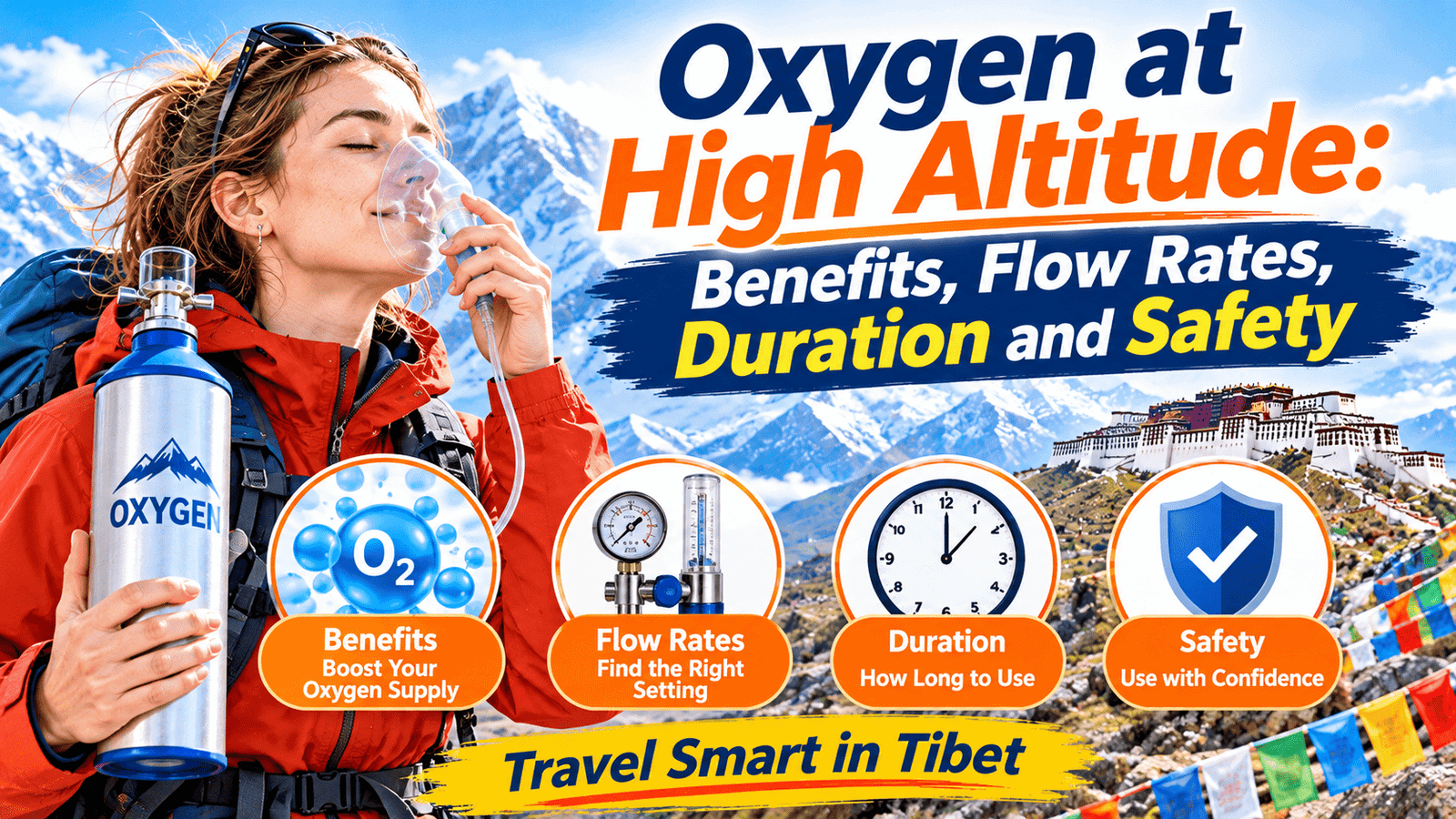
Oxygen is an important part of high-altitude medical care. At elevations such as Lhasa, Everest Base Camp and Mount Kailash, lower atmospheric pressure reduces the amount of oxygen pressure available with each breath. This can cause blood oxygen saturation to fall and make physical activity more difficult.
Supplemental oxygen increases the oxygen available for breathing. It can improve oxygenation and relieve symptoms in certain situations, including acute mountain sickness and more serious altitude-related conditions.
However, oxygen is not a replacement for acclimatization, and it should never be used to justify continuing to ascend when someone is unwell. In suspected high-altitude pulmonary edema or cerebral edema, oxygen should be provided alongside urgent medical assistance and descent or evacuation.
This guide explains how oxygen works, when it may be useful, what flow rates mean, how to estimate oxygen supply and how to use oxygen safely during a Tibet journey.
Why Is Oxygen Needed at High Altitude?
The percentage of oxygen in the atmosphere remains approximately 20.9% at high altitude. The main difference is that atmospheric pressure decreases as elevation increases. This reduces the partial pressure of oxygen entering the lungs. Less oxygen pressure is available to move oxygen into the bloodstream.
At approximately 3,050 metres, inspired oxygen pressure is around 69% of its sea-level value. At higher elevations, the reduction becomes more pronounced. The body responds by increasing breathing and making other physiological adjustments. These changes take time, which is why gradual acclimatization is important.
Supplemental oxygen increases the oxygen concentration being inhaled and can help restore blood oxygenation. Its effect depends on the delivery system, flow, breathing pattern, altitude and the person’s medical condition.
What Are the Benefits of Supplemental Oxygen?
Supplemental oxygen can be useful in several situations.
Improving blood oxygen saturation
Additional oxygen increases the amount of oxygen available in the air or gas mixture being inhaled. This can raise arterial oxygen levels and often improve pulse oximeter readings.
Relieving altitude-related symptoms
For some travelers with mild acute mountain sickness, supplemental oxygen can help relieve headache and other symptoms.
The CDC notes that oxygen at approximately 1–2 litres per minute may improve altitude-related headache within about 30 minutes when a person remains at the altitude where symptoms began. Other symptoms may take several hours to resolve.
This is general clinical guidance, not a universal prescription for every traveler or every oxygen device.
Supporting treatment of serious altitude illness
Oxygen is an important treatment for suspected high-altitude pulmonary edema and high-altitude cerebral edema. However, these conditions are emergencies. Oxygen should be given while arranging urgent descent, evacuation and medical care. It must not delay those actions.
Supporting travelers with certain medical conditions
Some people with pre-existing respiratory or cardiovascular conditions may need an individualized oxygen plan before traveling to high altitude.
This decision should be made with a clinician familiar with the person’s condition and high-altitude travel.
When Should Travelers Use Supplemental Oxygen?
Oxygen is not necessary for every traveler who visits Tibet. Many people acclimatize without needing supplemental oxygen.
It may be considered in the following circumstances:
- A clinician recommends it for a traveler with a medical condition.
- A medical professional uses it to treat altitude-related symptoms.
- A person develops suspected HAPE or HACE and oxygen is available during emergency response.
- An organized expedition carries oxygen as part of its medical and evacuation plan.
- A traveler needs prescribed oxygen during transport or sleep.
The appropriate use depends on the person’s condition and the medical plan.
Oxygen is not a substitute for acclimatization
A traveler who feels better after receiving oxygen may still be vulnerable to altitude illness. Oxygen can improve symptoms temporarily without resolving the underlying problem.
If someone develops altitude illness, they should not ascend to a higher sleeping elevation while symptomatic. Worsening symptoms require descent and medical assessment.
What Does Oxygen Flow Rate Mean?
Oxygen flow rate describes how much oxygen a delivery system supplies over time. It is commonly expressed in litres per minute (L/min).
For example:
- 1 L/min means one litre of oxygen is supplied each minute.
- 2 L/min means two litres are supplied each minute.
- 3 L/min means three litres are supplied each minute.
A higher flow rate uses the oxygen supply more quickly.
However, the number displayed on a device does not always represent the same delivery in every system. A continuous-flow device supplies oxygen continuously, while a pulse-dose concentrator releases oxygen in response to detected inhalation. Pulse-dose settings are device-specific and cannot be directly equated with the same numerical continuous-flow setting.
Nasal cannula and oxygen mask
Oxygen may be delivered through a nasal cannula or a mask.
A nasal cannula uses small tubes placed inside the nostrils. An oxygen mask covers the nose and mouth and connects to the oxygen supply.
The appropriate interface and flow depend on the person’s condition, the equipment and clinical requirements. A device setting should not be selected solely by copying another person’s oxygen flow.
How Long Does Oxygen Take to Work?
The response varies according to the person’s condition, the amount of oxygen delivered and the reason for using it.
For some people with mild AMS, supplemental oxygen may improve headache within approximately 30 minutes. Other symptoms can take several hours to improve.
People with HAPE or HACE require emergency management. Oxygen may improve oxygenation, but improvement in a pulse oximeter reading does not mean the emergency has resolved.
Do not use a short period of oxygen as proof that a person is safe to continue a trek or travel to a higher elevation.
6. How Much Oxygen Do You Need?
Oxygen supply planning depends on the amount of usable oxygen, the flow rate and the intended duration.
For a continuous-flow system, a simple estimate is:
Oxygen volume required = Flow rate × Duration
For example:
| Continuous flow | Duration | Approximate oxygen volume |
|---|---|---|
| 1 L/min | 60 minutes | 60 litres |
| 2 L/min | 60 minutes | 120 litres |
| 2 L/min | 120 minutes | 240 litres |
| 3 L/min | 120 minutes | 360 litres |
These are arithmetic examples, not treatment instructions.
The actual oxygen supply needed in an emergency depends on medical requirements, the delivery system, transport time, expected descent time and reserve capacity.
Estimating cylinder operating time
A second calculation can estimate how long a cylinder may last:
Operating time (minutes) = Usable oxygen volume (litres) ÷ Flow rate (L/min)
For example, if a cylinder has 300 litres of usable oxygen and the system supplies 2 L/min, the theoretical operating time is 150 minutes.
Actual operating time may be shorter because of residual pressure, leakage, regulator performance and other equipment limitations.
Always distinguish the cylinder’s water capacity from the volume of compressed gas it contains. A cylinder marked with a 2-litre water capacity does not contain only 2 litres of oxygen.
Should You Use Oxygen at Night?
Oxygen saturation can decrease during sleep at high altitude. Periodic breathing and changes in ventilation can produce fluctuations in nighttime oxygen levels.
Controlled nighttime oxygen may improve overnight oxygenation in some circumstances. However, nighttime oxygen should not be treated as a routine requirement for every traveler.
People with sleep-disordered breathing, significant lung disease or other relevant medical conditions should seek individualized medical advice before traveling.
If accommodation advertises oxygen-enriched rooms, ask what is actually provided:
- Is oxygen delivered through an individual cannula?
- Is the room’s oxygen concentration increased?
- Is oxygen concentration monitored at the sleeping position?
- How long does the system operate?
- What happens if the power supply fails?
- Are ventilation and fire-safety measures in place?
An oxygen-enriched room and personal oxygen therapy are not the same thing.
Can You Use Oxygen While Walking or Trekking?
Supplemental oxygen may be used during activity in certain medical or expedition settings, but it is not a general performance aid for tourists. The decision depends on the person’s condition and the medical plan. Oxygen equipment can also affect mobility, battery life, supply duration and the ability to move safely over rough terrain.
If someone becomes unusually breathless, weak or unsteady while walking, the correct response is not simply to increase oxygen and continue.
Stop activity, assess the person and seek medical assistance. Breathlessness at rest, worsening cough, poor coordination or confusion are emergency warning signs.
9. Does Oxygen Help You Acclimatize?
Supplemental oxygen improves the oxygen available for breathing while it is being used. However, it does not mean the body has completed its natural acclimatization process.
The body’s adjustment to altitude involves increased ventilation and other physiological changes over time.
Using oxygen for a short period does not automatically prevent acclimatization, but neither does it guarantee that acclimatization is complete. The effects of different oxygen-enrichment arrangements depend on exposure, duration, altitude and individual physiology.
Travelers should continue to follow gradual-ascent guidance even if they use oxygen.
10. Oxygen Safety: Important Precautions
Oxygen itself is not flammable, but it supports combustion and can make fires burn more intensely.
Follow these precautions:
- Never smoke near oxygen equipment.
- Keep oxygen away from candles, open flames and cooking fires.
- Do not use oil or grease on oxygen regulators or fittings.
- Keep cylinders secured against falling or impact.
- Use compatible regulators, tubing and delivery accessories.
- Follow the manufacturer’s operating and storage instructions.
- Keep oxygen equipment away from heat sources.
- Ensure appropriate ventilation.
- Do not use oxygen equipment that is leaking or visibly damaged.
- Do not attempt to repair a cylinder valve or regulator yourself.
Oxygen equipment must be handled carefully in vehicles, hotels and tents. Never use combustion heaters or cooking equipment inside an enclosed tent or vehicle because of the risks of fire and carbon monoxide poisoning.
11. Planning Oxygen for Remote Tibet Travel
Oxygen availability should be confirmed before traveling through remote areas.
A route to Everest Base Camp or Mount Kailash may pass through long stretches where medical facilities, replacement cylinders, electrical power and vehicle support are limited.
Before departure, confirm:
- Whether oxygen is included in the group’s emergency equipment.
- What type of oxygen source is available.
- How much usable oxygen is carried.
- Whether the regulator and delivery equipment are compatible.
- How the equipment will be transported and secured.
- How to arrange descent or evacuation.
- Where medical assistance can be obtained along the route.
Do not assume that every hotel, vehicle or remote settlement has a reliable oxygen supply.
For travelers with a medical need for oxygen, arrangements should be made with a qualified medical provider and confirmed with the tour operator well before departure.
Frequently Asked Questions
Does oxygen help altitude sickness?
Supplemental oxygen can improve oxygenation and may relieve symptoms of mild AMS. It is also important in the emergency management of HAPE and HACE. It does not replace descent or medical assessment when serious illness is suspected.
How many litres per minute of oxygen are needed at high altitude?
There is no single flow rate suitable for every person or condition. Flow depends on the medical situation and the delivery system. A clinician should determine the appropriate setting.
How long does oxygen last in a cylinder?
Operating time depends on usable gas volume and flow rate. Divide usable oxygen volume by continuous flow rate to estimate the theoretical duration, then allow for equipment limitations and an appropriate reserve.
Are small portable oxygen cans enough for altitude sickness?
No. Small cans contain very limited oxygen and cannot provide sustained oxygen therapy. They should not be relied upon for suspected HAPE, HACE or another serious emergency.
Can oxygen prevent altitude sickness?
Oxygen may improve oxygenation while being used, but it does not replace gradual ascent and acclimatization. It should not be treated as a guarantee against altitude illness.
Is it safe to sleep with oxygen at high altitude?
It may be appropriate for some people under a medical plan. The equipment, oxygen supply, ventilation and fire precautions must be considered. Travelers with sleep-related breathing disorders should seek medical advice before departure.
Conclusion
Supplemental oxygen can be valuable during high-altitude travel, especially when treating altitude-related symptoms or supporting emergency care. Its usefulness depends on the delivery system, available supply, medical condition and surrounding circumstances.
For travelers visiting Tibet, the safest strategy is to plan gradual acclimatization, understand the limits of oxygen equipment and prepare a reliable descent or evacuation plan for remote journeys.
Medical Disclaimer: This article provides general educational information and is not a prescription or individualized oxygen-treatment plan. Oxygen flow rates, delivery methods and treatment duration must be determined according to clinical needs and appropriate equipment. Suspected HAPE, HACE or severe altitude illness requires urgent medical assistance and descent or evacuation when possible.
References
- CDC Yellow Book 2026: High-Altitude Travel and Altitude Illness.
- Wilderness Medical Society Clinical Practice Guidelines for the Prevention, Diagnosis, and Treatment of Acute Altitude Illness: 2024 Update.
- US Food and Drug Administration: Pulse Oximeters and Oxygen Concentrators—What to Know About Home Oxygen Therapy.
- Manufacturer instructions for the specific oxygen cylinder, regulator, concentrator and delivery accessories being used.
Suggested Internal Links
- Blood Oxygen Levels at High Altitude: SpO₂ Guide
- How to Prevent Altitude Sickness
- Acute Mountain Sickness (AMS): Symptoms and Treatment
- High-Altitude Pulmonary Edema (HAPE)
- High-Altitude Cerebral Edema (HACE)
- Oxygen Equipment for Tibet: Cylinders, Portable Cans and Concentrators
- Tibet Travel Checklist: Essential High-Altitude Gear