
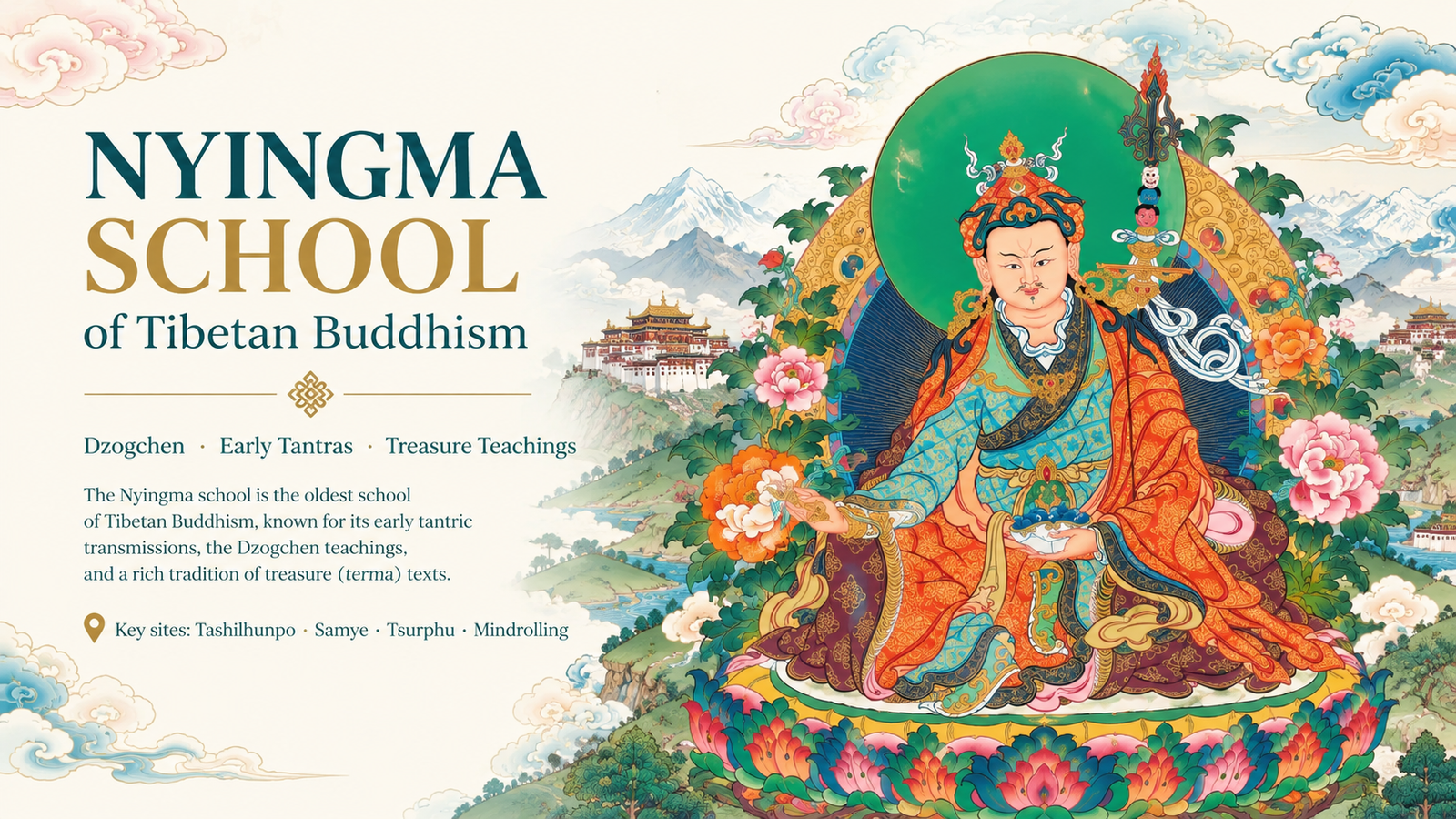
The Nyingma School of Tibetan Buddhism, is traditionally regarded as the oldest major school of Tibetan Buddhism. The Tibetan word “Nyingma” (རྙིང་མ་) means “old” or “ancient,” referring to the school’s connection with the early transmission of Buddhist teachings into Tibet during the Tibetan Empire.
The Nyingma tradition is especially known for its Dzogchen (Great Perfection) teachings, ancient tantric scriptures, meditation practices, and the tradition of terma, or revealed spiritual treasures. Its history is closely connected with great Indian Buddhist masters such as Shantarakshita, Padmasambhava, and Vimalamitra, as well as the Tibetan translator Vairotsana.
Unlike some other Tibetan Buddhist schools, the Nyingma tradition historically did not establish a centralized religious or political government. Instead, it developed through numerous monasteries, teachers, tantric practitioners, treasure revealers, and local lineages.
Origins of the Nyingma school of Tibetan Buddhism
The foundations of the Nyingma tradition were established during the first major spread of Buddhism in Tibet in the 8th century. Tibetan King Trisong Detsen invited the Indian Buddhist scholar Shantarakshita to Tibet. Shantarakshita helped establish Buddhist monastic education and played an important role in the founding of Samye Monastery, traditionally regarded as Tibet’s first Buddhist monastery.
The king later invited Padmasambhava, the great tantric master from the region of Oddiyana. Known in Tibet as Guru Rinpoche, Padmasambhava became one of the most important figures in the development of Tibetan Buddhism. Together with other Indian scholars and Tibetan translators, Padmasambhava helped establish the teachings of Vajrayana Buddhism in Tibet. He transmitted advanced tantric teachings to selected disciples, including the king and his renowned group of twenty-five disciples.
These early transmissions eventually became the foundation of what is now known as the Nyingma School of Tibetan Buddhism.
Padmasambhava and the Early Transmission of Nyingma Buddhism
Guru Padmasambhava holds a central place in Nyingma history. Tibetan tradition credits him with overcoming obstacles to the establishment of Buddhism in Tibet and with transmitting numerous Vajrayana teachings and practices. His teachings included methods for working with the mind, meditation, tantric practice, and advanced teachings concerning the nature of awareness.
One of the most important teachings associated with Padmasambhava is Dzogchen, or the Great Perfection. Dzogchen focuses on recognizing the fundamental nature of mind and directly realizing its primordial, awakened awareness. Padmasambhava was not the only source of Nyingma teachings. Other major Indian masters, including Vimalamitra, also transmitted important teachings to Tibet. The Tibetan translator Vairotsana played an especially important role in translating and preserving these teachings.
Samye Monastery and the Early Spread of Buddhism
Samye Monastery became one of the most important early centers of Buddhist learning in Tibet. It was associated with the translation of Buddhist scriptures from Sanskrit and other Indian languages into Tibetan. The translation movement created a large body of Buddhist literature that became known as the Nyingma Kama, referring to the authoritative oral and textual transmissions of the Nyingma tradition. This early period laid the foundation for the preservation of many teachings that continue to be practiced today.
The Three Zur Masters
The Nyingma tradition became more institutionally established during the 11th century, when earlier tantric transmissions were collected, studied, and organized by generations of teachers.
The Three Zur Masters, traditionally identified as:
- Zurpo Che Shakya Jungne
- Zur Shyérap Drakpa
- Zur Shakya Sengge
played an important role in preserving and organizing the old tantric teachings.
Their activities helped transform scattered early tantric transmissions into a recognizable religious tradition. Therefore, it is useful to distinguish between the 8th-century origins of Nyingma teachings and the 11th-century development of Nyingma as a distinct school.
History of the Nyingma School of Tibetan Buddhism
The Early Transmission Period
During the Tibetan Empire, Buddhist teachings were transmitted into Tibet from India and other Buddhist regions. Indian masters such as Shantarakshita and Padmasambhava were invited to Tibet, and Samye became a major center for the translation and study of Buddhist teachings. The period is traditionally referred to as the early or initial transmission of Buddhism into Tibet.
The Decline of Buddhism Under Langdarma
During the 9th century, the reign of Langdarma was associated with a major disruption of organized Buddhism in Tibet. Many teachings and practices survived through individual practitioners and local communities. According to Nyingma tradition, some teachings were deliberately concealed as treasures so that they could be rediscovered in later generations. This concept became one of the defining characteristics of Nyingma Buddhism.
The Later Transmission Period
From the 11th century onward, Tibetan Buddhism experienced a major revival. Nyingma teachers preserved older tantric traditions while other Buddhist schools, including Kagyu, Sakya, and Kadam, developed through new waves of Indian Buddhist transmission. Nyingma therefore became particularly associated with the “old translation” tradition, distinguishing it from later translation movements.
Development of the Treasure Tradition
The terma tradition became one of the most distinctive elements of Nyingma Buddhism. Treasure teachings are traditionally understood to have been concealed by great masters such as Padmasambhava and later revealed by spiritually accomplished tertöns, or treasure revealers.
These treasures may take the form of texts, ritual objects, symbolic teachings, or visionary revelations. The tradition helped ensure that Nyingma teachings continued to evolve while maintaining a strong connection with the early tantric heritage of Tibet.
Longchenpa and the Development of Dzogchen
One of the most important intellectual figures in Nyingma history was Longchen Rabjam (1308–1364). Longchenpa systematized and clarified many of the philosophical and meditative teachings of the Nyingma tradition, particularly Dzogchen, or the Great Perfection. His writings, especially the Seven Treasuries, became foundational works for Nyingma scholarship.
Longchenpa’s work helped establish a sophisticated philosophical framework for understanding Dzogchen and brought together numerous earlier teachings into a coherent system.
The Core Teaching: Dzogchen
The most famous teaching associated with the Nyingma School is Dzogchen, translated as Great Perfection. Dzogchen is regarded within the Nyingma system as the highest level of the Nine Yanas, or nine vehicles.
At its heart is the recognition of the nature of mind, traditionally described through qualities such as emptiness, luminosity, and awareness.Rather than treating enlightenment as something completely separate from ordinary experience, Dzogchen emphasizes recognizing and stabilizing the primordial nature of awareness.
Advanced Dzogchen practice traditionally includes teachings known as Trekchö (“cutting through”) and Tögal (“direct crossing”), which are transmitted through qualified teachers and appropriate initiation and instruction. These practices should not be understood as simple meditation techniques that can be learned independently from books or travel experiences.
Important Nyingma Masters
Over the centuries, many great scholars and meditation masters contributed to the development of the Nyingma school.
Important figures include:
- Shantarakshita – Indian Buddhist scholar who helped establish Buddhist monastic education in Tibet.
- Padmasambhava – the great tantric master central to the early transmission of Vajrayana Buddhism in Tibet.
- Vimalamitra – an influential Indian master associated with advanced tantric and Dzogchen teachings.
- Vairotsana – one of Tibet’s most celebrated early translators.
- Longchenpa – a major philosopher who systematized and explained Dzogchen teachings.
- Rongzom Chökyi Zangpo – an important Nyingma scholar and philosopher.
- Jigme Lingpa – a renowned tertön who revealed important teachings and established the Longchen Nyingthig tradition.
- Jamyang Khyentse Wangpo and Jamgön Kongtrul – major figures in the later preservation and transmission of Tibetan Buddhist teachings.
Another highly influential scholar was Ju Mipham (Mipham Rinpoche), whose writings contributed greatly to Nyingma philosophy and helped clarify Buddhist thought across different Tibetan traditions.
The Nine Yanas of Nyingma Buddhism
Nyingma philosophy and practice organize Buddhist teachings into a framework known as the Nine Yanas, or Nine Vehicles.
This system provides a gradual classification of Buddhist teachings, beginning with foundational Buddhist approaches and progressing toward the advanced practices of Vajrayana and Dzogchen.
The highest teachings are associated with the Three Inner Tantras:
- Mahayoga
- Anuyoga
- Atiyoga
Atiyoga, better known as Dzogchen or the Great Perfection, occupies a particularly important position in Nyingma Buddhism.
Dzogchen: The Great Perfection
Dzogchen is the central spiritual teaching most strongly associated with the Nyingma tradition. The term can be translated as “Great Perfection.” Rather than viewing enlightenment as something that must be created from nothing, Dzogchen emphasizes recognizing the mind’s primordial nature and its inherent awakened awareness. Nyingma Dzogchen teachings describe this fundamental nature using concepts such as primordial purity and spontaneous presence. The practice aims at direct recognition of the nature of mind through meditation and guidance from a qualified teacher.
Because Dzogchen involves advanced practices and direct experiential instruction, traditional Nyingma Buddhism places great importance on receiving teachings through an authentic lineage.
Sutra, Tantra and Meditation
The Nyingma tradition includes the complete range of Buddhist teachings, from Sutra philosophy and ethical discipline to Vajrayana Tantra and Dzogchen meditation. Practitioners may study Buddhist philosophy, develop compassion and Bodhicitta, practice visualization and mantra, engage in deity meditation, and undertake advanced Dzogchen practices.
The tradition therefore combines scholarly study and contemplative practice, although different Nyingma monasteries and lineages may emphasize different aspects.
Major Nyingma Monasteries and Travel Destinations
Samye Monastery
Samye Monastery, located in Shannan’s Dranang area, is one of the most important Buddhist sites in Tibet. Traditionally regarded as the first Buddhist monastery established in Tibet, Samye is closely associated with King Trisong Detsen, Shantarakshita, and Padmasambhava.
Its distinctive architectural design represents a Buddhist cosmological model and makes it one of the most fascinating historical monasteries in Tibet.Although Samye has connections with several Tibetan Buddhist traditions, it has particularly strong historical associations with the early tantric traditions preserved by Nyingma. For travelers interested in Tibetan Buddhism and the origins of Buddhism in Tibet, Samye is an essential destination.
Mindrolling Monastery
Mindrolling Monastery, located in the Dranang area of Shannan, is traditionally regarded as one of the most important Nyingma monasteries in central Tibet. It became famous for its religious scholarship, rituals, Tibetan Buddhist art, incense production, astronomy, and calendrical studies. The monastery is an important destination for travelers exploring Nyingma Buddhism in Tibet.
Dorje Drak Monastery
Dorje Drak Monastery, located in the Gonggar area of Shannan, is another major Nyingma institution in central Tibet. Together with Mindrolling, it has played an important role in preserving Nyingma teachings, rituals, and monastic traditions.
Nyingma School of Tibetan Buddhism in Eastern Tibet
Eastern Tibet, particularly the traditional Kham region, became one of the most important centers of Nyingma religious culture. The remote valleys of western Sichuan and eastern Tibet contain numerous historic monasteries, meditation centers, retreat communities, and Buddhist academies.
Kathok Monastery
Kathok Monastery, located in present-day Baiyu County in Sichuan, is one of the oldest and most influential Nyingma monasteries in Kham. It is traditionally regarded as one of the major centers of Nyingma teachings and is sometimes described as a “Second Vajra Seat.”
Dzogchen Monastery
Dzogchen Monastery in Dege is one of the most famous Nyingma centers for Dzogchen meditation and scholarship. Its name itself reflects the importance of the Great Perfection tradition.
Palyul Monastery
Palyul Monastery in Baiyu County is another major Nyingma institution and the center of the Palyul lineage. It developed into an important center for Buddhist philosophy, meditation, and tantric practice.
Shechen Monastery
Shechen Monastery in Dege is another major Nyingma institution associated with the preservation and transmission of Dzogchen teachings.
Larung Gar Buddhist Academy
Larung Gar, located in Sichuan, is one of the most internationally recognized contemporary Tibetan Buddhist study centers. It is associated particularly strongly with Nyingma and other non-sectarian Buddhist teachings. However, Larung Gar should be distinguished from the traditional historical Nyingma Six Mother Monasteries.
Major Characteristics of Nyingma Buddhism
- Dzogchen: It is the best-known philosophical and meditative tradition associated with Nyingma Buddhism. Its teachings focus on recognizing the fundamental nature of awareness and cultivating direct realization.
- Terma or Treasure Teachings: The terma tradition allows teachings concealed by earlier masters to be rediscovered by later tertöns. This creates a unique relationship between Tibetan Buddhist history, sacred landscapes, meditation, and religious literature.
- The Nine Yanas: Nyingma traditionally organizes Buddhist teachings into Nine Yanas; Three Sutra Vehicles, Three Outer Tantras, and Three Inner Tantras. Atiyoga, is placed at the highest level of this system.
- Non-Monastic Practitioners: Nyingma has historically included both monastic and non-monastic practitioners. Lay tantric practitioners, often known in Tibetan contexts as ngakpas, have played an important role in transmitting rituals, meditation practices, and tantric teachings.
- Rich Ritual and Sacred Landscape: Nyingma monasteries are famous for elaborate rituals, sacred dances, tantric ceremonies, protector practices, murals, statues, and stories about Padmasambhava and treasure revealers. Sacred mountains, caves, lakes, and pilgrimage sites are also important parts of Nyingma religious culture.
- No Centralized Nyingma Power: Unlike the historical political role played by the Sakya and later Gelug traditions, Nyingma did not establish a centralized religious government controlling Tibet.
Its influence instead developed through networks of monasteries, teachers, local communities, retreat centers, and religious lineages.
Best Nyingma Experiences for Travelers
Visit Samye Monastery
For visitors interested in the history of Buddhism in Tibet, Samye is arguably the most important starting point. The monastery connects the traveler with the early Tibetan Empire, Padmasambhava, Buddhist translation, and the development of Tibetan monastic culture.
Explore Mindrolling Monastery
Mindrolling provides an opportunity to experience the living heritage of central Tibetan Nyingma Buddhism. Its religious art, rituals, incense traditions, and historical scholarship make it an excellent stop on a Shannan travel itinerary.
Discover Nyingma Culture in Kham
Travelers with more time can explore the remote monastery regions of Dege and Baiyu. Kathok, Dzogchen, Palyul, and Shechen offer a very different experience from the major tourist monasteries around Lhasa. The landscape itself—high mountains, deep valleys, forests, rivers, and isolated monasteries—is an important part of the experience.
Nyingma Buddhism and Tibetan Culture
Nyingma Buddhism has had a profound influence on Tibetan culture beyond formal monastery life. Its traditions have contributed to:
- Tibetan Buddhist literature
- Sacred dance and ritual
- Thangka painting
- Buddhist sculpture
- Meditation traditions
- Sacred geography
- Tibetan medicine and calendrical culture
- Traditional incense production
- Pilgrimage traditions
- Oral religious storytelling
Stories of Padmasambhava, tertöns, sacred mountains, hidden valleys, and treasure discoveries remain an important part of Tibetan religious culture.
Travel Tips for Visiting Nyingma Sites
The easiest Nyingma destinations for international travelers are located in Shannan and Lhasa’s surrounding regions. Samye Monastery and Mindrolling Monastery can be incorporated into a Shannan itinerary from Lhasa.
For travelers interested in eastern Tibetan culture, Dege and Baiyu offer much deeper exposure to Nyingma monasteries, but the journey is considerably longer and some destinations are remote. Visitors should remember that Dzogchen, tantric empowerments, terma transmissions, and other advanced practices are traditionally transmitted by qualified teachers. A monastery visit is primarily a cultural and historical experience unless a traveler has arranged appropriate religious instruction in advance.
Photography rules vary between monasteries. Some chapels and religious objects prohibit photography, so visitors should always follow local instructions.
Nyingma Buddhism Today
The Nyingma School of Tibetan Buddhism continues to flourish in Tibet, the Himalayan region, and Buddhist communities throughout the world. Nyingma monasteries preserve ancient scriptures, ritual traditions, philosophical teachings, and meditation practices. Teachers and institutions also continue to transmit Dzogchen, terma teachings, and the Nyingma tantric traditions to new generations.
For travelers interested in Tibetan Buddhist history, some of the most important places connected with Nyingma Buddhism include Samye Monastery, Mindrolling, Dorje Drak, and the historic monasteries of Kham.
Conclusion
The Nyingma School of Tibetan Buddhism represents the ancient Tibetan tradition of Buddhist teachings associated with the first major transmission of Vajrayana Buddhism from India to Tibet. Its history is closely linked with Shantarakshita, Guru Padmasambhava, Vimalamitra, and Vairotsana, while later masters such as Longchenpa, Jigme Lingpa, and Mipham Rinpoche greatly expanded its philosophical and contemplative heritage.
The tradition is particularly distinguished by its Old Translation teachings, terma tradition, Nine Yanas, Three Inner Tantras, and Dzogchen—the Great Perfection. Today, Nyingma remains a living tradition that combines ancient Buddhist wisdom with meditation, philosophy, tantric practice, and the direct exploration of the nature of mind.


[…] occupies a particularly important place in the Nyingma tradition, the oldest of the major schools of Tibetan Buddhism. Tibetan Buddhist traditions remember him as a […]
[…] was a renowned Tibetan Buddhist master, scholar, meditator, and treasure revealer of the Nyingma school. He is especially celebrated for revealing the Longchen Nyingthig, or Heart Essence of the Vast […]