
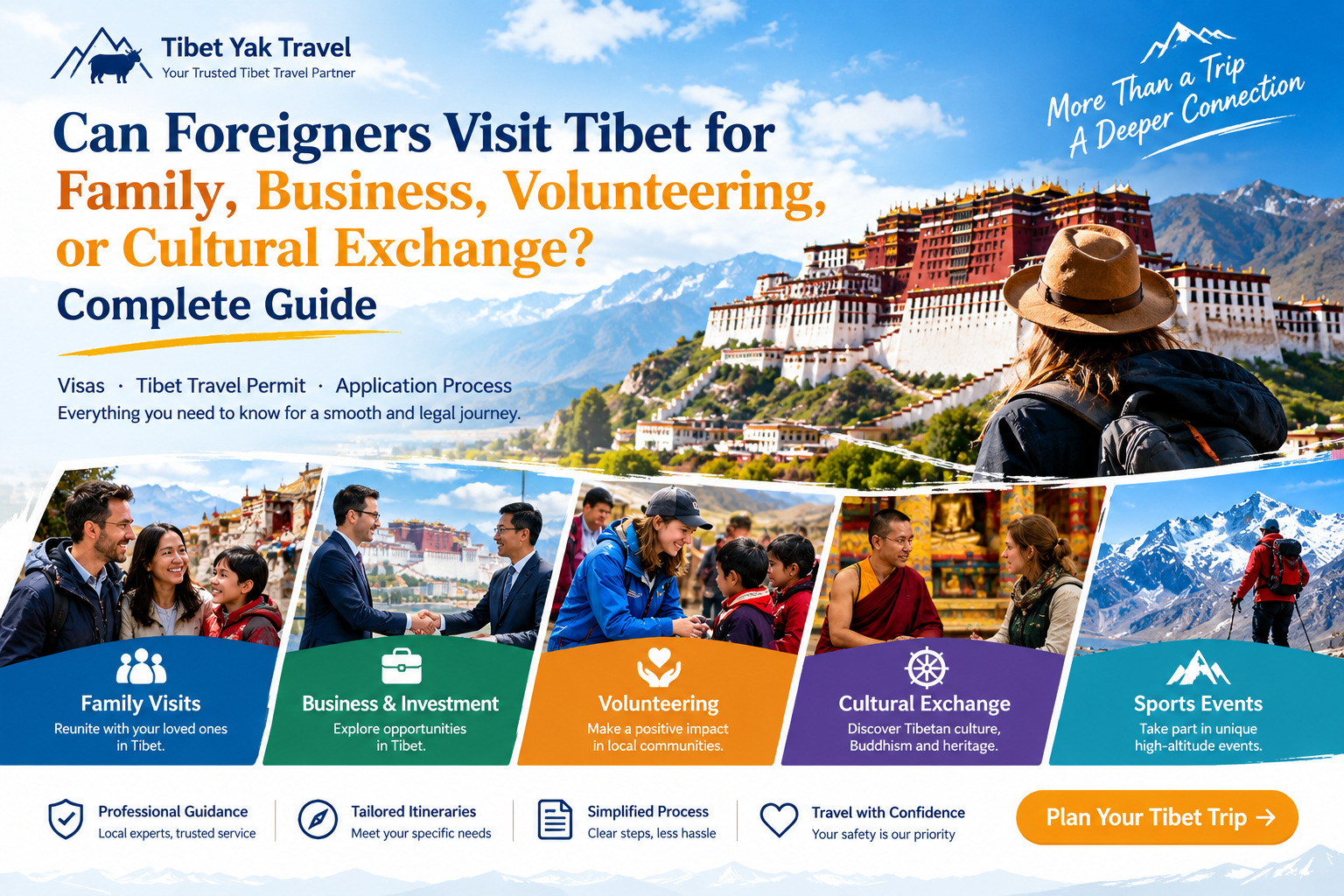
Yes. Foreign nationals may have reasons to visit Tibet beyond sightseeing, including visiting a spouse or partner, meeting family, conducting business, participating in volunteer programs, attending sporting events, or taking part in cultural and academic exchanges.
However, visiting Tibet as a foreign national requires additional planning. Travelers must consider two separate issues:
- Chinese visa or entry eligibility: The visa or visa-free entry conditions must match the purpose of the visit.
- Tibet travel authorization: Foreign passport holders generally need a Tibet Travel Permit (TTP), arranged through an eligible Tibet travel agency, before traveling to the Tibet Autonomous Region.
Depending on the purpose and destination, other approvals may also be necessary. These may include event permits, business arrangements, religious or cultural exchange approvals, or additional authorization for restricted border areas.
A private visit does not automatically qualify for independent travel. Travelers should confirm the current rules with their Tibet travel agency and the relevant Chinese authorities before making plans.
Essential Requirements for Foreigners Visiting Tibet
Before planning a trip, understand the main documents and procedures involved.
| Requirement | What It Means |
|---|---|
| Valid passport | A valid foreign passport is required for international travel and identification. |
| Chinese visa or eligible visa-free entry | Travelers must meet China’s entry requirements for their nationality and purpose of visit. |
| Tibet Travel Permit | Foreign passport holders generally need a TTP to enter the Tibet Autonomous Region. |
| Registered travel arrangements | The Tibet Travel Permit is normally arranged through an eligible Tibet travel agency. |
| Additional permits | Restricted border destinations may require further authorization. |
| Supporting documents | Depending on the purpose, invitation letters, business documents, event approvals, or other supporting records may be needed. |
What Is the Tibet Travel Permit?
The Tibet Travel Permit, also called the Tibet Entry Permit or Tibet Tourism Bureau Permit, is the main travel authorization required by foreign passport holders visiting the Tibet Autonomous Region. Individual foreign travelers generally cannot apply for this permit directly. An eligible Tibet travel agency arranges the application and submits the proposed itinerary and traveler information through the applicable procedures.
The permit is commonly checked before boarding flights or trains to Lhasa. Travelers should follow their agency’s instructions regarding the original permit and its use.
For more information, see our dedicated guide: Tibet Travel Permit 2026: Requirements, Application, and Processing.
Do Foreigners Have to Join a Group Tour?
A conventional group tour is not necessarily the only option. Depending on current approval requirements, private travel arrangements may be possible. A private tour can be organized for one foreign visitor, with a dedicated local guide and vehicle, rather than sharing a tour with other travelers.
However, a private tour is not the same as unrestricted independent travel. The approved itinerary, destination restrictions, and any applicable guide or agency requirements still apply. Before booking, ask your travel agency to confirm which arrangements are permitted for the specific purpose of the visit.

Visiting a Partner or Family Member in Tibet
Foreign nationals sometimes travel to Lhasa to visit a partner, spouse, parent, or other family member living in Tibet. The appropriate Chinese visa depends on the legal relationship, the visitor’s nationality, the host’s status in China, and the length and purpose of the stay.
Visiting a Boyfriend or Girlfriend in Lhasa
A foreign national visiting a boyfriend or girlfriend who lives in Lhasa may consider a tourist visa (L visa), if the actual purpose and circumstances meet the visa requirements. An unmarried romantic partner is not automatically eligible for a Q2 family visit visa. Q2 is intended for qualifying relatives of Chinese citizens residing in China or foreigners with permanent residence in China.
For example, a Singapore woman visiting her Chinese boyfriend in Lhasa may need to prepare:
- A valid Singapore passport.
- The appropriate Chinese visa or proof of eligible visa-free entry.
- An invitation letter from her boyfriend, if requested.
- A proposed travel itinerary.
- Information about her planned accommodation and length of stay.
- Documents required by the Tibet travel agency for the TTP application.
An invitation letter from a boyfriend may help explain the purpose of the visit, but it does not guarantee visa approval.
Visiting a Spouse in Tibet
A foreign spouse of a Chinese citizen may be eligible for a Q2 visa for a short family visit, subject to the consular authority’s requirements. For a longer family reunion involving residence in China, a Q1 visa may be appropriate.
Potential supporting documents include:
- A valid passport.
- Marriage certificate and any required authentication or verification.
- An invitation letter from the Chinese spouse.
- A copy of the spouse’s Chinese identity document.
- The spouse’s residential information.
- A completed visa application and any additional documents requested by the Chinese visa authority.
A Q2 or Q1 visa does not automatically authorize independent travel in Tibet. The visitor must separately confirm the applicable Tibet Travel Permit and travel arrangements.
Can a Foreign Spouse Stay at a Family Home in Lhasa?
Do not assume that a foreign visitor must stay in a hotel in every circumstance, or that staying with a spouse is automatically permitted. Foreign nationals staying in private accommodation in China generally have a legal obligation to complete accommodation registration within the required period. Local procedures and any Tibet-specific travel or reporting arrangements must also be checked.
Before departure, ask the travel agency and the local accommodation or public security authorities whether the proposed private accommodation is acceptable for the particular itinerary.
Foreign Volunteers and NGO Activities in Tibet
Foreign nationals interested in environmental protection, education, community development, disaster relief, or other volunteer activities should arrange the project before traveling. The correct visa and approval procedures depend on the activity, duration, organization, and whether the visitor will receive payment or other compensation.
Short-Term Volunteering
China’s visa application guidance recognizes F visas for certain exchange, visit, study tour, NGO, and short-term volunteer activities. The appropriate visa must be confirmed with the relevant Chinese visa authority.
A short-term volunteer project may require:
- An invitation from a legitimate Chinese organization.
- Details of the volunteer project.
- The activity location and schedule.
- Information about funding and expenses.
- Supporting documentation about the host organization.
- Any applicable local approvals or registration.
A private individual should not assume that they can independently sponsor a formal volunteer program.
Long-Term Volunteering and Employment
Long-term activities, paid work, teaching, or other work-like arrangements may require a different legal route, such as a work permit and an appropriate visa or residence permit. The distinction between volunteering and employment can depend on the actual activities, not simply whether the visitor receives a salary.
Foreign nationals should obtain written guidance from the host organization and relevant authorities before committing to a project.
Additional Approvals for NGO Activities
Certain activities involving overseas nongovernmental organizations may fall under China’s regulations governing overseas NGOs operating in mainland China. Depending on the organization’s legal status and the nature of the project, requirements may include cooperation with a Chinese partner organization, registration, or filing of temporary activities.
These requirements should not be confused with the Tibet Travel Permit. A project approval does not replace the separate procedures for traveling to Tibet.
Foreigners visiting Tibet for Buddhist Cultural Exchange and Academic Research
Tibet attracts international visitors interested in Tibetan Buddhism, history, art, architecture, language, and cultural heritage. Foreign nationals may participate in suitable academic and cultural activities, but the requirements depend on the nature of the visit.
Short-Term Cultural and Academic Visits
Possible activities include:
- Visiting monasteries open to the public.
- Studying Tibetan art, murals, and thangka painting.
- Attending academic seminars.
- Conducting approved historical or cultural research.
- Meeting scholars or cultural institutions.
- Participating in organized cultural exchange programs.
A visitor should distinguish ordinary cultural tourism from formal religious activities, academic fieldwork, and organized religious exchange.
If an institution is inviting a foreign researcher or exchange participant, it should confirm whether an F visa or another visa category is appropriate and whether additional approvals are required.
Studying Tibetan Buddhism in Tibet
Formal religious education, long-term study at a religious institution, or participation in organized religious activities may be subject to additional requirements.
Foreign nationals should not assume that a monastery can independently arrange admission, long-term residence, or religious training for international visitors.
Before making plans, contact the relevant educational institution, religious organization, or responsible authority to confirm eligibility and approval procedures.
Important Restrictions
Foreign visitors must comply with Chinese laws and the rules governing religious activities.
Cultural research and public visits should not be confused with authorization to conduct religious teaching, proselytizing, or other activities that are not permitted under applicable regulations.
For research projects involving interviews, photography, filming, publications, or access to restricted locations, confirm whether additional permissions are required.
Foreigners visiting Tibet for Business and Investment Opportunities in Tibet
Foreign investors and business representatives may visit Tibet to explore commercial opportunities, meet local companies, inspect potential project sites, or attend business meetings.
The appropriate Chinese visa depends on the main purpose of the visit.
Short-Term Business Visits
An M visa is generally used for commercial and trade activities. Depending on the circumstances, an F visa may be appropriate for certain noncommercial visits, exchanges, or study tours.
Business travelers may need to prepare:
- A valid passport.
- An appropriate Chinese visa.
- An invitation letter from a Chinese company or institution.
- The inviting organization’s business registration information.
- A meeting or inspection schedule.
- Details of the planned business activities.
- Supporting documents requested by the visa authority and Tibet travel agency.
The invitation letter should accurately explain the purpose, duration, locations, and financial arrangements of the visit.
Business Travel Arrangements in Tibet
Foreign visitors should coordinate their Tibet Travel Permit application and travel arrangements with an eligible agency or an appropriate local host.
The proposed itinerary may include business meetings, company visits, industrial parks, project sites, and accommodation details, as required by the applicable approval process.
Travelers visiting restricted border areas should check whether additional authorization is necessary.
Establishing a Foreign-Invested Business in Tibet
A short business visit is different from establishing and operating a company in Tibet.
Foreign investors considering a long-term business presence should check:
- Foreign investment access restrictions.
- Company registration requirements.
- Applicable industry regulations.
- Foreign investment information reporting.
- Work permit and residence requirements for foreign employees.
- Relevant tax, employment, and compliance obligations.
An investment approval or company registration does not replace immigration and Tibet travel authorization requirements.
Foreign Athletes and International Sporting Events in Tibet
Foreign athletes may have opportunities to participate in sporting events, training programs, and athletic exchanges in Tibet. However, event participation and travel authorization are separate matters.
Which Visa Is Required?
For certain commercial competitions and other business-related sporting activities, an M visa may be appropriate. For noncommercial sports exchanges, training visits, or other qualifying activities, an F visa may be considered.
The correct category depends on the event, the visitor’s role, compensation arrangements, and the requirements of the visa authority. Professional athletes, paid coaches, and long-term sports staff should obtain specific advice about work authorization where relevant.
Additional Event and Sports Approvals
The local organizer should verify which approvals are required before inviting foreign participants. High-altitude mountaineering, border-area races, and other activities with special safety or regulatory requirements may involve additional permissions.
For expeditions involving mountain climbing, participants should confirm whether mountaineering authorization is required, especially for regulated peaks and restricted areas.
Tibet Travel Permit and Event Itinerary
Foreign participants should arrange the Tibet Travel Permit separately from any event approval. The itinerary and event location should be confirmed in advance with the local organizer and travel agency. Do not assume that approval for a sporting event automatically authorizes unrestricted movement throughout Tibet.
Additional Permits for Restricted Border Areas
Some destinations in Tibet have additional access controls. The requirements depend on the destination, nationality, route, and current regulations.
Areas that may require additional authorization include:
- Mount Everest and surrounding border areas.
- Mount Kailash and the Ngari region.
- Certain areas of Medog.
- Other restricted frontier or military-sensitive locations.
Foreign travelers may need additional permits or travel authorization beyond the standard Tibet Travel Permit.
Do not confuse the following documents:
| Document | Purpose |
|---|---|
| Tibet Travel Permit | Main travel authorization for foreign passport holders visiting the Tibet Autonomous Region. |
| Foreigners’ Travel Permit | May be required for certain areas outside the ordinary open travel zones. |
| Border-area authorization | Additional authorization for specific restricted frontier destinations, where applicable. |
| Military or other special permits | May apply to certain sensitive areas or routes. |
The name and exact combination of required documents should be confirmed for each destination before travel.
See our related guides:
- Tibet Travel Permits Explained
- Tibet Military Permit
- Tibet Frontier Pass
- Mount Kailash Travel Permits
- Everest Base Camp Permits
Recommended Application Process
Although the supporting documents vary, the following sequence is a practical starting point for most foreign visitors planning a non-tourism visit to Tibet.
Step 1: Confirm the Purpose of the Visit
Clearly define the reason for traveling to Tibet. Is the visitor coming to see a spouse, meet a partner, conduct business, participate in a volunteer project, attend an academic exchange, or join a sports event?
The purpose determines which visa and supporting documents may be needed.
Step 2: Confirm Chinese Entry Requirements
Check whether the visitor needs a Chinese visa or qualifies for a visa-free entry policy. If a visa is required, confirm the correct category and the current application checklist with the relevant Chinese embassy, consulate, or visa application center.
Step 3: Arrange Any Required Invitations and Special Approvals
Depending on the visit, prepare relevant documents such as:
- Family invitation letters.
- Business invitations.
- Volunteer project information.
- Academic or cultural exchange invitations.
- Sporting event invitations.
- Relevant institutional approvals.
Do not purchase nonrefundable travel arrangements until the main eligibility and approval requirements are understood.
Step 4: Contact a Qualified Tibet Travel Agency
Contact a Tibet-based travel agency authorized to handle foreign visitors.
Explain the purpose of the trip and provide the intended dates, travel destinations, accommodation preferences, and any special activities.
Ask the agency to confirm whether a private itinerary is possible and which supporting documents are required for the Tibet Travel Permit.
Step 5: Submit the Tibet Travel Permit Application
Provide the required passport, visa or entry information, itinerary, invitation documents, and other supporting materials requested by the agency.
The agency will advise on submission and the applicable approval process.
Step 6: Confirm Travel and Accommodation
Once the required authorization is confirmed, finalize the transport arrangements and accommodation.
For flights or trains to Lhasa, follow the transport provider’s document requirements. Make sure the travel dates and itinerary are consistent with the approved arrangements.
Step 7: Follow the Approved Travel Arrangements
During the trip, comply with all applicable travel restrictions, registration requirements, and local laws.
If the purpose or itinerary changes, consult the agency and relevant host organization before making changes that may require new approval.
Quick Comparison: Different Reasons for Foreigners visiting Tibet
| Purpose | Possible Visa Category | Additional Requirements | Tibet Travel Permit |
|---|---|---|---|
| Visiting a boyfriend or girlfriend | L or another eligible entry route | Invitation and itinerary, if requested | Generally required |
| Visiting a Chinese spouse or qualifying relative | Q2 for short visits; Q1 for long-term family reunion, as applicable | Relationship evidence and invitation | Generally required |
| Short-term volunteering | F may apply | Host organization and any applicable activity approvals | Generally required |
| Long-term work or work-like activities | Z or another appropriate route | Work permit and residence procedures, where applicable | Generally required |
| Cultural or academic exchange | F may apply | Institutional invitation and any required research or exchange approvals | Generally required |
| Business or investment visit | M or F, depending on the activity | Business invitation and supporting company documents | Generally required |
| Sports competition | M or F, depending on the event | Event invitation and any necessary sports or safety approvals | Generally required |
| Religious or Buddhist academic exchange | Depends on the actual activity | Relevant institutional and regulatory approvals, where required | Generally required |
These are general indications, not automatic visa entitlements. The final visa category and approval requirements must be determined by the relevant authorities.
Frequently Asked Questions
Can foreigners visit Tibet without joining a group tour?
A conventional shared group tour may not be necessary in every case. A private tour may be possible, subject to current regulations and approval requirements. Foreign visitors should confirm their permitted travel arrangements with an eligible Tibet travel agency.
Can a foreigner visit a boyfriend or girlfriend in Lhasa?
Potentially, yes. The visitor must meet China’s entry requirements and arrange the necessary Tibet travel authorization. An unmarried romantic partner is not automatically eligible for a family visit visa.
Can a foreign spouse visit their husband or wife in Tibet?
A qualifying foreign spouse may apply for an appropriate family visit visa, such as Q2 for a short visit or Q1 for a longer family reunion, depending on the circumstances. The Tibet Travel Permit and applicable travel arrangements are separate requirements.
Can foreign visitors stay with family members in Lhasa?
Accommodation arrangements must comply with local registration rules and any applicable Tibet travel requirements. Travelers should confirm in advance whether a private residence is acceptable for their particular itinerary.
Can foreigners volunteer in Tibet?
Some volunteer activities may be possible through eligible organizations and under the appropriate visa and regulatory arrangements. The visitor must confirm that the project, visa, host organization, and activity approvals are all compliant before participating.
Can foreigners study Tibetan Buddhism in Tibet?
Foreign visitors can participate in certain cultural and academic activities, but formal religious education and organized religious activities may involve additional restrictions and approvals. Admission and permission should be confirmed directly with the relevant institution and authorities.
Can foreign investors visit Tibet independently?
Foreign investors can explore business opportunities if they meet the relevant entry and Tibet travel requirements. Business invitations, the correct visa, a Tibet Travel Permit, and additional destination-specific approvals may be necessary. Company registration does not automatically grant unrestricted travel rights.
How long does it take to obtain a Tibet Travel Permit?
Processing times vary with the application, travel dates, destination, and applicable review procedures. It is sensible to begin planning several weeks ahead, particularly for peak-season travel or itineraries involving restricted areas.
Do not treat a general estimate as a guaranteed processing time. Confirm the current timeline with the travel agency before booking transport.
Do foreigners need a Tibet Travel Permit if they enter China visa-free?
Visa-free entry to mainland China does not automatically remove Tibet travel requirements. Foreign passport holders should generally plan to obtain a Tibet Travel Permit when visiting the Tibet Autonomous Region, regardless of whether they need a Chinese visa.
Plan Your Tibet Visit with Local Experts
Whether you are visiting a partner, meeting family, exploring investment opportunities, joining an approved volunteer project, or participating in a cultural exchange, preparation is essential.
Tibet Yak Travel can help foreign visitors understand the Tibet Travel Permit application process, plan private travel arrangements, and coordinate the practical details of a Tibet itinerary.
Contact our local team before finalizing your travel plans. Tell us your nationality, purpose of visit, travel dates, and intended destinations so we can help identify the appropriate next steps. Plan your Tibet visit with Tibet Yak Travel.