
Supplemental oxygen can be an important part of medical preparation for high-altitude travel. However, not all oxygen equipment works in the same way, and the amount of oxygen available varies greatly between devices. Travelers visiting Lhasa, Everest Base Camp or Mount Kailash may encounter several types of oxygen equipment, including medical oxygen cylinders, portable oxygen concentrators and small handheld oxygen cans.
These products are not interchangeable. Some can provide a sustained oxygen supply, while others contain only a small amount of oxygen. Portable concentrators also depend on electricity or batteries and may perform differently at high altitude.
This guide explains the main types of oxygen equipment, their advantages and limitations, and what to check before taking them on a Tibet journey.
Three Main Types of Oxygen Equipment
The most common categories are:
| Equipment | How it works | Main limitation |
|---|---|---|
| Medical oxygen cylinder | Stores compressed oxygen | Limited supply; requires safe handling and compatible regulator |
| Portable oxygen concentrator | Concentrates oxygen from surrounding air | Needs power and may have altitude-related performance limits |
| Handheld oxygen can | Releases a small quantity of stored oxygen | Very short supply; not suitable for sustained oxygen therapy |
The right equipment depends on the medical purpose, intended duration, destination, transport arrangements and availability of replacement supplies.
2. Medical Oxygen Cylinders
Medical oxygen cylinders store oxygen under pressure. When connected to a suitable regulator and delivery system, they can provide a relatively predictable oxygen supply.
They are generally more appropriate than small handheld cans when a sustained supply is required.
How do oxygen cylinders work?
A typical system includes:
- A cylinder containing compressed oxygen.
- A pressure regulator.
- A flow-control mechanism.
- Oxygen tubing.
- A nasal cannula or mask.
The regulator controls the oxygen delivered to the user. The cylinder’s pressure gauge indicates the remaining pressure, but pressure alone does not tell you the exact usable operating time unless the cylinder capacity and other specifications are known.
Understanding cylinder capacity
One important distinction is the difference between cylinder water capacity and the amount of compressed gas inside it. For example, a cylinder marked with a 2-litre water capacity does not necessarily contain only 2 litres of oxygen. The cylinder’s internal water capacity describes its physical volume, while the compressed gas volume depends on its pressure.
A simplified calculation is: Approximate gas volume = Cylinder water capacity × Pressure
For example, a cylinder with a 2-litre water capacity and a pressure of 150 bar has an approximate gas volume of 300 litres under simplified assumptions.
Actual usable oxygen may be lower because of residual pressure, equipment limitations and other losses.
How long does a cylinder last?
For continuous-flow oxygen, an approximate operating-time calculation is:
Operating time = Usable oxygen volume ÷ Flow rate
For example:
| Usable oxygen volume | Flow rate | Theoretical duration |
|---|---|---|
| 150 litres | 2 L/min | 75 minutes |
| 300 litres | 2 L/min | 150 minutes |
| 300 litres | 3 L/min | 100 minutes |
| 600 litres | 2 L/min | 300 minutes |
These are mathematical examples, not treatment recommendations. Real operating time depends on the actual usable volume, regulator, residual pressure and equipment condition.
Advantages of oxygen cylinders
- Can provide a sustained supply when adequately sized.
- Do not require electricity to release stored oxygen.
- Can be used with compatible continuous-flow delivery systems.
- May be useful in a medical or emergency-support arrangement.
Limitations
- Oxygen supply is finite.
- Cylinders can be heavy and difficult to transport.
- Regulators and fittings must be compatible.
- Refilling or replacing cylinders may be difficult in remote locations.
- Cylinders require secure storage and careful handling.
For a remote Tibet journey, the available supply should be planned around the expected period of use and the time needed to arrange medical assistance or descent. A small cylinder may run out before evacuation can be completed.
Portable Oxygen Concentrators
A portable oxygen concentrator (POC) takes in surrounding air, removes much of the nitrogen and delivers concentrated oxygen to the user.
Unlike a cylinder, it does not store a large supply of compressed oxygen. It produces oxygen while it operates.
Portable concentrators are often used by people who need prescribed oxygen during daily activities or travel.
How does a portable concentrator work?
The device draws in ambient air and uses an internal separation process to concentrate oxygen.
Most portable concentrators use one of two delivery methods:
Continuous flow: Oxygen is supplied continuously at a selected flow rate, usually expressed in litres per minute.
Pulse dose: The device detects inhalation and releases a measured amount of oxygen during the breathing cycle.
Pulse-dose settings are specific to the device. A setting of 2 on a pulse-dose concentrator does not necessarily provide the same oxygen delivery as 2 L/min from a continuous-flow system.
Advantages of portable concentrators
- Do not require regular cylinder refilling while operating normally.
- Can be carried or transported more easily than many large cylinders.
- May be useful for people with a prescribed oxygen requirement.
- Some models offer rechargeable battery operation.
- Can provide oxygen for extended periods when power and equipment capacity are sufficient.
Important limitations at high altitude
Portable oxygen concentrators are not automatically suitable for every high-altitude destination.
Before taking one to Tibet, check the following specifications.
1. Maximum operating altitude
Every model has its own operating limits. Check the manufacturer’s stated maximum altitude and confirm that the device can function at the elevation of your destination.
A device that operates normally at a lower elevation may not deliver the same performance at a much higher one.
2. Oxygen output
Check the actual oxygen output at the intended altitude and operating setting. Do not rely only on a product’s advertised setting number.
3. Delivery mode
Confirm whether the device supplies continuous flow or pulse dose. People who require oxygen during sleep or have particular breathing patterns may need a different delivery arrangement.
4. Battery life
Battery runtime depends on the model, selected setting, operating conditions and battery condition. Cold weather can also affect battery performance.
Calculate the expected operating time and arrange spare batteries or a reliable charging option where appropriate.
5. Temperature range
Check the manufacturer’s permitted operating and storage temperatures. Cold conditions on the Tibetan Plateau may affect the device and its battery.
6. Power availability
Remote routes may have limited or unreliable electricity. Confirm whether the device can be charged at each overnight stop and whether a backup power arrangement is available.
A concentrator is not automatically an emergency oxygen system
A portable concentrator may be useful for a person with an established medical oxygen requirement, but its output may not be adequate for someone experiencing severe altitude illness.
Suspected HAPE or HACE requires urgent medical assistance and descent or evacuation. Do not rely on a consumer concentrator as the only emergency plan.
Handheld Portable Oxygen Cans
Small handheld oxygen cans are widely marketed to travelers visiting high-altitude destinations. They are compact and easy to carry, but their oxygen capacity is very limited compared with medical cylinders.
How do oxygen cans work?
These products contain a small quantity of compressed oxygen or an oxygen-containing gas mixture, depending on the product. The user releases gas through a nozzle or mask. The amount of usable oxygen varies by product. Always check the actual stated oxygen content rather than assuming that the can’s external size represents its oxygen supply.
Why are oxygen cans limited?
Consider a can containing approximately 5 litres of usable oxygen. At a hypothetical continuous flow of 2 L/min, that amount would last only around 2.5 minutes. This illustrates why a small can cannot provide sustained oxygen therapy.
The Wilderness Medical Society does not recommend nonprescription oxygen cans or oxygen bars as substitutes for sustained oxygen treatment for acute mountain sickness.
Are oxygen cans useful in Tibet?
They may be marketed as a convenient travel product, but they should not be relied upon as the main oxygen supply for a serious medical problem. They are not an adequate replacement for a medical oxygen cylinder or an appropriately prescribed oxygen system.
In suspected HAPE, HACE or another serious emergency, arrange medical assistance and descent or evacuation rather than depending on a small handheld can.
Comparing the Three Types of Oxygen Equipment
| Feature | Medical cylinder | Portable concentrator | Handheld oxygen can |
|---|---|---|---|
| Stores oxygen | Yes | No large stored supply | Yes, small quantity |
| Requires electricity | No | Usually yes or battery | No |
| Can provide sustained oxygen | Yes, if supply is adequate | Potentially, within device limits | No |
| Main limitation | Finite supply and transport | Power, battery and altitude performance | Very limited capacity |
| Suitable for serious emergencies | May support emergency care | Not a guaranteed emergency solution | No |
| Refill or replacement | Required when depleted | Not normally required during operation | Replace when empty |
No equipment type is automatically suitable for every traveler. The choice should reflect the actual medical requirement and the conditions along the route.
Oxygen-Enriched Rooms and Accommodation
Some high-altitude hotels advertise oxygen-enriched rooms or oxygen services. These arrangements can differ considerably. An oxygen-enriched room may increase the oxygen concentration in the room’s air. Another hotel may provide oxygen through an individual nasal cannula or mask.
These are different systems and should not be described as equivalent.
Before booking accommodation that advertises oxygen facilities, ask:
- Is oxygen supplied directly to the guest or added to the room air?
- Is the oxygen concentration monitored?
- Is the service available throughout the night?
- Is the equipment maintained?
- What happens if electricity fails?
- Are appropriate ventilation and fire precautions in place?
Do not assume that an advertised oxygen service is equivalent to hospital oxygen therapy or that it can treat a serious altitude emergency.
Taking Oxygen Equipment on Flights to Tibet
Travelers who use prescribed oxygen should arrange their flight requirements well before departure. Airlines have specific rules for portable oxygen concentrators, batteries and medical documentation. A device that is suitable for use in a hotel or vehicle is not automatically approved for use during a flight.
Before traveling:
- Contact the airline directly.
- Confirm whether your specific concentrator model is accepted.
- Ask whether a medical statement or advance notification is required.
- Check battery requirements and permitted battery capacity.
- Confirm whether the device can operate for the entire journey, including delays.
- Carry the manufacturer’s documentation and relevant medical information.
Do not assume that an airline will provide medical oxygen in the exact form or quantity you require.
Oxygen Equipment Safety
All oxygen equipment needs careful handling. Oxygen is not itself flammable, but it supports combustion and can make fires burn much more intensely.
Follow these precautions:
- Never smoke near oxygen equipment.
- Keep cylinders and oxygen tubing away from open flames.
- Do not use oxygen near candles, cooking fires or heaters.
- Keep oil and grease away from regulators and fittings.
- Secure cylinders so they cannot fall or roll.
- Use only compatible regulators and accessories.
- Follow the manufacturer’s storage and operating instructions.
- Keep equipment away from excessive heat.
- Do not use damaged cylinders, regulators or tubing.
- Do not attempt to repair cylinder valves yourself.
In tents, vehicles and hotel rooms, oxygen equipment must be used with appropriate fire-safety and ventilation arrangements.
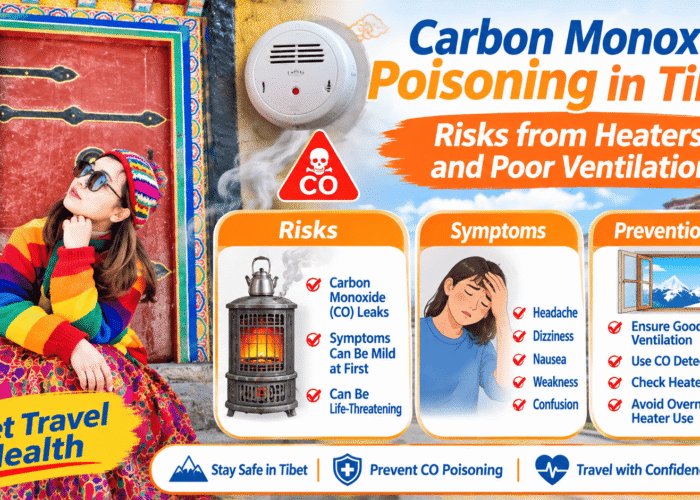
Never use combustion heaters or cooking devices inside an enclosed tent or vehicle. Carbon monoxide poisoning can be especially dangerous at high altitude because its symptoms may be confused with other travel-related illnesses.
What Oxygen Equipment Should You Prepare for Tibet?
The answer depends on the purpose of the equipment.
Ordinary sightseeing in Lhasa
Most healthy travelers do not need to bring personal oxygen equipment simply to visit Lhasa. Gradual acclimatization, moderate activity and awareness of symptoms are more important.
A pulse oximeter may be useful as a supporting monitoring tool, but it does not replace symptom assessment.
Everest Base Camp and remote high-altitude routes
For remote travel, the tour operator should have a clear emergency plan. Oxygen availability, transport, communication and descent arrangements should be discussed before departure.
Do not assume that every vehicle or hotel carries a reliable oxygen supply.
Mount Kailash pilgrimage
The Mount Kailash region involves high elevations, long road journeys and physically demanding walking. Travelers should plan for gradual acclimatization and understand where emergency assistance and lower-altitude evacuation may be possible.
Any oxygen equipment carried for medical or emergency purposes should have a clear role in the overall safety plan.
Travelers with existing medical conditions
People who already use oxygen or have significant lung or heart conditions should consult their treating clinician before traveling.
The clinician should assess the expected elevations, activity, sleep arrangements, equipment requirements and emergency alternatives.
Questions to Ask Before Relying on Oxygen Equipment
Before departure, confirm the following:
- What type of oxygen equipment is available?
- How much usable oxygen does it contain or produce?
- What delivery method does it use?
- Can it operate at the intended elevation?
- Does it need electricity or batteries?
- How long can it operate under the planned conditions?
- Is replacement oxygen or charging available along the route?
- Who is responsible for operating and checking the equipment?
- What is the plan if the equipment fails?
- How will the traveler descend or reach medical care?
A reliable emergency plan is more important than simply carrying an oxygen device.
Frequently Asked Questions
Which oxygen equipment is best for Tibet?
There is no single best option. Medical oxygen cylinders can provide a sustained supply when adequately sized. Portable concentrators may suit some travelers with prescribed oxygen needs, while handheld cans contain too little oxygen for sustained treatment.
Are portable oxygen cans effective at Everest Base Camp?
They contain very limited oxygen and should not be relied upon to treat serious altitude illness. A proper medical oxygen supply and emergency response plan are more important.
Can I take a portable oxygen concentrator to Tibet?
Possibly, but check the manufacturer’s operating altitude, oxygen output, delivery mode, temperature limits and battery capacity. Travelers who need oxygen should also confirm airline requirements before departure.
Do oxygen concentrators work at 5,000 metres?
Performance depends on the specific model. Check its manufacturer specifications and verify the oxygen output at the intended elevation. Do not assume that a device designed for lower elevations will perform adequately at Everest Base Camp.
How much oxygen should a tour vehicle carry?
There is no universal quantity for every vehicle or journey. Planning should consider the group, route, expected evacuation time, equipment type and medical requirements. The supply must be adequate for its intended purpose and should not replace descent or evacuation.
Does every hotel in Tibet provide oxygen?
No. Oxygen services vary between hotels and locations. Confirm the exact service with the accommodation before relying on it, particularly on remote routes.
Conclusion
Oxygen equipment can be useful during high-altitude travel, but the different products have very different capabilities. Medical cylinders can provide a sustained supply when correctly sized and managed. Portable concentrators may help travelers with prescribed oxygen needs, but their altitude performance, battery life and delivery mode must be checked. Small handheld oxygen cans provide only a brief supply and cannot replace medical oxygen therapy.
For a safe journey through Tibet, plan oxygen arrangements according to the route and medical needs, confirm the equipment’s limitations and maintain a clear emergency descent or evacuation plan.
Medical Disclaimer: This article is for general educational purposes and does not replace professional medical advice. Oxygen equipment must be selected and operated according to the manufacturer’s instructions and appropriate medical guidance. Suspected HAPE, HACE or severe altitude illness requires urgent medical assistance and descent or evacuation when possible.
References
- CDC Yellow Book 2026: High-Altitude Travel and Altitude Illness.
- Wilderness Medical Society Clinical Practice Guidelines for the Prevention, Diagnosis, and Treatment of Acute Altitude Illness: 2024 Update.
- US Food and Drug Administration: Pulse Oximeters and Oxygen Concentrators—What to Know About Home Oxygen Therapy.
- US Department of Transportation: Portable Oxygen Concentrator guidance for air travel.
- Manufacturer instructions and technical specifications for the specific oxygen cylinder, regulator or concentrator.
Suggested Internal Links
- Oxygen at High Altitude: Benefits, Flow Rates, Duration and Safety
- Blood Oxygen Levels at High Altitude: SpO₂ Guide
- How to Improve Oxygen Levels at High Altitude
- How to Prevent Altitude Sickness
- Tibet Travel Checklist: Essential High-Altitude Gear
- Altitude Sickness at Everest Base Camp
- Altitude Sickness on the Mount Kailash Pilgrimage