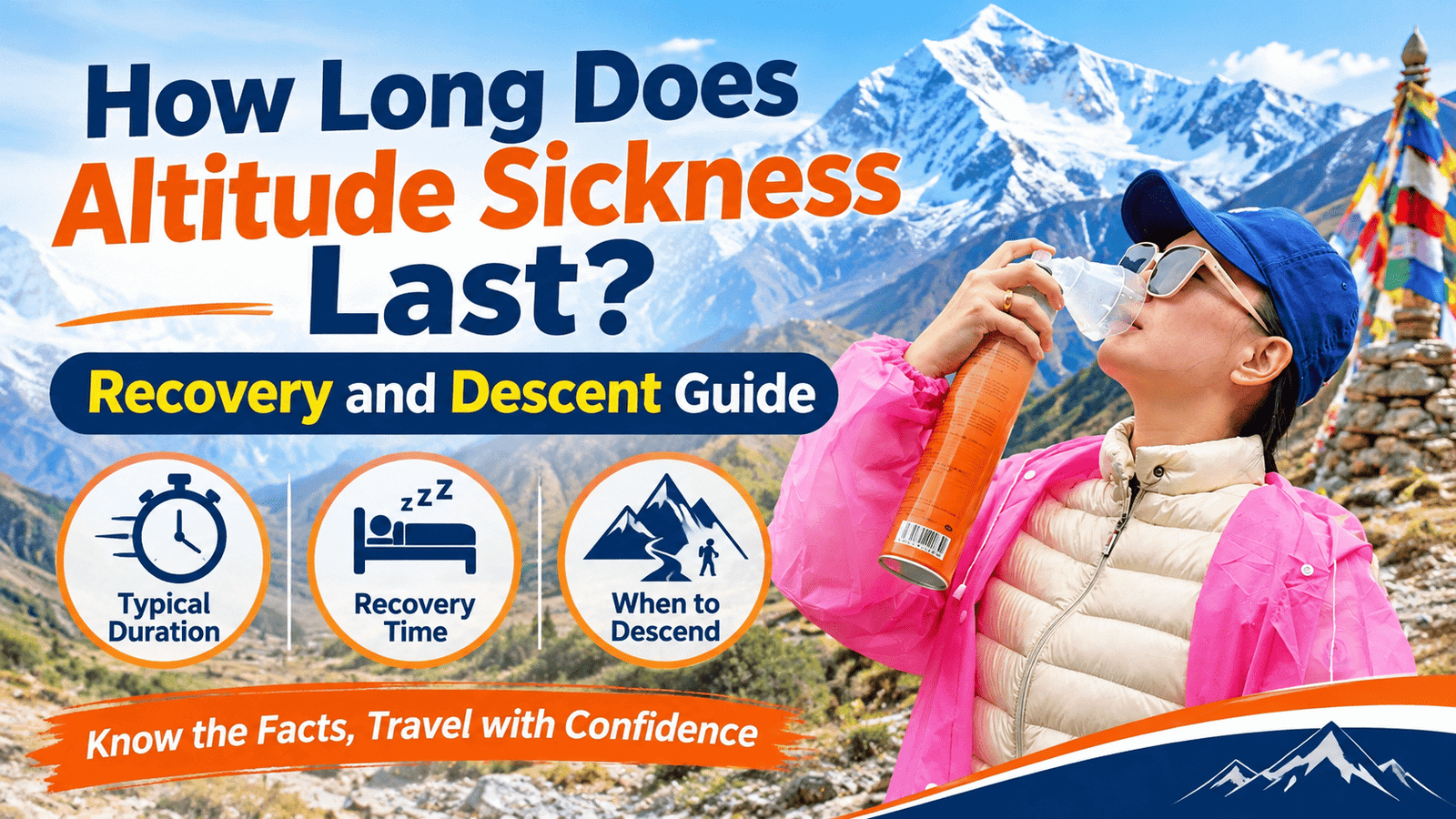
Altitude sickness is a common concern for travelers visiting Tibet. After arriving in Lhasa, traveling to Everest Base Camp or beginning the Mount Kailash pilgrimage, some visitors develop a headache, nausea, dizziness or unusual tiredness as their bodies adjust to the reduced oxygen available at high altitude.
One of the most common questions is: How long does altitude sickness last?
The answer depends on the type and severity of altitude illness, the altitude where symptoms develop, and whether the traveler continues ascending, stays at the same elevation or descends.
Mild acute mountain sickness (AMS) often improves within 12–48 hours if the traveler does not ascend further. Some cases take one to three days to settle. More serious conditions, including high-altitude pulmonary edema (HAPE) and high-altitude cerebral edema (HACE), require urgent medical treatment and should never be managed by simply waiting for symptoms to disappear.
This guide explains typical recovery times, what affects recovery and when a traveler should descend or seek medical attention.
How long does altitude sickness usually last?
The most common form of altitude sickness is AMS. It usually develops within 2–12 hours after arriving at a high altitude or sleeping at a higher elevation, often during or after the first night.
For many travelers, symptoms improve as the body begins to acclimatize.
| Situation | Typical course | Important advice |
|---|---|---|
| Mild AMS without further ascent | Often improves within 12–48 hours; may take 1–3 days | Rest at the same altitude and monitor symptoms |
| AMS after further ascent | Symptoms may persist or worsen | Stop ascending; do not sleep higher |
| AMS after descent | Often improves relatively quickly, sometimes after a descent of 300 m or more | Continue monitoring and seek care if symptoms persist |
| Severe AMS | May worsen despite rest or medication | Stop ascent and descend |
| HAPE | Can progress over 1–2 days if untreated | Urgent medical care, oxygen if available and descent |
| HACE | Can deteriorate rapidly | Emergency descent and medical treatment |
These are general patterns, not guaranteed recovery times. A traveler who becomes seriously ill may deteriorate much faster than someone with mild AMS.
2. How long does mild acute mountain sickness last?
Mild AMS usually improves within one to two days when the traveler stays at the same altitude and allows time for acclimatization.
Common symptoms include:
- Headache
- Nausea or reduced appetite
- Dizziness
- Fatigue
- General weakness or discomfort
For example, a visitor who flies directly to Lhasa at approximately 3,650–3,700 metres may experience a headache or reduced appetite during the first evening or the following morning.
If symptoms are mild and do not worsen, the traveler may remain at the same sleeping altitude, rest and monitor their condition. They should not continue to a higher sleeping elevation until symptoms have completely resolved.
The CDC describes AMS as generally resolving within 12–48 hours if travelers do not ascend farther, although the condition can take one to three days to develop and settle.
If symptoms become worse, remain severe or fail to improve after appropriate measures, the traveler should seek medical assessment and consider descent.
3. How long does altitude sickness last after descending?
Descent usually provides the fastest relief from altitude-related symptoms.
For AMS, symptoms often improve after descending approximately 300–1,000 metres. The amount of descent needed varies from person to person.
Some travelers notice improvement within a few hours. Others need more time, particularly if they have been unwell for longer or have another medical condition.
For example, a traveler who develops AMS during a high-altitude journey toward Everest Base Camp may improve after returning to a lower settlement. However, improvement does not automatically mean that the traveler is ready to return to the same elevation.
The important points are:
- Descend if symptoms are severe or worsening.
- Avoid strenuous activity during descent.
- Do not travel alone if seriously unwell.
- Continue monitoring symptoms after reaching a lower altitude.
- Seek medical assessment if symptoms persist or new symptoms develop.
A person with suspected HAPE or HACE needs urgent treatment. Do not use the expected recovery time for mild AMS to decide whether a serious condition can be safely managed.
4. How long does HAPE take to recover?
High-altitude pulmonary edema (HAPE) is a serious condition in which fluid accumulates in the lungs.
Early symptoms may include reduced exercise performance, unusual breathlessness during activity and a persistent cough. Without treatment, the condition can progress to breathlessness at rest and respiratory distress.
HAPE can worsen over approximately one to two days, although its course varies. It should be treated as an emergency rather than monitored at a hotel to see whether it improves.
Recovery depends on the severity of the condition, how quickly treatment begins and the patient’s response to descent and oxygen.
The main treatment principles are:
- Urgent descent to a lower altitude.
- Supplemental oxygen when available.
- Minimal physical exertion.
- Medical assessment and monitoring.
The Wilderness Medical Society recommends descent for HAPE, generally aiming for at least 1,000 metres or until symptoms improve. In selected mild cases, treatment with oxygen and bed rest at the same elevation may be considered by clinicians in a medical facility with adequate monitoring. This is not a strategy for independent travelers in remote areas.
Do not return to high altitude simply because breathing feels better. A clinician should assess recovery and determine whether further ascent is appropriate.
5. How long does HACE take to recover?
High-altitude cerebral edema (HACE) is a life-threatening condition involving brain dysfunction and swelling.
Warning signs include:
- Confusion
- Staggering or loss of balance
- Difficulty walking in a straight line
- Unusual behavior
- Severe drowsiness
- Reduced consciousness
HACE can progress rapidly. Without treatment, a person may become unconscious or develop a coma.
Treatment requires emergency descent, oxygen when available and medical care. Dexamethasone is used in the treatment of HACE under medical guidance.
There is no safe general recovery timetable that travelers should use to plan a return to sightseeing or trekking. Even when symptoms improve, the patient needs medical evaluation and a carefully managed recovery plan.
The Wilderness Medical Society advises avoiding reascent during the same trip after HACE because evidence supporting safe return to altitude is lacking.
6. What affects how quickly altitude sickness improves?
Recovery is not the same for everyone. Several factors can influence how long symptoms last.
The altitude reached
The higher a traveler sleeps, the greater the physiological challenge. A person staying in Lhasa may have a different experience from someone sleeping at Everest Base Camp or undertaking a high-altitude trek.
How quickly the traveler ascended
Rapid ascent gives the body less time to adapt. Flying directly to Lhasa exposes travelers to a substantial elevation change in a short period.
A gradual itinerary with adequate acclimatization time can reduce the risk of illness, although it cannot eliminate it.
Whether the traveler continues ascending
Continuing to a higher sleeping altitude while symptoms are present can make altitude illness worse.
A traveler with AMS should not ascend further until symptoms have resolved. If symptoms worsen despite rest or treatment, descent is necessary.
Physical exertion
Heavy exercise increases the body’s oxygen demand. During early acclimatization, rushing, carrying heavy luggage or undertaking strenuous trekking can make symptoms more difficult to manage.
Resting does not cure every form of altitude illness, but avoiding unnecessary exertion is sensible while symptoms are being assessed.
Individual susceptibility and health
People respond differently to altitude. Previous successful trips do not guarantee that a person will remain free of altitude sickness on a later visit.
Underlying heart or lung disease, recent illness and other health factors may also affect travel safety and recovery. Travelers with relevant medical conditions should discuss their itinerary with a healthcare professional before departure.
7. When should you descend instead of waiting?
Not every headache at altitude requires immediate descent. However, certain symptoms should never be managed by waiting.
Stop ascending and monitor
If symptoms are mild and consistent with AMS, stop increasing sleeping altitude. Rest at the current elevation and monitor for improvement.
Do not continue to a higher overnight stop simply because the vehicle journey is already planned.
Seek medical advice and consider descent
Arrange medical assessment if:
- Symptoms are moderate or persistent.
- Headache or nausea is getting worse.
- The traveler cannot eat or drink adequately.
- Symptoms do not improve after rest and appropriate care.
- There is uncertainty about whether another illness is responsible.
Descend urgently
Arrange urgent descent and medical assistance if there is:
- Breathlessness at rest.
- A worsening cough with breathing difficulty.
- Chest congestion and a marked decline in physical ability.
- Confusion or altered mental status.
- Loss of balance or inability to walk normally.
- Collapse or loss of consciousness.
These may indicate HAPE, HACE or another serious medical emergency.
Do not wait for a full set of symptoms. A single major warning sign can be enough to require emergency action.
8. When is it safe to continue traveling after altitude sickness?
A traveler should not return to a higher sleeping altitude while AMS symptoms remain.
For uncomplicated AMS, further ascent may be considered only after symptoms have completely resolved. The traveler should also be able to manage ordinary activity comfortably and should follow a gradual ascent plan.
After a more serious episode, the decision is different:
- After mild AMS: Consider continuing only after complete symptom resolution and a review of the planned sleeping elevations.
- After moderate or severe AMS: Seek medical advice before resuming ascent.
- After HAPE: Require medical assessment and stable recovery before considering any return to altitude.
- After HACE: Avoid further ascent during the same trip unless a specialist with knowledge of the case advises otherwise.
Medication can sometimes reduce symptoms, but symptom relief does not always mean that acclimatization is complete. In particular, dexamethasone does not help the body acclimatize.
9. How to plan a Tibet itinerary that allows time for recovery
A sensible itinerary should include flexibility, especially when traveling from Lhasa to higher destinations.
Lhasa
Lhasa sits at approximately 3,650–3,700 metres. Travelers arriving by air should take the first days slowly, avoid strenuous activity and monitor how they feel.
Shigatse and the Everest route
The journey from Lhasa toward Shigatse and Everest involves changes in sleeping altitude. The itinerary should not force a traveler with unresolved altitude symptoms to continue to a higher overnight stop.
Everest Base Camp
Everest Base Camp is a much higher destination than Lhasa. Travelers should follow a suitable acclimatization plan and understand that a headache, cough or unusual breathlessness may need medical assessment.
Mount Kailash
The Mount Kailash pilgrimage includes remote travel and strenuous walking during the kora. Travelers should be physically prepared, allow time for acclimatization and avoid starting the trek while unwell.
A flexible schedule is essential. If a traveler develops significant altitude symptoms, changing the itinerary is safer than trying to complete the journey as originally planned.
10. Can medication make altitude sickness disappear faster?
Some medicines can help manage altitude illness, but they do not all work in the same way.
- Acetazolamide helps the body acclimatize and is commonly used for prevention. It may also be considered in some cases of AMS.
- Dexamethasone can rapidly reduce symptoms of moderate or severe AMS and is used for HACE, but it does not promote acclimatization.
- Nifedipine may be used in selected cases of HAPE under medical guidance. It is not a general treatment for ordinary altitude sickness.
Medication should not be used to justify continuing to a higher altitude while symptoms remain. A qualified healthcare professional should advise on the appropriate medicine and whether descent is necessary.
Frequently Asked Questions
Does altitude sickness go away on its own?
Mild AMS often improves as the body acclimatizes, provided the traveler does not ascend further. However, worsening symptoms or signs of HAPE or HACE require medical treatment and may require urgent descent.
How long does altitude sickness last in Lhasa?
Mild AMS after arrival in Lhasa often improves within 12–48 hours, although some travelers need one to three days. Persistent or worsening symptoms should be assessed rather than automatically attributed to altitude.
Does altitude sickness disappear after sleeping?
Not necessarily. Some travelers feel better after resting, while others develop symptoms during or after their first night at altitude. Sleep does not guarantee acclimatization or recovery.
How long should I wait before going higher?
Wait until all AMS symptoms have resolved before increasing sleeping altitude. The appropriate timing also depends on the itinerary, the altitude involved and the traveler’s health.
Will going down 500 metres cure altitude sickness?
A descent of 300–1,000 metres often improves AMS, but the response varies. Severe AMS, HAPE and HACE may require greater descent and urgent medical care.
Can I return to Everest Base Camp after altitude sickness?
It depends on the type and severity of the illness. After uncomplicated AMS, return may be considered once symptoms have completely resolved and a safe ascent plan is in place. After HAPE or HACE, medical assessment is essential, and further ascent may be inappropriate.
Is it normal to feel tired for several days at high altitude?
Some tiredness can occur during acclimatization. However, severe or worsening fatigue, particularly when accompanied by headache, nausea, cough, breathlessness or changes in behavior, should not be ignored.
Final advice
Mild altitude sickness often improves within one to two days if travelers stop ascending and allow time for acclimatization. But recovery time is not a reason to delay treatment when symptoms become serious.
For Tibet travelers, the most important rules are:
- Do not sleep higher while altitude symptoms remain.
- Stop ascending if symptoms develop.
- Descend if symptoms become severe or continue to worsen.
- Treat breathlessness at rest, confusion and loss of coordination as emergencies.
- Do not resume high-altitude travel until recovery is complete and it is medically appropriate.
A safe Tibet journey should always allow enough time for acclimatization and the flexibility to change plans when health requires it.
Suggested internal links
- Altitude Sickness in Tibet: Complete Guide for Travelers
- What Is Altitude Sickness? Causes, Types and Risk Factors
- Acute Mountain Sickness (AMS): Symptoms, Lake Louise Score and Treatment
- How to Prevent Altitude Sickness: Acclimatization and Travel Planning
- How the Human Body Adapts to High Altitude
- Altitude Sickness at Everest Base Camp: Risks and Safety Advice
- Altitude Sickness on the Mount Kailash Pilgrimage
- Tibet Altitude Guide: Elevations of Major Tourist Destinations
Medical disclaimer
This article provides general educational information and is not a substitute for professional medical advice, diagnosis or treatment. Recovery times vary. Suspected HAPE, HACE, severe AMS or any rapidly worsening symptoms require urgent medical assessment.