
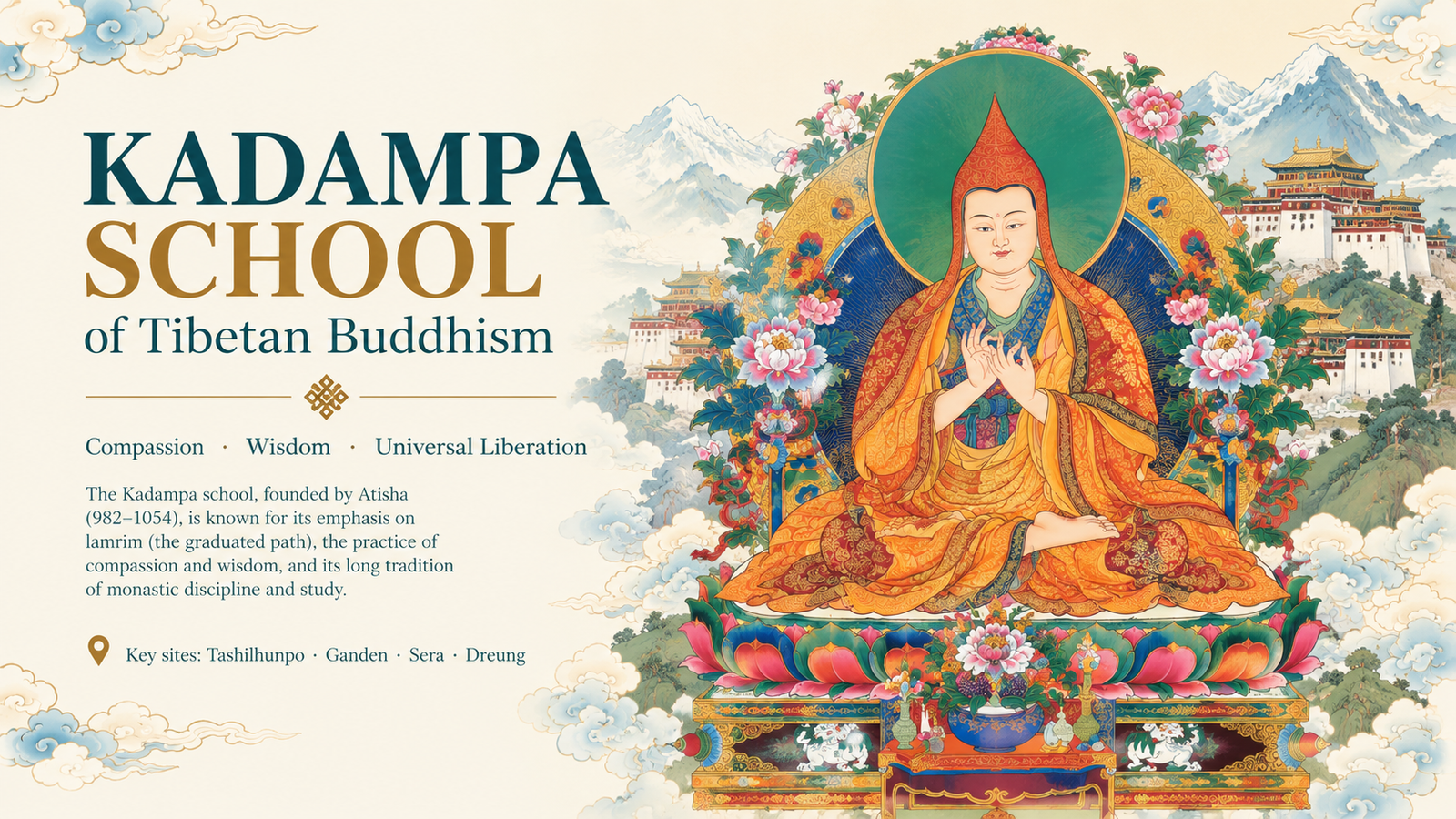
The Kadam School of Tibetan Buddhism is one of the important traditions in the history of Tibetan Buddhism. Known for its emphasis on ethical discipline, compassion, wisdom, and the systematic practice of the Buddha’s teachings, the Kadam tradition played a major role in shaping Tibetan Buddhist philosophy and spiritual life.
The school emerged in the 11th century through the teachings of the Indian Buddhist master Atisha (Atiśa Dīpaṃkara Śrījñāna) and the efforts of his Tibetan disciple Dromtönpa Gyelwa Jungné. Its teachings brought together the Buddha’s sutras, monastic discipline, and practical instructions for spiritual development.
Although the Kadam School later became closely connected with the Gelug tradition, its legacy remains an important part of Tibet’s religious and cultural heritage. Visitors interested in Tibetan Buddhism can explore this history through places such as Reting Monastery and other historic Buddhist sites in central Tibet.
What Is the Kadam School of Tibetan Buddhism?
The Kadam School is a Tibetan Buddhist tradition founded on the principle that the Buddha’s teachings should be understood as practical instructions for spiritual development.
The Tibetan word Kadam is traditionally explained as referring to the Buddha’s teachings being incorporated into personal guidance. According to the account preserved in The Origin of the Buddhist Schools by the Tibetan scholar Tāranātha?
The traditional explanation recorded in The Origin of the Buddhist Schools by the Tibetan scholar Thukwan Losang Chökyi Nyima emphasizes that no part of the Buddha’s teachings should be discarded. Instead, the entire body of Buddhist scripture should be understood through the practical instructions of the three levels of spiritual development.
This approach became the defining feature of the Kadam tradition. Rather than treating Buddhist philosophy, meditation, ethical conduct, and religious practice as separate subjects, Kadam masters taught that they should work together as a complete path toward awakening.
The Meaning of Kadam: Bringing All the Buddha’s Teachings into Practice
The name Kadam is associated with the idea of integrating the Buddha’s words into personal spiritual instruction. According to a traditional account, the master Dromtönpa asked the Kadam teacher Gönpa? about the meaning of Kadam. The teacher explained that it meant understanding every word of the Buddha’s teachings as instruction for practice.
Dromtönpa reportedly praised this explanation, recognizing it as a particularly clear expression of the tradition’s central principle.
The Kadam approach emphasizes three interconnected elements:
- Scriptural study: Understanding the Buddha’s teachings through the Buddhist canon.
- Ethical discipline: Developing responsible conduct and a stable foundation for spiritual practice.
- Meditation and contemplation: Applying Buddhist teachings to the mind and everyday life.
The tradition also emphasizes the Three Scopes of Spiritual Practice, which organize the path according to the practitioner’s developing motivations and aspirations.
Atisha: The Indian Master Who Revitalized Tibetan Buddhism
The history of the Kadam School begins with Atisha, one of the most influential Indian Buddhist masters to teach in Tibet. Atisha was born in the region traditionally known as Bengal and received extensive training in Buddhist philosophy, monastic discipline, meditation, and tantric practice. He studied at major Buddhist centers in India, including the renowned monastic university of Vikramaśīla.
He also traveled to Sumatra, where he studied under the revered teacher Dharmakīrtiśrī, known in Tibetan sources as Serlingpa. There, Atisha received important instructions on bodhicitta—the aspiration to attain enlightenment for the benefit of all sentient beings.
By the 11th century, Tibetan Buddhism had experienced significant changes following the persecution of Buddhism under King Langdarma and the subsequent revival of Buddhist institutions. Although Buddhist traditions had survived and developed in different regions, some Tibetan religious leaders were concerned about inconsistent interpretations of Buddhist teachings and the weakening of monastic discipline.
The western Tibetan ruler Lha Lama Yeshe Ö sought to invite a highly learned Indian Buddhist master to Tibet to help strengthen Buddhist education and practice. According to traditional accounts, Yeshe Ö made considerable efforts to secure Atisha’s arrival. After his death, his nephew Jangchub Ö continued the effort and sent the translator Nagtso Lotsawa to India. Nagtso eventually met Atisha and explained the condition of Buddhism in Tibet. Following spiritual guidance and traditional prophecies, Atisha agreed to travel to Tibet. His arrival became a turning point in the development of Tibetan Buddhism.
Atisha’s Journey to Tibet
Atisha arrived in western Tibet in the early 11th century, traditionally dated to around 1042. He spent several years in the western Tibetan kingdom of Guge, where he taught Buddhist philosophy, clarified religious practices, and composed important works.
One of his most influential writings was the Lamp for the Path to Enlightenment (Bodhipathapradīpa). This concise text presents Buddhist practice as a progressive path, explaining how practitioners can develop their understanding and motivation step by step.
Atisha’s teachings brought together:
- The foundations of Buddhist ethics and discipline
- The cultivation of compassion and bodhicitta
- The wisdom of understanding reality
- The gradual development of meditation
- The relationship between sutra and tantra
Atisha later traveled to central Tibet, where he continued teaching for many years. Traditional accounts describe his work as helping restore a more systematic understanding of Buddhist doctrine and practice. He passed away at Nyetang, near Lhasa, in 1054. His teachings continued through his Tibetan disciples, especially Dromtönpa, who established the institutional foundations of the Kadam School.
Dromtönpa: Founder of the Kadam Tradition
Dromtönpa Gyelwa Jungné (1005–1064) was Atisha’s principal Tibetan disciple and the key figure in establishing the Kadam tradition. Dromtönpa was deeply devoted to Atisha’s teachings and helped transmit them to future generations. He emphasized the integration of Buddhist scripture, ethical discipline, compassion, and meditation.
In 1056, Dromtönpa founded Reting Monastery, north of Lhasa. The monastery became one of the most important centers of the Kadam tradition and a major destination in the history of Tibetan Buddhism. At Reting, Buddhist teachings were studied, explained, and practiced within an organized monastic community. The monastery helped transform Atisha’s teachings from a teacher-disciple lineage into an enduring religious institution. Dromtönpa’s work established the foundation for the Kadam School’s later development across Tibet.
The Three Kadam Brothers and the Spread of the Tradition
After Dromtönpa, several influential disciples helped expand Kadam teachings.
Among the most celebrated were the Three Kadam Brothers, traditionally identified as:
- Potowa Rinchen Sel (1027–1105): Known for his extensive scriptural knowledge and teaching.
- Chengawa Tsultrim Bar (1038–1103): Remembered for his emphasis on discipline and practical instruction.
- Phuchungwa Shönnu Gyaltsen (1031–1106): Associated with the transmission of Kadam teachings and meditation instructions.
These masters helped establish a strong tradition of Buddhist study and practice. Kadam teachers emphasized that Buddhist learning should lead to personal transformation. Their instructions covered the development of compassion, the cultivation of bodhicitta, the importance of ethical conduct, and the gradual training of the mind. Their students and successors carried Kadam teachings to monasteries and communities throughout central Tibet.
The Three Kadam Lineages
Kadam teachings are often described through three interconnected traditions or lineages.
1. The Scriptural Lineage
This lineage emphasized the study and explanation of Buddhist scriptures, including the teachings of the Buddha and the major Indian Buddhist masters. It encouraged practitioners to develop a broad understanding of Buddhist philosophy and to use scriptural knowledge as a guide for practice.
2. The Oral Instruction Lineage
This lineage focused on practical guidance passed from teacher to student. Its teachings emphasized how to apply Buddhist principles to everyday life, meditation, and the development of compassion.
3. The Profound Instructions
These teachings included specialized guidance for meditation and spiritual development. They were transmitted through teacher-disciple relationships and helped preserve the Kadam tradition’s emphasis on direct experience and disciplined practice. Together, these lineages reflected the Kadam belief that Buddhist scripture, oral guidance, and meditation should support one another.
The Kadam Teaching of the Three Scopes
One of the most influential features of the Kadam tradition is its systematic presentation of the Buddhist path through the Three Scopes of Spiritual Practice. This approach was developed from Atisha’s teachings and became a foundation for later Tibetan Buddhist lamrim literature.
The Initial Scope: Developing Ethical Conduct
The initial scope focuses on understanding the value of human life, recognizing impermanence, and considering the consequences of actions. Practitioners are encouraged to develop ethical conduct and cultivate a meaningful direction for their lives.
The Intermediate Scope: Seeking Liberation
The intermediate scope emphasizes understanding the causes of suffering and developing the determination to become free from cyclic existence, known as samsara. It includes the cultivation of ethical discipline, meditation, and wisdom.
The Great Scope: Developing Bodhicitta
The great scope centers on bodhicitta, the aspiration to attain complete enlightenment for the benefit of all sentient beings. Practitioners develop compassion, wisdom, and the bodhisattva path. This progressive approach became one of the most influential contributions of the Kadam tradition to Tibetan Buddhist thought.
The Kadam School and the Development of Tibetan Buddhism
The Kadam School played an important role in the revival and organization of Buddhist learning in Tibet. Atisha’s teachings helped strengthen the relationship between Buddhist philosophy, monastic discipline, and meditation. Dromtönpa and later Kadam masters established institutions that supported the systematic study and practice of these teachings.
The Kadam tradition also influenced other Tibetan Buddhist schools. Its emphasis on the gradual path, ethical discipline, compassion, and the integration of scripture into practice became especially important in the development of the Gelug School.
The relationship between Kadam and Gelug is particularly significant: the Gelug tradition adopted and further developed many Kadam teachings, especially the lamrim, or stages of the path to enlightenment. As a result, Kadam teachings continued to influence Tibetan Buddhism even as the original school gradually became less distinct as an independent institution.
Reting Monastery: The Historic Heart of the Kadam School
Reting Monastery (Radreng Monastery) is one of the most important historical sites associated with the Kadam tradition. Founded by Dromtönpa in 1056, Reting became a major center for Buddhist study, meditation, and the transmission of Kadam teachings. The monastery is located in a mountainous valley north of Lhasa, surrounded by forests, hills, and the landscapes of central Tibet.
Its remote setting reflects the importance of contemplation and monastic life in the Kadam tradition. Reting is also associated with the later history of the Gelug School and the development of Tibetan Buddhist institutions. For travelers interested in Tibet’s religious history, the monastery offers an opportunity to learn about the early development of the Kadam tradition and its lasting influence. Visitors should confirm current access arrangements, road conditions, and any required travel permissions before planning a visit.
Narthang Monastery and the Kadam Legacy
Narthang Monastery, located near Shigatse in western Tibet, is another important site associated with the historical Kadam tradition. The monastery was founded by the Kadam teacher Dromtönpa’s spiritual descendants and became a renowned center of Buddhist learning.
Narthang later developed a major printing tradition, helping preserve and circulate Buddhist texts across Tibet. Its historical importance extends beyond the Kadam School, as it contributed to the preservation of Tibetan Buddhist literature and scholarship. For travelers exploring the cultural heritage of Shigatse, Narthang provides a valuable connection to Tibet’s history of Buddhist education and printing.
The Kadam School and the Rise of the Gelug Tradition
The Kadam School gradually became closely connected with the development of the Gelug tradition. In the 14th and 15th centuries, the Tibetan Buddhist master Je Tsongkhapa (1357–1419) studied and synthesized teachings from several Buddhist lineages, including important Kadam instructions.
Tsongkhapa placed particular emphasis on the gradual path to enlightenment, ethical discipline, monastic education, and the integration of sutra and tantra. His works, especially the Great Treatise on the Stages of the Path to Enlightenment (Lamrim Chenmo), developed many themes associated with Atisha’s Lamp for the Path to Enlightenment.
The Gelug School subsequently became one of the major traditions of Tibetan Buddhism. Many Kadam monasteries and communities eventually adopted Gelug teachings, while Kadam instructions continued to be preserved within the broader Tibetan Buddhist tradition.
What Makes the Kadam Tradition Distinctive?
The Kadam School is particularly known for its emphasis on integrating Buddhist teachings into a complete path of personal development.
Its main characteristics include:
| Feature | Description |
|---|---|
| Founder and key teacher | Atisha, with Dromtönpa establishing the tradition in Tibet |
| Central principle | Understanding the Buddha’s teachings as practical instructions |
| Main practice framework | The Three Scopes of spiritual development |
| Key spiritual quality | Bodhicitta, the aspiration to attain enlightenment for all beings |
| Important text | Lamp for the Path to Enlightenment |
| Historic center | Reting Monastery |
| Lasting influence | The lamrim teachings and the development of the Gelug School |
The Kadam tradition’s influence can be seen in the way Tibetan Buddhism presents the path to enlightenment as a gradual process combining ethical conduct, compassion, meditation, and wisdom.
Visiting Kadam Buddhist Heritage Sites in Tibet
Travelers interested in Tibetan Buddhism can explore Kadam history through monasteries and cultural sites associated with the tradition.
Reting Monastery
Located north of Lhasa, Reting is closely connected with Dromtönpa and the founding of the Kadam School. Its mountainous setting also offers insight into the contemplative environment of Tibetan monastic life.
Narthang Monastery
Near Shigatse, Narthang is associated with Buddhist education and the preservation of Tibetan texts. It is a meaningful stop for travelers interested in the religious and literary history of Tibet.
Nyetang
Located near Lhasa, Nyetang is associated with the final years of Atisha’s life. It is an important place for understanding his role in the development of Tibetan Buddhism. Travel arrangements to religious sites can depend on road conditions, local regulations, and current access requirements. International visitors should check the latest arrangements with a licensed Tibet travel agency before setting out.
Frequently Asked Questions About the Kadam School
What is the Kadam School of Tibetan Buddhism?
The Kadam School is a Tibetan Buddhist tradition established in the 11th century through the teachings of Atisha and the work of his disciple Dromtönpa. It emphasizes understanding the Buddha’s teachings as practical instructions for spiritual development.
Who founded the Kadam School?
Atisha introduced the teachings that inspired the Kadam tradition in Tibet, while Dromtönpa Gyelwa Jungné established its institutional foundations and helped organize its transmission.
What does the word Kadam mean?
Kadam is traditionally explained as the integration of the Buddha’s teachings into practical spiritual instructions, with the aim of applying the entire Buddhist path to personal development.
What are the Three Scopes in Kadam Buddhism?
The Three Scopes describe progressive levels of spiritual motivation: ethical conduct and concern for future lives, the aspiration for liberation from samsara, and the development of bodhicitta for the benefit of all sentient beings.
What is the most important Kadam text?
Atisha’s Lamp for the Path to Enlightenment is one of the most influential texts associated with the Kadam tradition. It presents the Buddhist path in a systematic and progressive way.
Which monastery is most closely associated with the Kadam School?
Reting Monastery, founded by Dromtönpa in 1056, is one of the principal historic centers of the Kadam tradition.
Is the Kadam School still practiced today?
Kadam teachings continue to influence Tibetan Buddhism, particularly through the lamrim tradition and the Gelug School. The original Kadam School is no longer generally regarded as a separate major school in the same way it was historically.
How is Kadam Buddhism connected to the Gelug School?
The Gelug School incorporated and further developed important Kadam teachings, especially the gradual path to enlightenment. Je Tsongkhapa’s lamrim works are a major expression of this continuity.
Explore the Buddhist Heritage of Tibet
The Kadam School represents an important chapter in the history of Tibetan Buddhism. Through Atisha’s teachings and Dromtönpa’s leadership, it helped establish a systematic approach to Buddhist study and practice that continues to shape Tibetan spiritual life. From the historic setting of Reting Monastery to the Buddhist heritage of Narthang and Nyetang, the Kadam tradition offers travelers a deeper understanding of Tibet’s religious history, philosophy, and monastic culture.
Planning a Tibet cultural journey? Explore Lhasa, Shigatse, and the historic monasteries of central Tibet with a locally organized itinerary. A well-planned trip can help you discover the Buddhist heritage of the Tibetan Plateau while respecting local customs and monastery guidelines.