
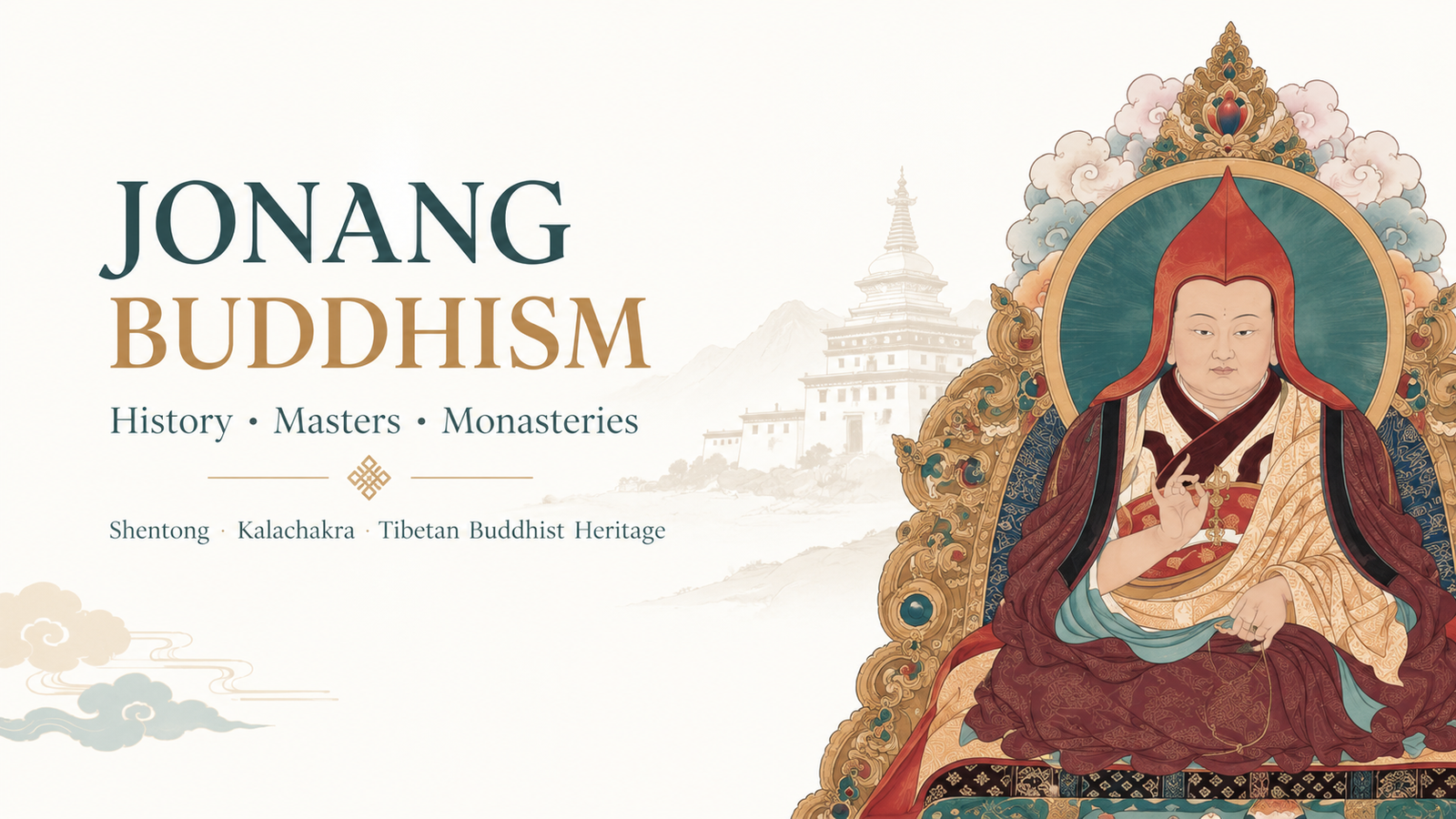
The Jonang school of Tibetan Buddhism is a distinctive Buddhist tradition known for its philosophy of other-emptiness (shentong), its deep connection with the Kalachakra Tantra, and its remarkable history of scholarship, meditation, and monastic practice.
Originating in the Jonang valley of present-day Lhatse County in Shigatse, Tibet, the tradition developed from a lineage of Buddhist teachings into an organized monastic school during the late 13th century. It later flourished under influential masters such as Dolpopa Sherab Gyaltsen and Taranatha, before undergoing major institutional changes during the 17th century.
Although Jonang monasteries in central Tibet experienced significant transformations, the tradition continued in other Tibetan regions, particularly in parts of Sichuan and Qinghai. Today, its heritage can be explored through historic monasteries, monumental stupas, Kalachakra art, traditional chanting, and living religious communities.
For travelers interested in Tibetan Buddhist history and culture, Jonang offers a fascinating perspective on a tradition that remains less familiar to many visitors than the larger Tibetan Buddhist schools.
What Is the Jonang School?
Jonang is one of the distinctive traditions within Tibetan Buddhism. Its name comes from Jonang, originally the name of a valley known in full as Jomolang valley, in the region of present-day Lhatse County, Shigatse, Tibet.
The school is particularly known for three closely connected features:
- Other-emptiness (shentong): A distinctive interpretation of Madhyamaka philosophy emphasizing ultimate reality and Buddha-nature.
- Kalachakra Tantra: A major tantric tradition that forms a central part of Jonang’s religious identity.
- Six-Branch Yoga: An advanced system of contemplative practice associated with the Kalachakra completion-stage teachings.
Jonang developed over several centuries. Its early philosophical roots are associated with Yumo Mikyo Dorje, while Kunpang Thukje Tsöndru is traditionally regarded as the figure who established the monastic institution from which the school takes its name.
The tradition later became especially influential through the writings of Dolpopa Sherab Gyaltsen, whose philosophical works gave systematic expression to Jonang’s understanding of other-emptiness.
The Origins of Jonang: From a Teaching Lineage to a Monastic School
The formation of Jonang was a gradual historical process rather than the work of a single founder at one moment.
Yumo Mikyo Dorje: An Early Philosophical Figure
Yumo Mikyo Dorje is remembered in Jonang tradition as an important early master associated with the development of its other-emptiness teachings and Kalachakra practice. His dates are given differently in historical and religious accounts, with some placing him in the 11th century and others in the 12th century. He is traditionally associated with the transmission of Buddhist teachings that later became central to Jonang philosophy.
Jonang’s own historical understanding connects its teachings with the wider Indian Buddhist heritage, including the works and traditions associated with Nagarjuna, Asanga, and Vasubandhu. The school’s philosophical development was shaped by Tibetan interpretations of Indian Buddhist texts, particularly discussions concerning emptiness, ultimate truth, and Buddha-nature.
Kunpang Thukje Tsöndru: The Institutional Founder
Kunpang Thukje Tsöndru (1243–1313) is traditionally regarded as the founder of Jonang as an organized monastic school. He studied and practiced the teachings associated with Yumo Mikyo Dorje’s lineage. Through teaching, writing, meditation, and training disciples, he helped transform a relatively dispersed tradition into a more organized religious community.
Kunpang established a monastery in the sacred valley of Jomolang, giving the tradition a permanent center for study and practice. Historical accounts differ over the exact date of the monastery’s establishment, with references to both 1278 and 1293. These dates should be treated cautiously rather than combined into a single definitive year.
The monastery became known as Jonang Monastery, and the name eventually came to identify the school itself. Kunpang is also associated with important writings on Kalachakra and the Six-Branch Yoga, which helped establish the practical and scholarly foundations of the tradition.
The Importance of Jonang Monastery
Before the establishment of a permanent monastic center, practitioners associated with the lineage often followed more dispersed patterns of religious life. The monastery provided a place where monks could gather for collective study, teaching, meditation, and the transmission of the lineage.
This institutional development was crucial to Jonang’s growth. It helped preserve teachings across generations and created the conditions for later masters to expand the school’s philosophical and religious influence.
The Historical Development of Jonang
Jonang’s history reflects the changing religious, political, and cultural landscape of Tibet over several centuries.
Early Development and Growth
During the late 13th and 14th centuries, Jonang developed into an influential Buddhist tradition in Tibet. Its monasteries and teachers contributed to the spread of Kalachakra practice and the study of other-emptiness. The school attracted scholars and meditators interested in its distinctive interpretation of ultimate reality and its advanced tantric teachings.
The Fourteenth Century: The Rise of Dolpopa
The 14th century was a particularly important period in Jonang history. Dolpopa Sherab Gyaltsen became the school’s most influential philosophical teacher. His writings gave a systematic structure to other-emptiness and established it as the central doctrinal position of Jonang.
He also contributed to the development of Jonang Monastery, including the construction of its monumental stupa, traditionally known as the Great Stupa or Kumbum.
The Sixteenth and Seventeenth Centuries: Revival and Expansion
During the 16th century, Jonang experienced renewed development under several influential masters, including Jonang Kunga Drölchok and Taranatha. Taranatha received support from the Tsangpa political authorities in western Tibet. In 1615, he established Takten Phuntsok Ling Monastery, which became an important center for the tradition.
Jonang teachings also spread into areas that are now part of Sichuan and Qinghai, helping establish communities beyond the school’s historical heartland.
The Seventeenth Century: Institutional Transformation
During the 17th century, the rise of the Gelug-led Tibetan government brought major changes to religious institutions in central Tibet. Many Jonang monasteries in Ü-Tsang were converted to Gelug institutions. Takten Phuntsok Ling was among the monasteries affected by these changes and became known as Ganden Phuntsok Ling.
Religious property, monastic resources, and collections of texts were also affected by the political and institutional transformations of the period. Jonang’s institutional presence in central Tibet declined, but the tradition did not disappear. Its teachings continued in other Tibetan regions, including parts of Sichuan and Qinghai.
Jonang Today
Jonang remains a living Tibetan Buddhist tradition. Monastic communities continue to preserve its teachings, rituals, and contemplative practices. Its heritage is especially associated with monasteries in the Tibetan regions of Sichuan and Qinghai, as well as historic sites in Shigatse, Tibet.
The school’s survival illustrates how Tibetan Buddhist traditions have continued through changing political circumstances, migration, regional religious networks, and the work of successive generations of teachers.
Important Jonang Masters and Lineage Teachers
Jonang’s development involved many generations of scholars, meditators, translators, and monastic leaders.
Yumo Mikyo Dorje
Yumo Mikyo Dorje is remembered as an early source of Jonang’s philosophical and tantric teachings. His association with other-emptiness and Kalachakra helped shape the distinctive identity of the lineage that later developed into the Jonang school.
Kunpang Thukje Tsöndru (1243–1313)
Kunpang was the institutional founder of Jonang. He established the monastery that gave the tradition its name and helped create a stable environment for teaching, meditation, and the transmission of its philosophical and tantric practices. His writings on Kalachakra and the Six-Branch Yoga became important sources for later practitioners.
Jangsang Gyalwa Yeshe (1257–1320)
Jangsang Gyalwa Yeshe was an important disciple of Kunpang Thukje Tsöndru. According to Jonang lineage accounts, he studied extensively with several teachers before receiving advanced instruction in the Six-Branch Yoga from Kunpang. He is associated with Dechen Monastery, where he taught and helped transmit Jonang’s Kalachakra practices. He later served as an important religious leader within the Jonang tradition and is remembered for his role in maintaining the lineage.
Khetsun Yönten Gyatso (1260–1327)
Khetsun Yönten Gyatso succeeded Jangsang Gyalwa Yeshe in the lineage of Jonang teachers. He continued the transmission of the school’s teachings and helped train the next generation of scholars and practitioners. Among the important figures associated with this period was Dolpopa Sherab Gyaltsen, who would become the most influential philosophical voice in Jonang history.
Dolpopa Sherab Gyaltsen (1292–1361)
Dolpopa Sherab Gyaltsen (多朴巴·喜饶坚赞) is widely regarded as Jonang’s greatest philosophical master. He developed a comprehensive explanation of shentong, or other-emptiness, in his influential work Mountain Dharma: The Ocean of Definitive Meaning.
His writings argued that ultimate reality should not be understood simply as the absence of inherent existence. Instead, he emphasized Buddha-nature and the qualities of awakening as the basis of the ultimate truth. Dolpopa’s work transformed the philosophical teachings of Jonang from a lineage transmitted largely through teachers and disciples into a well-developed body of written literature.
He is also associated with the construction of the monumental stupa at Jonang Monastery, traditionally described as a vast structure containing numerous chapels, Buddhist images, mandalas, and sacred texts. The stupa became one of the defining architectural features of Jonang’s religious heritage.
Other Disciples of Dolpopa
Dolpopa trained numerous disciples who continued the transmission of Jonang teachings. Among the figures remembered in the tradition are Bang Lotsawa Lodrö Drak and Chogle Namgyal.
Chogle Namgyal is associated with the teaching activities of Jonang Monastery and Angren Monastery, where Jonang rituals and religious teachings continued to be practiced. The next generations of masters preserved the lineage during a period when Jonang’s institutional influence began to decline.
Jonang Kunga Drölchok (1507–1572?)
Kunga Drölchok was an important figure in the later revival of Jonang. He studied widely across Tibetan Buddhist traditions, including teachings associated with the Karma Kagyu and Shangpa Kagyu schools.
His approach to Buddhist learning crossed sectarian boundaries and reflected the broader culture of religious scholarship in Tibet. Kunga Drölchok wrote on a range of subjects, including Buddhist teachers, meditation, and the history of religious lineages. He helped prepare the ground for the later flourishing of Jonang under Taranatha.
Taranatha (1575–1634)
Taranatha was one of Jonang’s most influential later masters. Recognized as the reincarnation of Kunga Drölchok in Jonang tradition, he entered the monastery at a young age and received extensive instruction in Buddhist philosophy and tantric practice.
He became a major teacher and scholar, and in 1615 established Takten Phuntsok Ling Monastery with support from the Tsangpa rulers. Taranatha was also a prolific author. His writings cover Buddhist philosophy, tantra, ritual, Sanskrit learning, and the history of Indian Buddhism.
His History of Buddhism in India is particularly well known and has been translated into several languages. It remains an important historical source for the study of how Tibetan scholars understood the development of Indian Buddhism. Taranatha’s reincarnation lineage later became historically connected with the Jebtsundamba Khutuktu tradition in Mongolia.
Jonang Philosophy: What Is Other-Emptiness?
The most distinctive philosophical feature of Jonang is its interpretation of emptiness known as shentong (gzhan stong), usually translated as “other-emptiness.” To understand this teaching, it is useful to consider the broader Buddhist concept of emptiness.
The Buddhist Concept of Emptiness
In Mahayana Buddhism, emptiness refers to the absence of independent, inherent existence. Phenomena arise through causes and conditions. They do not exist as permanent, self-sufficient entities independent of everything else. Tibetan Buddhist scholars have developed different interpretations of how this principle applies to ultimate truth and Buddha-nature. Jonang’s other-emptiness position is one distinctive interpretation within these wider debates.
What Does Other-Emptiness Mean?
In Jonang philosophy, ultimate reality is described as empty of what is other than its own awakened nature. This means that temporary mental and emotional obscurations do not define the deepest nature of reality. The tradition emphasizes Buddha-nature, luminous awareness, and the qualities of awakening as central to the understanding of ultimate truth.
In simplified terms:
- Ordinary mental afflictions and conceptual obscurations are temporary.
- Buddha-nature is not defined by these temporary obscurations.
- Spiritual practice involves removing obscurations and realizing the nature of ultimate reality.
Jonang’s interpretation of Buddha-nature is not simply a belief in an eternal personal soul. It belongs to a specialized Buddhist philosophical system concerning awakening, ultimate truth, and the nature of mind.
The Three Turnings of the Wheel of Dharma
Jonang authors interpret Buddhist teachings through the framework of the three turnings of the Wheel of Dharma. In this framework, the teachings of the final turning, including those concerning Buddha-nature and luminous awareness, are understood as particularly important for explaining ultimate truth.
Jonang scholars argue that these teachings should not be reduced to a merely provisional or figurative interpretation. This understanding forms part of the school’s justification for its other-emptiness position. Other Tibetan Buddhist schools interpret the relationship between the three turnings, Madhyamaka, and Buddha-nature differently.
Jonang and Self-Emptiness
The term rangtong, or “self-emptiness,” is commonly used in Tibetan philosophical discussions to describe the view that phenomena are empty of inherent existence. Jonang scholars distinguish their position from interpretations of Madhyamaka that they believe do not adequately account for the ultimate status of Buddha-nature.
The Gelug school, strongly associated with Tsongkhapa’s interpretation of Madhyamaka, is often central to discussions of this philosophical difference. However, these traditions should not be reduced to a simple contrast between “everything is empty” and “something is permanent.” Both are sophisticated Buddhist systems concerned with the meaning of emptiness, dependent arising, and awakening.
How Jonang Differs from Other Tibetan Buddhist Schools
| School | Important characteristics |
|---|---|
| Nyingma | Associated with early tantric transmissions and the Dzogchen tradition. |
| Kagyu | Known for meditation lineages, Mahamudra teachings, and oral transmission. |
| Sakya | Associated with the Lamdre teachings and a long tradition of Buddhist scholarship. |
| Gelug | Associated with Tsongkhapa, monastic education, and influential Madhyamaka interpretations. |
| Jonang | Particularly distinguished by its systematic defense of other-emptiness and its close association with Kalachakra. |
These are broad descriptions rather than complete accounts of each school. All have diverse lineages and complex teachings, and several share important Buddhist philosophical and tantric traditions.
Kalachakra Tantra and the Six-Branch Yoga
The Kalachakra Tantra is central to Jonang’s religious identity. Kalachakra means “Wheel of Time” and refers to a complex tantric system encompassing cosmology, ritual, meditation, and spiritual transformation. Jonang is particularly associated with preserving and transmitting Kalachakra teachings, including the Six-Branch Yoga.
Kalachakra and Its Religious Meaning
Kalachakra teachings include explanations of the relationship between the external world, the human body, and spiritual practice. The tradition uses elaborate symbolism, sacred diagrams, and ritual practices to express its understanding of the Buddhist path. Kalachakra mandalas are among the most recognizable forms of this sacred art.
The Six-Branch Yoga
The Six-Branch Yoga is an advanced contemplative system associated with the Kalachakra completion-stage teachings. Its practices are traditionally transmitted through qualified teachers and require appropriate instruction and preparation.
For Jonang practitioners, the Six-Branch Yoga is not simply a physical exercise system. It belongs to a structured tantric path involving meditation, subtle-body practices, and the cultivation of spiritual realization.
Shambhala and Kalachakra
The Kalachakra tradition is also associated with Shambhala, a legendary kingdom described in Buddhist literature. Shambhala has religious, symbolic, and cosmological significance within Kalachakra teachings.
Its imagery appears in some Tibetan Buddhist paintings and mandalas, offering a distinctive visual connection between sacred geography, Buddhist cosmology, and spiritual practice.
7. Important Jonang Monasteries in Tibet
Jonang’s historic heartland lies in the Shigatse region of Tibet, particularly around Lhatse County. Two important sites associated with the school’s history are Jonang Monastery and Takten Phuntsok Ling.
Jonang Monastery: The Ancestral Monastery
Location: The Jonang valley in the Lhatse area, Shigatse, Tibet.
Jonang Monastery is the institution from which the Jonang school takes its name. Traditionally associated with Kunpang Thukje Tsöndru, the monastery became a major center of Buddhist learning, Kalachakra practice, and other-emptiness philosophy. Its most distinctive landmark is the monumental stupa known as the Great Stupa, or Kumbum.
The Great Stupa
The stupa is traditionally associated with Dolpopa Sherab Gyaltsen and is remembered for its monumental scale and complex religious architecture. Historical descriptions refer to numerous chapels, Buddhist images, mandalas, and sacred texts within the structure.
It is an important example of Jonang’s architectural and artistic heritage. The stupa is sometimes compared with the famous Kumbum at Pelkor Chode Monastery in Gyantse. Both are important examples of Tibetan Buddhist sacred architecture, although their histories and designs are not identical.
What Travelers Can See
Visitors interested in Jonang Monastery may encounter:
- Historic monastic architecture.
- The monumental stupa and its religious significance.
- Buddhist imagery and sacred spaces, where access is permitted.
- The highland landscape around the monastery.
The monastery is an important destination for travelers interested in Tibetan Buddhist history beyond the best-known tourist sites.
Takten Phuntsok Ling Monastery
Location: Historic Jonang heartland, Tibet.
Takten Phuntsok Ling was established by Taranatha in 1615 and became an important center of Jonang during its later period of expansion. The monastery received support from the Tsangpa rulers and played a significant role in the school’s religious and scholarly life.
During the 17th century, it was converted into a Gelug institution and became known as Ganden Phuntsok Ling. Its history reflects the wider transformation of religious institutions in central Tibet during this period.
What Makes the Site Interesting?
The monastery is significant for its connection with Taranatha, its role in Jonang’s later flourishing, and its place in the religious history of Shigatse. Visitors should verify its present-day status and access arrangements before planning a visit, particularly if they are interested in specific historical buildings, murals, or collections.
Jonang Art, Architecture, and Cultural Heritage
Jonang’s religious heritage includes sacred paintings, monumental stupas, ritual objects, and traditions of chanting and meditation. Its art shares many conventions with wider Tibetan Buddhist culture while reflecting its own philosophical and tantric priorities.
Kalachakra Mandalas
Kalachakra mandalas are among the most distinctive visual elements associated with Jonang. They represent sacred space and are used in particular religious and contemplative contexts. Their intricate patterns, colors, and figures communicate aspects of Kalachakra cosmology and tantric practice.
Thangka Paintings
Jonang-related thangkas may depict Kalachakra, lineage masters, Buddhist deities, mandalas, and sacred narratives. Thangka painting is a wider Tibetan Buddhist art tradition, and Jonang works belong to this shared artistic heritage.
Monastery Murals
Monastery murals may illustrate Buddhist teachings, historical lineages, sacred figures, and cosmological themes. The subjects and artistic styles vary between monasteries, and not every mural in a historically Jonang monastery necessarily dates from its Jonang period.
Stupas and Sacred Architecture
The monumental stupa at Jonang Monastery is an important example of the school’s architectural heritage. Its historical descriptions emphasize its scale, internal chapels, and religious imagery. The structure reflects the importance of sacred architecture in Tibetan Buddhist practice, where stupas serve as objects of devotion and symbols of awakening.
Chanting and Ritual Music
Tibetan Buddhist chanting and ritual music are important elements of monastic life. Jonang communities preserve distinctive liturgical practices within the broader Tibetan Buddhist tradition. Visitors should remember that religious ceremonies are primarily acts of worship and practice, not performances arranged for tourists.
Jonang Travel Guide: How to Visit
Jonang heritage can be explored through two broad travel approaches: visiting historic sites in Shigatse, Tibet, or traveling to Tibetan communities in Sichuan.
Visiting Jonang in Shigatse, Tibet
A visit to Jonang’s historic sites may be included in a wider journey through Shigatse and the western Tibet travel corridor.
Possible destinations include:
- Jonang Monastery in the Lhatse area.
- Takten Phuntsok Ling and its historical association with Taranatha.
- Other monasteries and cultural sites in the Shigatse region.
Travelers should confirm road conditions, monastery access, and the time required for detours before finalizing an itinerary.
Visiting Jonang in Sichuan
Zhongrangtang in Zamtang County offers an opportunity to explore the continuing Jonang tradition. A cultural journey may include monastery visits, local Tibetan communities, sacred art, and the surrounding highland landscape. Because the region is remote, transportation and accommodation should be planned in advance.
Practical Travel Tips
- Check monastery access: Religious institutions may have different visitor rules, and not every building or shrine is open to the public.
- Respect religious activities: Keep quiet in prayer halls and avoid interrupting monks or worshippers.
- Ask before taking photographs: Murals, shrines, ritual objects, and ceremonies may have photography restrictions.
- Prepare for altitude: Many Tibetan destinations are located at high elevations. Allow time to acclimatize and avoid rushing your itinerary.
- Verify current travel requirements: Entry arrangements and travel permissions depend on nationality, itinerary, and current regulations.
- Travel with cultural awareness: A monastery is first and foremost a religious space. Follow local guidance and dress respectfully.
Why Jonang Matters in Tibetan Buddhist History
Jonang is important not only because of its distinctive philosophy but also because of its contribution to Tibetan Buddhist scholarship, tantric practice, and religious culture. Its history demonstrates how a lineage of teachings can develop into an organized monastic school, flourish through influential teachers, experience institutional decline, and continue through communities in other regions.
The writings of Dolpopa Sherab Gyaltsen established other-emptiness as a major subject of Tibetan Buddhist philosophical debate. Taranatha’s scholarship contributed to the study of Buddhist history and the transmission of tantric teachings. The survival of Jonang communities in Sichuan and Qinghai also illustrates the diversity of Tibetan Buddhism beyond the most widely known schools and monasteries.
For travelers, Jonang offers an opportunity to explore Tibetan religious history through both historic monuments and living traditions.
Frequently Asked Questions About Jonang
What is the Jonang school of Tibetan Buddhism?
Jonang is a Tibetan Buddhist tradition particularly known for its other-emptiness philosophy, Kalachakra teachings, and distinctive monastic heritage.
Who founded the Jonang school?
Yumo Mikyo Dorje is remembered as an early philosophical and tantric figure. Kunpang Thukje Tsöndru is traditionally regarded as the founder of Jonang as an organized monastic school.
Where did the Jonang school originate?
Jonang originated in the Jonang valley in the region of present-day Lhatse County, Shigatse, Tibet. Its name comes from the monastery established there.
What is Jonang’s main philosophical teaching?
Jonang is particularly associated with shentong, or other-emptiness, which emphasizes the ultimate nature of Buddha-nature and awakened qualities while distinguishing them from temporary obscurations.
What is the difference between Jonang and Gelug?
A major philosophical difference concerns their interpretations of emptiness and ultimate truth. Jonang is known for its systematic defense of other-emptiness, while Gelug scholarship is strongly associated with Tsongkhapa’s Madhyamaka interpretation.
Why is Kalachakra important to Jonang?
Kalachakra is central to Jonang’s tantric heritage. The school is particularly associated with its transmission and with the Six-Branch Yoga, an advanced system of contemplative practice.
Who was Dolpopa Sherab Gyaltsen?
Dolpopa Sherab Gyaltsen (1292–1361) was Jonang’s most influential philosophical master. His writings, especially Mountain Dharma: The Ocean of Definitive Meaning, developed a systematic explanation of other-emptiness.
Who was Taranatha?
Taranatha (1575–1634) was an influential Jonang master, historian, and author. He established Takten Phuntsok Ling Monastery in 1615 and wrote the important History of Buddhism in India.
Does the Jonang school still exist today?
Yes. Jonang teachings and monastic traditions continue in Tibetan Buddhist communities, particularly in parts of Sichuan and Qinghai.
Where can travelers visit Jonang monasteries?
Historic Jonang sites are associated with the Shigatse region of Tibet. Continuing Jonang communities are also found in areas of Sichuan and Qinghai, including the Zhongrangtang region of Zamtang County.
Can tourists attend Jonang religious ceremonies?
Some public ceremonies may be accessible to visitors, depending on the monastery and occasion. Visitors should confirm permission in advance and respect local rules.
Conclusion: Discover Jonang’s Distinctive Tibetan Buddhist Heritage
The Jonang school is a distinctive part of Tibetan Buddhism, bringing together a rich philosophical tradition, advanced Kalachakra practices, monumental sacred architecture, and centuries of monastic history.
From the historic Jonang valley in Shigatse to the continuing religious communities of Sichuan and Qinghai, its heritage reveals a lesser-known dimension of Tibetan Buddhist culture.
For travelers interested in Buddhist philosophy, sacred art, monastery architecture, and cultural journeys beyond the best-known landmarks, Jonang offers a meaningful way to explore the diversity and continuity of Tibetan religious life.