
Pabongka Monastery is one of the most historically significant Buddhist sites in the Lhasa area. Located northwest of central Lhasa, near Sera Monastery, it is famous for its unusual construction on a huge natural rock, its association with the early history of Tibetan Buddhism, and its connection with the development of the Tibetan written language.
Unlike many major Tibetan monasteries, Pabongka is especially associated with early Tibetan kings, Buddhist masters, sacred meditation caves, and the legendary origins of Tibetan writing. The site also contains ancient rock carvings, including a revered representation of the Three Protectors—Avalokiteshvara, Manjushri, and Vajrapani.
Today, Pabongka offers travelers a quieter alternative to Lhasa’s better-known monasteries. Its combination of natural rock formations, Buddhist traditions, ancient inscriptions, and historical legends makes it an important cultural stop for travelers interested in the origins of Tibetan civilization.
Where Is Pabongka Monastery?
Pabongka Monastery lies on the northern side of the Lhasa Valley, approximately northwest of Sera Monastery. The surrounding landscape forms part of the sacred hills and valleys associated with the early Buddhist history of Lhasa.
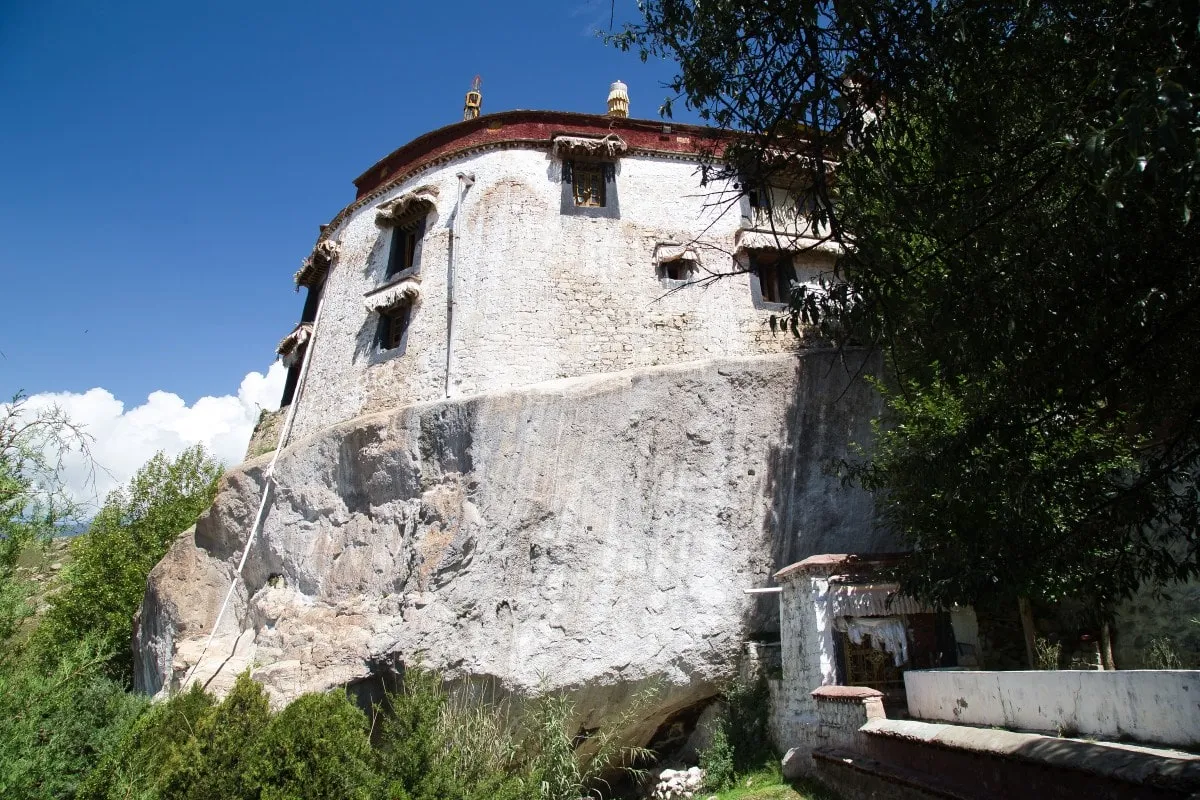
The name Pabongka is commonly associated with a rocky or stone-covered mountain. The monastery itself is built around an enormous natural rock that rises prominently above the surrounding landscape.
The rock is traditionally described as resembling a turtle, with the monastery constructed on its upper surface. This unusual setting is one of Pabongka’s most distinctive features.
A Monastery Built on a Giant Rock
The enormous rock at Pabongka rises roughly 20 meters above the surrounding ground. Historical descriptions of the site state that its upper surface covers approximately 300 square meters. The original monastery was constructed as a multi-level structure directly on the rock. Its unusual architecture demonstrates how Tibetan religious buildings were often adapted to the natural environment rather than built separately from it.
The monastery suffered severe destruction during the 20th century, and much of the historic structure was lost. The remaining lower section and several important religious features were subsequently restored. Today, visitors can still appreciate the extraordinary relationship between the monastery and the massive rock beneath it.
Pabongka and the Early History of Tibetan Buddhism
Pabongka occupies an important place in Tibetan Buddhist tradition. According to the traditional account recorded in The Clear Mirror of Royal Genealogies, King Songtsen Gampo and his two queens, Princess Wencheng and Princess Bhrikuti, practiced religious rituals at Pabongka while preparing to establish Buddhist foundations in Lhasa.
These traditions connect Pabongka with the religious transformation of early Tibet and with the establishment of major Buddhist sites in Lhasa, including the Jokhang Temple.
It is important to distinguish these traditions from independently documented historical evidence. Many stories surrounding Pabongka belong to Tibetan religious and cultural tradition and have been transmitted through Buddhist texts, oral histories, and local accounts.
The Three Protectors of Pabongka Monastery
One of Pabongka Monastery’s most important features is its sacred Three Protectors: Avalokiteshvara (Chenrezig), representing compassion; Manjushri, representing wisdom; and Vajrapani, representing spiritual power.
According to local tradition, these sacred images first appeared naturally on the rock and were later reproduced by skilled artisans. The figures remain an important part of Pabongka’s religious heritage and have been preserved through successive restorations.
The Sacred Rock Eye
Another unusual feature at Pabongka is a naturally formed marking on a rock beside the Three Protectors. The marking resembles a large human eye.
Local tradition explains that this is the eye of a powerful religious figure who eventually converted to Buddhism after losing a spiritual contest with Buddhist masters. According to the legend, the figure possessed three eyes, and one of them became manifested in the rock.
For local pilgrims, the rock eye is not simply a geological curiosity. It has become part of the sacred landscape and is traditionally regarded as watching over visitors to the site.
Such stories illustrate an important characteristic of Tibetan sacred geography: natural rock formations are often interpreted through religious narratives and become part of a living pilgrimage tradition.
Pabongka and the Origins of Tibetan Writing
Perhaps the most important cultural tradition associated with Pabongka concerns Thonmi Sambhota, the Tibetan minister traditionally credited with creating the Tibetan script during the reign of Songtsen Gampo.
According to traditional Tibetan historical accounts, Thonmi Sambhota was sent to India to study language and writing systems. After returning to Tibet, he is traditionally said to have developed a writing system suited to the Tibetan language, drawing inspiration from Indian scripts.
Pabongka tradition holds that Thonmi Sambhota spent an extended period studying and refining the Tibetan script at this location. A stone inscription of the Buddhist mantra Om Mani Padme Hum is associated with this tradition.
The inscription is particularly significant because the six-syllable mantra became one of the most recognizable expressions of Tibetan Buddhist devotion. The tradition connecting Thonmi Sambhota with Pabongka is an important part of the monastery’s cultural identity, although details of the historical development of the Tibetan script are more complex than the traditional narrative alone suggests.
Why the Tibetan Script Was So Important
The development of Tibetan writing transformed the cultural and religious history of the Tibetan Plateau.
A standardized writing system allowed Tibetan scholars and translators to:
- Record political and administrative information
- Develop Tibetan literature
- Translate Buddhist scriptures
- Preserve religious teachings
- Produce legal and historical texts
- Support the development of Tibetan scholarship
The translation of Indian Buddhist literature into Tibetan eventually produced one of the world’s major bodies of Buddhist literature. For this reason, places traditionally associated with the early development of Tibetan writing hold special cultural significance.
The Ten-Day Meditation Cave
Pabongka is also associated with Trisong Detsen, the Tibetan emperor who strongly supported Buddhism, and the Indian Buddhist masters Padmasambhava and Shantarakshita.
According to tradition, they practiced meditation for ten days in a cave beneath the sacred rock. The site later became known as Tsechuru Lhakhang, or the “Ten-Day Chapel.”
Pabongka After the Early Tibetan Empire
The history of Pabongka reflects the changing fortunes of Tibetan Buddhism. Traditional accounts state that during the reign of Langdarma, a period associated with persecution of Buddhism in Tibet, Pabongka was damaged or destroyed along with other Buddhist structures.
Later Buddhist traditions connect the site with the restoration of Buddhism in Tibet. By the 11th century, the monastery became associated with the Kadampa tradition, one of the important Buddhist traditions that developed during the later spread of Buddhism in Tibet.
According to traditional accounts, the Kadampa master Potowa Rinchen Sal and his disciples encountered the ruined site and initiated restoration work. The monastery was gradually rebuilt, and religious activity once again developed around the sacred rock.
Pabongka Monastery and the Gelug Tradition
Pabongka later became connected with the Gelug school of Tibetan Buddhism, particularly during the period associated with the Fifth Dalai Lama. The monastery underwent further expansion and renovation, and additional structures were built above the earlier levels.
Its religious status also became closely connected with the Buddhist educational and institutional traditions of Lhasa. Pabongka’s historical importance therefore extends across several major periods of Tibetan Buddhist history—from the early Tibetan empire and the later revival of Buddhism to the development of major Buddhist institutions in Lhasa.
A Monastery Without a Traditional Reincarnate Lama?
One distinctive feature traditionally associated with Pabongka is its system of leadership. Unlike monasteries that became closely identified with a particular reincarnate lama lineage, Pabongka historically placed considerable importance on its Khenpo, or senior abbot. Traditional accounts describe the Pabongka Khenpo as holding a particularly respected position within the religious hierarchy of Lhasa.
This distinction is important because Tibetan monasteries have historically developed different systems of institutional leadership. Some became associated with recognized reincarnate lama lineages, while others were administered by abbots or senior monastic scholars. Pabongka’s reputation was therefore connected not only to its sacred history but also to the status of its monastic leadership.
What to See at Pabongka Monastery ?
- Giant Sacred Rock – The monastery is built directly on a massive natural rock, creating a unique landscape.
- Three Protectors – See the sacred representations of Avalokiteshvara, Manjushri, and Vajrapani.
- Ancient Rock Inscriptions – View the traditional Om Mani Padme Hum inscription associated with Thonmi Sambhota.
- Meditation Caves – Explore caves traditionally linked with Buddhist masters and meditation practices.
- Sacred Rock Formations – Discover natural features such as the legendary Stone Eye, part of Pabongka’s sacred landscape.
Why Visit Pabongka Monastery?
Pabongka is particularly worthwhile for travelers who want to understand the historical foundations of Tibetan culture, rather than simply visit famous architectural landmarks.
The site brings together several themes that shaped Tibet:
Early Tibetan kings → Buddhism → Tibetan writing → Buddhist translation → meditation traditions → sacred geography
Its location near Sera Monastery also makes it possible to combine the two sites into a cultural excursion from Lhasa. Compared with the busiest attractions in central Lhasa, Pabongka generally offers a more contemplative environment where visitors can spend time observing the relationship between the monastery, surrounding mountains, caves, and sacred rocks.
Pabongka Monastery Travel Tips
Pabongka can be visited as part of a Lhasa sightseeing itinerary. A typical visit takes approximately 1–2 hours, depending on how much time you spend exploring the monastery and surrounding sacred sites.
Because Pabongka is an active religious site, visitors should dress respectfully and follow local monastery rules. Photography restrictions may apply inside religious buildings, so always ask before photographing statues, murals, scriptures, or ceremonies.
Visitors should also remember that Pabongka is a sacred pilgrimage site rather than simply a tourist attraction. Walking quietly, avoiding unnecessary disturbance, and respecting worshipers will make the experience more meaningful.
Pabongka Monastery: A Living Record of Tibetan Heritage
Pabongka Monastery is one of the most fascinating historic Buddhist sites in the Lhasa region. Its enormous sacred rock, ancient inscriptions, meditation caves, Three Protectors, and traditions surrounding Songtsen Gampo and Thonmi Sambhota give the site a unique place in Tibetan cultural history.
Some stories associated with Pabongka belong to religious tradition and local legend rather than independently verified historical records. Nevertheless, these traditions remain important because they reveal how generations of Tibetans have understood their religious landscape and preserved memories of the origins of Buddhism, writing, and scholarship.
For travelers exploring Lhasa, Pabongka provides an opportunity to look beyond the city’s most famous monuments and discover a quieter place where Tibetan history, Buddhist belief, natural landscape, and cultural memory meet on a single sacred rock.
Frequently Asked Questions
Where is Pabongka Monastery?
Pabongka Monastery is located northwest of Lhasa, near Sera Monastery, in the Lhasa Valley of Tibet.
Why is Pabongka Monastery famous?
Pabongka is famous for its monastery built on a huge natural rock, its connection with early Tibetan Buddhist traditions, the Three Protectors, sacred meditation caves, and traditions concerning the development of Tibetan writing.
Is Pabongka connected with Songtsen Gampo?
Yes. Tibetan religious and historical traditions associate Pabongka with Songtsen Gampo and his Buddhist activities in the Lhasa region.
Did Thonmi Sambhota create Tibetan writing at Pabongka?
Traditional accounts associate Thonmi Sambhota with Pabongka and say that he studied and developed the Tibetan script there. Modern historical scholarship treats the development of Tibetan writing as a more complex process, so the traditional account should be understood in its cultural and religious context.
What are the Three Protectors at Pabongka?
The Three Protectors are Avalokiteshvara, Manjushri, and Vajrapani, representing compassion, wisdom, and spiritual power.
Can Pabongka Monastery be visited from Lhasa?
Yes. Pabongka is close to Lhasa and can be included in a Lhasa cultural sightseeing itinerary, often together with Sera Monastery and other historic sites in northern Lhasa.
Is Pabongka a good place for travelers interested in Tibetan culture?
Yes. Pabongka is particularly interesting for travelers interested in Tibetan Buddhism, ancient Tibetan history, sacred geography, Buddhist art, meditation traditions, and the development of Tibetan writing.