
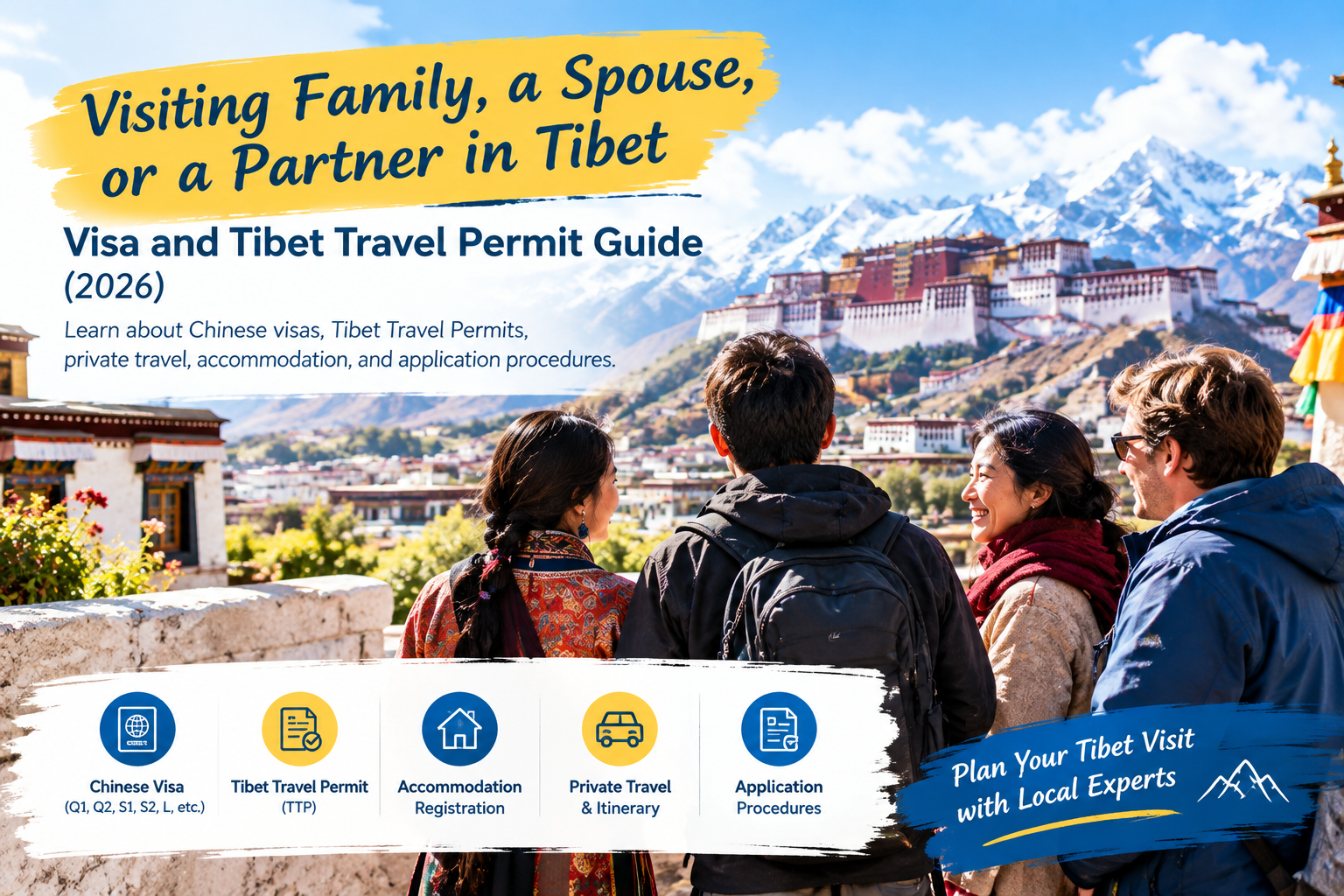
Can Foreigners Visit Family or a Partner in Tibet?
Yes. Foreign nationals can plan visits to family members, spouses, and partners living in Tibet, provided they meet the applicable Chinese entry requirements and Tibet-specific travel requirements. However, visiting a relative or romantic partner does not automatically exempt a foreign national from Tibet travel authorization requirements.
Foreign passport holders generally need a Tibet Travel Permit (TTP) to visit the Tibet Autonomous Region (TAR). Travel arrangements are normally coordinated through an eligible Tibet travel agency, subject to current procedures and destination restrictions.
Three separate matters must be considered:
- Chinese visa or entry permission: Whether you need a visa and which category matches your purpose of travel.
- Tibet Travel Permit: Whether you qualify for the necessary authorization to visit the Tibet Autonomous Region.
- Accommodation registration: How your stay must be registered if you live with a spouse, partner, or relative rather than in a hotel.
For example, a German citizen visiting a Chinese spouse in Lhasa, an American visiting parents in Tibet, and a British traveler meeting an unmarried partner may have different visa options. The best approach is to confirm your entry eligibility first and then coordinate the Tibet travel arrangements.
Which Chinese Visa Do You Need for a Family Visit?
The appropriate visa depends on whom you are visiting, their immigration status in China, your relationship, and the intended duration and purpose of your stay. China’s visa categories distinguish between family visits to Chinese citizens or foreign permanent residents and visits to foreign nationals residing in China.
| Visit purpose | Visa category to investigate | Main consideration |
|---|---|---|
| Short visit to a qualifying relative who is a Chinese citizen living in China | Q2 | Qualifying family relationship and intended stay of no more than 180 days |
| Family reunion with a Chinese citizen for a stay exceeding 180 days | Q1 | Eligibility for family reunion and subsequent residence procedures |
| Short visit to a qualifying relative who holds Chinese permanent residence | Q2 | Relationship and eligibility |
| Visit to an eligible foreign national working or studying in China | S2 | Qualifying family relationship and intended stay of no more than 180 days |
| Long-term visit to an eligible foreign national working or studying in China | S1 | The relationship must fall within the applicable category; residence procedures may follow |
| Visit to an unmarried boyfriend or girlfriend | L or another eligible route | An unmarried romantic relationship alone does not establish Q1 or Q2 eligibility |
| Traveler eligible for visa-free entry | Applicable visa-free arrangement | Nationality, purpose, duration, and current policy conditions |
These are general categories, not a determination of an individual’s eligibility. The Chinese visa authority makes the final decision based on the application and supporting documents.
Official reference: Chinese Visa Application Service Center — Visa Categories.
What Is the Difference Between Q1 and Q2 Visas?
The Q visa categories cover qualifying family visits involving Chinese citizens living in China or foreign nationals with permanent residence in China.
- Q2 visa: Generally intended for qualifying short-term family visits of no more than 180 days.
- Q1 visa: Generally intended for qualifying family reunion or other eligible family-related stays exceeding 180 days. Holders usually need to complete the applicable residence-permit procedures after entering China.
The definition of a qualifying family member is important. It can include relationships beyond a spouse or parent, but an unmarried boyfriend or girlfriend is not automatically considered a qualifying relative.
What Is the Difference Between S1 and S2 Visas?
S visas generally concern family members visiting foreign nationals who are staying or residing in China for work, study, or other eligible purposes, as well as certain other personal matters.
- S2 visa: Generally applies to eligible short-term visits of no more than 180 days.
- S1 visa: Generally applies to eligible visits exceeding 180 days, with residence procedures normally required after entry.
For family visits under the S categories, the qualifying relationship and the status of the person being visited matter. For example, the S1 family category specifically identifies certain close family members, including a spouse, parents, children under 18, and parents-in-law. Do not assume that the Q and S categories are interchangeable. Confirm the correct category with the relevant Chinese visa authority.
Can a Foreigner Visit a Boyfriend or Girlfriend in Lhasa?
Potentially, yes. However, an unmarried romantic partner does not automatically qualify for a Q1 or Q2 family reunion visa. For example, an American woman planning to visit her Chinese boyfriend in Lhasa should first check whether she qualifies for an L tourist visa or another permitted entry arrangement based on her actual plans.
Her boyfriend may be able to provide an invitation letter supporting the application. Depending on the requirements, it may include:
- His full name and Chinese identity information.
- His residential address in Lhasa.
- The intended dates of the visit.
- The purpose of the trip.
- The relationship between the visitor and the inviter.
- Proposed accommodation and financial arrangements.
- His contact details.
The visa authority may request further supporting documents. An invitation letter does not guarantee visa approval or replace the Tibet Travel Permit. If the traveler qualifies for a visa-free entry arrangement, the applicable conditions must still be checked. Visa-free entry does not automatically remove Tibet-specific travel requirements.
What Documents Are Needed to Visit a Chinese Spouse in Tibet?
A foreign spouse of a Chinese citizen may qualify for a Q2 visa for a short family visit or a Q1 visa for an eligible long-term family reunion. The appropriate category depends on the intended duration and purpose of the stay.
Potential supporting documents include:
- A valid passport.
- The completed visa application and required photograph.
- An invitation letter from the Chinese spouse.
- A copy of the spouse’s Chinese identity document.
- Evidence of the family relationship, such as a marriage certificate.
- The spouse’s residential or contact information.
- Any additional documents requested by the visa authority.
If the marriage certificate was issued outside China, check whether an apostille, consular legalization, translation, or another form of document verification is required for the specific application.
For a Q1 application, prepare for the applicable residence-permit procedures after arrival. A short-term family visit and long-term residence are different immigration situations.
What If Your Spouse Is a Foreign National Living in Tibet?
If your spouse is a foreign national working, studying, or otherwise residing legally in China, the S1 or S2 categories may be relevant, depending on the circumstances. The visa authority will consider the sponsor’s status, the family relationship, the proposed duration, and the supporting documents. Confirm the correct route before booking travel.
Do You Need a Tibet Travel Permit for a Family Visit?
Generally, foreign passport holders visiting the Tibet Autonomous Region need the applicable Tibet travel authorization, even if they already hold a valid Chinese visa or qualify for visa-free entry. The Tibet Travel Permit is separate from a Chinese visa. A Q1, Q2, S1, or S2 visa does not automatically grant permission to travel to Tibet. The permit application is generally coordinated through an eligible Tibet travel agency, subject to the applicable procedures.
What Documents May Be Required?
Depending on the visitor’s circumstances and the proposed itinerary, the agency may request:
- Passport information.
- Chinese visa information or evidence of eligible visa-free entry.
- Intended arrival and departure dates.
- The location of the family member or partner.
- Accommodation information.
- Transport details and a proposed itinerary.
- An invitation letter or supporting documents explaining the purpose of the visit, if required.
The exact list depends on the current application procedures and individual circumstances. The agency should confirm the necessary documents before the application is submitted.
Does a Family Invitation Guarantee a Tibet Travel Permit?
No. An invitation letter from a spouse, partner, or relative does not guarantee that Tibet travel authorization will be issued. Likewise, a Chinese visa does not replace Tibet-specific authorization.
If you intend to stay in Lhasa with family and take additional trips to destinations such as Everest Base Camp, Shigatse, or Mount Kailash, disclose the complete itinerary when discussing your application. Some destinations may require additional authorization or arrangements.
Can You Travel Independently to Visit Family in Tibet?
Do not assume that a family visit gives foreign nationals unrestricted independent travel throughout Tibet. Foreign travel arrangements in the Tibet Autonomous Region are subject to the applicable authorization and itinerary requirements. Depending on the circumstances, a private, agency-organized itinerary may be an option. A private arrangement may allow you to plan around family visits rather than follow a fixed shared-group sightseeing schedule.
Possible arrangements include:
- Private transportation.
- A personalized itinerary.
- Time allocated for visiting family or a partner.
- Prearranged accommodation.
- Sightseeing before or after the family visit, where permitted.
A private itinerary does not remove applicable travel restrictions or permit requirements. Before confirming the trip, explain to the travel agency whether you intend to spend most of your time at a private residence, visit several family members, or travel to other destinations. The agency can then explain which arrangements may be possible under current procedures.
Can You Stay at a Family Home in Lhasa?
Foreign visitors should not assume that staying in a private residence is automatically permitted under every travel arrangement. Accommodation registration requirements must also be followed. Under Article 39 of China’s Exit and Entry Administration Law, foreigners staying in hotels must have their accommodation registered by the hotel. For stays in private residences or other accommodation outside hotels, the foreign visitor or the person providing accommodation must generally complete registration with the local public security authorities within 24 hours of arrival.
As of September 21, 2026, China’s National Immigration Administration has expanded online accommodation registration for foreigners staying outside hotels nationwide. Online registration is available through designated National Immigration Administration services, including the NIA 12367 app and associated mini programs. In-person registration remains available.
Official reference: National Immigration Administration — Accommodation Registration for Foreigners Staying Outside Hotels.
Before staying with a spouse, partner, or relative in Lhasa, confirm the accommodation arrangement and registration process with the relevant local authorities and your travel agency. You should also confirm that the planned accommodation is compatible with the travel arrangements and any applicable itinerary requirements.
Important: Accommodation registration is not the same as a Tibet Travel Permit. Completing one does not replace the other.
Step-by-Step Guide to Arranging a Family Visit to Tibet
Follow these steps to reduce uncertainty and avoid preventable delays.
Step 1: Confirm Your Chinese Entry Eligibility
Check whether you need a Chinese visa or qualify for a current visa-free entry arrangement. If you need a visa, identify the appropriate category based on your relationship with the person you are visiting, their status in China, and your intended duration.
Step 2: Prepare the Invitation and Supporting Documents
Ask your spouse, partner, or relative to prepare any required invitation letter and identification documents. If you are applying for a family visa, prepare evidence of the qualifying relationship where required.
Step 3: Contact a Tibet Travel Agency
Explain that the purpose of the trip is to visit family or a partner. Provide your intended dates, destination, accommodation preferences, and any additional sightseeing plans. Ask which travel arrangements and documents are currently required.
Step 4: Arrange the Tibet Travel Permit
Follow the agency’s instructions for submitting the necessary passport and travel information. Provide any additional documents requested for your particular circumstances. Allow sufficient time for the application process.
Step 5: Confirm Accommodation and Registration
If you plan to stay at a private residence, determine how the accommodation will be registered and confirm that the arrangement is compatible with your travel plans. If staying in a hotel, confirm the reservation and the hotel’s registration arrangements.
Step 6: Finalize Transportation and Itinerary
Coordinate flights or trains, airport transfers, local transportation, and any additional destinations. Avoid making nonrefundable arrangements that depend on unconfirmed visa or permit approvals.
Step 7: Travel with the Required Documents
Carry your passport and the relevant travel documents. Follow the conditions of your entry permission, Tibet travel authorization, and accommodation arrangements. If your plans change after arrival, confirm whether the changes affect your itinerary or any required permissions.
How Early Should You Apply?
There is no universal processing period for every family visit to Tibet.
The preparation time may depend on:
- The visitor’s nationality and visa eligibility.
- The visa category and supporting documents.
- Whether a family relationship needs to be documented.
- The proposed travel dates.
- The Tibet Travel Permit application.
- Any additional destinations or authorization requirements.
- Peak-season demand and current processing procedures.
Start planning several weeks in advance and allow additional time if your documents require translation or verification, your itinerary includes restricted destinations, or you are arranging a long-term family reunion. Ask the visa authority and travel agency for current requirements and estimated processing times. Do not treat an estimated timeframe as a guarantee.
Frequently Asked Questions About Visiting Family in Tibet
Can an American visit family in Tibet?
Yes, provided the traveler meets the applicable Chinese entry requirements and obtains the necessary Tibet travel authorization. The correct visa or entry arrangement depends on the traveler’s circumstances and purpose.
Can a foreign girlfriend visit her Chinese boyfriend in Lhasa?
Potentially, yes. She must qualify for entry into China and arrange the required Tibet travel authorization. An unmarried romantic relationship alone does not establish eligibility for a Q1 or Q2 family visa.
Can a foreign wife visit her Chinese husband in Tibet?
A foreign spouse may qualify for a Q2 visa for a short family visit or a Q1 visa for an eligible long-term family reunion. The appropriate category depends on the circumstances, and Tibet travel authorization must be considered separately.
Can a foreigner visit parents living in Tibet?
Potentially, yes. The traveler must meet the applicable Chinese entry requirements and Tibet travel authorization procedures. The appropriate visa category depends on the parents’ status and the intended visit.
Does a Q2 visa allow independent travel in Tibet?
No. A Q2 visa concerns entry into China for an eligible family visit. It does not automatically remove Tibet-specific travel authorization requirements or other applicable restrictions.
Can I stay at my Chinese partner’s home in Lhasa?
Private accommodation may be possible, but you must confirm the applicable travel arrangements and foreigner accommodation registration requirements. Registration outside hotels generally must be completed within 24 hours of arrival.
Can I visit Tibet if my spouse works in China?
Potentially, yes. Depending on your relationship, your spouse’s immigration status, and the duration of your visit, an S1 or S2 visa may be relevant. Confirm your eligibility and the separate Tibet travel requirements before departure.
How long does it take to obtain a Tibet Travel Permit for a family visit?
There is no universal processing time. Allow time for document preparation, visa arrangements, permit processing, and any additional authorization. Confirm the current schedule with your travel agency.
Can I visit family in Lhasa and then travel to Everest Base Camp?
A combined itinerary may be possible, subject to the applicable travel authorization, destination requirements, and arrangements. Inform the agency about all intended destinations before the permit application is prepared.
Can I enter Tibet using visa-free entry?
This depends on your nationality, passport, purpose of travel, duration, and the current Chinese visa-free policy. Visa-free eligibility does not automatically remove Tibet travel authorization requirements.
Plan Your Family Visit with Tibet Yak Travel
Visiting a spouse, partner, or relative in Tibet can be a meaningful experience. Preparing the right documents and coordinating the travel arrangements in advance can help you avoid unnecessary complications. Tibet Yak Travel helps international visitors plan private Tibet itineraries, coordinate local transportation and accommodation, and understand the Tibet Travel Permit application process.
When contacting our team, please provide:
- Your nationality and passport type.
- Your intended travel dates.
- The city or area where your family member or partner lives.
- The purpose and expected duration of your visit.
- Whether you plan to stay at a private residence or in a hotel.
- Any additional destinations you would like to visit.
With these details, our team can discuss possible travel arrangements and explain the information needed for Tibet travel authorization. Visa eligibility and permit issuance remain subject to the relevant authorities and applicable procedures.
Ready to plan your visit? Contact Tibet Yak Travel to discuss your itinerary and travel requirements. Plan your Tibet visit with local experts.
Official Sources and Further Reading
Use these sources to verify current requirements before applying:
- Chinese Visa Application Service Center — Visa Categories: Official visa category guidance. Covers the general purposes of Q1, Q2, S1, S2, L, and other visa categories.
- National Immigration Administration of China: Accommodation registration for foreigners staying outside hotels. Explains the registration requirement and nationwide online registration arrangements introduced on September 21, 2026.
- National Immigration Administration: Official immigration information. Consult current guidance on entry, residence, and accommodation registration.
Disclaimer: This article provides general travel information, not legal advice or a guarantee of visa or Tibet Travel Permit approval. Visa classifications, entry policies, and Tibet travel procedures may change. Confirm the current requirements with the relevant Chinese authorities and an eligible Tibet travel agency before making travel commitments.