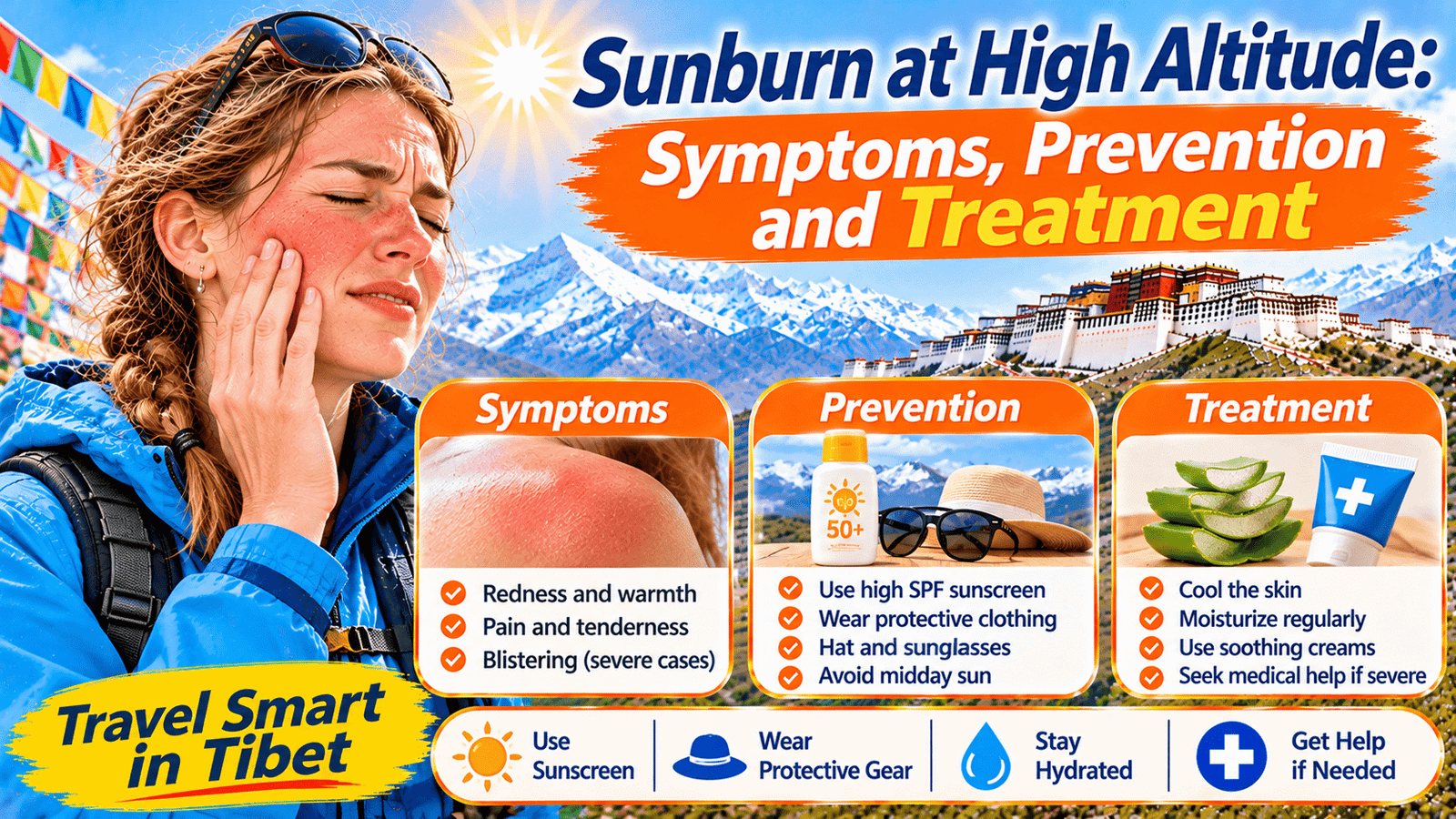
Sunburn at high altitude is a common but often underestimated risk during high-altitude travel. Visitors to Tibet may spend hours outdoors in strong sunlight while sightseeing, hiking, photographing mountain landscapes or travelling across open plateaus.
At high altitude, ultraviolet (UV) radiation is generally stronger because sunlight passes through a shorter column of atmosphere before reaching the ground. Snow and ice can reflect additional UV radiation, increasing exposure to areas of the face and body that travellers may overlook.
Cold temperatures and strong winds can make the sun feel less intense than it really is. Skin damage can begin before redness or pain becomes noticeable. This guide explains why sunburn risk increases at altitude, how to recognize symptoms, how to choose effective sun protection and what to do if your skin becomes burned during a Tibet trip.
Why Is Sunburn More Common at High Altitude?
Sunburn is an inflammatory reaction caused by excessive exposure to ultraviolet radiation.
Two main types of UV radiation affect the skin:
- UVB: A major cause of sunburn and direct UV-related DNA damage.
- UVA: Penetrates more deeply into the skin and contributes to pigmentation changes, photoaging and cellular damage.
At higher elevations, the atmosphere absorbs and scatters less incoming UV radiation. The World Health Organization reports that UV levels increase by approximately 10% for every 1,000 metres of elevation on average, although the actual change varies with atmospheric and environmental conditions. This matters in Tibet, where many popular destinations are already several thousand metres above sea level.
Snow reflection increases exposure
Fresh snow can reflect up to approximately 80% of incoming UV radiation. This means sunlight can reach your skin from below and from the sides, not only from directly overhead.
Areas that are often missed include:
- The underside of the nose
- The chin and lower face
- The ears
- The sides and back of the neck
- The backs of the hands
- Skin around the eyes
Snowfields, glaciers and bright mountain landscapes therefore require particular attention to sun protection.
Cold weather does not prevent sunburn
Low temperatures do not stop UV radiation from damaging the skin.
Wind can also make the skin feel cool, masking the sensation of prolonged sun exposure. Travellers should use sun protection even when the weather feels cold or cloudy.
2. What Is the UV Index?
The Ultraviolet Index (UVI) describes the strength of sunburn-producing UV radiation at a particular place and time.
The World Health Organization recommends sun-protection measures when the UVI reaches 3 or higher.
| UV Index | Category | Practical protection |
|---|---|---|
| 0–2 | Low | Normal precautions; protect exposed skin and eyes during prolonged outdoor activity |
| 3–5 | Moderate | Wear protective clothing, a hat, sunglasses and sunscreen |
| 6–7 | High | Use comprehensive protection and reduce prolonged midday exposure |
| 8–10 | Very high | Strengthen protection and avoid unnecessary exposure during peak UV hours |
| 11+ | Extreme | Minimize unprotected outdoor exposure and cover exposed skin |
These categories are general guidance. Actual exposure also depends on elevation, cloud cover, snow reflection, shade, time of day and how much skin is covered.
Check the UV forecast before outdoor activities
Before a hike or road trip:
- Open a weather application.
- Search for your destination, such as Lhasa, Shigatse or Everest Base Camp.
- Check the day’s UV Index.
- Look at the hourly forecast if available.
- Adjust clothing, sunscreen and outdoor plans accordingly.
A forecast for a lower town may not accurately represent conditions on a higher mountain ridge or snowfield. Use additional protection when travelling to higher elevations.
3. What Are the Symptoms of Sunburn?
Sunburn symptoms are often delayed. Skin damage may begin during exposure, while redness and pain develop several hours later.
Common symptoms include:
- Red or darker-looking skin
- Warmth in the affected area
- Tenderness or pain
- Swelling
- Itching
- Dryness and peeling
More severe sunburn may cause blisters.
How does sunburn develop?
During exposure: UV radiation damages skin cells. The skin may initially look and feel normal.
Around 2–6 hours later: Redness, warmth and tenderness may begin to appear.
Over the following 12–24 hours: Symptoms may become more noticeable, depending on the exposure and individual sensitivity.
During recovery: Redness and discomfort gradually improve. The skin may become dry and peel as the damaged outer layer is shed.
The timing varies. Do not wait for visible redness before protecting your skin.
4. How to Treat Sunburn During a Tibet Trip
The first priority is to stop further UV exposure and reduce discomfort.
Step 1: Move out of direct sunlight
Find shade or go indoors. Cover the affected area with loose clothing and avoid further exposure while the skin is recovering.
Step 2: Cool the skin gently
Apply a cool, damp cloth to the affected area or take a cool shower.
Avoid placing ice directly on sunburned skin. Very cold temperatures can cause additional skin injury.
Step 3: Moisturize
Apply a gentle, fragrance-free moisturizer or a suitable aloe vera preparation if your skin tolerates it.
Avoid products that sting or irritate the affected area.
Step 4: Drink normally and rest
Maintain normal fluid intake, especially if you have been outdoors for a long time. If you also have symptoms of heat illness or dehydration, take them seriously and seek medical advice when appropriate.
Step 5: Do not break blisters
Blisters help protect damaged skin. Do not deliberately puncture them. Keep the area clean and protect it from friction.
Step 6: Avoid further irritation
Do not scrub, exfoliate or peel the damaged skin. Avoid tight clothing that rubs against the affected area.
When should you seek medical attention?
Seek medical assessment if you develop:
- Extensive blistering
- Severe or worsening pain
- Significant swelling
- Fever or chills
- Severe headache, vomiting or marked weakness
- Signs of dehydration
- Eye pain or vision changes after intense UV exposure
Confusion, fainting or severe dehydration require urgent medical help. These symptoms should not be dismissed as an ordinary sunburn.
5. How to Prevent Sunburn at High Altitude
The most reliable strategy is to combine clothing, sunscreen, eyewear and sensible exposure management.
Wear protective clothing
Clothing provides consistent protection and does not need to be reapplied like sunscreen.
For prolonged outdoor activities, consider:
- Long-sleeved shirts
- Long trousers
- UPF 50+ garments
- A wide-brimmed hat
- A neck covering or face covering
- Gloves when appropriate
A garment’s protection depends on fabric construction, fit, stretch, wear and wetness. Pay attention to exposed skin around the collar, cuffs and neck.
Choose sunglasses with verified UV protection
Look for sunglasses labeled UV400 or documented to block 99–100% of UVA and UVB radiation.
For snowy environments, wraparound sunglasses or snow goggles with side protection can reduce exposure from reflected light.
Dark lenses and polarized lenses do not automatically provide adequate UV protection. Check the manufacturer’s UV protection information.
Choose broad-spectrum sunscreen
Use a sunscreen that protects against both UVA and UVB.
For everyday travel, SPF 30 or higher is a reasonable baseline. For prolonged outdoor activities, heavy sweating or snow exposure, water-resistant SPF 50 or SPF 50+ is a practical choice.
On many Asian-market products, the PA rating also indicates UVA protection. Under the relevant Chinese PA labeling system, PA++++ corresponds to a UVA protection factor (PFA) of at least 16.
SPF and PA describe different aspects of protection and should not be treated as interchangeable.
How much sunscreen should you apply?
Apply a generous, even layer to every exposed area. Commonly missed areas include:
- The sides of the nose
- The ears and skin behind the ears
- The underside of the chin
- The neck
- The backs of the hands
For an adult covering the entire body with exposed skin, approximately 30 mL may be needed for one application. During travel, clothing usually covers much of the body, so focus on applying sufficient sunscreen to all uncovered areas.
When should you reapply sunscreen?
- Follow the product instructions for initial application.
- Reapply approximately every two hours during continuous outdoor exposure.
- Reapply sooner after heavy sweating, swimming, wiping or toweling.
- Follow the stated water-resistance period.
Water-resistant sunscreen is not permanently protective. Do not rely on sunscreen alone to make prolonged exposure safe.
Protect your lips
The lips can also become sunburned. Use a lip balm with a clearly stated SPF rating and reapply according to the product instructions.
6. Understanding SPF, PA, UPF and UV400
These labels describe different kinds of protection.
| Label | What it measures | What to look for |
|---|---|---|
| UVI | Environmental UV intensity | Increase protection from UVI 3 |
| SPF | Sunscreen protection against UV-induced redness, mainly associated with UVB | SPF 30+ |
| PA | UVA protection rating used on many Asian-market products | PA++++ for high UVA protection |
| UPF | UV transmission through fabric | UPF 50+ |
| UV400 | Eyewear protection against UV wavelengths up to approximately 400 nm | Verified UV400 protection |
SPF 50 does not mean you can stay in the sun 50 times longer. Real-world protection depends on how much sunscreen you apply, whether it is evenly spread, how often it is reapplied and how intense the sunlight is.
Similarly, UPF 50 fabric does not protect skin left uncovered around the neck, wrists or face.
Can You Get Sunburned on a Cloudy Day?
Yes. Cloud cover does not always eliminate UV exposure. Some UV radiation can pass through clouds, and conditions can change quickly in mountain environments. Reflected radiation from snow can also contribute to exposure.
Do not use temperature, cloud cover or the absence of direct sunshine as the only guide to sun protection. Check the UV Index when possible and continue using protective clothing and eyewear during outdoor activities.
Medications That Can Increase Sun Sensitivity
Some medicines can make the skin more sensitive to sunlight. This is known as photosensitivity.
Examples include:
- Doxycycline and certain other antibiotics
- Some nonsteroidal anti-inflammatory drugs (NSAIDs)
- Certain thiazide diuretics
- Some retinoid medicines
Two types of reactions can occur:
- Phototoxic reactions: UV exposure interacts with a medication or its by-products, producing a sunburn-like reaction that may include redness and pain.
- Photoallergic reactions: A delayed immune response produces an itchy rash after exposure to a medication and light.
The risk depends on the specific medicine, dose and individual circumstances.
Check the medicine information before travelling and ask a doctor or pharmacist whether you need additional precautions. Do not stop a prescribed medicine without appropriate medical advice.
Long-Term Effects of Repeated UV Exposure
A single mild sunburn usually improves as the skin heals. Repeated UV exposure over months and years can contribute to cumulative skin damage.
Possible long-term effects include:
- Uneven pigmentation
- Fine lines and wrinkles
- Rough skin texture
- Reduced skin elasticity
- Actinic keratoses
- Increased risk of certain skin cancers
UV radiation can damage cellular DNA even when visible sunburn does not develop. The absence of redness does not prove that the skin has experienced no UV damage.
People who spend many hours outdoors should maintain consistent protection and seek medical assessment for a new or changing skin lesion, a spot that repeatedly bleeds or a sore that does not heal.
Sun Protection for Popular Tibet Destinations
Lhasa
Lhasa is already at high altitude. Use sunscreen, sunglasses and a hat during outdoor sightseeing, including visits to the Potala Palace, Jokhang Temple and Barkhor Street.
Yamdrok Lake
The open landscape around Yamdrok Lake can expose visitors to prolonged sunlight and reflected light from the water. Cover exposed skin and reapply sunscreen during long outdoor stops.
Everest Base Camp
The high elevation and open mountain environment make sun protection especially important. Use broad-spectrum sunscreen, protective clothing and UV-protective sunglasses.
Namtso Lake
At Namtso, strong sunlight, wind and cold conditions can occur together. Protect the face, lips, ears and hands rather than relying only on sunscreen applied to the cheeks and forehead.
Mount Kailash
Pilgrims undertaking the kora may spend many hours outdoors over several days. Pack enough sunscreen, lip protection, sunglasses and sun-protective clothing for the full journey.
Frequently Asked Questions
Why is the sun stronger in Tibet?
Many parts of Tibet are at high elevation. A shorter atmospheric path allows more UV radiation to reach the surface, and snow can reflect additional UV onto exposed skin.
Can you get sunburned in cold weather?
Yes. UV radiation can damage the skin even when the air feels cold. Wind and low temperatures may make it harder to notice prolonged exposure.
What SPF sunscreen should I use in Tibet?
Broad-spectrum SPF 30 or higher is a reasonable minimum. For extended outdoor activities and reflective snowy environments, water-resistant SPF 50 or SPF 50+ is a practical option.
How often should I reapply sunscreen?
Approximately every two hours during continuous outdoor exposure, and sooner after heavy sweating, swimming or wiping the skin. Always follow the product label.
Can snow cause sunburn?
Snow reflects UV radiation and can increase exposure to the face, neck and other uncovered areas. Use sunscreen, protective clothing and suitable eyewear.
Does a tan protect the skin from sunburn?
A tan is a response to UV exposure and does not provide reliable protection. Continue using sun-protective clothing and sunscreen.
Can I use ordinary sunglasses in Tibet?
Only if they provide verified UV protection. Lens darkness and polarization do not prove that sunglasses block UVA and UVB radiation. For snowfields, consider wraparound protection or snow goggles.
Conclusion
Sunburn is an avoidable risk during high-altitude travel in Tibet, but it is easy to underestimate. Strong UV radiation, reflected sunlight from snow and long outdoor activities can expose the skin to substantial radiation even in cold or cloudy weather.
Use broad-spectrum sunscreen, protective clothing, a wide-brimmed hat and verified UV-protective sunglasses. Reapply sunscreen regularly and pay attention to the nose, ears, neck, lips and backs of the hands.
If sunburn develops, stop further exposure, cool the skin gently and protect the affected area while it heals. Seek medical attention for extensive blistering, severe pain, significant swelling or systemic symptoms.
Medical Disclaimer: This article is for general educational purposes and does not replace professional medical advice. Seek medical assessment for severe burns, extensive blistering, signs of infection, significant eye symptoms or symptoms suggesting heat illness or dehydration.