
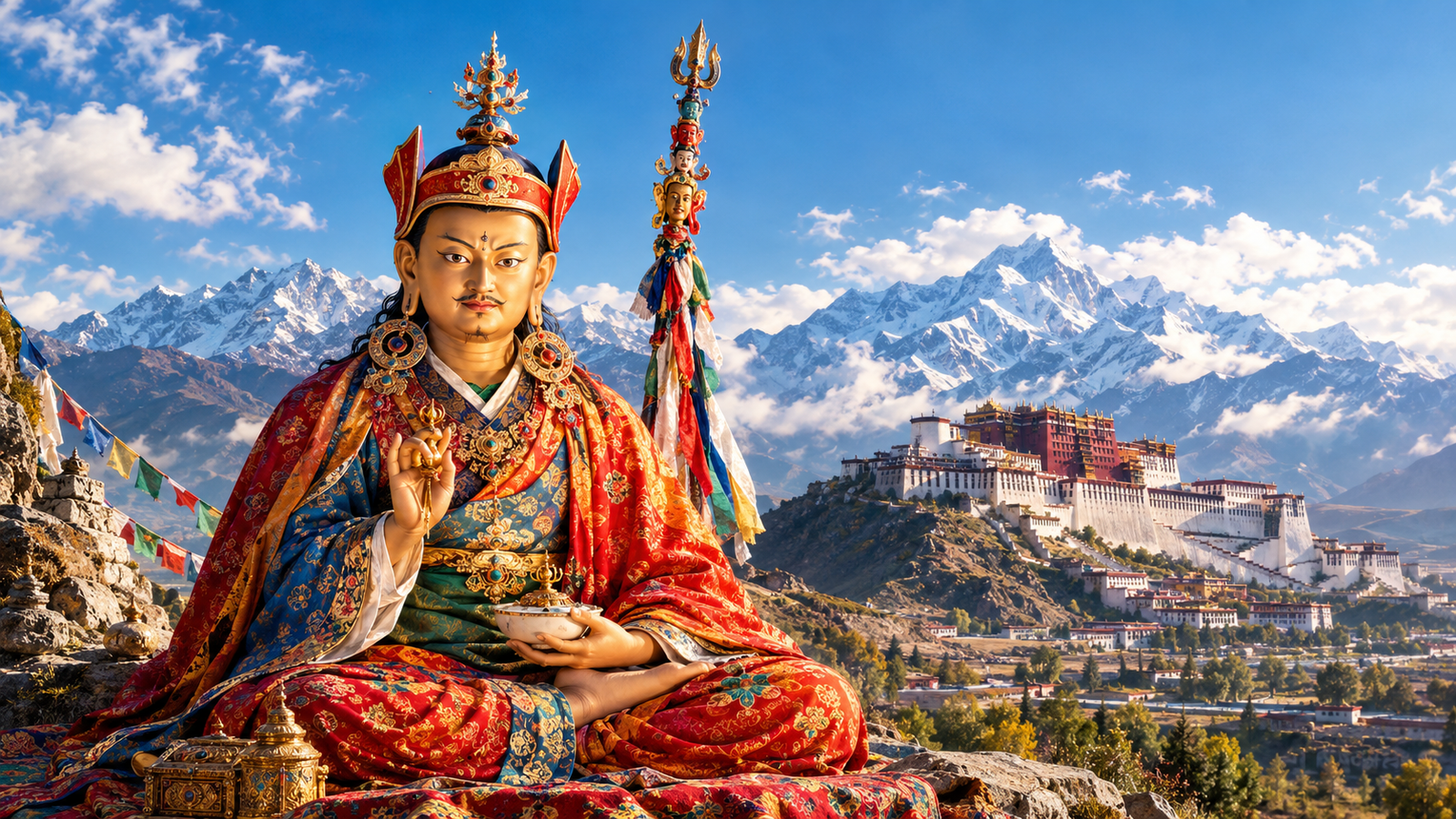
Padmasambhava, also known as Guru Rinpoche or the Lotus-Born, is one of the most important figures in Tibetan Buddhism. Traditionally described as an Indian tantric master associated with Uddiyana, he is closely connected with the transmission and development of Vajrayana Buddhism in Tibet during the early imperial period.
He occupies a particularly important place in the Nyingma tradition, the oldest of the major schools of Tibetan Buddhism. Tibetan Buddhist traditions remember him as a master of meditation, tantra, Buddhist philosophy, ritual, and esoteric practice, as well as a foundational figure in the establishment of Buddhism in Tibet.
At the same time, Padmasambhava’s biography contains many miraculous episodes, including his lotus birth, supernatural powers, encounters with spirits, and extraordinary manifestations. These accounts belong primarily to Tibetan Buddhist sacred biography and hagiographical literature and should be distinguished from historical evidence concerning 8th-century Tibet.
Who Was Padmasambhava?
Padmasambhava is traditionally described as an Indian Buddhist master who lived during the 8th century and was associated with the kingdom of Uddiyana, called Orgyen in Tibetan sources. Many modern accounts associate Uddiyana with the Swat Valley region of present-day Pakistan, although the historical identification of Uddiyana remains debated.
His name, Padmasambhava, means “Lotus-Born.” He is more commonly known among Tibetan Buddhists as Guru Rinpoche, meaning “Precious Guru.” Other traditional names include Orgyen Rinpoche, Lopon Rinpoche, and Pema Jungne, a Tibetan name associated with his miraculous lotus birth.
Padmasambhava is particularly associated with the early transmission of Vajrayana Buddhism to Tibet. Traditional histories place him in the reign of the Tibetan emperor Trisong Detsen, alongside other important Indian Buddhist masters, translators, and Tibetan scholars.
His legacy is especially strong within the Nyingma school, where he is regarded as one of the principal lineage masters.
The Lotus-Born Birth of Padmasambhava
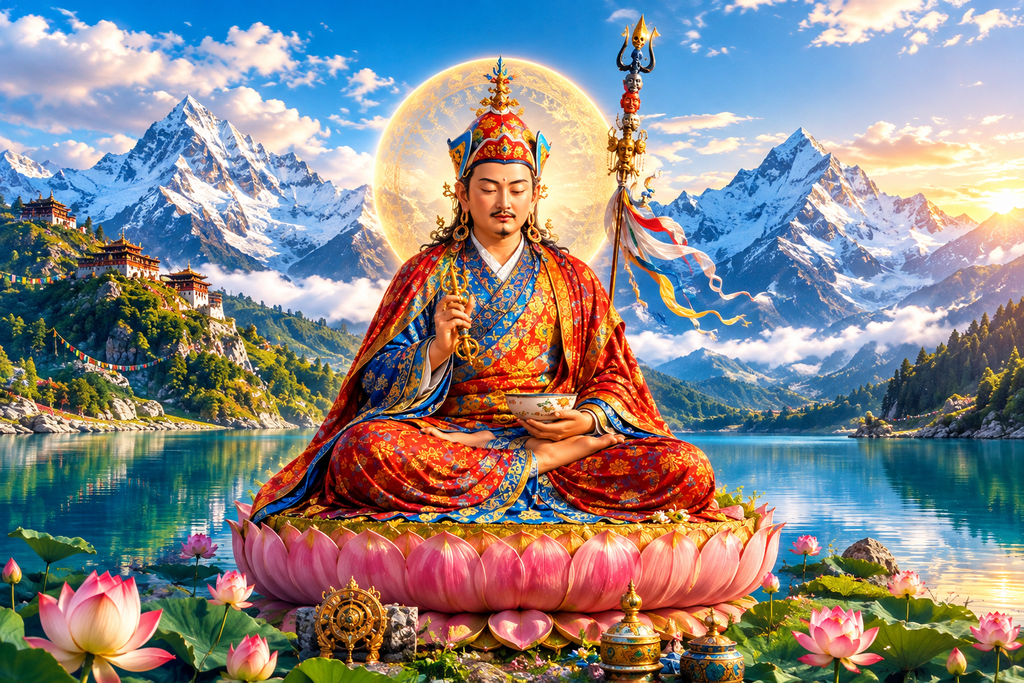
One of the most famous stories about Padmasambhava concerns his miraculous birth. According to Tibetan Buddhist tradition, Padmasambhava did not enter the world through an ordinary human birth. Instead, he appeared as an eight-year-old child seated upon a lotus in a lake associated with Uddiyana.
One version of the story connects his appearance with Amitabha Buddha. A sacred ray of light is said to have reached a lotus in Lake Dhanakosha, from which the extraordinary child appeared. King Indrabhuti, traditionally described as the ruler of Uddiyana, eventually encountered the child. Different biographies provide different details concerning the king, the circumstances of the encounter, and Padmasambhava’s early identity.
The child was ultimately welcomed into the royal household and became known as Padmasambhava, the Lotus-Born. The story should be understood as a sacred Buddhist narrative rather than a historically verified account of biological birth. Different Tibetan sources preserve different versions, demonstrating that the biography developed through multiple religious and literary traditions.
The lotus itself carries deep Buddhist symbolism. A lotus grows from muddy water while producing an unstained flower, making it an enduring symbol of purity, transformation, and spiritual awakening.
Padmasambhava’s Royal Life as Pema Gyalpo
Traditional biographies describe Padmasambhava as spending part of his early life within a royal environment. He became associated with the name Pema Gyalpo, meaning “Lotus King.” In these narratives, he possessed royal status, wealth, authority, and access to worldly pleasures.
Yet the story emphasizes that he gradually recognized the impermanent nature of worldly power.
This represents an important Buddhist theme. Wealth, political authority, status, and physical pleasures are temporary because they remain within samsara, the cycle of birth, death, and rebirth.
Padmasambhava’s eventual renunciation therefore symbolizes the movement from worldly authority toward spiritual realization.
Leaving the Royal Court
Traditional biographies tell a dramatic story about Padmasambhava’s departure from royal life. According to one version, he became involved in an incident concerning the family of a powerful minister and was accused of causing the deaths of a minister’s wife and child. He was subsequently sentenced to exile.
Rather than portraying exile simply as punishment, the sacred biography presents it as a turning point. Padmasambhava left the royal environment and began the life of a wandering yogin, devoting himself to meditation and tantric practice.
There is no contemporary evidence independently confirming the alleged crime, trial, or exile. These episodes are best understood within the framework of Padmasambhava’s religious biography.
Padmasambhava and the Charnel Grounds
Traditional biographies describe Padmasambhava practicing in the eight great charnel grounds of Indian tantric Buddhism.
Charnel grounds had a special role in Vajrayana practice. Far from being merely places associated with death, they provided practitioners with an environment for confronting impermanence, fear, attachment, and the reality of mortality.
Traditional accounts describe Padmasambhava meditating among corpses, wearing discarded funeral cloth, using symbolic objects associated with death, and receiving teachings and empowerments from tantric masters and dakinis.
The dakinis, feminine figures associated with wisdom and tantric practice, occupy an important place in these traditions.
Padmasambhava is also associated with powerful tantric deities and practices during this period. Through these experiences, the sacred biographies portray him as developing extraordinary spiritual realization.
Padmasambhava’s Indian Teachers
Padmasambhava is traditionally described as having studied with numerous Indian Buddhist scholars and tantric masters rather than receiving all his training from a single teacher.
Among the important figures associated with his lineage are Sri Singha, Buddhaguhya, Vimalamitra, and other accomplished Indian masters.
Sri Singha is particularly important because Tibetan Buddhist traditions connect him with the transmission of Dzogchen, or the Great Perfection, one of the central systems of meditation and philosophy in the Nyingma tradition.
Traditional biographies also associate Padmasambhava with Buddhaguhya and describe him as an exceptionally accomplished practitioner who achieved profound realization.
These accounts reinforce Padmasambhava’s traditional image as a master who combined scholarship, meditation, tantric practice, and direct spiritual realization.
Padmasambhava and Dzogchen
Dzogchen, commonly translated as “Great Perfection,” became one of the most important teachings associated with Padmasambhava in the Nyingma tradition.
Dzogchen emphasizes recognizing the fundamental nature of mind and cultivating direct awareness. Traditional Nyingma sources connect Padmasambhava’s Dzogchen transmission with masters such as Sri Singha and with a wider network of Indian Buddhist teachers.
His teachings were transmitted through direct instruction as well as through later terma, or treasure traditions.
According to Nyingma belief, Padmasambhava concealed certain teachings so they could be discovered by spiritually prepared practitioners in later generations. These treasure discoverers are known as tertöns.
Historically, the terma tradition developed over many centuries. Therefore, texts attributed to Padmasambhava should not automatically be treated as documents personally written by an 8th-century historical figure. Within Nyingma religious tradition, however, they are understood as authentic transmissions connected with Guru Rinpoche.
Padmasambhava and Wutai Mountain
Some traditional biographies also associate Padmasambhava with Mount Wutai, or Wutaishan, in northern China.
According to one biography, he traveled there after receiving Dzogchen teachings from Sri Singha. The tradition associates his stay with studies including astronomy, calendrical science, and numerical calculations.
Wutai Mountain was already an important Buddhist pilgrimage center associated particularly with Manjushri, the bodhisattva of wisdom.
The story is significant because it reflects the broad network of Buddhist exchanges linking India, Central Asia, China, and Tibet during the early medieval period.
However, the exact historical circumstances of Padmasambhava’s supposed journey to China remain difficult to establish. Traditional accounts should therefore be distinguished from securely documented historical evidence.
Padmasambhava and the Early Development of Buddhism in Tibet
The traditional story of Padmasambhava eventually turns toward Tibet during the reign of King Trisong Detsen.
The 8th century was a crucial period in the development of Buddhism in Tibet. Indian Buddhist scholars, translators, and tantric masters traveled into the Tibetan Empire, while Tibetan rulers supported translation projects and the creation of Buddhist institutions.
Traditional Tibetan histories credit the Indian monk Shantarakshita with an important role in this process. According to the traditional narrative, Shantarakshita advised the Tibetan court to invite Padmasambhava to Tibet.
Master Padmasambhava was reportedly asked to help overcome obstacles surrounding the establishment of Buddhist institutions and to assist with the development of a major monastery.
Padmasambhava and Samye Monastery
Padmasambhava is closely associated with Samye Monastery, traditionally regarded as Tibet’s first Buddhist monastery.
Samye became an important center for Buddhist study, translation, meditation, monastic discipline, and the transmission of Indian Buddhist literature into Tibetan.
Traditional accounts describe Padmasambhava as helping overcome obstacles to the monastery’s establishment and consecrating Buddhist sites.
Historically, the development of Samye formed part of a much larger process involving Tibetan rulers, Indian teachers, translators, and scholars. Padmasambhava should therefore be understood within the broader movement of Buddhist transmission rather than as an isolated figure.
The precise chronology of his arrival in Tibet remains debated. Traditional biographies provide different dates, and some proposed chronologies do not fit easily with modern reconstructions of Trisong Detsen’s reign or the development of Samye.
Padmasambhava and the Tibetan Imperial Court
Traditional Tibetan histories portray Padmasambhava as having a significant relationship with the imperial court.
His role extended beyond meditation instruction. Religious narratives describe him consecrating sacred places, establishing tantric practices, and dealing with forces believed to obstruct the spread of Buddhism.
Stories about Padmasambhava subduing spirits and other powerful beings became an important part of Tibetan Buddhist literature.
These stories should not be interpreted simply as historical accounts of literal battles with supernatural beings. They also express the religious idea that obstacles can be transformed and incorporated into the Buddhist Dharma.
Buddhism and Earlier Tibetan Religious Traditions
Traditional accounts frequently describe Padmasambhava as subduing local spirits and powerful beings before incorporating them into the Buddhist religious world.
This theme reflects the interaction between Buddhism and older Tibetan religious traditions.
Within Tibetan Buddhism, some local deities were incorporated into Buddhist cosmology as Dharma protectors. The stories therefore often describe transformation rather than simple destruction.
It is also important to distinguish pre-Buddhist Tibetan religious practices from Bon, which developed into a distinct religious tradition with its own doctrines, scriptures, rituals, and institutions.
Padmasambhava’s traditional role in this process helped establish his later image as a protector and founder of the Dharma in Tibet.
The Eight Manifestations of Padmasambhava
One of the most distinctive features of Guru Rinpoche’s religious tradition is the Eight Manifestations of Padmasambhava.
These eight forms represent different aspects of his enlightened activity and appear throughout Tibetan Buddhist paintings, murals, sculptures, thangkas, and religious texts.
The eight manifestations are commonly presented as:
1. Guru Orgyen Dorje Chang — Lake-Born Vajra
Guru Orgyen Dorje Chang is traditionally associated with Padmasambhava’s miraculous lotus birth. According to the sacred narrative, a sacred presence associated with Amitabha appeared upon a lotus in the waters of Uddiyana, from which an eight-year-old child emerged. King Indrabhuti encountered the child and eventually brought him into the royal household. This manifestation emphasizes Padmasambhava’s extraordinary and miraculous origin.
2. Guru Dorje Drolo — Wrathful Vajra
Guru Dorje Drolo represents the fierce dimension of Padmasambhava’s enlightened activity. Traditional biographies associate this manifestation with Padmasambhava’s experiences in charnel grounds and with his ability to overcome forces regarded as hostile to the Dharma. In Tibetan Buddhist symbolism, wrathful manifestations do not represent ordinary anger. Their fierce appearance symbolizes the forceful transformation of ignorance, aggression, attachment, and spiritual obstacles. Dorje Drolo is therefore one of the most powerful visual expressions of Guru Rinpoche’s tantric identity.
3. Guru Shakya Sengé — Lion of the Shakyas
Guru Shakya Sengé, meaning “Lion of the Shakyas,” is traditionally associated with Padmasambhava’s connection to the Buddhist monastic tradition. Traditional accounts place him at Vajrasana, identified with Bodh Gaya in India, where he eventually received monastic ordination under the teacher Prabhahasti. This manifestation emphasizes Padmasambhava’s relationship with the teachings and institutional traditions associated with Shakyamuni Buddha.
4. Guru Loden Chokse — Wise and Knowledgeable Guru
Guru Loden Chokse represents wisdom, scholarship, and mastery of Buddhist teachings. Traditional biographies associate Padmasambhava with numerous Indian teachers, including Sri Singha and Vimalamitra, and with profound teachings concerning Dzogchen. This form emphasizes his identity as a learned master capable of understanding Buddhist philosophy, tantra, meditation, and esoteric teachings.
5. Guru Padmasambhava — The Lotus-Born Guru
The fifth form is the Guru Padmasambhava most commonly recognized in Tibetan Buddhist art. Traditional biographies describe a dramatic episode in the kingdom of Sahor, where Padmasambhava was subjected to punishment by fire. According to the sacred narrative, the fire was transformed into a lake and Padmasambhava emerged unharmed, seated upon a lotus and wearing a garland of skulls. The episode reinforces the symbolism of the lotus and Padmasambhava’s miraculous spiritual identity.
6. Guru Pema Gyalpo — Lotus King
Guru Pema Gyalpo, or “Lotus King,” represents Padmasambhava in a regal form. Traditional accounts describe him receiving royal clothing and ornaments and becoming associated with the lotus-shaped hat that later became an important element of Guru Rinpoche’s iconography. This manifestation combines his royal identity with his spiritual authority.
7. Guru Nyima Özer — Guru of the Sun’s Rays
Guru Nyima Özer, meaning “Guru of the Sun’s Rays,” represents a dynamic and transformative aspect of Padmasambhava. Traditional accounts connect this manifestation with tantric practice, charnel grounds, and teachings transmitted to dakinis. The imagery of sunlight and radiant energy symbolizes powerful spiritual activity and transformation.
8. Guru Sengé Dradrok — Lion’s Roar
Guru Sengé Dradrok, meaning “Lion’s Roar,” represents Padmasambhava’s fearless proclamation of the Dharma. Traditional biographies place this manifestation at Vajrasana in India and describe Padmasambhava engaging in religious debates with non-Buddhist teachers. The lion’s roar is an established Buddhist metaphor for the confident proclamation of Dharma.
Padmasambhava as Dorje Drolo and Vajrakilaya
Another important tantric form associated with Padmasambhava combines Guru Drakpo, the Wrathful Guru, with Vajrakilaya, known in Tibetan as Phurba. This form is traditionally known as Guru Drakpo Kila.
Vajrakilaya is a powerful tantric deity associated with removing obstacles and transforming forces that obstruct Buddhist practice. The combined manifestation therefore represents fierce enlightened activity directed toward overcoming spiritual obstacles. Traditional iconography presents this form with a fierce expression, flames, tantric ornaments, weapons, and the three-edged phurba, or ritual dagger.
The frightening imagery is symbolic. Wrathful Buddhist forms are not generally understood as expressions of ordinary anger. Instead, they represent the powerful transformation of ignorance, aggression, attachment, and other obstacles.
Traditional ritual texts also associate these practices with subduing harmful spirits and forces within Buddhist cosmology. Such effects should be described as religious beliefs and ritual purposes, rather than scientifically verified phenomena.
The Seven-Line Prayer to Padmasambhava
The Vajra Seven-Line Prayer is one of the best-known prayers associated with Guru Rinpoche. It is particularly important in the Nyingma tradition and is recited in prayers, meditation practices, empowerments, teachings, and tantric ceremonies.
The prayer invokes Padmasambhava as the extraordinary master associated with Uddiyana and his miraculous lotus manifestation. Its importance extends beyond its words: the Seven-Line Prayer has become one of the most recognizable expressions of devotion to Guru Rinpoche throughout Tibetan Buddhist communities.
Padmasambhava and His 25 Disciples
Traditional Nyingma sources describe 25 principal disciples who received profound teachings from Padmasambhava and attained high levels of tantric realization. These disciples are traditionally said to have included members of the Tibetan royal family, ministers, translators, and other practitioners.
Among the most famous are:
- Yeshe Tsogyal
- Vairotsana
- Namkhai Nyingpo
- Palgyi Dorje
- Palgyi Senge
Different Tibetan sources provide variations in the names and forms of these lists.
Yeshe Tsogyal is especially revered as one of Padmasambhava’s principal disciples and as an important female master in Tibetan Buddhism. Vairotsana is remembered as one of Tibet’s great early translators. Through these disciples, Indian Buddhist teachings were translated, transmitted, and preserved for later generations.
Padmasambhava and the Terma Tradition
One of Padmasambhava’s most enduring legacies is the terma, or “treasure,” tradition. According to Nyingma belief, Padmasambhava concealed teachings, sacred objects, and instructions in different locations so that they could be discovered in future generations when the appropriate conditions arose.
Those who discover these teachings are called tertöns, or treasure revealers. The tradition allowed Padmasambhava’s religious legacy to remain dynamic across centuries. New teachings could emerge through treasure revelation while remaining connected to Guru Rinpoche and the Nyingma lineage.
From a historical perspective, however, the terma texts emerged through complex processes of transmission and revelation over many centuries. They therefore require a distinction between religious attribution and historical authorship.
Why Padmasambhava Is Called the “Second Buddha”
Padmasambhava holds an exceptionally high position in Nyingma devotion. Traditional teachings sometimes describe him as the “Second Buddha”, or Sangye Nyipa, because of his extraordinary role in establishing and transmitting Vajrayana Buddhism in Tibet.
The title is a devotional and doctrinal expression. It does not mean that Buddhist history recognizes a second historical Buddha identical in status and chronology to Shakyamuni Buddha.
Instead, it emphasizes the belief that Padmasambhava’s enlightened activity was especially important for the Tibetan Buddhist world.
He is particularly revered in Nyingma practice, although his image and teachings are respected across other Tibetan Buddhist traditions as well.
Padmasambhava’s Legacy in Tibet and the Himalayas
Padmasambhava’s influence extends far beyond the stories of his miraculous life. His image appears in Tibetan monasteries, temples, meditation centers, caves, murals, thangka paintings, ritual texts, and household shrines.
Padmasambhava name is invoked in prayers and tantric practices, and numerous sacred sites across Tibet and the wider Himalayan region are associated with his meditation, teachings, disciples, and religious activities.
His influence extends beyond Tibet into Bhutan, Nepal, the Himalayan regions of India, and other areas where Tibetan Buddhism developed.
Padmasambhava and Tibetan Buddhist Pilgrimage
For travelers interested in Tibetan Buddhist history, places associated with Guru Rinpoche offer an opportunity to explore the connection between sacred biography and Tibet’s religious landscape.
Samye Monastery is particularly important because of its traditional association with the early establishment of Buddhism in Tibet.
Other sacred locations preserve meditation caves, statues, murals, temples, and oral traditions connected with Padmasambhava.
These places demonstrate how Guru Rinpoche’s story became embedded not only in religious texts but also in the physical landscape of Tibet and the Himalayas.
Historical Records and the Sacred Biography of Padmasambhava
The historical Padmasambhava remains difficult to reconstruct in complete detail.
Sources concerning his life include Tibetan Buddhist biographies, religious texts, oral traditions, treasure literature, and historical records. These sources were produced and transmitted at different times and do not always agree.
Traditional biographies also provide different accounts of his origins and early life. One account associated with the Tibetan historian Taranatha, writing in the early 17th century, places Padmasambhava within the royal family of Uddiyana and connects his birth with the period of King Devapala of Magadha. Other traditions identify him with the family of Indrabhuti of Uddiyana.
These differences demonstrate why Padmasambhava’s biography needs to be read on two levels.
The first is the historical level: the 8th century witnessed significant Buddhist exchange between India and Tibet, and Indian teachers, translators, and tantric traditions clearly contributed to the development of Buddhism in the Tibetan Empire.
The second is the religious level: Tibetan Buddhist traditions developed a rich sacred biography of Padmasambhava containing miraculous births, supernatural events, tantric manifestations, encounters with spirits, and visionary teachings.
Neither dimension needs to erase the other. The sacred narratives explain why Guru Rinpoche became such a powerful religious figure, while historical study helps place his tradition within the broader development of Buddhism in early Tibet.
The Importance of Padmasambhava Today
Padmasambhava remains one of the most recognizable and influential figures in Tibetan Buddhist culture. Nyingma practitioners, he represents the transmission of Vajrayana, Dzogchen, tantric practice, meditation, and treasure teachings.
For students of Tibetan history, his tradition provides a window into the complex movement of Buddhist ideas, teachers, translators, and religious practices between India and Tibet. For visitors to Tibet and the Himalayas, his legacy can be encountered through monasteries, sacred caves, pilgrimage sites, murals, sculptures, and living religious practices.
The story of Padmasambhava ultimately brings together several dimensions of Tibetan Buddhist culture: Indian Vajrayana Buddhism, Tibetan religious traditions, tantric practice, meditation lineages, sacred geography, Buddhist art, and the continuing transmission of teachings. Whether approached as a sacred master, a figure in the history of Tibetan Buddhism, or a central subject of Himalayan art and pilgrimage, Padmasambhava remains fundamental to understanding the religious heritage of Tibet.