
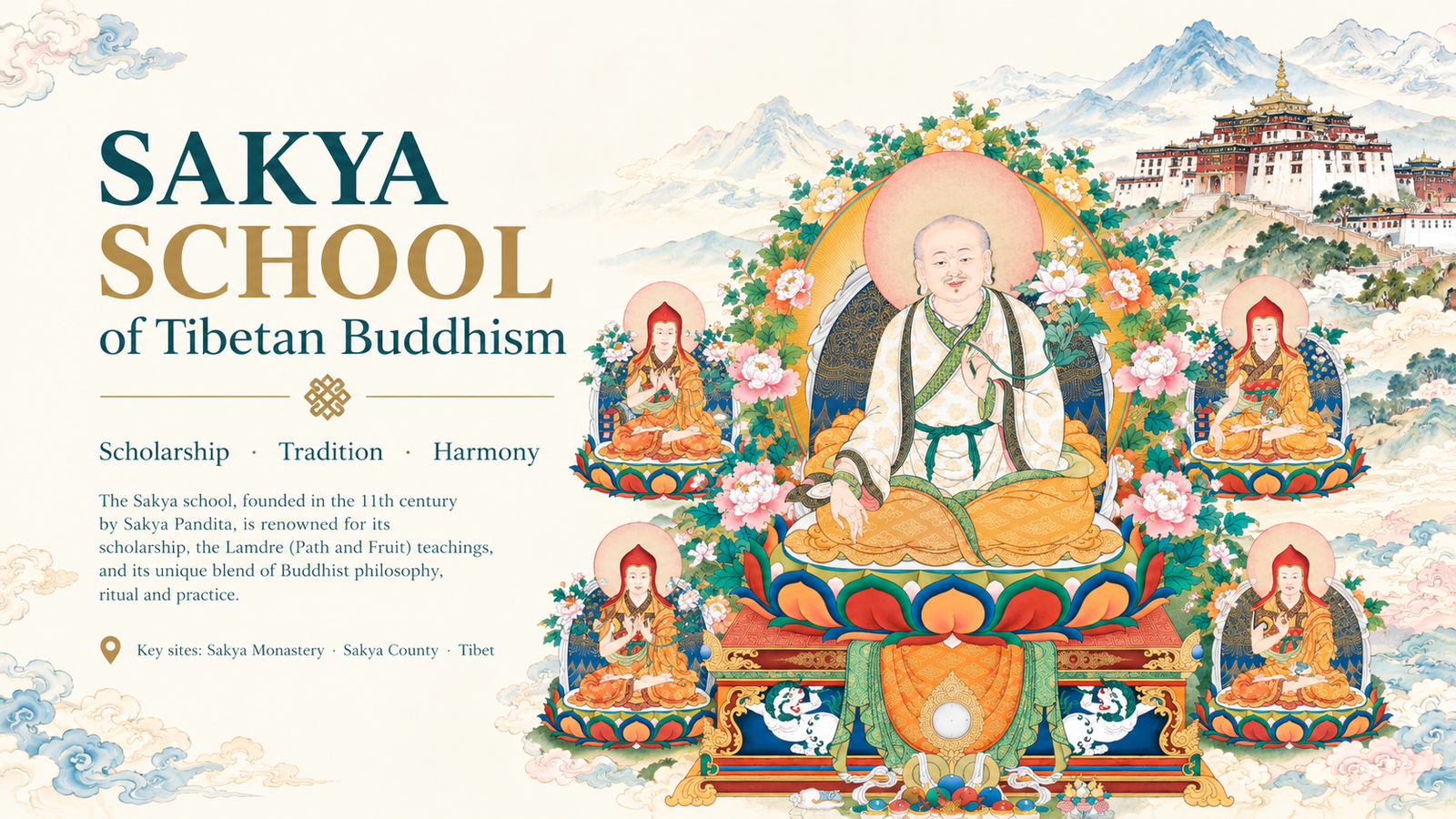
The Sakya School of Tibetan Buddhism, is one of the four major traditions of Tibetan Buddhism. The Tibetan word Sakya refers to the “gray earth” of the area where Sakya Monastery was founded. Sakya monasteries are easily recognized by their distinctive red, white, and blue vertical wall decorations, traditionally associated with Manjushri, Avalokiteshvara, and Vajrapani. Unlike the Gelug tradition, which developed a highly organized monastic and reincarnation system, the Sakya tradition has historically been closely connected with the Khön family lineage, making hereditary transmission one of its most distinctive characteristics.
The Sakya School also played a major role in the political history of Tibet. During the Yuan dynasty, the Sakya leadership became closely connected with the Mongol imperial court and was involved in the administration of Tibet.
Origins of the Sakya Tradition
The Sakya tradition traces its spiritual lineage to the Indian Mahasiddha Virupa, one of the great tantric masters associated with the Indian Buddhist tradition. Virupa is especially connected with the Hevajra Tantra and the system of teachings known as the Path and Fruition, or Lamdre.
Another important figure was Drokmi Shakya Yeshe (992–1074), a renowned Tibetan translator who traveled to India to study with Indian Buddhist masters. During his time in India, he received teachings on the Lamdre, Hevajra Tantra, Kalachakra, and other important Buddhist systems.
After returning to Tibet, Drokmi Shakya Yeshe transmitted these teachings to his students. Among them was Khön Könchok Gyalpo (1034–1102), who became the principal founder of the Sakya school.
Who Founded the Sakya School?
The Sakya tradition traces its institutional origins to Khön Könchok Gyalpo (1034–1102), a member of the influential Khön family. In 1073, he founded Sakya Monastery in the Sakya region. This event is generally regarded as the formal beginning of the Sakya School.
Khön Könchok Gyalpo studied under the renowned translator Drogmi Shakya Yeshe, through whom he received important tantric teachings, including the foundational Lamdre tradition. The Lamdre teachings became the central philosophical and tantric system of Sakya Buddhism.
History of the Sakya School
Foundation in 1073
The establishment of Sakya Monastery provided the institutional foundation for the Sakya tradition. Khön Könchok Gyalpo’s son, Sachen Kunga Nyingpo, later developed and systematized the school’s teachings. Under successive generations of the Khön family, Sakya Buddhism expanded throughout Tibet and developed a distinctive combination of Buddhist scholarship, tantric practice, and hereditary religious leadership.
The Sakya Five Founding Masters
The tradition is particularly associated with the Five Founding Masters of Sakya, who played a decisive role in its religious and intellectual development. The first three masters are traditionally known as the “Three White-robed Ancestors.” Their family and religious roles demonstrate the importance of hereditary transmission in early Sakya history.
The Rise of Sakya Power
The Sakya School became increasingly influential during the 13th century. A major historical turning point came with the 1247 meeting at Liangzhou, when Sakya Pandita Kunga Gyaltsen met the Mongol prince Godan. The meeting became an important event in the history of relations between Tibet and the Mongol Empire and contributed to the incorporation of Tibet into the administrative framework of the Yuan period.
The Yuan Dynasty and Phagpa
The Sakya tradition reached its greatest political influence during the Yuan dynasty. Phagpa Lodrö Gyaltsen, the fifth of the Sakya founding masters, became an important religious adviser to Kublai Khan and was appointed Imperial Preceptor. Phagpa also developed the Phags-pa script, created for the multilingual needs of the Yuan imperial administration. During this period, the Sakya leadership became closely involved in the administration of Tibet, making the Sakya School one of the most politically influential Tibetan Buddhist traditions of the era.
Decline of Political Power
Sakya political authority gradually declined during the 14th century as the Phagmodrupa tradition rose to prominence. The Sakya institution subsequently divided into several branches and lineages, including the Ngor, Dzong, and Tsar traditions. Although it lost its former political authority, the Sakya tradition continued as an important religious and philosophical school. Sakya Monastery remains an important center of Sakya Buddhism today.
The Five Founding Masters of Sakya School

Sachen Kunga Nyingpo
Sachen Kunga Nyingpo was the first of the five major Sakya founding masters. He played a crucial role in establishing and transmitting the Lamdre teachings. Unlike fully ordained monks, early Sakya hereditary leaders could maintain family life. This helped establish the distinctive Khön family lineage that became central to Sakya institutional history.
Sönam Tsemo
Sönam Tsemo was an accomplished scholar who contributed to the development of Sakya Buddhist philosophy and the transmission of both sutra and tantric teachings.
Drakpa Gyaltsen
Drakpa Gyaltsen was another major Sakya master who was associated with Sakya Monastery for many decades. He became known for his scholarship, religious discipline, and contributions to the development of Sakya teachings. The first three masters are traditionally referred to as the Three White-robed Ancestors, reflecting the historical role of married hereditary religious leaders within the Sakya tradition.
Sakya Pandita Kunga Gyaltsen
Sakya Pandita (1182–1251) was one of Tibet’s most famous scholars and an important figure in Tibetan history. He was renowned for his knowledge of Buddhist philosophy, logic, Sanskrit, and Tibetan literature. His Sakya Legshé, or Sakya’s Elegant Sayings, became one of the most widely circulated collections of Tibetan wisdom literature. His meeting with the Mongol prince Godan at Liangzhou in 1247 was also an important event in the political history of Tibet.
Phagpa Lodrö Gyaltsen
Phagpa (1235–1280) was the nephew of Sakya Pandita and the fifth major Sakya master. He became a prominent religious figure at the court of Kublai Khan and was appointed Imperial Preceptor of the Yuan dynasty. Phagpa is particularly remembered for his contribution to the development of the Phags-pa script, which was intended to provide a unified writing system for the multilingual Yuan Empire. His period represents the height of Sakya political and cultural influence.
The Central Teaching of Sakya Buddhism: Lamdre
The central teaching of the Sakya School is called Lamdre, usually translated as “Path and Fruition”. Lamdre presents a complete Buddhist path that brings together Sutra and Tantra. Rather than treating these traditions as completely separate systems, Sakya teachings explain how they can be practiced as parts of a unified spiritual path.
The tradition places particular importance on tantric meditation and the Hevajra Tantra, while also incorporating Buddhist philosophical teachings concerning wisdom, compassion, ethics, and the nature of mind. The Lamdre system is therefore both philosophical and practical. It explains the Buddhist view of reality while providing methods for meditation and spiritual transformation.
Samsara and Nirvana in Sakya Philosophy
An important principle of the Sakya philosophical tradition is the relationship between Samsara and Nirvana. According to the Lamdre teachings, the fundamental nature of mind is not inherently divided into ordinary existence and enlightenment. Instead, the difference depends on whether the mind is obscured by ignorance and other mental afflictions.
When the mind is covered by confusion and negative mental patterns, it gives rise to Samsara, the cycle of conditioned existence. When these obscurations are removed through Buddhist practice and realization, the same fundamental nature is experienced as Nirvana, or liberation. For this reason, Sakya practice emphasizes meditation and wisdom as ways to recognize the true nature of mind and gradually remove the obstacles that prevent realization.
Major Sakya Monasteries
Sakya Monastery
Sakya Monastery, located in Sakya County of Shigatse, is the historic seat and principal monastery of the Sakya School of Tibetan Buddhism. Founded by Khön Könchok Gyalpo, it became the main center from which the Sakya teachings and Lamdre tradition developed and spread. Historically, the Sakya monastic complex consisted of Northern Sakya Monastery and Southern Sakya Monastery. The southern complex remains the most important surviving part of the site and is immediately recognizable for its massive fortress-like walls painted with the distinctive red, white, and blue colors associated with the Sakya tradition.
Sakya Monastery is sometimes described as the “Second Dunhuang” because of its remarkable collection of Tibetan Buddhist scriptures, manuscripts, murals, thangkas, sculptures, and other religious artifacts. Its library preserves a vast body of Tibetan Buddhist literature, including rare and historically significant texts. The monastery is also renowned for its ancient murals and religious artwork, which provide valuable insights into the development of Tibetan Buddhist art and Sakya religious culture. For visitors interested in Tibetan Buddhism, history, architecture, and traditional art, Sakya Monastery is one of the most significant cultural attractions in the Shigatse region.
Ngor Monastery
Ngor Monastery, also known as an important center of the Ngor lineage of the Sakya tradition, has played a significant role in preserving Sakya tantric teachings and religious practices. The monastery became particularly influential as a center for Lamdre teachings, tantric meditation, Buddhist philosophy, and religious scholarship. The Ngor lineage developed distinctive traditions of ritual and meditation while remaining closely connected to the broader Sakya school.
Gongkar Monastery
Gongkar Monastery is another important institution connected with the wider Sakya tradition. Over the centuries, monasteries and teachers associated with Gongkar helped transmit Buddhist teachings, rituals, and meditation practices. Its historical importance reflects the wider network of Sakya institutions that developed throughout Tibet and helped maintain the continuity of the tradition.
Dege Gönchen Monastery and Printing Tradition
The Dege region of Sichuan is another important center for Tibetan Buddhist scholarship and literary culture. Sakya institutions in the area contributed to the preservation and transmission of Buddhist teachings, scriptures, and traditional learning. Nearby, the historic Dege Parkhang Printing House is renowned for its traditional Tibetan woodblock-printing techniques. Established as an important center of Tibetan publishing, it preserves thousands of woodblocks used to reproduce Buddhist scriptures and other Tibetan texts.
The Dege printing tradition is particularly valuable because it preserves an important part of Tibetan literary and religious heritage. Together with monasteries such as Gönchen, the region demonstrates how Tibetan Buddhism was preserved not only through monasteries and teachers but also through the careful production and transmission of written texts.
Distinctive Characteristics of the Sakya School
Hereditary Religious Lineage
One of the most distinctive features of Sakya history is its connection with the Khön family lineage. Unlike traditions that rely primarily on reincarnated lamas for institutional succession, the Sakya leadership historically developed through hereditary family transmission.
Early Sakya masters could marry and have children, allowing religious leadership to remain within the Khön family. This does not mean that every Sakya practitioner or monastery follows a hereditary model. Sakya Buddhism includes monks, lay practitioners, scholars, tantric practitioners, and different institutional lineages.
Lamdre and Tantric Practice
The Lamdre tradition is the defining religious system of Sakya Buddhism. It integrates Buddhist philosophical teachings with advanced tantric practice and emphasizes a gradual process of spiritual development. The teachings traditionally require formal transmission and should not be understood simply as general meditation techniques that can be practiced independently.
Red, White, and Blue Monastery Walls
The most recognizable visual symbol of Sakya architecture is the red, white, and blue striped monastery wall. These colors are traditionally associated with three major Buddhist figures:
- Red — Manjushri
- White — Avalokiteshvara
- Blue — Vajrapani
This distinctive color scheme makes Sakya monasteries particularly easy to identify when traveling through Tibet.
Sakya Pandita and Tibetan Wisdom Literature
Sakya Pandita’s Sakya Legshé, or Sakya’s Elegant Sayings, is an important example of Tibetan literature combining Buddhist wisdom with observations about human behavior, ethics, education, and society. The work remains widely known beyond strictly religious circles.
Major Sakya Sub-Traditions
Over the centuries, several important lineages developed within the Sakya tradition. The three best-known branches are the Ngor, Dzong, and Tsar lineages.
Ngor Lineage
The Ngor tradition was established by Ngorchen Kunga Zangpo (1382–1456). It became an important center for the preservation and transmission of Sakya tantric teachings, particularly the Lamdre tradition. Successive masters continued the Ngor lineage and helped preserve its distinctive ritual, philosophical, and meditation practices.
Dzong Lineage
The Dzongpa lineage is associated with Dzongpa Kunga Namgyal, an important Sakya master. This branch developed its own methods of transmitting and practicing Sakya teachings while remaining firmly connected to the wider Lamdre tradition.
Tsar Lineage
The Tsar lineage was established by Tsarchen Losal Gyatso (1502–1566). It became another major branch of the Sakya tradition and contributed significantly to the preservation and development of tantric teachings. These three lineages—Ngor, Dzong, and Tsar—represent important streams within the wider Sakya school.
Sakya School of Tibetan Buddhism Today
The Sakya tradition continues to be practiced in Tibet, the Himalayan region, and Buddhist communities around the world. Sakya monasteries and institutions preserve extensive collections of Buddhist scriptures, philosophical texts, tantric teachings, rituals, and meditation practices. The tradition remains especially associated with Lamdre, the Hevajra Tantra, Buddhist philosophy, and the integration of Sutra and Tantra.
For travelers interested in the history of Tibetan Buddhism, Sakya Monastery in Shigatse Prefecture is one of the most important places to visit. Its historic buildings, massive collections of scriptures, murals, thangkas, and traditional Buddhist architecture provide an excellent introduction to the cultural and religious heritage of the Sakya school.
Sakya School Compared With Other Tibetan Buddhist Schools
| Tibetan Buddhist School | Common Name | Major Characteristics |
|---|---|---|
| Sakya | Flower School | Khön family lineage, Lamdre teachings, tantric practice, distinctive red-white-blue monastery walls |
| Gelug | Yellow Hat School | Strong monastic discipline, philosophical education, debate, and major reincarnation institutions |
| Nyingma | Red School | Oldest major Tibetan Buddhist tradition, early tantric teachings, and Dzogchen |
| Kagyu | White School | Meditation, Mahamudra, yogic practice, and numerous sub-lineages |
These descriptions are useful introductions, but each Tibetan Buddhist school contains diverse lineages and practices.
Best Travel Experiences for Understanding Sakya school of Tibetan Buddhism
Explore Sakya Monastery
The highlight of a Sakya pilgrimage or cultural tour is undoubtedly Sakya Monastery. Visitors can admire its enormous walls, traditional Tibetan architecture, murals, scriptures, sculptures, and religious atmosphere. The monastery’s historic library and collections are especially important for understanding the development of Tibetan Buddhist literature.
Photograph the Famous Three-Color Walls
The red, white, and blue exterior walls are among the most recognizable examples of Sakya religious architecture. They provide one of the strongest visual connections between the modern traveler and the history of the Sakya School.
Visit Dege Parkhang
Travelers exploring eastern Tibet and Sichuan can visit Dege Parkhang, where traditional woodblock printing continues to preserve Tibetan Buddhist literary heritage. The experience provides a different perspective on Tibetan culture, focusing on the preservation and production of Buddhist texts.
Learn About Sakya Pandita and Phagpa
Understanding the history of Sakya Pandita and Phagpa adds an important historical dimension to a visit to Sakya Monastery. Their lives connect Tibetan Buddhist scholarship with the wider history of Tibet, the Mongol Empire, and the Yuan dynasty.
How to Visit Sakya Monastery
Sakya Monastery is located in Sakya County, Shigatse Prefecture, in western Tibet. For most travelers, it works best as part of a western Tibet or Everest Base Camp itinerary. The journey from Shigatse to Sakya takes several hours by road, depending on road conditions and the exact itinerary.
Because Sakya is located in a high-altitude region, travelers should allow time for altitude acclimatization, particularly if continuing toward Everest Base Camp. Visitors should also follow monastery rules concerning photography. Some chapels, scriptures, murals, and religious objects may have photography restrictions, so always ask permission before taking photographs.
Why Visit Sakya Monastery?
Sakya Monastery offers something different from the better-known monasteries of Lhasa. While Sera Monastery is famous for philosophical debate, Drepung Monastery for its historical connection with the Dalai Lama institution, and Ganden Monastery for its connection with Tsongkhapa and the origins of Gelug Buddhism, Sakya Monastery provides a window into the Sakya tradition, Lamdre teachings, hereditary religious history, and the political history of medieval Tibet.
For travelers interested in Tibetan Buddhism, it is one of the most rewarding cultural destinations in the Shigatse region.
Conclusion
The Sakya School of Tibetan Buddhism developed from a long lineage of Indian and Tibetan Buddhist masters, beginning with teachings associated with Virupa and later transmitted to Tibet through Drokmi Shakya Yeshe. Khön Könchok Gyalpo established Sakya Monastery and laid the institutional foundation for the tradition.
At the heart of Sakya Buddhism is Lamdre, the Path and Fruition, a comprehensive system that brings together Sutra philosophy and Tantric practice. Through the work of masters such as Sachen Kunga Nyingpo, Sakya Pandita, and Chögyal Phagpa, the tradition became one of the most influential schools of Tibetan Buddhism. Today, the Sakya lineage continues to preserve these teachings and remains an important part of Tibet’s religious, philosophical, and cultural heritage.