
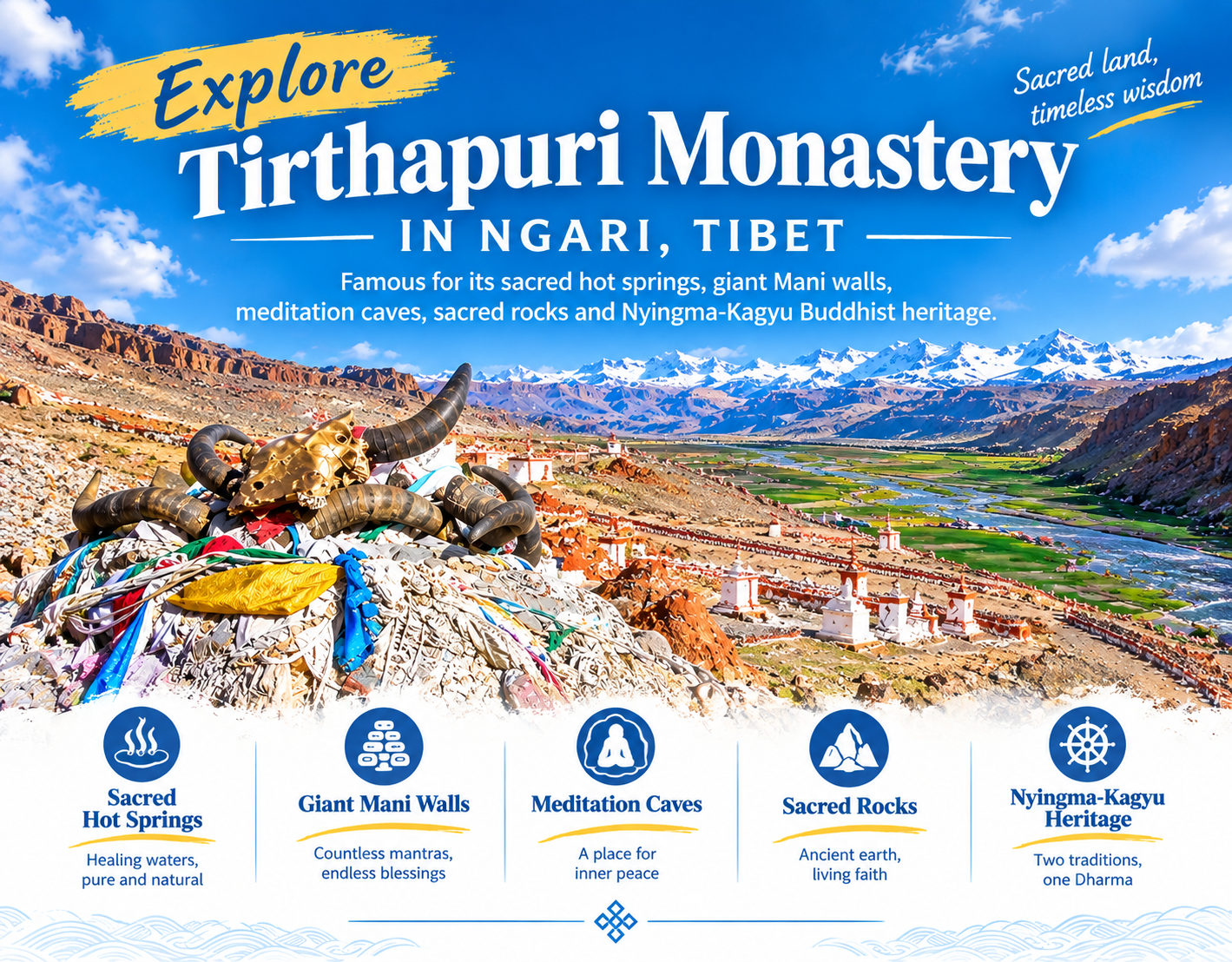
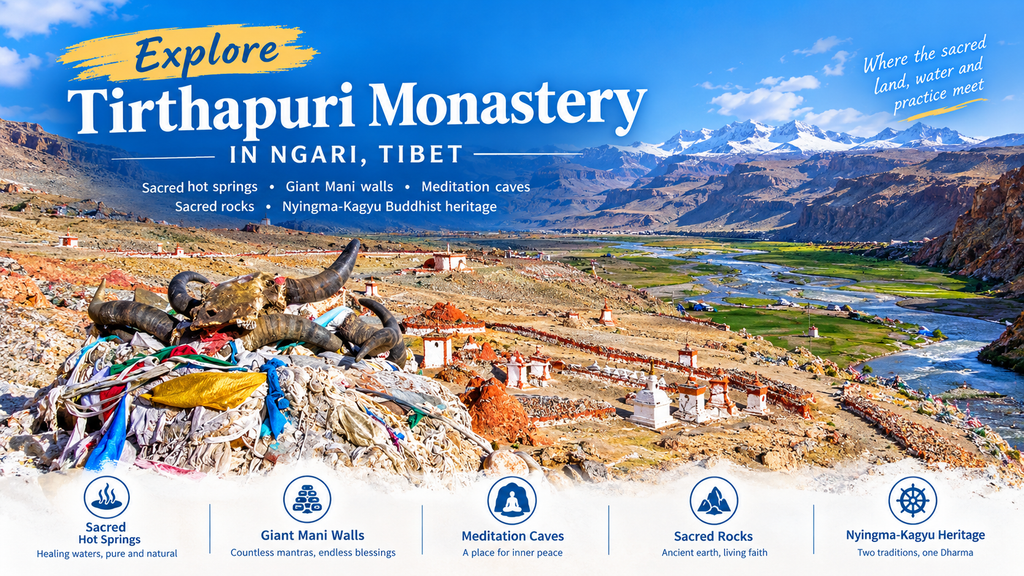
Tirthapuri Monastery, located in Men’shi Township of Gar County, Ngari Prefecture, western Tibet, is one of the region’s fascinating sacred sites. Set beside the Xiangquan River and surrounded by hot springs, unusual rock formations, meditation caves, stupas, and enormous Mani stone walls, Tirthapuri offers travelers a remarkable combination of Tibetan Buddhism and natural landscape.
Tirthapuri Monastery is particularly important in the religious geography of western Tibet. Its history is connected with both the Nyingma and Kagyu traditions of Tibetan Buddhism, while the surrounding landscape contains numerous sacred places associated with Buddhist masters, deities, and meditation practices.
The site is also located relatively close to Mount Kailash (Gang Rinpoche), making Tirthapuri an interesting cultural destination for travelers undertaking a Mount Kailash pilgrimage or exploring the wider Ngari region.
Where Is Tirthapuri Monastery?
Tirthapuri Monastery is located in Men’shi Township, Gar County, Ngari Prefecture, Tibet Autonomous Region. The monastery is approximately 260 kilometers from Gar County town and around 60 kilometers from Mount Kailash.
Because Tirthapuri Monastery lies in a remote part of western Tibet, travelers normally reach the monastery by private vehicle or chartered car as part of a longer Ngari or Mount Kailash journey. The surrounding landscape is typical of the high-altitude Ngari region, with barren mountains, wide valleys, exposed rock formations, and the flowing waters of the Xiangquan River.
History of Tirthapuri Monastery
Tirthapuri Monastery was originally established by the Nyingma master Dozha Lama Chökyi Zangpo. In its early history, the site was associated with the Nyingma school (Nyingmapa) and was regarded as a sacred palace of Vajrayogini, known in Tibetan Buddhist traditions as Dorje Phagmo.
Tirthapuri was later placed under the influence of the Kagyu school (Kagyupa) and became associated with Kagyu Buddhist practice. The monastery was damaged in 1947 by raiders. It was subsequently rebuilt by Lama Yeshe Panden (ye-shes-dpal-ldan) and later became a branch monastery of Shepeling Monastery in Purang.
Like many monasteries across Tibet, Tirthapuri suffered severe destruction during the Cultural Revolution. Reconstruction began in 1983, restoring the site as a functioning Buddhist monastery. Today, Tirthapuri remains a relatively small religious community, with two resident monks and two monastery management staff, according to local information.
Sacred Buddhist Images at Tirthapuri Monastery
Tirthapuri Monastery preserves several important Buddhist images and sacred objects.
The principal religious figures associated with the monastery include:
- Guru Padmasambhava (Guru Rinpoche)
- Amitabha Buddha
- Shakyamuni Buddha
- Yeshe Tsogyal
- Dorje Phagmo (Vajrayogini)
- Sacred footprints traditionally associated with Dorje Phagmo
The monastery and its surroundings also contain several traditional meditation sites associated with important Buddhist practitioners. Three notable practice sites are traditionally connected with Padmasambhava, Gotsangpa, and Dorje Phagmo.
These sites demonstrate an important feature of Tibetan Buddhism: sacred practice is not confined to monastery buildings. Mountains, caves, springs, rivers, and unusual rock formations can all become part of a sacred landscape.
Tirthapuri Monastery Hot Springs
One of the most distinctive attractions at Tirthapuri is the natural hot spring located in front of the monastery. The spring is locally known as chu-tshan. Hot water emerges from underground and flows toward the Xiangquan River. White and yellow mineral deposits have accumulated around the spring, creating unusual formations that resemble marble.
Local traditions attribute medicinal and blessing properties to some of these mineral deposits. Changes in groundwater levels and the erosion of the riverbed have altered the relationship between the spring and the river. Today, the spring source is higher than the river, and hot water flows downhill toward the Xiangquan River.
At the point where the hot spring meets the colder river water, local Tibetan people have traditionally bathed and washed. The spring is especially popular in springtime, when local visitors come to enjoy the warm water and natural surroundings. For travelers, the Tirthapuri hot springs offer an opportunity to experience an aspect of local Tibetan life that goes beyond conventional sightseeing.
Sacred Spring Deposits and Limestone
The hot spring has created an unusual landscape of mineral deposits around the water source. These formations give the area a pale, stone-like appearance and contribute to the distinctive scenery surrounding Tirthapuri.
Visitors may also find “gangti” limestone in the surrounding area. Local religious tradition associates this stone with protection from illness and misfortune. Such beliefs are part of the living religious culture surrounding Tirthapuri and should be understood within the broader Tibetan tradition of attributing spiritual significance to natural materials and landscapes.
Sacred Rock Formations Around Tirthapuri Monastery
The hills and valleys surrounding Tirthapuri contain numerous weathered rock formations. According to local religious traditions, some of these rocks represent Buddhist deities, sacred palaces, and places associated with tantric Buddhist practice.
Among the formations are rocks traditionally identified with:
- Mahakala
- Garuda
- Chakrasamvara and Vajrayogini
- Medicine Buddha’s sacred palace
- The Eight Manifestations of Guru Rinpoche
- Sacred palaces of the dakinis
These interpretations form part of the sacred geography of Tirthapuri.
The Dakini Sacred Landscape
Across the river to the west of Tirthapuri is a distinctive purple rock formation traditionally regarded as representing the palace of the 100,000 dakinis. The flat ground below the formation is described as a sacred place associated with the dakinis’ dancing.
Nearby red-and-white rocks are traditionally identified with a sacred dakini passage, while yellow and blue formations are associated with the wealth deity and the Lion-Faced Dakini. For visitors interested in Tibetan Buddhist culture, these formations provide an excellent example of how natural landscapes can become integrated into religious traditions.
Gotsangpa’s Meditation Cave
Near the river is a protector shrine containing a natural cave traditionally associated with Gotsangpa (rgod-tshang-ba), an important Kagyu practitioner. Inside the cave is an image of Four-Armed Mahakala, one of the most important Buddhist protector deities in the Tibetan tradition.
Mahakala at Tirthapuri Monastery
Mahakala is known in Tibetan as Nagchenpo and in Sanskrit as Mahakala. The deity is associated with powerful protective activity and is traditionally understood as a guardian of Buddhist teachings and practitioners.
The Four-Armed Mahakala image is represented in a fierce form, with multiple arms, weapons, an elephant-skin cloak, and a garland of skulls. The imagery can appear striking to visitors unfamiliar with Tibetan Buddhism. Within Vajrayana Buddhist symbolism, however, fierce protector figures represent the power to overcome obstacles, ignorance, harmful influences, and forces that obstruct spiritual practice.
Tirthapuri Monastery Great Mani Walls
One of the most remarkable features of Tirthapuri Monastery is its extraordinary collection of Mani stones and Mani walls. The site is known for having one of the largest concentrations of Mani stones in the Ngari region. In front of the monastery is a Mani wall more than 250 meters long. Thousands upon thousands of stones are carefully arranged along the wall. Many are carved with Tibetan Buddhist scriptures, prayers, sacred symbols, and mantras.
At the center of the Mani complex is also a large circular Mani mound measuring more than 10 meters in diameter. The circular form is reminiscent of traditional Tibetan religious imagery in which the sun and crescent moon appear together. Additional Mani walls can be found around the monastery’s stupa area. These smaller walls are generally between approximately 10 and 20 meters long. Further Mani mounds are scattered across the surrounding hillsides. Together, these structures create one of the most impressive sacred stone landscapes in western Tibet.
What Are Mani Stones?
Mani stones are carved stones found throughout Tibet and other areas of the Tibetan cultural region.
They may contain:
- Buddhist mantras
- Prayers
- Scriptural passages
- Images of Buddhist deities
- Auspicious symbols
One of the most common inscriptions is the six-syllable mantra associated with Avalokiteshvara: Om Mani Padme Hum
Mani stones are not simply decorative objects. For Tibetan Buddhists, carving, placing, and circumambulation Mani stones can form part of devotional and merit-making practices. At Tirthapuri, the extraordinary scale of the Mani walls gives visitors a powerful visual impression of the continuity of Tibetan religious devotion.
Tirthapuri Monastery and the Kagyu School of Tibetan Buddhism
Tirthapuri Monastery later religious history is closely associated with the Kagyu school, one of the major traditions of Tibetan Buddhism. The Tibetan term Kagyu refers broadly to a tradition emphasizing the transmission of Buddhist teachings from teacher to disciple.
The lineage traces important transmissions through Indian masters such as Tilopa and Naropa. In Tibet, the teachings were further developed and transmitted by major figures including Marpa the Translator, Milarepa, and Gampopa. Historically, Kagyu traditions developed into numerous branches and sub-schools, including Karma Kagyu, Drikung Kagyu, Drukpa Kagyu, and others.
Kagyu teachings are especially associated with Mahamudra (phyag-rgya-chen-po), or the “Great Seal,” as well as tantric meditation and direct teacher-to-student transmission. Several Kagyu lineages became highly influential in Tibetan history. Some hierarchs received titles and political patronage from successive imperial governments, while certain Kagyu branches established powerful religious and political institutions.
The Karmapa lineage is also particularly important in Tibetan Buddhist history and is closely associated with the development of the institution of recognized reincarnate teachers.
Why Visit Tirthapuri?
Tirthapuri is not among the most heavily visited tourist attractions in Tibet, but its combination of religious history and natural scenery makes it particularly interesting for travelers exploring Ngari. A visit allows travelers to experience several aspects of Tibetan culture in one location.
Tibetan Buddhist Heritage
Discover a monastery with Nyingma origins and a later Kagyu connection, along with sacred images, meditation caves, and religious sites.
Tirthapuri Hot Springs
See the natural hot springs and the unusual mineral deposits formed around the water source.
Sacred Rocks
Explore the surrounding rock formations that local traditions associate with Buddhist deities, dakinis, sacred palaces, and meditation sites.
Giant Mani Walls
Walk beside the enormous 250-meter-plus Mani wall and explore the many smaller Mani walls and stone mounds surrounding the monastery.
Meditation Sites
Visit traditional meditation places associated with Padmasambhava, Gotsangpa, and Dorje Phagmo.
Connection with Mount Kailash
Monastery of Tirthapuri is only about 60 kilometers from Mount Kailash, making it a potentially valuable cultural stop during a wider Kailash pilgrimage.
Tirthapuri and the Mount Kailash Pilgrimage
Tirthapuri is particularly relevant to travelers visiting Mount Kailash and Lake Manasarovar. Mount Kailash is one of the most sacred mountains in Asia and is revered by followers of several religious traditions. Tirthapuri adds another layer to a Kailash journey by allowing visitors to explore a sacred site where Buddhist meditation traditions, natural hot springs, Mani stones, and sacred geography come together. Rather than being simply a sightseeing stop, Tirthapuri can be understood as part of the wider spiritual landscape of western Tibet.
Best Time to Visit Tirthapuri
The warmer months are generally the most practical period for traveling through the Ngari region. Spring can be particularly interesting for visitors who want to experience the local hot springs, while summer and early autumn generally provide more favorable conditions for long-distance road travel.
However, weather in high-altitude western Tibet can change quickly. Travelers should be prepared for strong sunlight, cold temperatures, wind, and sudden weather changes even during the warmer season. If you are visiting Tirthapuri as part of a Mount Kailash or Ngari tour, it is best to include the monastery within a carefully planned route rather than treating it as an isolated day trip.
Tirthapuri Monastery: A Hidden Sacred Treasure of Ngari
Tirthapuri Monastery is a remarkable example of the relationship between Tibetan Buddhism and the natural landscape of western Tibet. Its religious history connects the Nyingma and Kagyu traditions, while the surrounding area contains hot springs, sacred rocks, meditation caves, stupas, and one of the most impressive Mani stone landscapes in Ngari.
The enormous Mani walls are particularly striking, but the true character of Tirthapuri lies in the way the entire landscape functions as a sacred environment. Here, a hot spring becomes part of local tradition, a natural cave becomes a meditation site, a weathered rock becomes a sacred symbol, and thousands of carved stones become an expression of devotion.
For travelers interested in Tirthapuri, Tibetan Buddhism, Ngari, Mount Kailash pilgrimage routes, sacred landscapes, and lesser-known monasteries of Tibet, this remote site offers an opportunity to experience a quieter and deeply cultural side of western Tibet. Tirthapuri is a place where nature, pilgrimage, meditation, and Tibetan Buddhist tradition meet in one extraordinary landscape.